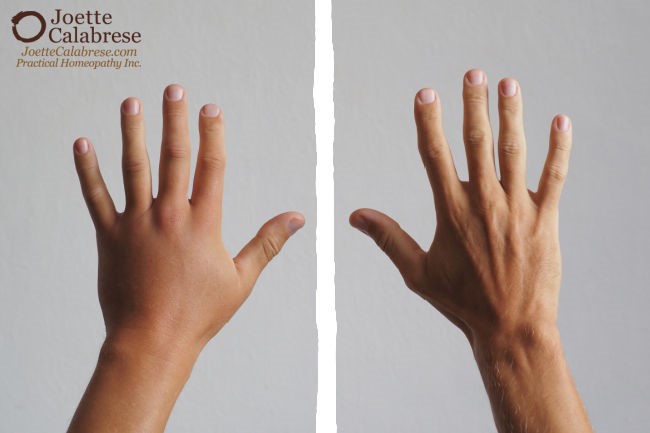
Edematous Swelling and Apis

Joette Calabrese, Practical Homeopathy

There you are! Let’s add another medicine to our well-curated homeopathic inventory, shall we?

A few weeks ago, I discussed the swelling of extremities from heat and humidity in my blog post, Having a Swell Summer, focusing on the cell salt Nat sulph 6X. However, you may recall I mentioned that we also find Apis mellifica strongly suggested as a medicine for edema in the homeopathic repertory.

What’s the difference? Well, Nat sulph is more for the overall body: hands, wrists, ankles and feet.

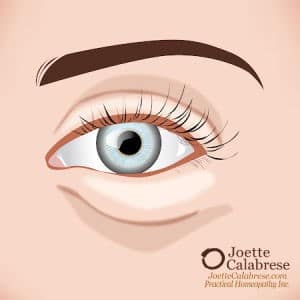
Conversely, Apis has been shown to address edematous swelling around the more tender tissues of the body: the eyes, lips, tongue, uvula and throat. We’re talking about a distinct edematous swelling that almost mimics bags of water.
Joette Calabrese, Practical Homeopathy

Imagine a water balloon under your eyes or surrounding your tender tissues.

Often, this kind of water-logged swelling can result from food allergies, chemical sensitivities, and even insect stings. In fact, Apis has been historically noted for reactions that show up on the skin — such as a rash, wheals or hives — especially when the itching is stinging and severe.

For acute conditions such as these, Apis mellifica 30 is generally employed every 3-6 hours, depending on severity, until very much better. However, if the situation is a dangerous allergic reaction, Apis 30 has been reported to be utilized every few minutes while on the way to the hospital emergency room.

Before we go any further, I want to caution that Apis mellifica is one of the few homeopathic medicines that should not be used capriciously during pregnancy without the guidance of a professional homeopath or a well-trained understanding of the medicine.

Apis mellifica 30 is also a valuable choice for urinary tract infections (UTIs), especially when accompanied by a scalding pain. Generally, it would be employed every 3-12 hours, again, depending on severity.

“But Joette, what about Cantharis for UTIs?” Good question. It shows you listened to my podcast, “Ladies Only.”
Joette Calabrese, Practical Homeopathy

Indeed, Cantharis is most often our first choice with UTIs, so what are the differentials between the two? My friends, in any situation where we have two (or more) medicines that are both appropriate for a condition, that’s where a good materia medica comes in.

Whether you use my easy-to-read Materia Medica: Practical Homeopathy® for Busy Families or a more in-depth professional volume, such as Dr. Robin Murphy’s Nature’s Materia Medica, this is what my students learn to do:

They crack open their book and read the entry of one of the medicines in question. Then, they read the entry for the other potential remedy.

But they’re not done yet.

They go back and reread them both again! Reading important information twice can help bring items you may have missed the first time to the fore.

Then, they choose the medicine that fits most closely with all the symptom nuances.

I encourage you, dear readers, to do the same (when there is no specific protocol to follow). The more understanding you have about this process, the better your choices of homeopathic medicine will be. So, education is key.

Never. Stop. Learning.

To that end, have you already joined a Gateway to Practical Homeopathy® study group? Utilizing my easy-to-follow curriculum, you and like-minded friends can learn the basics of homeopathy and begin your journey to health freedom.

No, my friends.  Not just garden variety health freedom but the kind that reduces and eventually eliminates fear altogether.

You know… Distress. Anxiety. Dependency on a scary and unreliable industry and its questionable medicaments. Apprehension. Dread. Horror.

All of that melts away when you know what to do in a health crisis. 

Allow me to explain further.

Interestingly, many conditions — physical, emotional and mental — begin in the gut. So, an excellent way to continue your education is by diving into my course, Good Gut, Bad Gut: A Homeopathic Strategy to Uproot Seemingly Unrelated Illness in Body and Mind. You’ll find I cover utilizing Apis for swelling and allergic reactions, plus so many more Practical Protocols for gut issues and the ailments they cause. With a little education, you can successfully care for yourself, your family, and your loved ones.

Nothing is more valuable than health autonomy. So, join me and the thousands of students who’ve preceded you in making homeopathy their preferred health paradigm.

And add Apis mellifica to your growing collection of carefully chosen homeopathic medicines. All the education in the world won’t help if the precise medicine needed is not readily available to use.

If your inventory is beginning to get unwieldy, I have shared quite a few ingenious organizational methods in my Memos to Mighty Members over the years. Last week’s Memo contained one of the most decorative and elaborate organizational systems yet. You’ll be inspired when you join my Mighty Members.

Pass on the good news of homeopathy! (It really is good news, isn’t it?)

Warmly,

Joette Calabrese

P.S. And remember — all my Mighties (Joette’s Mighty Members) qualify for a 10% discount on course purchases. If you need assistance getting your discount, email [email protected] for more information.
9/24/23 Edematous Swelling and Apis”


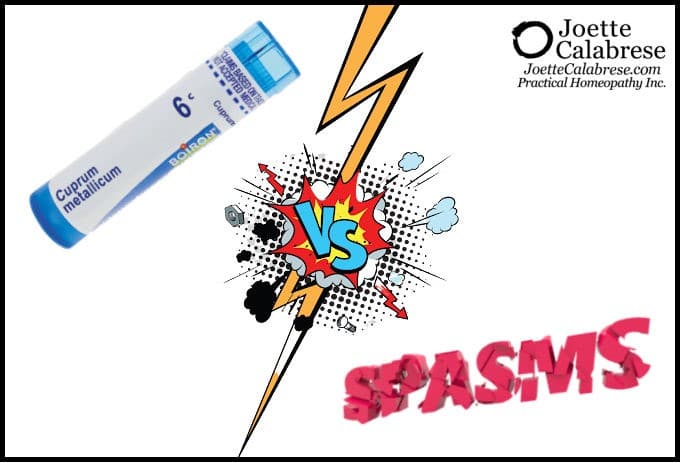
Cuprum vs. Spasms

Joette Calabrese

I’ve written about Cuprum metallicum before. So, perhaps you remember its history of usefulness for restless legs, strabismus or colic. But today, I want to stress Cuprum’s ability to address spasms.

Muscle spasms? ✔️

Spasms and cramps of any muscles (legs, hands, back, neck, etc.) may be addressed with Cuprum metallicum 6, twice daily, until the condition is very much better.

Facial tics and twitches? ✔️

Yes, even that annoying eye twitch that we all get from time to time. Generally, these conditions are self-limiting (meaning they’ll go away of their own accord, given enough time). But as a neurological remedy, Cuprum has been shown to address the spasmodic nature of facial tics and twitches. It may be a choice to employ Cuprum twice daily, until the condition is very much better.

Spasms in the abdomen? ✔️

The stomach muscles perform many tasks, from keeping your organs neatly in place to supporting your body in motion. But the various muscles in the abdomen can experience painful spasms sometimes, signaling a need to contemplate Cuprum.

In fact, while we often initially think of Ipecac for vomiting, Cuprum is great for vomiting accompanied by spasms of any sort.

Whether the act of vomiting itself is spasmodic or the abdomen and stomach muscles are spasming during the sickness, Cuprum may likely be a tighter fit than Ipecac. If the sufferer is even experiencing concomitant spasms in unrelated areas (legs, hands or back) while vomiting, those symptoms are a call to consider Cuprum metallicum 6, as needed, until the condition is very much better.

Paroxysms of coughs? ✔️

Indeed, everyone has experienced a coughing jag. “Cough, cough, cough, cough — GASP — cough, cough, cough, cough.” You know the drill.

For spasmodic coughing fits that result in breathlessness or feel like an attack of suffocation, once again, homeopathy’s spasm medicine, Cuprum metallicum 6, may be just the ticket to regaining equilibrium. It’s worth a thought!

So, we’ve discussed several usages of the 6th potency here. However, in my practice, clients with frozen shoulder have reported success by utilizing Cuprum in the 200th potency. Consequently, I’d say no well-curated homeopathic kit should be without Cuprum metallicum in several potencies.

And my friends, in this coming week’s Memo to Mighty Members, I will share a fantastic organizational system for homeopathic medicines. Organizational tips are just one of the things we share in our private enclave, along with additional information on medicines, current events, homeopathic research, recipes, success stories, and the list goes on. Don’t miss out! Join my Mighty Members today!

And pass on the good news of homeopathy!

Warmly,

Joette Calabrese

P.S. Speaking of stomach spasms and vomiting, our guts are much more critical to our overall well-being than we realize. So many conditions — both physical and emotional — stem from gut dysfunction.

Many may not realize that homeopathy can be the needle-mover to bring the gut back to its optimal health … undoing years of antibiotic use and poor eating habits.

I created my course Good Gut, Bad Gut: A Homeopathic Strategy to Uproot Seemingly Unrelated Illness in Body and Mind to provide concrete solutions — solutions drawn from my almost 40 years of practice dealing with the gut and gut/psychology connections.

Intrigued? I encourage you to download this free infographic to show you that effective, polite homeopathic protocols (with reproducible results) do exist.

And if you need two more reasons to stay engaged on your journey to health autonomy, join my Mighties and qualify for an immediate 10% discount on all my courses or become a Gatewayer in a Gateway to Practical Homeopathy Guided Study Group.

If you join in a Gateway group purchase, you’ll receive a 30% discount! Once you are Gatewayer, all the details are provided. I can’t think of a better way to spend the cool nights ahead in front of the fire.


Calling All Nurses

Practical Homeopathy, Joette Calabrese

People trust nurses.

And they should! Nurses are in the trenches.

They’re the ones who have gathered practical, day-to-day experience over years of observation. They’re the ones who give invaluable tips and tricks. For instance, I had a necessary surgery decades ago. Upon release, my nurse showed me how to get out of bed without pain or risk of further injuring my surgical site. She was an angel.

Nurses know the little things that will make their patients’ lives easier.

In a hospital setting, the attending doctors prescribe and walk away. The nurses stay. They’re attuned to people’s needs. They witness the fallout after drugs are employed firsthand because they are left to deal with it.

Nurses know.

How many times have you had an experienced nurse — a friend or relative — unofficially alert you to the dangers of a specific pharmaceutical? “I wouldn’t take it,” they might offhandedly say. Sometimes they make a special effort to whisper it to a patient after the doctor has left the room.

Indeed.

Why? Because they have witnessed the repercussions — nay, the fallout of synthetic, patented drugs of commerce.

I see it constantly. As of this writing, approximately 15% of my Academy of Practical Homeopathy® students are nurses. Those whom I’ve spoken to are frustrated by the fact that Big Pharma has such a debilitating strong hold on patient care. They are disillusioned by the repercussions of synthetic drugs.

So, they are learning homeopathy as a natural progression in their thinking of how to make patients’ lives better without introducing new, iatrogenic consequences down the road.

As I said before, these nurses are more attuned to patients’ needs, and they are turning to homeopathy in large numbers.

But if I may be so bold, we need more nurses to join our movement! Can you imagine the good that can be done with more boots on the ground — or should I say “Crocs” on the ground? Indeed, these women and men could be the difference-makers in the future of health care.

So, if you’re a nurse, I urge you to join us. If you know a nurse, I urge you to share your knowledge of homeopathy with them. Once they witness the tip of the iceberg of homeopathy’s potential, they’ll want to learn more.

A great place to start — for nurses, mothers and other caregivers alike — is my course, Good Gut, Bad Gut: A Homeopathic Strategy to Uproot Seemingly Unrelated Illness in Body and Mind. So many human health issues originate in the gut that this course has become a popular entry point to learning homeopathy’s ability to affect overall well-being, whether physical, emotional or mental.

For instance, students learn more about Nat phos 6X (Natrum phosphoricum) for indigestion, which I briefly discussed in my cell salt series blog post, David vs. Goliath. It’s a more polite replacement for over-the-counter antacids.

But even if one’s meals are perfect, food sources are top-notch, and every meal is made from scratch, one can still experience problems related to the gut, such as anxiety, depression, bloating, brain fog and weight gain. My course, Good Gut, Bad Gut, provides education on homeopathic medicines and protocols that have been shown to act for the last two centuries!

So, I’m calling all nurses! I want to give you hope that real solutions exist! Click here to download your copy of my free infographic, From Bad Gut to Good Gut, containing a sneak peek at a few of the medicines covered in the course. In fact, share this link with others as an easy way to pass on the good news of homeopathy!

Joette Calabrese, Practical Homeopathy

Recently, I received an email from Homeopathy magazine granting public access to two fascinating research articles. These two laboratory studies “add evidence for the existence of physical phenomena in homeopathic dilutions,” says the editor of Homeopathy magazine. As continuing investigations into nanoscience deepen, I have no doubt we will see more and more of these studies further substantiating homeopathy scientifically.

I have placed links to both of these articles in my free Resource Library in The Learning Center at the bottom of the list of Homeopathic Research Sites.

While you’re there, click around. My free Resource Library contains many other articles and resources validating homeopathy’s astounding body of work. New scientific methods are helping to uncover the underlying reasons for what homeopaths have known for years: Homeopathy works!

Warmly,

Joette Calabrese

P.S. Not quite ready for an in-depth course? Join a Gateway to Practical Homeopathy® study group. Addressing your family’s conditions requires confidence. And confidence comes from competence! 


Uh-Oh, I’m Estrogen Dominant

practical homeopathy, Joette Calabrese

I hear it from women all too often. “Uh-oh, Joette! I found out I’m estrogen dominant!”

Well, that sounds quite ominous, but in truth, estrogen dominance is not a true conventional diagnosis. It’s an explanation of the diagnosis.

We’re not going to treat “estrogen dominance” because we don’t treat the dominance of any one hormone or another. So, we don’t need to know the explanation; we need to know the conventional diagnosis and the symptoms.

The true diagnosis is no great mystery. It hits every woman around the ages of, say, 42-60. It’s menopause — the symptoms being hot flashes, weight gain and lowered libido.

These kinds of hormonal fluctuations — while natural with age, of course — can be exacerbated by anything that tinkers with one’s endocrine system (e.g., pesticide exposure, plastics in water bottles and food containers, birth control pills or thyroid issues).

But the only reason I mention those potential “causes” is to urge women (and their daughters) to stay away from those influences. But it’s not essential that we really, truly know what stimulated the shift.

Practical Homeopathy, Joette Calabrese

So, what can we do if a sufferer feels like menopause is a rollercoaster? What if they can’t soar through menopause because symptoms are burying them — holding them down? They don’t need a test. Instead, in Practical Homeopathy®, we use the symptoms to help us make the most informed medicine choice.

I’ve written many times about Sepia 200 — generally utilized every three days — as our primary medicine to consider for menopausal symptoms.

However, today, I want to point out another excellent choice for hormonal fluctuations that belongs in every well-curated homeopathy kit: Ammonium carbonicum 200C, employed every seven to ten days. It’s even worth consideration for perimenopausal symptoms as well!

So, there are two good choices to consider, but only pick one or the other. Ammonium carb would be appropriate for more generalized menopausal conditions, while Sepia more specifically covers hormonal headaches, vaginal pain and low libido. But, as always, I suggest you study both medicines thoroughly in a materia medica.

However, Ammonium carb doesn’t work quickly. It could take months to observe improvements. But often, many women report, “My symptoms are not nearly as bad as they used to be.”

And that’s what we’re going for, right?

If you have concerns about women’s health issues, I suggest you learn more about my course, Feminopathy: How You Can Correct Female Ailments Using Safe, Inexpensive and Effective Homeopathy. A simple blog post doesn’t allow me enough time to discuss thoroughly the potential that homeopathy has been shown to offer. But taking a deep dive into a course on women’s issues could be, as they say, just what the doctor ordered. (And wouldn’t that be one order from a doctor we would be happy to act upon?)

Get off the menopausal rollercoaster and pass on the good news of homeopathy, my friends.

Warmly,

Joette Calabrese

Joette Calabrese, Practical Homeopathy

P.S. Spurred by comments on the recent blog Dogs Days, I have added additional information to the post for new readers. However, for those of you who may not have reread the post since its initial publication, let me add my addendum here:

Remember that Pulsatilla is a medicine and should not be given indefinitely. We generally use a medicine for a few weeks and then reassess.

We reassess by looking at what symptoms and conditions remain, if there’s been an improvement and, if so, to what extent. According to our findings, we either halt the medicine (because its job is done) or carry on because there’s still plenty more work to be completed.

One of the most important ways to determine if a medicine has done its work is to halt the medicine and see if the suffering returns. If it does return, we can either begin utilizing the medicine again — less frequently (such as every other day instead of twice daily) — or carry on for another few weeks while always observing.

The same principle applies to pooches or people.

Join Joette’s Mighty Members for more in-depth weekly blog posts, video conversations with me, daily quotes, and a safe, secure social center to discuss what you’re learning about homeopathy with like-minded new friends. It’s the place to be! Don’t miss out on the fun.


Having a Swell Summer

Joette Calabrese, Practical Homeopathy

Many schools are back in session, but some folks are still having a swell summer.

By “swell,” I mean that certain people are experiencing swelling in the crazy heat and humidity blanketing the Northern Hemisphere. In fact, one of my reader’s fingers was so swollen he could barely get his wedding ring off!

Joette Calabrese, Practical Homeopathy

As always, homeopathy provides a polite, gentle medicine that has been shown to nudge the body back into proper function. Indeed, one of our valuable cell salts, Natrum sulphuricum, has been shown to address aggravations from warm, humid weather.

More commonly referred to as Nat sulph, this cell salt would generally be employed in a 6X potency, twice daily, for edematous swelling. (Of course, as always, we halt the use of the medicine when the condition is very much better or if no measure of improvement is observed after giving it due time to act.)

In fact, when we moved to Florida, my body was completely thrown off kilter by the oppressive heat and humidity. So, I utilized Nat sulph with great success. (You may remember I discussed my experience at the time in my Cell Salt Series: Sweltering and Swelling.)

What’s interesting about Nat sulph 6X is that it may be taken in advance.

For instance, let’s say the weatherman says a heat dome is expected to encompass your area. (Sound familiar this week, middle America?) Suppose a sufferer knows without a doubt that their body doesn’t react well to hot, humid weather. It always makes them unbearably uncomfortable or perhaps even makes them out-and-out sick. A little advanced use of Nat sulph — perhaps a few days ahead of the impending weather — may naturally bolster their body’s ability to cope and preempt ill effects as the heat settles in.

Plus, Nat sulph is not only for edema. It may also be called upon for other conditions related to hot, moist weather, such as asthma, nausea, headache, body aches and fatigue. The keynotes — what differentiates this medicine from other medicine choices — is the condition’s worsening from moist heat.

Under the rubric of edema, we also find Apis mellifica listed as a strongly suggested medicine in the homeopathic repertory. Apis 30 can be helpful as well, most notably if stinging accompanies the swelling. But we’ll talk about Apis and edema more soon, so be sure to return to this site!

And here’s a little tidbit I’ve discussed several times previously, but it bears repeating. Wisely, my son regularly makes a homemade electrolyte rehydration beverage. The recipe actually includes Nat sulph. This healthful, delicious drink sure beats the questionable ingredients (such as dyes and artificial flavorings) contained in commercial Gatorade. Plus, it’s quite refreshing.

Through this year’s blog posts, we’re slowly but surely curating a well-stocked homeopathy inventory. In case you missed earlier posts, here’s a list of the must-have medicines we’ve included in our kit so far. (Click on the medicine names to learn more.)

  1. ColdCalm®
  2. Ruta graveolens
  3. Symphytum officinale
  4. Arnica montana
  5. Hypericum perforatum
  6. Oscillococcinum®
  7. Arsenicum album
  8. Aconitum napellus
  9. Hepar sulphuris calcareum
  10. SleepCalm®
  11. Pulsatilla nigricans
  12. Ignatia amara
  13. Rhus toxicodendron
  14. Helleborus niger
  15. Euphrasia officinalis
  16. Lycopodium
  17. Nux vomica
  18. Sepia
  19. Cantharis vesicatoria
  20. Cyclease® Menopause
  21. Sulphur
  22. Bryonia alba
  23. Berberis vulgaris  
  24. Ledum palustre
  25. Belladonna
  26. Gelsemium sempervirens
  27. Hyoscyamus niger
  28. Coffea cruda
  29. Cina maritima

You can also learn more about many of these medicines in A Materia Medica: Practical Homeopathy® for Busy Families. I wrote this materia medica with families in mind. There’s no complicated homeopath-speak … just my plain-spoken English with examples from my family and practice. It’s an excellent materia medica for beginners as well as a quick resource for the more experienced user when time is of the essence.

Be sure to pass on the good news of homeopathy!

Warmly,

Joette Calabrese

P.S. Here at JoetteCalabrese.com, we continuously and ardently fight for your privacy.

In response to recent disturbing trends in artificial intelligence and concerns about large companies collecting our data, the Practical Homeopathy® internet technology team has conducted a thorough review of current policies and technical systems employed by Zoom, Inc.

After an in-depth conference call with Zoom’s Tier 3 Support, here are the current precautions we are taking on your behalf:

  • We have verified that all AI-related settings within our Zoom account are disabled and locked in the off position.

Practical Homeopathy, Joette Calabrese

  • Our IT team has established an open, ongoing dialog with our Zoom account executive and their respective IT teams regarding this matter. Further documentation and assurances should be forthcoming. We will share any new, pertinent information.

My entire team at Practical Homeopathy® understands and shares your concerns, and we don’t take our promise to provide a “safe and secure” site lightly. Rest assured that, to the best of our ability, we will continue to ensure our platform remains free of prying eyes and invasive AI so that you, our esteemed students, may confidently grow your homeopathic skills. 

As is the case with all technology, the climate is ever-changing. We will continue to put our students’ and followers’ privacy first by monitoring these changes as they happen and acting accordingly.


Dog Days

Joette Calabrese

Yes, yes … seems as though everyone in the Northern Hemisphere has been perspiring their way through the Dog Days of Summer.

But today, I’m not talking about those dog days. Today, I want to share an inspirational success story involving an adorable pup named Odin and our friends who own him.

Because when you own a dog, every day is a dog day!

And that brings me to little Odin. (Isn’t he adorable?) He howled and cried whenever his people, Amanda and Jeff, left him. It was heartbreaking … for all of them.

As a nurse, Amanda knows that homeopathy works and works well, so she’s an astute reader of my blogs.

Rather than complicating her assessment of Odin’s freakouts, she kept it simple. What do I mean by “simple”?

In homeopathy, we don’t want to bring assumptions into play. Many people might think Odin was neurotic or prone to panic attacks. “Oh, it must be his breed.” “Oh, it must be his age.” “Oh, it must be that he’s afraid of the silence.”

When choosing a homeopathic medicine, we must resist the temptation to interpret the symptoms! There’s no room for “Oh, it must be …” assumptions. We have to distill the condition down to its simplest components and just look at precisely what it is.

In this case, it was a simple equation. “When we leave, the dog doesn’t like it.” That’s it! Nothing more. It’s a clear case of Odin crying, “Don’t leave me. I want to be with you!”

Separation anxiety is generally a call for Pulsatilla nigricans. I’ve already discussed Pulsatilla as a must-have medicine in any well-curated homeopathy kit for fake-dairy intolerance. But as I say in A Materia Medica: Practical Homeopathy® for Busy Families, Pulsatilla’s “primary classical characteristic is the need for love and affection.”

That’s it. Little Odin needed his people’s love and affection. So, Amanda knew he needed the safe, polite, gentle nudge homeopathy could provide, and she gave him Pulsatilla nigricans 30.*

In her words: “We’ve been using Pulsatilla for about two months now and give him one dose every morning. It has helped with his separation anxiety tremendously, so much that other people have noticed and have asked what we’ve done to change his behavior!”

Look at that, my friends. Pulsatilla aborted the whole thing all because Amanda paid attention to the homeopathy facts and philosophies I’ve shared in my blogs.

You can do this too! My blogs and podcasts provide a wealth of information — for free. And when you’re ready to learn more, check out The Learning Center, where you will find information on my popular condition-specific protocol courses. There’s even a Course Selector to help determine which course best matches your family’s needs. And until you’re ready to take that deeper dive, you’ll also find a free Resource Library with additional useful information from various sources.

No matter what path you choose to take, just keep learning and stay curious, my dear readers. Then pass on the good news of homeopathy!

Warmly,

Joette Calabrese

*Remember that Pulsatilla is a medicine and should not be given indefinitely. We generally use a medicine for a few weeks and then reassess.

We reassess by looking at what symptoms and conditions remain, if there’s been an improvement and, if so, to what extent. According to our findings, we either halt the medicine (because its job is done) or carry on because there’s still plenty more work to be completed.

One of the most important ways to determine if a medicine has done its work is to halt the medicine and see if the suffering returns. If it does return, we can either begin utilizing the medicine again — less frequently (such as every other day instead of twice daily) — or carry on for another few weeks while always observing.

The same principle applies to pooches or people.

P.S. My friends, the perfect place to begin your journey into this healthcare paradigm is through the Gateway to Practical Homeopathy®: A Guided Study Group Curriculum. Learning with others — sharing experiences — is the fastest way to garner knowledge for yourself, your family, and even your larger community. Once you know how efficacious homeopathy is, you won’t be able to keep it a secret! Join our movement. Let my curriculum take you by the hand and raise your understanding to the next level!


Bruxism

Joette Calabrese

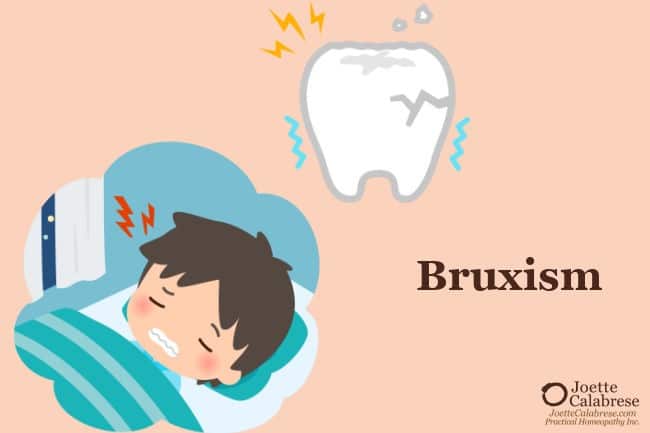
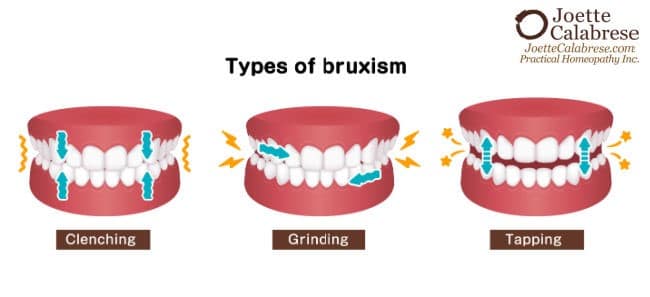
There’s nothing like a fancy word to make a condition sound exotic. However, bruxism is far from exotic. In fact, it’s pretty common, especially in children. Bruxism is just another way to say grinding the teeth.

It’s not uncommon that children will grow out of grinding their teeth. Although, some individuals remain plagued with the condition well into adulthood. For still others, the condition commences in adulthood.

While this condition can certainly be uncomfortable, it can also be damaging. Temporomandibular disorders (TMDs) may result, such as the jaw pain of TMJ. Teeth can also crack under the repeated stress of grinding or clenching, and cracks lead to tooth decay and loss of structural integrity.

With adults, often, the answer can be a simple lifestyle change, as some causes of bruxism are:

  • Drug use — Most notably, anti-anxiety and anti-depression drugs such as selective serotonin reuptake inhibitors (SSRIs) can result in tooth grinding.
  • Chocolate
  • Coffee

If one finds drugs, chocolate or coffee are affecting their dental health, then common sense dictates one should cut back or eliminate the culprit! Right?

It reminds me of the old doctor joke: “My arm hurts when I do this!” Doc says, “Then don’t do that!”

So, if coffee makes one grind their teeth, don’t drink it! I’ve reduced my coffee intake and added ingredients to make it a more enriching beverage. In fact, I did a Monday Night Live event on this topic, and my Mighty Members received my recipe — along with my rationale —earlier this week.

Joette Calabrese

Other cases of bruxism may stem from:

  • Food intolerances and allergies
  • Anxiety

However, in children, a more common cause of bruxism can be parasites — pinworms, to be exact. I hate to tell you folks, but if one child has pinworms, then it’s not uncommon that the whole family may get them.

Believe it or not, a common culprit is sharing popcorn! The female worms cause such intense itching in the rectum that a child (or anyone for that matter) can barely contain their need to scratch, particularly at night. And then the eggs are under the fingernails.

Unless one performs a good, old-fashioned morning scrub under those nails, then reaching in a shared bowl of popcorn can spread the eggs.

But I don’t want people to freak out! This is life. This is nature. We don’t want to live in fear of all the little critters surrounding us daily. In fact, one of my most ardent messages is to stop fearing infections. Did you hear me? I’ll repeat it in case you didn’t hear me: Stop fearing infections! Our bodies are designed to handle these things … sometimes they just need a polite, gentle nudge.

When it has been established that pinworms are present and there is grinding of the teeth (especially at night), one such nudge can be Cina maritima 30, utilized twice daily. Usually, this would be continued over many weeks. But as always, we stop using a medicine when significant improvement in the condition is observed — when the sufferer is “very much better.” We also halt the medicine if no improvement at all is seen (after its use for an adequate period of time).

However, pinworms are not required to be present along with the bruxism to call upon Cina. As is often the case in homeopathy, the etiology doesn’t necessarily affect the medicine choice.

Indeed, Cina is one of our quintessential childhood remedies. But it can also be utilized for adults. Although, with adults, it is a good idea to begin by reducing exposure to the aforementioned extrinsic influences, such as coffee, chocolate or drugs, before moving forward into utilizing a homeopathic medicine.

But remember what I often say: Just because you know the medicine doesn’t mean it’s the one you use! I always encourage those employing homeopathy to do their homework. Read about Cina in a materia medica to ensure it’s a relatively tight fit for the case! It’s but one of the many medicines that can be utilized for bruxism. There’s generally more than one way to peel an orange in homeopathy. In fact, that’s one of the beauties of this paradigm!

Pass on the good news of homeopathy!

Warmly,

Joette Calabrese

P.S. Want to learn more about using a repertory and materia medica? Of course, you do! Get acquainted with both books through the Gateway to Practical Homeopathy I and II. Learning through my study group curriculum is the best way to begin developing your homeopathy skills. And I should know. Creating a study group is how I learned decades ago.

And why not join Joette’s Mighty Members to dive deeper into these topics. You’ll receive extra weekly blog posts (in my Memos to Mighty Members), exclusive videos from me, daily inspirational quotes, free gifts and a private social center to discuss homeopathy with like-minded folks — away from the prying eyes of public social media. Plus, so much more. And all my Mighties qualify for a 10% discount on course purchases. Don’t be left behind! Join us!


When Tooth Extraction Is Unavoidable

Joette Calabrese

Our first choice is to avoid tooth extractions. That’s a no-brainer!

Indeed, our goal is to retain all our teeth through good diet and homeopathic support when needed.

(See my article, Homeopathy for Home Dental Care, written for Weston A. Price’s “Wise Traditions” in 2011, as well as Dental Health: Tooth Pain and last week’s article, Exquisite Tooth Pain.)

But sometimes, despite our best efforts, the unthinkable happens. We must part ways with a beloved tooth. (However, if it were me, I would certainly make sure I had received a confirmatory second or even third opinion — preferably from a biological dentist.)

To that end, I was recently asked about specific homeopathic medicines for consideration when an extraction occurs.

Extractions are a surgical procedure. So, one might strongly consider following the surgical protocols I have written about previously in Anticipating Surgery? Homeopathy Can Help and Surgery: Answering Your Questions.

Another consideration for the extraction would be diluted Calendula officinalis mother tincture (MT). Placing 5-10 drops of Calendula MT in a few ounces of water creates a mouth rinse that has been shown to soothe the pain, control bleeding and help with wound healing. Generally, this dilution is gently swished about the mouth and then spit out or swallowed.

So, Calendula should be added to our list as another must-have homeopathic for a well-curated kit. I’ve discussed this useful medicine before in several blog posts. In the 200th potency, Calendula can help with the pain amputees experience of phantom limbs.

However, topically, Calendula has been clinically shown to be an antiseptic of sorts. I consider it one of My Top 5 Sizzling Summer Remedies for the minor cuts and abrasions that kids inevitably get from playing outside.

It also has a history of success with preventing infection in instances of surgical incisions. (You might remember my post, Don’t Look if You’re Squeamish.)

Besides homeopathic Calendula in pillule form, Boiron offers several topical Calendula first-aid products (cream, ointment or gel) that are convenient and well-regarded. So, there are many forms of Calendula, each of which deserves a place in our homeopathy inventories!

My friends, we hear much in the media about building generational wealth. But what could be more important than building generational HEALTH?

I’ve said this so many times, but it bears repeating. Learning homeopathy can keep you relevant in your children’s and grandchildren’s lives. By passing your homeopathy knowledge on to them, you further ensure that even their children and grandchildren will enjoy self-reliance in health care matters through Practical Homeopathy®. Imagine … your great-great grandchildren could be born into a world of health autonomy with the same gentle, efficacious, safe homeopathic medicines that have successfully weathered the test of time.

Now, that is generational health.

But don’t simply take my word for it! To illustrate my point, I want to share (with permission, of course) a non-solicited testimonial that I recently received from a proud grandmother.

Joette Calabrese

“I love helping people with homeopathy. I cannot begin to say what it has meant and still means to my family. My children and grandchildren love it also. My 11-year-old granddaughter burst into my office a couple of weeks ago and said, ‘Mamaw, I need Hypericum quickly!’

“My first thought was maybe there was a smashed finger, but I was wrong. One of the young ladies at a church function was having ‘shooting’ pains in her back, and she was so distressed. There were lots of tears flowing!

“[My granddaughter] said, ‘I know Hypericum is good for shooting pains!’ Well, needless to say, I was impressed.

“It turns out that this lady was under a lot of stress. Her grandmother in another state was dying. So, I encouraged [my granddaughter] to calm down and take a minute so we could look at it.

“I showed her in the repertory how that Nat Mur is good for grief, and it also is used for shooting pains. [My granddaughter] took some Nat Mur to this lady, and within 5 minutes, there was a smile on both of their faces!

“Now, I can’t imagine anything that could make a grandmother happier than to see her children use homeopathy to help others! [My granddaughter] said, ‘I knew we could help her!’ ”

— Janie S.

Is that not powerful? After reading stories like that, time and again I’m convinced of homeopathy’s powerful future — and the future of humanity.

Janie and her granddaughter are a perfect illustration of creating generational health. If you haven’t already, won’t you join us in our movement?

Want to begin the journey? As with anything, it’s best to begin at the beginning! Step through the Gateway to Practical Homeopathy®, my guided study group curriculum. Over 20,000 study group members have started their journey to confidence and competence in homeopathy through membership in Gateway study groups.

Not only will you develop a solid foundational knowledge of my unique paradigm — Practical Homeopathy® — but you will also develop deep, lifelong friendships with your fellow study group members. These like-minded moms, grandmoms and dads will become your support system in tough times and your cheering section for victories!

Build generational health by taking that first step through the Gateway!

And don’t forget to pass on the good news of homeopathy!

Warmly,

Joette Calabrese

**Lightly edited for clarity and privacy.


Exquisite Tooth Pain

Joette Calabrese

We often take our teeth for granted. They help us eat. They help us speak. They help maintain facial and intracranial structures that even affect the alignment of our neck and spine.

However, when a tooth hurts … yee-owh! There often is no pain like tooth pain. It’s like having a little jackhammer in your mouth — a relentless jackhammer.

Most people think of Hypericum perforatum for toothaches. And rightfully so, if nerve damage is involved. Indeed, Hypericum has been shown to be effective for nerve pain, which is often a contributing factor to toothache.

Pulsatilla nigricans is another medicine generally considered, particularly when the pain is triggered by hot food or drink.

But there is another medicine to consider if the pain is pretty severe. (I’m talking exquisite tooth pain.) If nothing else has helped and cold brings a little comfort, then Coffea cruda 200, twice daily until very much better, has been observed to act.

Now, I’ve talked about Coffea in previous blog posts for racing hearts from too much chocolate, severe itching that causes wakefulness at night, insomnia, anxiety and even fainting from joy. But dental pain is another reason to ensure Coffea cruda is poised and ready in your homeopathy kit.

 I’m not promising that Coffea will necessarily act on pain like morphine. But in my experience, when employing this medicine, sufferers have achieved enough improvement to make life bearable again. Indeed, sometimes a slight improvement in the pain is all that’s needed until the underlying condition is fully addressed.

Interestingly, many of my clients suffering from toothache have reported that absolutely nothing improves the pain. So, I ask a more precise question, “What are you doing for it?”

Often, that’s when they’ll explain, “Well, this doesn’t necessarily make it stop hurting completely, but I just find myself drinking cold water or holding an ice pack against my jaw.”

Joette Calabrese

Ah-ha!

While they might not label this behavior as providing relief, they are listening to their body’s instincts, and that’s an important indication for the Practical Homeopath™ when choosing a medicine.

Let me give you another example: abdominal pain. Some clients can’t stand any pressure against their stomachs. They may even resort to wearing only dresses so that a waistband doesn’t press against them. However, conversely, some clients are doubled over with their arms squeezed against their stomachs, keeping pressure on the gut!

Neither of these groups of sufferers would claim their behavior is ameliorative. They simply find themselves doing it!

These unconscious behaviors are the body’s innate indications that help point to the correct medicines.

So, keep this in mind as you observe yourself or your loved ones. As you know, in homeopathy, observation is a critical part of choosing what medicine to use, how long to use it for, and when to halt.

My friends, you may be interested in downloading a white paper I prepared some time ago called “Teeth Worthy Tips.” It’s completely free, and you can find it in my newly revamped Free Resource Library in The Learning Center.

If you’re a Mighty Member or already own one of my courses, simply log in with your existing account information. If not, you can create a free account to access the Free Resource Library with a few clicks of your keyboard.

Either way, once logged in, scroll down to the section “Additional Sources of Homeopathic Information.” You’ll find “Teeth Worthy Tips” close to the top of the list.

Browse around while you’re there. I’ve curated a great many articles from other sources on homeopathic research, specific diseases, the worldwide practice of homeopathy, my course infographics and so much more. I even included an archive of all 94 of my daily “At Home with Homeopathy Tips” from the 2020 shutdown when many of my readers were stuck at home.

So, peruse the information in the Free Resource Library to help you pass on the good news of homeopathy! And add must-have Coffea cruda to your homeopathy kit!

Warmly,

Joette Calabrese

P.S. Do you want to learn more? Get started today and restore your loved ones’ health in a way you may not have thought possible.

Over 20,000 participants have gone through my Gateway to Practical Homeopathy® Guided Study Group Curriculum.

It’s easy to create a study group with friends — as I did decades ago — or join a group with an experienced leader. Either way, you’ll form life-long friendships as you begin your journey to health autonomy.

Just click here to learn more about the Gateway to Practical Homeopathy®.


“I Don’t Like That Baby”: Homeopathy and Behavioral Issues

Joette Calabrese

Yes, you read that title correctly. Although many people associate homeopathy with only physical conditions, these polite yet powerful medicines have been shown to be effective for behavioral issues as well.

Hyoscyamus niger is a great medicine for psychological problems and behavioral disorders —and those conditions in children are no different. In fact, I’ve discussed it before in a previous blog post concerning Attention Deficit Disorder.

But today, I’d like to teach another use of Hyoscyamus, for I’ve used it so many times in my practice for children who demonstrate frustrated anger and may even show a tendency toward violence. While the etiology is not always important in our choice of medicines, I have often seen this unpleasant behavior stem from jealousy.

For instance, Nanette has a new baby brother. Nanette had been accustomed to getting all the attention in her family, but Baby Nick had dethroned her.

While she appeared to love him, she also intensely disliked him. This dichotomy between those emotions — that love/hate relationship — was too much for her little mind to process. She was overwhelmed and began acting out.

“I don’t want that baby!” she would think. “Don’t put that baby beside me! I don’t like him.”

Nanette’s mom reported, “But my child is so sweet! She’s such a good child!” Meanwhile, when Mom’s back was turned, Nanette would give Baby Nick a stealthy little pinch … just enough to cause him pain and make him cry. As if to say, “That’ll show that interloper!”

Mom was at her wit’s end.

Nanette had never shown this kind of behavior in the past. Mom was convinced that she would simply outgrow it, but then the sleepwalking began!

The tendency to act out with physical aggression (such as pinching, striking or biting) and sleepwalking calls for a homeopathic medicine with a history of addressing both of these behavioral symptoms: Hyoscyamus niger 6C, used twice daily until very much better.

Now, one doesn’t necessarily need to observe both of those symptoms before choosing this particular medicine. However, when both behaviors are present, they serve as solid confirmation of our choice.

Nanette simply needed a gentle little nudge from Hyoscyamus to help her central nervous system settle down. Soon, she was transformed back into the pleasant, even-tempered little girl she had been before Nick’s birth.

She no longer pinches her little brother, grabs his toys or pushes him down. They play together like two peas in a pod.

For now.

Wait until they’re teenagers, and her pesty little brother follows her everywhere!

Speaking of teenagers, Hyoscyamus 6C, twice daily, is also a consideration for ailmenst from heightened emotions after jilted love.

Whether it’s the sudden end of first puppy love or a former best friend at school who has moved on to another relationship, the feelings of jealousy, rejection and resentment can rev up the central nervous system. The adolescent or teenager can develop behavioral traits that make them become annoying, too much to handle or downright awful to be around.

Other typical keynotes can include sleepwalking, restlessness, strange gestures, loquaciousness, inappropriate laughter, lewd jokes or discussing sex in a ribald way. Even promiscuity, hyper-sexuality and exhibitionism can ensue.

Now, I am not saying that all those symptoms will present in every youngster with a broken heart or that those behaviors must be on full display 24 hours a day. But if any of those symptoms occur with enough frequency for the parents to wonder, “What the heck is going on with my child?” then Hyoscyamus niger 6C, twice daily until very much better, is worth considering for this pathology.

So, be sure to add this useful medicine to your well-curated homeopathy kit.

There’s no need for the entire family to endure the unpleasantness of behavioral issues. Indeed, emotional, mental and behavioral conditions are no match for proven homeopathic medicines. I teach many more conditions — and the associated medicines and protocols — in greater depth in my course, Mindful Homeopathy: Practical Protocols for Mental and Emotional Conditions.

Joette Calabrese

I think it goes without saying, but uprooting mental and emotional conditions with gentle, efficacious homeopathy triumphs over the use of dangerous psychotropic drugs. Pharmaceutical intervention may cause anything from unpleasant side effects to personality changes to even iatrogenic illness.

And later this week, my Mighty Members will receive a fascinating interview with a renowned psychiatrist who said, “Giving a child a psychiatric drug is poisoning, not treatment.” I couldn’t have said it better myself. This revealing interview is not to be missed, so join us!

Pass on the good news of homeopathy!

Warmly,

Joette Calabrese

P.S. Remember — all my Mighties (Joette’s Mighty Members) qualify for a 10% discount on course purchases, such as Mindful Homeopathy. If you need assistance getting your discount, email [email protected] for more information.