Podcast 126 — Moms with Moxie: From a Mom Just Like You to a Successful Practical Homeopath®!

Joette Calabrese, Practical Homeopathy®, Podcast 126, Moms with Moxie, Mom Just Like You to Successful Practical Homeopath®

IN THIS PODCAST, WE COVER:

01:00   Introduction

The Academy of Practical Homeopathy®

02:04   What Brought Kirsten to Homeopathy? Pediatrician Pushback and Pizza

05:43   The Gateway and the Garden Injury

Gateway to Practical Homeopathy®: A Guided Study Group Curriculum

06:44   Success Battling Cellulitis (with the photos)

Nailing MRSA with Homeopathy

08:00   The Photographic Proof of the Efficacy of Hyper/Ars

10:00   The Watershed Moment: Where Had These Medicines Been All My Life?

12:21   Success with Celiac Disease and Reducing Pharmaceuticals

15:48   Success with Rheumatoid Arthritis

17:18   From Mom to Practical Homeopath®

19:13   Learning Practical Homeopathy® Is Doable

ADDITIONAL RESOURCES:

Joette’s Learning Center

Joette’s Mighty Members

Joette Calabrese on YouTube

Kate:

This is the Practical Homeopathy® Podcast, episode number 126, with Joette Calabrese.

Joette:

Hi, I’m Joette Calabrese, and I welcome you to our health care movement — yours, mine and the countless men and women across the globe who have re-taken control of their families’ health with Practical Homeopathy®.

So, for the next few minutes, let’s link our arms as I demystify homeopathy — what was once considered an esoteric paradigm — into an understandable, reproducible, safe and effective health care solution available to all.

This is the medicine you’ve been searching for — my unique brand of homeopathy, PRACTICAL Homeopathy®.

INTRODUCTION

Kate: (01:00)

Hi, and welcome back to the podcast. We’re so glad that you’ve joined us today. We love that you’re here and are so excited about your homeopathy journey. So, thanks for being here.

Today, we have a special treat. Joette is going to be talking to a special guest, so I’m just going to let her take it away.

Joette:

Thanks, Kate. So, I’d like to introduce Kirsten Decca.

I’ve gotten to know Kirsten pretty well through the last few years because she’s been a student of mine for some time. She joined The Academy — and we’re going to hear all about that — and then, she went into the next year, the Mastery™ program. And now, she’s in our Mastermind program, and I really wanted you to hear her story.

So, welcome, Kirsten.

Kirsten:

Thanks, Joette. It’s a pleasure to be here. Thank you for having me.

Joette:

Yeah, this is going to be good today.

So, I’m interested in knowing — as many people are — a little bit about your life, what you do and what brought you to homeopathy.

WHAT BROUGHT KIRSTEN TO HOMEOPATHY? PEDIATRICIAN PUSHBACK AND PIZZA

Kirsten: (02:04)

Okay. Well, I’m a mom of six. My husband and I live here in the northwestern part of Florida. My husband is retired Air Force, and we have moved up here kind of out into the country. We have a little homestead, and we raise chickens, and we have dogs and some goats and horses.

My journey to homeopathy is interesting. I have a background in health care. I’m a licensed physical therapist assistant. Although I’m retired, I haven’t been in a clinic for probably, oh gosh, over 20 years now. But I’ve always loved anatomy and physiology. I’d like to say health care, although I feel different about what it actually is now.

But my dad was actually a pharmaceutical rep, so I was raised with drugs. They were everywhere. It’s just what we did. In fact, I didn’t really know that there was even another way. If you were sick, that’s just what you did.

You took a pill. Or actually, we used to have — I don’t know if you remember Kaopectate®, Joette. You remember?

Joette:

I do.

Kirsten:

So, we used to have it everywhere. And I don’t know why I thought it tastes good, but we would just drink it. We would go sneak it out of my dad’s samples and take Kaopectate. I don’t know how we ever went to the bathroom. But anyway, so to say that drugs were commonplace is just an understatement.

I went to school to be the physical therapist assistant. I had played sports for years and years, had gotten injured and had had multiple surgeries. So again, drugs, drugs and more drugs during surgery after surgery.

And then I didn’t really question until probably most of us … when we had children. So, I had my kids. And then, I had a son that began displaying some behavioral issues. And we just noticed something was different, and he was diagnosed with Asperger’s.

So, that really kind of started me on my journey of questioning kind of what I had done. Was anything that I had done contributed to this? And so, I started reading, educating myself, and then I started asking questions at the doctor’s office, which that did not go over really well, and I began to get pushback.

And so that even pushed me further in questioning. “Okay, why is this an issue? These are my kids. You would think they would welcome it.” I really expected the doctors to pat you on the head and go, “Good job!” But that was not the case.

So, we started deciding not to do certain things, and I began to get kicked out of doctor’s offices. And I started doing my own research. And for my son … we started changing diet; we added herbs; we did all those things. And we did see some things get better, but we just never saw it go away. And if you stop doing those things, issues came back.

So, then I had a friend who was kind of on that same journey — gluten-, dairy-free. She was actually a client of yours, Joette. She introduced me to homeopathy, and I thought I saw her one day eating pizza.

And I thought, “Oh my goodness, she has given up! She’s just decided she’s going to go out and enjoy food.” I just couldn’t believe it. I knew her diet was very restrictive.

And I said, “What are you doing? Why are you eating pizza?

“And she’s like, “Homeopathy.”

And I thought, “What are you talking about?” And I probably wasn’t really nice about it. I probably was like, “What is that? It sounds crazy.”

[00:05:30] So she just very nicely smiled, does what you tell people to do, you know? Just leave your little seeds and walk away.

And I just over time asked her a few more questions, and she invited me to a Gateway.

THE GATEWAY AND THE GARDEN INJURY

Kirsten: (05:43)

So, that’s really where I started … was that Gateway class. And I did that Gateway class and started to implement those medicines for my kids, for other people. And that’s really, I began to see some things change.

And then fast forward just a little bit of time (that was 2019). So, spring of 2020 (where we all know there were some crazy things happening), and I hurt my foot.

I love to garden. And I was tilling some manure into the garden and left something out and was walking around in flip-flops at night and shoved this tool right between my toes.

And I did all the things. I took Ledum, and I took Arnica. I took a few other things, but I still didn’t really know. I was not proficient. I didn’t really know what I was doing. So, I called my friend and said, you know, “What else do I do?”

And she helped me. But it continued to kind of get infected, and it got pretty nasty. And I developed cellulitis.

SUCCESS BATTLING CELLULITIS

Kirsten: (06:44)

And I had called some friends of mine that were in the medical profession. And they said, “You’ve got to go in. You’ve got to go in. You need IV antibiotics.” But I did not want … at that time, I was like, “This is not a time I want to go to the hospital. I’m just going to really try this on my own.”

And I tell people, it was my “burn the ships” moment. I was like, “This is do or die for me. I couldn’t tell somebody else not to go, but I’m not going. And so, I’m going to figure this out.”

Well, amazingly, it wasn’t super painful. It looked like it should have been, but I was still kind of able to move around on it. And it stopped.

So, it looked bad, but it wasn’t progressing. It wasn’t getting any worse. And I think it was your article, Joette, that I came across. It was on MRSA because it looked very much like MRSA to me.

Joette:

Yes.

Kirsten:

And so, when I read that, I was like, I need to do Hyper/Ars [Hypericum perforatum 200 mixed with Arsenicum album 200], and I added Pyrogenium.

And when I did that, within 24 hours, I saw a shift. I saw the redness go down; the swelling go down; normal color started to return. And I knew I was on the right track. And within a week of that, it was completely gone. You wouldn’t have even known I had had an infection.

THE PHOTOGRAPHIC PROOF OF THE EFFICACY OF HYPER/ARS

Joette: (08:00)

It’s an amazing story because I’ve seen the photographs of it.
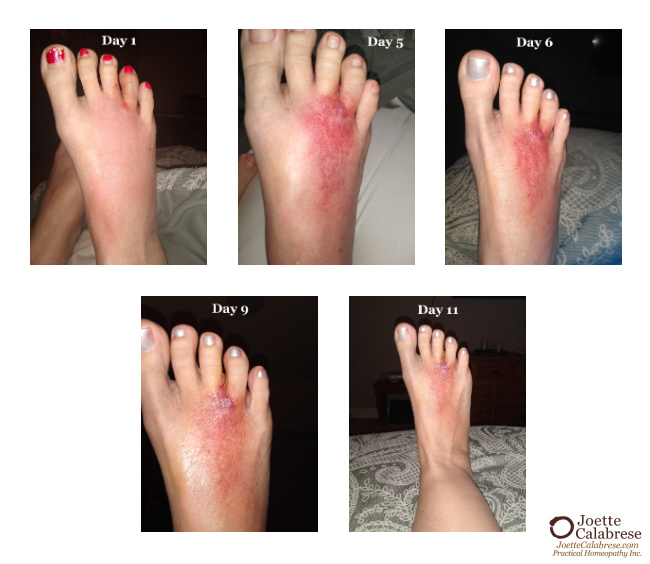
Joette Calabrese, Practical Homeopathy®, Cellulitis

Joette:

Cellulitis is nothing to play around with. You either go in and get the antibiotics and do what you’re told to do at an ER. OR you know what you’re doing homeopathically.

And you knew what you were doing. Yeah.

And I’m sure that you questioned it because we all do when we’re not well. “Uh-oh! Am I doing the right thing? Let me believe I’m doing the right …” And then you go back, and you read up on those remedies. “Am I sure this is the right remedy?” (After taking it.)

I’m sure that went through your mind that day.

Kirsten:

It did. And this is where community comes in. The friend that was helping me came to my house, and she continued to reassure me. “You’re on the right track. It’s okay. I think you’re all right,” for those moments of doubt. So, that was really important too.

Joette:

But that’s not empty reassuring, I must say. What she was doing was … she was reading the symptoms: where the symptoms were, like, just before taking the homeopathic and where they were shortly after taking them. Because we can learn how to read symptoms and determine, “Is this improving?” Because if it isn’t, we really do have to perhaps go to traditional medicine. Once you have an understanding of this — as she did, and that I’m sure you do now as well — you can read what’s going on … what the body’s telling us.

Kirsten:

Right. And she was seeing the pictures too. So, I think I was just … there were those times where you’re like, “Oh, am I going to do a good enough job to make this work?”

And thankfully, it did work. And I’ve seen it work time and time again. Hyper/Ars is incredible. I’ve seen infections just be able to melt away.

Joette:

Yeah, it’s a Banerji Protocol: Hypericum 200 with Arsenicum 200. And the Banerjis call it Hyper/Ars, and so that’s what we call it in our study. So, yeah … it’s mixed together.

Yeah, it’s pretty amazing for these kinds of conditions. And then you use Pyrogenium, as well … 200, right?

Kirsten:

Correct.

THE WATERSHED MOMENT: WHERE HAD THESE MEDICINES BEEN ALL MY LIFE?

Kirsten: (10:00)

So, that was really when I decided, “Okay, these medicines … they work time and again, and this shouldn’t have healed.” I thought this. Conventionally speaking, everybody thought I was crazy, and this worked.

I know they’ll work. There’s no reason why this should have healed without these medicines. I decided I needed to learn more. And when The Academy became available, I applied. And that’s kind of how this journey started.

Joette:

It starts with a watershed moment for most people. Something happened to their child; something happened to them; something happened to their parent or even their livestock and animal. And that’s when people say, “Wait. Wait a minute. I’ve got to find out more.”

And it’s someone like you, Kirsten, who’s — and this is one of my favorite words — autodidactic, likes to learn on their own. And so that’s how you started. But then you found, as you said, then, the next step is joining a group of people in Gateway to Homeopathy so that you’re with others who think similarly or at least are looking to study in the same fashion.

Kirsten:

And that was really the first thing I did is I did Gateway again, and then I taught it again.

Joette:

Then you taught it!

Kirsten:

Then I taught it. That’s right. And then that was really what I did before starting The Academy.

Joette:

So, you had a good head start.

Kirsten:

Yeah, I was really wanting to learn. It was amazing. I just couldn’t believe … where had these been all my life? I’d done all the things, and why did I not know these?

And so, I felt — and I still feel — I’ve got a limited amount of time. I’m not 20; I’m 50. So, I want to really continue to learn these so I can know them well and help people, my family and my community.

Joette:

Some people say they get angry when they realize, “Wait a minute. I mean, we’re grateful that we’ve got this great medicine. But wait, you mean to tell me that all these years [just like you said], this has not been out there for me to see or to know about or to be able to use? My parents didn’t know … my grandparents. This has been around since the late 1700s. What? We don’t know about this?”

Kirsten:

Right. And then, when you start learning the history behind it and why we don’t know, it makes you even more angry.

Joette:

Yes. Yeah, it’s an interesting history. Medical history is pretty darn interesting.

SUCCESS WITH CELIAC DISEASE AND REDUCING PHARMACEUTICALS

Joette: (12:21)

So, tell us what else you’ve done. You have another story? We love stories.

Kirsten:

Oh, gosh. Well, I have some really neat ones. Since going through APH and Mastery™, I’ve had a chance to work with some clients and had some really great results.

I think one of the neatest stories and probably one of the most difficult, I have someone close to me that has a daughter that has Type 1 diabetes, asthma, and now has actually been diagnosed with Addison’s disease.

So, that has been difficult, but so rewarding. And I think this is hopeful for people that even if they have to be tied to some sort of pharmaceutical — like, we’re never going to get away from insulin. That’s going to always be in our lives.

And because of that Addison’s disease, we’re going to have to have some measure of steroid replacement. But I will tell you the amount of medication we’ve been able to get away from for this child since helping her has been incredible.

She was diagnosed with celiac; she had chronic constipation, she had eczema. And those are all gone.

For a Type 1 diabetic, to not have food choices is really difficult. And this child could not go anywhere where there was gluten. We couldn’t bring food into the house. She would get sick and throw up.

And she can eat anything she wants now!

So, to have brought that kind of freedom and quality of life to someone is just incredible. So, are we going to still have to be tied to some medication? Yes, but the pharmaceutical needs have gone down drastically. And her quality of life has gone up immensely. Her mom told me that she said, “Mom, what did we do before homeopathy?” That’s really incredible.

Joette:

So, obviously, it’s not just for her. It’s for parents and someday for her own children. And the ripple effect is grand.

Kirsten:

It really is. And her insulin needs have gone down. She is on the smallest dose. They didn’t even know … it’s hard to titrate kids with Addison’s. So, she’s on the lowest dose of steroid that you can even be on. And she’s going through puberty! So, her needs should be going up, but the needs for her pharmaceuticals are not.

So, to say that this has been just really incredible in her life is an understatement.

Joette:

Beautiful. Great story. Love it. And so, what that gives us is a great deal of hope, but it also tells us that we can move a case along. We can move someone along quite far without saying it’s a hundred percent “cure.”

If we can give someone their life back. Someone, let’s say, with rheumatoid arthritis. They might still have deformance of their hands, but they no longer have pain. And now that woman can knit, and now that woman can prepare meals for her and her husband.

And so, those are the kinds of things we know. It will take it as far as it can take it, but meanwhile, the quality of life has been improved greatly. Good story.

Kirsten:

It really has.

SUCCESS WITH RHEUMATOID ARTHRITIS

Kirsten: (15:48)

Funny you talk about RA. Actually, one of my first cases was a rheumatoid arthritis case. And this person came to me because they were having to switch. They had been on biologics for years, and they were having chronic infections. They really were not feeling well.

I don’t think at the time, necessarily, that she put that with the biologics … you know, understood that maybe that was coming from the biologics. But even the doctor said, “Yeah, it’s going to lower your immune system. It can have these side effects.”

After we talked about it, and I said, “I’ll work with you, whatever you want to do.” But she decided she was going to have to switch medications, and she wanted to get off.

So, I said, “Okay, if that’s what you want to do, and your doctor’s on board, well, let’s just give it a go.” So, we started the protocol, and she has not been back on these medicines since — and it took three months. In three months, she was completely …

Joette:

That’s what I was going to ask.

Kirsten:

Three months. That’s it! I was amazed. I really didn’t know that it would work that fast. She was amazed. I was amazed. Just such a great outcome.

Joette:

So, again, it affects you, your children, your family, her, her family, and then her friends and her neighbors and her church mates, et cetera, et cetera. And it has that effect that that’s how this information needs to get out there … is through word of mouth. And that’s exactly what we’re doing today. It’s another way of getting the word out how important this medicine is in the hands of mothers and grandmothers.

And now, you’re a practitioner.

FROM MOM TO PRACTICAL HOMEOPATH®

Kirsten: (17:18)

You know, that was never my intention. I thought I would go into this, and I was just … wanted the information for myself and my family. And then Mastery™ came along. And I thought, “Well, if I’m going to do it, I want to do it well. So, let’s learn how to do it even better.”

And so, I sort of fell into that. People come to you. They know that you’re out there, and they want help, and they say, “Would you be willing to help me?”

And what are you going to do? You’re not going to say no. And really, it is, for lack of a better term, it’s addictive to help people. There’s no feeling like being able to help someone heal when they’ve been suffering for years. It is just a wonderful feeling.

Joette:

That’s kind of our mission being on this earth is to help others. Being part of it; you bet.

Well, Kirsten, I can’t thank you enough. People need to know that you can start from scratch and move all the way into being able to help your family and your friends and then move on to even practice. And that’s, of course, what you’ve done. And this has been over a span of what, how many years would you say …

Kirsten:

Goodness.

Joette:

… when you first met with your friend and who recommended homeopathy …

Kirsten:

Oh, that was 2019.

Joette:

Five years.

Kirsten:

So, it’s not been that long.

No, and I really am just a mom. I never had any intention on going back to school. We’re in the company, as you know, Joette … there are some really sharp cookies in The Academy and in Mastery™, and I’m humbled to just rub shoulders with them. There are some quite, just intelligent practitioners.

I really came into this just as a mom, but it’s amazing what you can learn and what you can do to help someone. And it’s just been a pleasure.

And I tell other students, you just trust the process. Trust the process. It’s a process. You don’t realize what you can accomplish, and anybody can do it.

LEARNING PRACTICAL HOMEOPATHY® IS DOABLE!

Joette: (19:13)

Yes, anybody can learn some of the protocols. But when someone is able to put it together in the fashion that you have because you are studious — I have to say that, Kirsten — and you’re myopic about it. You become very intense and have studied. I know! I can see you! I’ve seen you in class through the years, and I can see what kind of person you are. And it takes someone with a certain amount of dedication as well to be able to get to this point.

So, I hope that this has inspired many others because this is doable. It is doable! Anybody can do a few of these, but only certain kind of a person who’s willing to put the effort into it can do as much as I think you’ve accomplished.

So, there you have it.

Kirsten:

Thank you.

Joette:

Yes, you’re welcome. My hope is that we’ve inspired you to have a little more control over your life, my dear listeners, and less anxiety and a whole lot more confidence when it comes to taking care of your family and even moving forward in a new career.

It’s my honor to share many lessons on this simple method of using homeopathy for free —without affiliates or advertising — here in my podcasts, but also my blog posts and Monday Night Lives.

But it’s critical that you learn how to use these medicines properly. These podcasts should serve as only the beginning of your training. Peruse JoettesLearningCenter.com to find fun study group opportunities and in-depth courses developed by subject.

So, with the proper training, you can join the thousands of students before you in developing the confidence and competence to protect the health of your family and loved ones with my brand of homeopathy, Practical Homeopathy®.

Kate:

You just listened to a podcast from internationally acclaimed homeopath, public speaker and author, the founder of The Academy of Practical Homeopathy®, Joette Calabrese. Joette’s podcasts are available on all your favorite podcast apps.

To learn more and find out if homeopathy is a good fit for your health strategy, visit PracticalHomeopathy.com.

Spasmodic Dysphonia: Robert F. Kennedy Jr.’s Rare Voice Condition. Can Homeopathy Help?

Joette Calabrese, Practical Homeopathy®, spasmodic dysphonia, Robert F. Kennedy Jr.

I present my message with my voice, whether talking to clients, teaching my students, creating videos, podcasts or holding live events. I cannot imagine the frustration of discovering my voice has become strained or strangled, as though my vocal cords were in a vice.

But that’s what happens in cases of spasmodic dysphonia.

Spasmodic Dysphonia in the News

I was recently asked about this disorder by a student who was curious as to whether there were specific homeopathic medicines that might help Robert F. Kennedy Jr., the most famous sufferer of this condition.

However, I have encountered this condition twice in my clinical experience. One case did not improve because, in my estimation, I still needed to gain a greater level of experience to address it adequately.

However, the second case I tackled was successfully resolved.

Spasmodic dysphonia is a twenty-five-cent term for uncontrollable spasms in the muscles that open and close the vocal cords, causing the vocal folds to either slam shut or open involuntarily.

We don’t think of our ability to speak as dependent on muscles, but that’s exactly what creates and controls our unique voices. Spasms in those muscles controlling the vocal cords can render our speech unintelligible.

Even though the condition is not life-threatening, how life-altering it must be!

Is the Etiology of Spasmodic Dysphonia Important?

No clear-cut, across-the-board cause has been attached to spasmodic dysphonia as of yet, but there are several areas of suspicion. It might be genetic, or a prior illness may trigger it. Even though the vocal cords themselves are often healthy, it is currently considered to be a neurological disease (related to the brain). Because of this neurological component, some clinicians believe the condition to be related to emotions — especially grief and sense of injustice — while others attribute it to trauma.

However, Robert F. Kennedy Jr. is quoted as saying, “For years, people asked me if I had any trauma at that time. My life was a series of traumas … so there was nothing in particular that stood out.”

But as you’ll recall from reading my blog, in my brand of homeopathy — Practical Homeopathy® — we often do not need to know the etiology of a condition. We utilize the name of the condition and the symptoms.

Of course, I cannot speak directly to Robert F. Kennedy Jr.’s unique situation, given that I have very limited knowledge of his particular case. But without having taken this case and with only the little bit of information I have garnered from his public descriptions and my observation of his presentation, I did a little research for my own edification.

Repertorizing the Condition

To arrive at a well-considered homeopathic medicine, we always research the condition and associated symptoms in a homeopathic repertory, such as Dr. Robin Murphy’s “MetaRepertory, Fourth Edition,” a primary reference book I use as I teach The Academy of Practical Homeopathy® and Mastery™.

As I repertorized spasmodic dysphonia for this blog post, the medicine that most stood out to me was Causticum.

Why? Well, RFK Jr. has been fighting the powers that be for decades. He began with environmental causes and now is leading the charge in his latest health crusade (ahem … It starts with a “v,” and I think you know what I mean).

Causticum is not only related to aphonia (which is the complete loss of voice, and thereby, includes dysphonia, as well), it is also closely associated with those who have a strong sense of duty, are sincere, idealistic, intense, incensed and concerned about the environment. They fear something bad will happen and — here it is — they’ll harbor great anger over injustices towards themselves or others.1

Now, I may be reading too much into this, but these seem like his dominant personality traits.

Causticum also applies to hoarseness and paralysis of the esophagus (throat muscle dysfunction).

If I had this condition, what would I do? I would utilize Causticum 200C every third day over a period of weeks, and then observe to see if any — and I do mean any — improvement was noted. If even a slight improvement ensued, I would continue with this schedule. If no improvement whatsoever was noted, then I would re-repertorize to pivot to another medicine or consider a different potency or frequency.

This is how Practical Homeopathy® works.

From an interview in the LA Times2: “ ‘I feel sorry for the people who have to listen to me,’ Kennedy said in a phone interview with The Times, his voice as strained as it sounds in his public appearances. ‘My voice doesn’t really get tired. It just sounds terrible. But the injury is neurological, so actually the more I use the voice the stronger it tends to get.’ ”

His is certainly one voice that should remain strong!

To that end, I have a not-so-secret wish that he will stumble upon this blog post and consider the potential of homeopathy. As we know, homeopathy often shortens the duration of acute illnesses or injuries and reduces suffering in chronic conditions. It gives the body a natural, gentle, polite nudge, helping it return as much as possible to homeostasis.

How marvelous it would be to have a political leader in the United States who could attest to the efficacy of homeopathy as leaders in many European countries, India and South America can and do.

But until that day, it’s up to us to pass on the good news of Practical Homeopathy®!

Warmly,

Joette Calabrese, Practical Homeopathy®

1 “Desktop Guide to Keynotes and Confirmatory Symptoms” by Dr. Roger Morrison
2 https://www.latimes.com/politics/story/2024-04-08/rfk-jr-voice-condition-spasmodic-dysphonia

P.S. Homeopathy should not be erudite or elusive — at least not my brand of homeopathy, Practical Homeopathy®. But it does take some study to utilize at home on your own.

If you haven’t yet joined a study group, click here to learn more about my Gateway to Practical Homeopathy® study group curriculum. Once you join a study group, you will meet your new best friends who think like you. As of this writing, we’re almost 20,000 strong!

I can assure you that joining a study group will boost your confidence in using homeopathy, and the friends you’ll make will be there to support you when you need them most. Together, we will bring homeopathy to every family across the globe. Health autonomy is true freedom. Take the first step through the gateway.


Powerful Arnica montana: Widespread Utilization of Our #1 Homeopathic Medicine Is Increasing

Joette Calabrese, Practical Homeopathy® Arnica montana

Do you know what I find heartening, encouraging and validating? Many folks are utilizing homeopathy without even realizing it. Homeopathy is beginning — just beginning — to become ubiquitous in drug stores, and it’s a beautiful thing to see.

Now, I’m not saying drug stores carry the entire line of Boiron’s little tubes. But I bet you’ll be able to find Arnica montana just about anywhere you look.

Homeopathic Arnica montana is becoming ubiquitous in many circles.

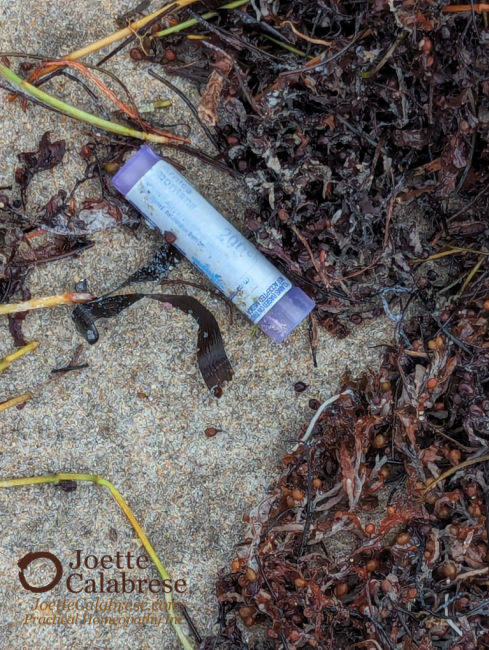
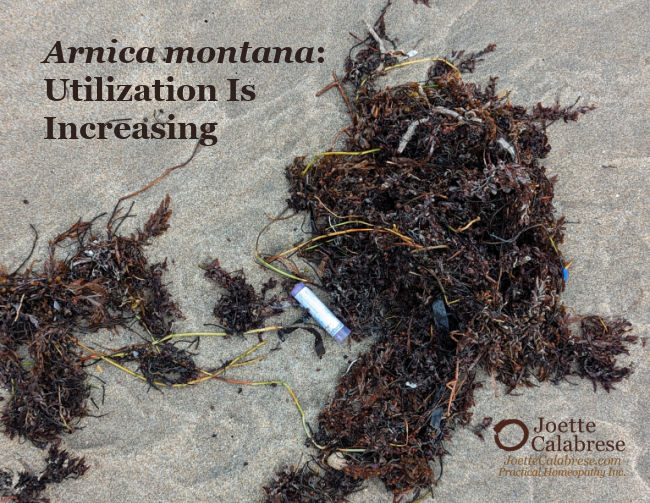
In fact, not too long ago, my husband and I were walking on the beach when we found a tube of Arnica 200. Before you say, “Well, Joette, it’s probably one of your tubes that you left down there accidentally,” let me tell you, we found this tube nowhere near where we live.

So, I decided to investigate.

As it turns out, everyone is apparently beginning to recognize Arnica montana‘s power. How do I know? Well, a few feet down the beach, we ran into Paul.

Joette Calabrese, Practical Homeopathy® Arnica montana

Paul Pufferfish, shown here, had misplaced his tube of Arnica and had come up on shore to retrieve it. It seems Paul had bumped his head on the bottom of a boat, and boy, did he have a massive bump on his head from the blunt force trauma.

Arnica montana: the go-to homeopathic for head injuries

His seahorse-eopath Shirley had recommended Arnica montana 200 as an acute SOS medicine for Paul’s likely concussion. She knew it would also help him with the pain of the trauma and suggested he utilize it every 15 minutes or so at the onset, tapering off as his symptoms eased and stopping when he felt very much better.

However, because of Paul’s stupor after his head injury, his little fin accidentally dropped the tube of Arnica, and it washed ashore. Unfortunately, Paul Pufferfish does not have a Boiron account, so he couldn’t order more. So, he decided to look onshore.

With a pounding head — darn those boats anyway — he shimmied out of the waves to look for his Arnica. Thank goodness that’s when Perry and I came along.

Joette Calabrese, Practical Homeopathy® Arnica montana

Recognizing that Paul needed a dose of Arnica right away, I reunited him with his tube and poured out a single dose for him. (Homeopathic medicine tubes are decidedly tricky to handle with only fins. Thanks to our opposable thumbs, we humans have no excuse for not utilizing homeopathy whenever we’re in need!)

Paul threw the little pillules into his mouth and winked at me in a friendly fish thank-you way. He seemed to be a little breathless as a result of being out of the water for so long, so he didn’t stick around. So, I didn’t see how quickly the medicine acted on his head injury. But I have no doubt that within a few doses, he was very much better.

Don’t miss your free Remedy Card regarding Arnica.

Scroll down and download a free Remedy Card containing information about Arnica for head injuries. Unfortunately, the ink will probably run if you live in the ocean. But if you’re a human, like me, you can keep a recipe box filled with all the free Remedy Cards I offer in various blog posts.

Next time you walk on the beach, you’ll never know what you may find or who you may meet. All I know is that I’m thrilled that homeopathic Arnica montana is becoming so popular in so many circles. It’s become the gateway medicine to a more expanded use of homeopathy!

Speaking of a “gateway” …

My Gateway to Practical Homeopathy®: A Guided Study Group Curriculum is the perfect entry point for newcomers to homeopathy. In addition, because of the wide breadth of experience that each study group contains, it’s also great for folks who have used homeopathy before and are hoping to increase their proficiency.

You can start your own study group with friends. The curriculum lays it all out for you.

Or, to augment your learning, join a group with an experienced leader. Once you’ve purchased the study guide, log in to your “Gateway to Practical Homeopathy® I, Second Edition” portal page through The Learning Center. On the Welcome page, you will find a list of my Ambassadors — students and graduates of The Academy of Practical Homeopathy® — who are now leading study groups.

Pass on the good news of Practical Homeopathy®!

Warmly,

Joette Calabrese, Practical Homeopathy®

P.S. I’ve written about Arnica many times before. Check out my blog, When in Doubt: Arnica, to learn more. https://joettecalabrese.com/blog/when-in-doubt-arnica/ And learn how Arnica montana is made into a homeopathic medicine in this short video: https://www.youtube.com/watch?v=8KeNMha0F9g

P.P.S. When you enter the promo code Joette at checkout on BoironUSA, Boiron applies a 20% discount on your purchase. I might add that this is not an affiliate program offering me a kickback. The discount is given to you. For my Canadian friends, the discount code for Boiron Canada’s website is Joette20CA.


Podcast 125 — Stay Calm. Don’t Fear a Cold.

Joette Calabrese, Practical Homeopathy® Podcast 125 Don't Fear a Cold

IN THIS PODCAST, WE COVER:

01:00   Introduction: It’s Called a Cold for a Reason

02:20   What Is the Terrain?

03:22   The Immune System

06:00   Lean Into a Cold as an Opportunity To Cleanse

09:40   Stop Worrying. A Cold is Natural. Plus, We Have Homeopathy, if Necessary.

            ColdCalm®

            Oscillococcinum®

            Aconitum napellus 200 and Bryonia alba 30

14:53   Managing Expectations

18:26   Stay Calm. Don’t Fear a Cold

19:18   Become the Wise, Calm, Relevant Caregiver in Your Family

ADDITIONAL RESOURCES:

Joette’s Learning Center

Gateway to Practical Homeopathy®: A Guided Study Group Curriculum

Joette’s Mighty Members

The Academy of Practical Homeopathy®

Joette Calabrese on YouTube


Kate:

This is the Practical Homeopathy® Podcast, episode number 125, with Joette Calabrese.

Joette:

Hi, I’m Joette Calabrese, and I welcome you to our health care movement — yours, mine and the countless men and women across the globe who have re-taken control of their families’ health with Practical Homeopathy®.

So, for the next few minutes, let’s link our arms as I demystify homeopathy — what was once considered an esoteric paradigm — into an understandable, reproducible, safe and effective health care solution available to all.

This is the medicine you’ve been searching for — my unique brand of homeopathy, PRACTICAL Homeopathy®.

INTRODUCTION: IT’S CALLED A COLD FOR A REASON

Kate: (01:00)

Are you concerned about getting sick or your kids going back to school and being exposed to something that makes them sick? Well, let’s examine that today on this podcast. We’re so glad that you joined us. I’m Kate, and I’m here with Joette.

Joette:

Hi, Kate.

Kate:

Hi! I want to start with the basics. Joette. It seems like every year, especially in the fall, people can expect to get a cold. What do you think about that?

Joette:

Well, it’s called a cold for a reason, in my estimation. It’s because, generally, it’s the shift in weather. The weather gets cold, or, even if you’re not in an area where the weather gets cold, there’s a shift — an environmental shift. And it has been commonly understood that if someone gets a chill that they, you know, “Put your hat on, or you’ll catch your death of cold!”

Well, I believe that that can be so. You can get quite sick if you get a chill … especially after you’ve been perspired or children running around in a playground or a park or something. And then they get a chill, And often, that’s what can lead to this.

So, I believe that it does have something to do with the environment. But now, I also believe that it has to do with immunity. Now, when we say “immunity,” I don’t mean immune from bugs necessarily.

I believe it has more to do with the terrain.

WHAT IS THE TERRAIN?

Joette: (02:20)

What is the terrain? Well, it’s making sure that there’s strength in that terrain. And the terrain is upon which the person is depending to get through those times when their body might need to make a shift, like releasing toxins, et cetera.

So, let me be more specific. I believe that if germs are ever-present — and that’s the way people see them — then why is it that people only get germy colds and flus at a certain time of the year? Pretty much it’s only in the fall, sometimes in the winter — January, February. (I’m talking about those parts … I’m talking about the U.S., but also in Europe, et cetera.)

When that cold comes — that cold weather comes — and now are the germs more virulent? Do they get excited and start hopping onto people? Or are the germs always there, and those who have a good immune system are able to fend them off?

THE IMMUNE SYSTEM

Joette: (03:22)

Well, if that’s so, then why are we even looking to germs? Why are we not looking to the immune system or the ability to be able to withstand an onslaught of this or that? Why not just count on that to start?

So, the way that I look at it is that if we are taking care of ourselves, we’re eating good food — and I mean real food, food that’s made at home. Doesn’t mean we can’t go out to dinner occasionally, but homemade food where there are no ingredients listed on the package. Because if you’re reading ingredients, it means you’re already buying something that someone else has manufactured, and that is no longer whole. So, whole food — a beef roast put into the oven with carrots and onions and potatoes — and that’s dinner. That’s what I’m talking about. Eggs — well sourced — for example, cooked in butter. Yes, butter.

And so that’s step one.

Step two is making sure that your family and you are getting enough sleep and good rest. Going to bed early; getting out of bed early; sleeping in a room that’s clean with the windows slightly ajar, even in the cold weather (windows should be ajar so that there’s fresh air seeping through); keeping hands clean and the body clean and the home clean. Also, when we can, outside in the sun every day for half an hour — without sunscreen, my friends. We do not want to put chemicals on our bodies.

So, what we want to be doing is treating our bodies with respect and treating our children’s bodies in the same way by following simple measures. Drinking water — pure good water regularly, every hour … a few ounces every hour of good water; exercise, moving — raking the leaves, cleaning out the garage — doing purposeful work combined with exercise is a great way to keep the body moving properly; reading only what’s good; watching only what is pure and lofty; and eschewing those areas of life that are downtrodden and bring us down.

Now we approach the cold season with an immune system — whatever we might want to call it — with an “ability,” (let’s say it that way) for the body to be able to withstand something that might occur.

LEAN INTO A COLD AS AN OPPORTUNITY TO CLEANSE

Joette: (06:00)

Now, I actually believe that a “cold” (air quotes) … that a “cold” is really just a cleansing. It’s a release; it’s an opportunity.

And so, instead of fighting it and being afraid of it and figuring that we’ve got to fight this: “This can’t be! I’m not … I can’t have a cold! My child can’t have a cold!” Just lean into it and take care of yourself or your child’s body.

Go to bed, drink plenty of water again. Often, it’s a great idea to put some Celtic salt in that water because that’s what we perspire … some Celtic salt in that water that’s drunk every hour. Make some good bone stock and drink that and take it easy.

And instead of fighting it, lean into it. It’s an opportunity to cleanse.

And so how do we know that it is even a cleanse? Well, usually the first feeling when someone gets a “cold” (air quotes), they sneeze, or they feel a little scratchy throat (probably because the mucus is releasing down the throat and causing some irritation). And then, they get fatigued.

What does fatigue mean? It means that we need to lay down and sleep.

What does all the release of the mucus mean? It means we blow our nose and replenish it with good quality water, bone stock, et cetera.

And we take it easy and allow this process to happen.

We’ve lived with this bouillon cube — this concentration of ideas, this whole constellation of ideas that getting (air quote) a “cold” is a bad thing and that we must do everything we can to avoid it.

We take drugs; we take synthetic vitamins; we don’t take care of our bodies. We push ourselves through it. We get injections because we’re so afraid it could turn into something like pneumonia.

And it’s an entire constellation of ideas that has been put upon us for a very long time — really a hundred years, approximately, maybe even less than that — that teaches us that there are some really big, ugly bad germs that are out there to get us. And know my friends, it’s just nature.

I use this analogy regarding your garden.

If you look at your garden, and you go out into it, and it looks like the tomato plants are withering, and they’re not robust, do you inject the plant? Do you give the plant pesticides, herbicides, fungicides? Do you start clouding it all up with drugs and chemicals? No. You say, “Hmmm, what could this be?”

Perhaps the plant has not gotten enough water. Or, perhaps the plant was planted in the shade, and it should have been in the sun. Or, perhaps there are other plants around it that are causing trouble, and it needs to be separated. It’s too crowded. It needs more air around it.

We use common sense when it comes to a tomato plant. But when it comes to ourselves, we think we must chemicalized it. We must fight it and pretend it doesn’t exist and push through it instead of leaning into it and allowing ourselves to take life easy for a few days or so.

STOP WORRYING. A COLD IS NATURAL. PLUS, WE HAVE HOMEOPATHY, IF NECESSARY.

Kate: (09:40)

I think part of what allows us to lean into that and not worry so much about whatever is the latest thing that’s going around or our kids getting a cold is that we have tools that we can use when that happens … if it’s something that requires a little assistance for the body. And so, can you give us some ideas about how we can be prepared going into what’s commonly known as the cold and flu season in the fall, and how parents cannot worry about that?

Joette:

Well, I love that you said that. Stop worrying! This is natural. We’re supposed to release those things, those — for lack of a better way — toxins from the body. It is intended that we are to cleanse these substances out.

What substances are they? I’m going to tell you. I don’t really know. Are they microorganisms? Perhaps. Are they exposure to chemicals? Perhaps. Whatever it is, let it just happen. Let’s start with that and not become afraid.

Because when it comes to children, the real danger in a child’s life is not a so-called infectious disease. The real danger in a child’s life is, well, number one is, the drugs that are going to be used on the child — put into the child — whatever form that might be. But minus that, the concern that most parents should have is about safety.

And what I mean by that is children are harmed in the house by getting burned or falling from high places or getting cut by accident or getting bitten by a bad dog or something like that.

That is much more dangerous than any regular common “cold” (quote-unquote) or flu or anything like that.

So, can we use homeopathy when something like this comes along? Well, I’ll tell you that there are two schools of thought, and they both rattle around in my head.

One is that I think it’s valuable to just leave the person alone. Let them just sleep off. Give them, as I said, bone stock; plenty of water with a pinch of salt in it; and rest, rest, rest. And just let it be.

On the other hand, if it’s severe enough, and it looks like this is bigger than you bargained for, then we do have homeopathic medicines. One of them is ColdCalm®, made by Boiron. But they’re not the only ones. There are other homeopathic pharmacies that manufacture combination medicines that are really useful.

They also — Boiron — happens to manufacture a product called Oscillococcinum®. “Oscillo” it’s known for, as a shortened version of Oscillococcinum.

Kate:

Named after their dog?

Joette:

Yes. Well, actually, the dog is named after it, but yes. Yeah, Michelle Boiron …

Kate:

Oh, the dog was named after it. The dog was named after the …

Joette:

Yes. Oh, Michelle Boiron, the owner of Boiron. When I interviewed her years ago, she told me that her dog’s name was Oscillo, and that he wore a little blue coat, like the blue bottles.

Kate:

So cute.

Joette:

I know it is funny.

But then we also have Aconitum 200, and if we mix it with Bryonia 30, that can be used. We can use homeopathy, and homeopathy can be efficacious. But we have to start with the underpinnings of an understanding that colds, flus are not generally dangerous. In fact, it’s extremely rare that they are. What they are is a nuisance. That’s all they are. They make us slow down.

But if we lean into that too and recognize that even though it may be a nuisance, it might be one of the best things for us to just calm down, slow down. Maybe the person is doing too much; maybe they’re staying up too late. Maybe they’re not getting sunshine without sunscreen ever. Maybe they’re not moving enough. Maybe the news that they’re indulging in is too negative, et cetera.

So, it is an opportunity to remove what needs to be removed from the body, whether it’s through the sinuses, the throat, the mouth, the ears, the skin — even the skin, yes — the colon.

And let me just say this, parenthetically, that a lot of times, parents say, “Oh my gosh, my child had a cold, and now he’s got a rash.”

Yes! How cool is that? Yes, it’s a release! It’s a great way to get rid of something. Just leave it alone. Don’t put anything on it.

If you use anything that is manufactured by the pharmaceutical industry — and I mean over the counter, anything from a drugstore, et cetera — it will only potentially suppress. And that’s the same for all those cold drugs — other than homeopathic. All of those cold drugs can cause more trouble in the long run than just leaving it alone.

MANAGING EXPECTATIONS

Kate: (14:53)

So, let’s talk a little bit about expectations. Say you’re using homeopathy, and the child is not feeling well, and you want them to feel better. Right? So, you’re giving them some homeopathy, and you expect the cold to just go away after a few doses or maybe a day or two. Is that realistic?

Joette:

Well, let’s go back one step further again.

The attitude of the mother is key. If the mother goes, “Oh, no, look, you’re sick again. Oh, for crying out loud, what are we going to do? This is terrible. And stay away from your brothers! Stay away from your sisters! Don’t let your father get near you!”

That’s a lot different than saying, “Oh, you don’t feel well. Come on over here, honey. Let me hold you. And let’s make some bone stock, and we’ll just lay down here on the sofa, and I’ll put a blanket over you, and maybe we’ll pray together.” How about that idea? “And then you just rest. And don’t worry, it’ll be over in no time.”

That’s a lot different than the first scenario.

Now, I’m not saying that all mothers follow the first scenario, but they may not say it, but they may be thinking it.

And instead of thinking that, instead of worrying, just let it be. And that’s that leaning into it again.

So, having said that, let’s start with that. If you must use a homeopathic medicine, then the expectation might be, “Well, I’ll give it a couple doses. If it doesn’t act, maybe I won’t even bother using it anymore,” which is not a bad thing.

But let me also say that if you expect the homeopathic medicine to act, you have to follow the directions. And on the outside of the box — if it’s, for example, ColdCalm® — you’re going to use it pretty frequently over a period of a couple of days or until there’s a good amount of improvement.

Is this diametrically opposed these two schools of thought? Leave it alone; let it be; lean into it and just know it’s a good thing to release all of this. Or the other side is using homeopathy.

And so, for someone who’s new to this kind of thinking, often they still want to give something. “I got to give something. I got to at least give synthetic vitamin C!” Not juice some oranges, no. “I’ve got to give synthetic vitamin C. I’ve got to give synthetic vitamin D.”

No, what we’re talking about is nothing. Lean into it. And then, if you must use something, then it’s, in my estimation, the best choice is to use homeopathy.

And the expectations might be that it moves very quickly, but it may not.

Kate:

You might just give the body a little boost and help the body to slowly heal.

Joette:

Yes! Yes, but it has to be … you have to follow the directions. You’ve got to give it frequently. In other words, you’ve got to use it … in some situations, you would use a medicine — homeopathic medicine — every 15 minutes for the first hour, and then after that, every few hours. That’s generally the way it’s used, depending on which homeopathic medicine you’re using.

So, what’s the upshot of all of this? That we are intended to live within nature. We are intended to act a certain way. And in our society today, we’ve been trained in this chaotic soup of wrong information to believe that you should not get a cold.

Kate:

Or you should fear … that’s the other thing.

Joette:

Or that you should fear. That’s even worse than getting the cold itself. Fear is really the concern.

STAY CALM. DON’T FEAR A COLD.

Joette: (18:26)

And so, as a mother or a grandmother, our job is to calm. The fear is to look at it and say, “No worries, honey. It’s not a big deal. Let’s just do this. Okay, you do that. Okay, now I’m going into the kitchen, and I’m going to go prepare dinner. If you need me, I’m here. But you’ll be fine.”

Minimize it. Completely minimize it. You would be surprised how quickly a child will get over being sick — or your husband for that matter, or yourself — if you approach it without fear and just know that this is just an opportunity to get rid of what the body needs to get rid of.

Kate:

That’s great information. So where does that leave us, Joette? What can you give us as we walk away from this podcast as a tool?

BECOME THE WISE, CALM, RELEVANT CAREGIVER IN YOUR FAMILY

Joette: (19:18)

Well, I believe that it’s one of the greatest joys that a mother can experience, and that is to learn how to take care of her family without fear. To step into it with strength, with courage, but also with knowledge. Because you can’t do this without undoing all the years of being told that these colds are serious, and we’ve got to get injections, and we’ve got to get this drug and take that drug.

There’s something grand about keeping the calm in the family, and you can feel it from you to them. And then being able to look back and see what you’ve accomplished. You may not notice it the first time, particularly if you’ve had fear in the past. In order to undo that in your family so that they can see you standing firmly in a new way, it may take a couple of times — three, four times — for the family to catch onto the fact that “Mom doesn’t worry anymore, so I guess I don’t need to worry.”

And so, as we age, as we grow into being a mature mother, grandmother that has strength and a strong fulcrum upon which to stand, we remain relevant. So, as we become an older woman, people will look to us and say, “So should I be afraid of this?” I mean, they’re not going to necessarily say it in those terms, but that’s what people will be asking you.

“Do you have a homeopathic medicine that you know to use for this?” “Is it necessary to even use a homeopathic medicine at this point?” So, the young will look to the old, and you will be the old grandma, older, wiser mother that can say, “No, you don’t have to worry about this. I got you on this. I’ve got you covered. Just take it easy. And should you need a homeopathic medicine, then indeed, here it is … and I know which one to use and how to use it.”

Joette:

It’s my honor to share many lessons on this simple method of using homeopathy for free —without affiliates or advertising — here in my podcasts, but also my blog posts and Monday Night Lives.

But it’s critical that you learn how to use these medicines properly. These podcasts should serve as only the beginning of your training. Peruse JoettesLearningCenter.com to find fun study group opportunities and in-depth courses developed by subject.

So, with the proper training, you can join the thousands of students before you in developing the confidence and competence to protect the health of your family and loved ones with my brand of homeopathy, Practical Homeopathy®.

Kate:

You just listened to a podcast from internationally acclaimed homeopath, public speaker and author, the founder of The Academy of Practical Homeopathy®, Joette Calabrese. Joette’s podcasts are available on all your favorite podcast apps.

To learn more and find out if homeopathy is a good fit for your health strategy, visit PracticalHomeopathy.com.

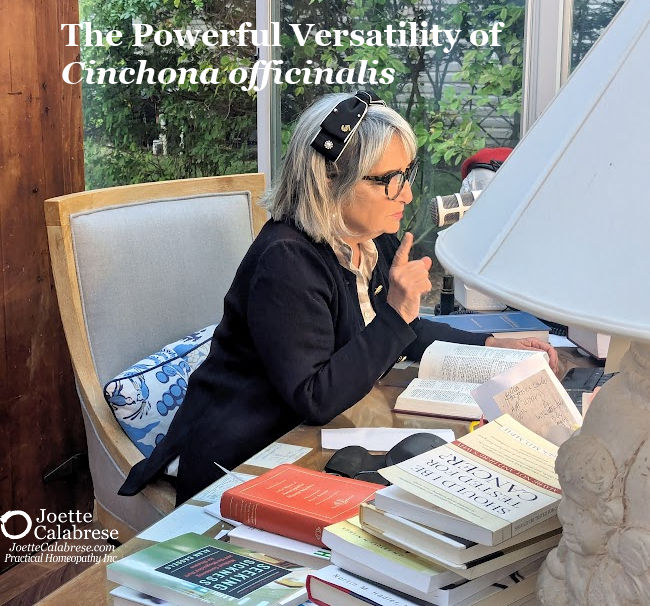
The Powerful Versatility of Cinchona officinalis: From Breastfeeding to Debility to Post-Surgical Gas

Joette Calabrese, Practical Homeopathy® Cinchona officinalis, China, post-surgical gas

I’ve said it before, and I’ll say it again: Homeopathic medicines are gentle, polite and effective. Yet perhaps I don’t say this enough: Most remedies are remarkably versatile, too. A single tube of a particular medicine may address several conditions, often covering more than one member of your family’s needs.

For example, let’s look at Cinchona officinalis — the name you’ll find printed on Boiron’s tubes. Robin Murphy’s “Nature’s Materia Medica” lists this medicine as China officinalis, and more often than not, I refer to it as simply “China.”

Add Cinchona officinalis to your well-curated homeopathy kit.

By whichever name you call it, China is a highly versatile medicine destined to join our list of 50+ homeopathic medicines to include in your well-curated homeopathy kit. (Don’t forget to check out the entire list at 50+ Homeopathic Medicines: How to Create an Economical, Well-Curated Homeopathy Kit. As commercially prepared kits have recently been challenging to procure, building your own kit and understanding the medicines you’ve included are critical safeguards for the health of you and your loved ones.

I’ve written about Cinchona in previous blog posts for debility, especially after the dehydration of a sunburn.

We’ve discussed it as one of the remedies appropriate for distortion of taste.

Cinchona officinalis for women

While those versatile uses apply equally to both sexes, China can also be a gem for women — new mothers in particular.

Perhaps you recall my story about its suitability for exhaustion after nursing a ravenous newborn.

China can also gently boost the female body’s natural ability to produce milk. In fact, in Homeopathy While Breastfeeding, I make particular mention of ensuring one doesn’t overuse China and, thereby, initiate an overabundance of milk. It’s just that effective!

Be sure to read those blog posts. The medicine is the same, but the potencies may differ from condition to condition. Potency matters!

A thorough education in homeopathy allows you to understand which of the versatile homeopathic medicines would be best considered in each situation. Women have unique health needs and would be wise to consider my course, Feminopathy: How You Can Correct Female Ailments Using Safe, Inexpensive and Effective Homeopathy. When we care for ourselves, we are better able to care for our families.

One more usage for our versatile Cinchona officinalis: Post-op Caregiving

 Joette Calabrese, Practical Homeopathy®, Boiron Cinchona officinalis

As mothers, wives or nurturers, we will move heaven and earth to make our loved ones more comfortable during an illness. Indeed, that’s why most of us came to homeopathy in the first place!

However, sometimes, despite our best efforts, surgery cannot be avoided for certain conditions. Perhaps you have referred to my blog posts on the topic:

Well, here’s something new you can add to that arsenal. (Before you leave this page, be sure to scroll down and download the free Remedy Card.) Our versatile China can also be of particular use during post-op recovery.

When post-surgical gas pains are not relieved by the passing of gas, Cinchona officinalis 30 may be the choice to consider.

As unrelenting post-surgical gas pains would be considered an acute issue, the medicine would be used in the typical SOS fashion: every few hours according to severity, until very much better.

Talk about versatility! From breastfeeding to debility to post-surgical flatus, homeopathic Cinchona — China — has us covered.

Pass on the good news of Practical Homeopathy®!

Warmly,

Joette Calabrese, Practical Homeopathy®

P.S. As kids return to school, now is the time to consider enhancing your own education with Feminopathy: How You Can Correct Female Ailments Using Safe, Inexpensive and Effective Homeopathy.

My course covers all manner of women’s health concerns, whether headaches, heavy menses, interstitial cystitis, vaginosis, infertility, alopecia or more. Perhaps it might make an excellent homeschooling course for your high school daughters. You can learn together!

Remember, all my Mighties (Joette’s Mighty Members) qualify for a 10% discount on course purchases.


Caulophyllum: A Homeopathic Hero for Labor and Delivery

Joette Calabrese, Practical Homeopathy® Caulophyllum for labor and delivery

Caulophyllum thalictroides. Two big Latin words that are all about labor.

Years ago, when I was a classical homeopath, I was trained to find the similimum — the one medicine covering almost everything important in the case — and use it once or twice within a 24-hour period. And that’s it.

Then you wait.

I heard from another group of homeopaths or read somewhere that Caulophyllum 6X is remarkably helpful when employed during the last couple of weeks of pregnancy to tone up the uterus in preparation for delivery.

When I brought that information to my classical teacher back in the 1980s, she said, “Oh, no, no, no, no, no, no! We never use a remedy like that. We only use a homeopathic remedy if there are problems and we don’t repeat it daily. 

The other side of this argument was saying, “Well, why have problems? Caulophyllum 6X is a low potency. Time and time again, when utilized once or twice a day at the tail end of a pregnancy, it’s been shown to aid in a smoother labor and delivery.”

That was just one controversy that I had to overcome in my journey from classical to Practical Homeopathy®.

My own successes with Caulophyllum

I didn’t yet know anything about homeopathy in my first pregnancy. But toward the end of my second pregnancy, I did use Caulophyllum thalictroides 6X, twice daily, for just a few days because the baby was very, very late. When he finally decided to join us, that delivery was super-fast. It was under four hours!

I did it again for my third pregnancy, and once again, it was super-fast. This time it was less than two hours! And the baby was ten pounds!

I’ll put a couple more feathers in my cap for that last pregnancy: I was 43 and gave birth at home. With the help of Caulophyllum, the labor was so fast that the doctor made it only for the last few minutes of the birth! Until those final few moments, it was just the baby, my husband, a friend and me.

Indeed, in my experience — both personally and clinically — Caulophyllum is a great remedy for toning the uterus and preparing it for delivery. I’ll share a dramatic success story in my next Memo to Mighty Members.

Let me quickly mention that if one can’t locate this medicine in a 6X potency, the 6C, which is more readily available, will also work.

The difference between homeopathy and conventional drugs is that homeopathy does not manipulate with synthetic drugs or overpowering procedures. It doesn’t force the body to go one way or the other. Instead, it stimulates the body’s natural ability to correct what’s out of balance. So, even though it is not a supplement, the best way to describe Caulophyllum’s function is to tone the uterus in whichever way is needed.

In other words, if contractions begin too early, Caulophyllum calms them down. If the baby is too late, then Caulophyllum gently revs things up.

What more can you ask for than an intelligent medicine that works cooperatively with your body?

Yet, Caulophyllum is not unique. Our homeopathic medicines function as gentle nudges toward the equilibrium our bodies naturally seek. Unlike synthetic drugs of commerce that operate with brute force interference, homeopathics are an amiable, effective encouragement to the miraculous human body.

We can spare our women from the assaults of modern medicine and the medicalization of the female body. I designed my course, Feminopathy: How You Can Correct Female Ailments Using Safe, Inexpensive and Effective Homeopathy, to teach more homeopathic medicines specifically applicable to women’s health.

Painful or irregular periods? Recurring yeast infections? Interstitial cystitis? Migraines? Endometriosis? Osteoporosis? PMS? Hot flashes? Pregnancy? Infertility? Varicose veins? Those topics and so many more are covered in my course.

Download my free infographic for a sneak peek at just a few of the most commonly utilized remedies.

Then pass on the good news of Practical Homeopathy® to all your girlfriends! When it comes to Feminopathy, we ladies must stick together.

Warmly,

Joette Calabrese, Practical Homeopathy®

Why are more and more mothers, fathers and grandparents turning to homeopathy? Find out on Wednesday, August 21, 2024, at 8 p.m. EDT, as I explain how homeopathy can be easily taught, learned, and utilized, with a particular focus on medicines to address gut issues common among older populations. Register now for this free webinar hosted by the National Center for Homeopathy and sponsored by Boiron USA, world leader in homeopathic medicines. Don’t wait! Space is limited.

 As a gift for registering for my presentation, I want to offer new users* the opportunity to experience the benefits of a Mighty Members’ subscription free for 30 days. Enjoy a safe, secure place where my members and I share knowledge safely and more candidly.

They say knowledge is power. However, my Mighties learn that knowledge, in itself, is not powerful. The application of that knowledge and the action taken makes them powerful.

Join us, and you can be Mighty, too!

Watch your inbox. A couple of days after the presentation, I will email you with a link to take advantage of this free 30-day offer.

*This offer is exclusive to those who register for the NCH event but, regrettably, not to existing Mighty Members.


Podcast 124 — Moms with Moxie: “Does Homeopathy Really Work?”

Joette Calabrese, Practical Homeopathy® Does Homeopathy Really Work? Yes!

IN THIS PODCAST, WE COVER:

01:30   Introduction
            Gateway to Practical Homeopathy®: A Guided Study Group Curriculum

02:43   From Conventional Medicine to Homeopathy
            Joette’s blog

05:03   We Don’t Need Expensive Medical Terms; We Use Symptoms

06:29   Gateway to Practical Homeopathy®

07:25   Switching from HRT to Homeopathy 
            Estrogen Dominance and Other Red Herrings
            Strong Enough for a Woman
            Saving Menopausal Women

08:25   Addressing Arrhythmia

09:30   Success with Severe Respiratory Illness in 2021

11:08   A Baby’s Amazing Turnaround

12:56   Attack of The Black Widow Spider
            The Academy of Practical Homeopathy®
            The Survivalist Guide to Homeopathy

16:55   “Does Homeopathy Really Work?”

19:18   Closing Advice
                The Learning Center
             Find a Practical Homeopath®

ADDITIONAL RESOURCES:

Joette’s Learning Center

Joette’s Mighty Members

Joette Calabrese on YouTube


Kate:

This is the Practical Homeopathy® Podcast, episode number 124.

Joette:

Hi! This is Joette Calabrese. My Practical Homeopathy® is transforming lives all over the globe by offering health freedom!

They say a picture is worth a thousand words, but I say a podcast is priceless.

I want you to hear — in their own words — how regular people just like you have reshaped their lives using the practical protocols I teach in my Practical Homeopathy®.

So, with the help of my reporter Kate, I bring you this podcast series featuring interviews with moms, dads, teens, health care practitioners and Academy of Practical Homeopathy® students from all walks of life.

With education, you can follow in these students’ footsteps. You can eliminate your fear of illness and injury by learning how to care for yourself and your family. Like them, YOU can be in control — without acquiescing to authority — to live healthier, more autonomous lives. Indeed, you, too, can heal yourself and your family through my brand of homeopathy — Practical Homeopathy®.

INTRODUCTION

Kate: (01:30)

Welcome back to the podcast. I’m Kate. Today’s guest is someone I’ve known for years, and I’ll let her tell you more about that. But let’s just say that what she’s accomplished in the past four years has been amazing. I can’t wait for you to hear her story. She will share some dramatic stories using homeopathy and some tips on studying homeopathy. So, with that, everyone meet Susan.

Susan:

Hi Kate. It’s great to get to chat with you today, and I was so happy to get to meet you in November in Florida.

Kate:

Yes, it was great!

Susan:

And it’s amazing how a few years have changed so much for us.

As you said, my name is Susan. And my husband and I have been married for 39 years, and we have three sons and four grandsons. We love to be outside, and we love to go camping and cook our food in the Dutch oven and just take our books and relax.

And my passion had been homeschooling my children. And when they grew up and left home, it was a very good opportunity for me to plunge into studying homeopathy. That has become my passion.

Kate:

Tell me, Susan, how did you first hear about homeopathy? Because I know we connected in a Gateway to Homeopathy study group years ago, and that’s how we first met. But how did that come about?

FROM CONVENTIONAL MEDICINE TO HOMEOPATHY

Susan: (02:43)

Well, like many other people, I had a lot of health problems, and I had a team of doctors working on my conditions, and I was getting some help.

They did the best they could. They offered me a handful of prescriptions, and I said, “No, thank you.”

And my doctor said, “I know. These come with many potential harmful effects.”

So, I had ongoing fatigue and many food intolerances. Anything I ate would upset my stomach. I began listening to medical seminars and searching for answers: why I would have such painful fatigue, one good day and three bad days. So, I was looking into this.

There’s a popular medical doctor talking about the M-T-H-F-R gene and mitochondria and your homocysteine levels. So, I was plunging into that. And at the same time, a good friend said to me, “You know, you should really look at Joette’s blog.” She said, “I’ve been helped with my food intolerances with that.”

And I was really skeptical because I had not had a good report about homeopathy. It seems kind of strange. But for my regard for my friend — and I knew she was a good researcher and her whole family relied on her for medical information — I thought, “Okay, I’ll take a look.”

I was very pleasantly surprised.

Kate:

That’s funny. You were skeptical. You looked, and then you have really exploded from there — from that first interaction with homeopathy, I guess you could say.

Susan:

Yes, Joette was different from anything I had been exposed to homeopathy-wise. She was a no-nonsense approach to health, and that really resonated with me. And I even saw that she had raised and homeschooled three sons in the country, just like me.

I studied Joette’s blog for a year and a half. And I made a spreadsheet to record the remedies and what they were used for. And I put the reference so I could find it later.

I started seeing patterns of “Wow, something like Hepar sulph is used for so many things, I better buy that remedy.”

And I just continued from there.

Kate:

I’m going to interject because all of you listening today don’t know Susan like I do, and Susan is a researcher and extremely detailed-oriented person. She is a hard worker. She studies thoroughly, and she really knows her stuff.

So, I think this is a good suggestion though for people who are wanting to learn more, just to look at the blogs and write down all the information from the blogs.

And we have the Remedy Cards [found at the bottom of most blog posts], right? So, people could print those out.

WE DON’T NEED EXPENSIVE MEDICAL TERMS; WE USE SYMPTOMS

Susan: (05:03):

Yes, those are wonderful. I have a collection of those, too.

So, I learned that Samuel Hahnemann founded homeopathy over 200 years ago. The French would argue that he rediscovered it. Homeopathic medicines are well-proven. The medicines haven’t changed. The human body hasn’t changed. Medical vocabulary has changed.

We don’t need expensive words. We don’t have to research a homeopathic remedy for mitochondrial dysfunction. Instead, we can look at fatigue. We can say, “What is the remedy for fatigue?” And there are many.

In my case, I used China, and it helped me. And I also studied deeper and layered another remedy that was in that rubric specific for strength alternating with great fatigue.

Kate:

Now what Susan’s talking about there is she’s using a homeopathic repertory. And that helps her to look up symptoms and what medicines might be useful for those symptoms. So, that’s some terminology that she’s using that refers to how you look up symptoms in a homeopathic repertory.

Susan:

Yes. So, I don’t have to worry about my “mitochondria” anymore. It’s not that homeopathy is simplistic, it’s just it’s simpler to use in research what we’re looking for.

Kate:

Okay. So, you started learning about homeopathy at that very basic level and seeing some results. And then what happened next? How did you take that to the next level?

GATEWAY TO PRACTICAL HOMEOPATHY®

Susan: (06:29)

Well, I had this massive spreadsheet with all kinds of remedies and all kinds of helps, which was fantastic. But I thought there’s something missing. And because I am self-motivated and a self-learner, I put off for a long time taking a Gateway class.

And then this friend that recommended the Joette’s blog to me, I got with her, and I said, “You know, we really need to have a Gateway class.”

So, I led it that summer, and I was really happy that I was exposing many to Gateway information. And I realized, “Wait a minute. I need somebody to challenge me!”

So, that’s when I looked you up and joined in your class. I wanted to have a bigger group, and I wanted to have something that stretched me.

Kate:

And that group has really grown for you over the years because you plugged in, and you became friends with many of those people in the study group. Those friendships have lasted through the years, right?

Susan:

Yes, they have. And I’ve gotten to meet some of them in person!

Kate:

Yeah. So, what happened next?

FROM HRT TO HOMEOPATHY

Susan: (07:25)

Well, one day my husband and I took a deep look at our budget. I calculated how much money was being spent on my hormone therapy and tests. And I suggested to my husband, I said, “I’ve been reading on Joette’s blog, I think I could do this. I think I want to just switch to homeopathy and save the money.”

And so, it was a wonderful change. I felt better using Sepia or Ammonium carbonicum than I had in the ten years of what is called biosynthetic hormone therapy.

Kate:

And where did you find that information?

Susan:

Joette has some blogs called Estrogen Dominance and Other Red Herrings, and the one called Strong Enough for a Woman, and Saving Menopausal Women. Those are the ones that I really studied.

Kate:

And we can put links to those blogs below this podcast on the website too. So that’s joettecalabrese.com, J-O-E-T-T-E-C-A-L-A-B-R-E-S-E.com, and those blogs will be on the website for reference.

ADDRESSING ARRHYTHMIA

Susan: (08:25)

So, that one budget change alone enabled me to buy Joette’s courses and start learning more.

So, I joined study groups to go through those courses. And at that time, I was still having a serious heart arrhythmia. One of the study group friends is a medical professional, and she said, “I think you should study the Kali-s.”

And I thought I went through the material medicas and read through the “Kali” section, which is potassium. I found that Kali carb helped my arrhythmia and many other satellite conditions as well.

Kate:

Awesome. So, when you say I studied the Kali-s, you’re talking about the remedies that the name starts with Kali, like Kali phos, Kali mur, Kali carbonicum. So, there’s a lot of remedies that have Kali as the first name. So, I just wanted to explain that for people who might not know what you meant by “Kali-s.”

So that’s wonderful! That condition resolved for you?

Susan:

Yes.

Kate:

Awesome.

SUCCESS WITH SEVERE RESPIRATORY ILLNESS IN 2021

Kate: (09:30)

Can you share some of your other ones? Because I know you’ve had a lot of other things that you’ve done with homeopathy — people that you’ve helped — so, maybe you could share some of those stories with us as well.

Susan:

Sure. So, back in 2021, my husband and I got the severe respiratory illness that everyone was having. And we began dosing a combination medicine that included Eupatorium and Gelsemium.

This hit us so suddenly. Just within a few hours, we were down for the count. But we got three doses of that combination down, and we fell asleep.

We woke up the next morning quite improved. We needed the remedies a few more times. But we were well on the mend, whereas others around us that had gotten sick at the same time continued to get more sick. It was a difficult time for everybody.

About that time, a friend texted me and said, “I’m too sick to come to church today.” And I said, “I’m coming over.”

So, I went over to her house, and I left her some remedies and said, “If you want to try these, see what you think.” And she did, and she improved very quickly.

She had a history of pneumonia, but this time, she didn’t get pneumonia. She’d never used homeopathy before and was immediately interested in “What is this stuff?”

And so, she bought a homeopathic kit, and she enrolled in my Gateway class.

Kate:

Yay! That’s so fun. I mean, it’s great that you saved her from further sickness, and now she wants to know more.

Susan:

That’s right. Now she’s using Symphytum and Arnica for her knees and can’t believe that she can walk so well.

Kate:

Oh, that’s a powerful combination. Yes. What else?

A BABY’S AMAZING TURNAROUND

Susan: (11:08)

Last fall, I saw a baby have an amazing turnaround. The older siblings had had a cough and a cold. But this little baby got sick, and he got severe very quickly. The older children had used Aconite and Bryonia and some Ipecac, but he needed more. He had a lot of fever. He had chest congestion, and he stopped nursing.

Kate:

Oh, no.

Susan:

So, the parents had a bag packed ready to go to the ER — which they lived just around the corner from that. So, they were ready, but they called me to say, “Is there anything else we can do?”

Well, I’d heard that Naja [tripudians] had helped many with this type of illness. So, I grabbed my remedies and my toothbrush and headed over there for the night. She already had Naja on hand and had given him some after our call.

When I arrived, the baby couldn’t hold up his head. I put my head to his chest, and I could hear gurgling and rattling inside his chest. He winced when I touched him. He was too weak to cough. The mama gave him another dose of Ipecac and some Naja and added Quebracho.

The baby relaxed and fell asleep.

Kate:

Wow.

Susan:

He woke up about 2 a.m., and he nursed and was breathing more freely. He had firmed up and coughed up some phlegm. His mother gave him more remedies. When he woke up at seven in the morning, he was a much better baby. It was like he had a mild cold now. By that afternoon, he [00:12:30] was sitting on his own, playing with toys.

Kate:

Oh, my gosh! That is incredible!

Susan:

Yeah. We were so happy.

Kate:

Wow. And so that was a really fast turnaround. I mean, the stories that you’ve just said are really dramatic, but I want people to understand that that’s not always that dramatic. Things can take longer to resolve, but I know you have more to share with us. So, I think there’s a story about a spider bite.

ATTACK OF THE BLACK WIDOW SPIDER

Susan: (12:56)

Yes. Some things take longer to resolve.

So, last July, I got a black widow spider bite.

You know, I’ve always admired those spiders. One time, I put one in the freezer to show my grandchildren.

Kate:

Oh, my gosh!

Susan:

You can’t smash ’em, and still look at ’em, you know? But they look so elegant. I mean, after all, what creature can have a big abdomen and still retain her hourglass figure?

So, I had just finished The Academy, and I was ready to celebrate. I had company coming for a few days. And I went out into the garden, and I pressed my shin against the raised garden bed. I got a very painful bite. I looked around for a snake. It was that painful.

I didn’t see anything. So, I went about my work. I went into the house, and I took some Ledum and some Lachesis, but I didn’t really pay it much attention. Life was too exciting at that time.

And then, I developed a headache and some severe abdominal cramps. And I thought, “Well, it’s just because I’m busy doing stuff.” And I dismissed everything. We took a walk with my friends, and both feet felt very swollen and hot, but the leg where the bite was got raw and peeled, and a third of my foot was totally raw. And I remembered having a pebble in my sandal. So, I thought, “Well, that’s probably what it was,” and I just ignored it.

Kate:

Oh, my goodness, Susan! You should never do that.

Susan:

So, I started getting sporadic numbness in my toes, and it went away. And then it came back.

Kate:

Don’t tell me that you dismissed that too.

Susan:

I did. I did. We were having a lot of fun!

Kate:

Oh, my goodness.

Susan:

And then, I got a little numbness the next day in my knee, but it went away.

The next time the numbness came, it was in my thigh. And I thought, “There’s something going on.”

I think I was taking homeopathic remedies for the raw skin on my feet and everything, but I didn’t really put the whole picture together until the twelfth day after the bite. I didn’t have any pain. But when I got out of bed, I couldn’t put weight on that leg. It felt like my bone was broken.

I believe that I was having a bone infection because where the bite was is so close to the bone, and the venom disturbs the central nervous system. It causes very dark, foreboding emotions. This has become an involved case.

So, the allopathic treatment includes an antidepressant and a synthetic anti-venom. I was determined to avoid those if at all possible. I was prepared to put homeopathy to the test. My training in The Academy enabled me to take care of this at home.

Kate:

Wow.

Susan:

I recommend if you want to use homeopathy for a poisonous spider bite, buy the remedies now. You never know when you’re going to need them.

Use The Survivalist Guide. That was where I went to. That’s what I studied. It’s fantastic for all kinds of situations, but don’t ignore your symptoms like I did.

I believe it could have been much more quickly resolved if I had been more aggressive in the beginning with the remedies. But because I was ignoring it, it continued on until it got more complex.

Kate:

So, you just used homeopathic medicines to resolve the infection from the bite. How long did that take?

Susan:

That is correct. From bite to where I had no more symptoms was about two months. But it went through phases, and I would have nerve pain. I would try to walk, and just all of a sudden, my leg would give out. So, I used a number of homeopathic remedies. It was complex. Yes.

Kate:

Oh, my goodness. Well, that was a very challenging case, so it’s pretty incredible.

But I know I don’t want people who are listening to think that if you have an emergency that, you shouldn’t go to the emergency room.

Susan, you made that choice to use homeopathy, but just … we are not saying that you shouldn’t ever go. So, I just want to make that clear, too. Yeah.

Susan:

That’s right. At no time did I feel like my life was a danger, but that’s the choice I made.

“DOES HOMEOPATHY REALLY WORK?”        

Kate: (16:55)

So, I would like to hear a little bit more about your experiences with The Academy and Mastery™, and what you’re doing now because you are in the middle of the Mastery™ program. Tell me about what’s happening in your life around that. You’re just studying, or what’s going on?

Susan:

Oh, I’m having the time of my life. I’m enjoying Mastery™ very much. We have a great study group. We’re learning how to go deeper — how to apply homeopathy to so many things.

My husband is extremely supportive of homeopathy and has encouraged my ongoing studies.

Originally though, this was all just for me and my health. We realized how many people are hurting and need help and are seeking help. And so, I am seeing clients now and really getting to know people. And that’s been a really great blessing in my life to be able to see people be so excited about homeopathy and know that there are choices out there.

Kate:

And actually, you’re very busy. I know that you’re helping a lot of people, so that’s great. I’d like you to share what your husband and his friend talked about, and it was funny. So, can you just share that little story?

Susan:

Okay. Well, my husband has been supportive, as I said, and he also has a great sense of humor. And so, a friend asked him, he said, “Between you and me, does homeopathy really work?”

My husband answered, “Homeopathy accomplishes the purpose for which I take it. Every time I take it, my wife feels better.”

Oh, I can live with that. His better health makes me happy.

Kate:

So, he was making a joke out of it, but he is supportive, and he uses homeopathy and finds the benefits as well.

Susan:

Absolutely. We had a friend here one time that I went to hand my husband the little dosing cup, and he holds his hand out without even looking up to take the medicine. And his friend said, “She’s got you trained like a dog!”

Kate:

Oh, that’s funny. I know people who use homeopathy with their kids. The kids are so trained on how to use the medicine that they just open up their mouths, and the parent just pops the little pellets in their mouth, and it’s like a little bird.

Susan:

One of my grandsons would count the little pellets on his tongue — the teeny tiny ones — and he always got it right.

CLOSING ADVICE

Kate: (19:18)

Wow. Yeah, they can be pretty small.

So, as we finish up the podcast, I would like you to share any wisdom that you have with the listeners. Since you’ve been on this journey for a while now, and you’ve really come a long way, what would you say to someone who is wanting to go deeper with homeopathy?

Susan:

Well, I always tell everyone to take advantage of the blog. It’s free. It’s loaded with great information.

And organize your notes to have them ready when you need them. You can study a lot, but if you don’t have your notes ready for an emergency, then your knowledge will fail you. So, be prepared for whatever situation you have by having your notes organized.

And if you want to go further, of course, the information and the protocol courses are great. The Gateway is wonderful. You connect with a lot of people. And I highly recommend The Academy and Mastery™ if you would like to go that direction. It is life changing. There’s never a dull lesson with Joette. She is inspiring.

There’s a growing community of homeopaths trained by Joette, and so you can find us all at her APH alumni site [Editor’s Note: now located at FindAPracticalHomeopath.com] to help with those more difficult cases. So, at any level that you want to be at, it’s all there for you.

Kate:

Yes, well said, Susan.! I really appreciate all that you shared today, and you’ve had some great success stories and great tips. So, thank you, Susan, for being here today. I really appreciate you taking the time and sharing all this wonderful information.

Susan:

Thank you, Kate. I am so excited to see the movement growing. Homeopathy is a wonderful way to take charge of our health.

Joette:

These podcasts focus on students of Practical Homeopathy® who have learned how to take care of themselves, family, friends, clients, pets, patients and even livestock using homeopathic medicine.

I hope listening to this podcast has inspired you to follow in their footsteps.

But this podcast is only a start. It’s critical that you learn how to use these homeopathic medicines properly. So, peruse JoettesLearningCenter.com to find fun study group opportunities and in-depth courses developed by subject.

With the proper training, you can join the tens of thousands of students before you in developing the confidence and competence to protect the health of your family and loved ones with my brand of homeopathy — Practical Homeopathy®.

Kate:

You just listened to a podcast from internationally acclaimed homeopath, public speaker and author, the founder of The Academy of Practical Homeopathy®, Joette Calabrese. Joette’s podcasts are available on all your favorite podcast apps.

To learn more and find out if homeopathy is a good fit for your health strategy, visit PracticalHomeopathy.com.
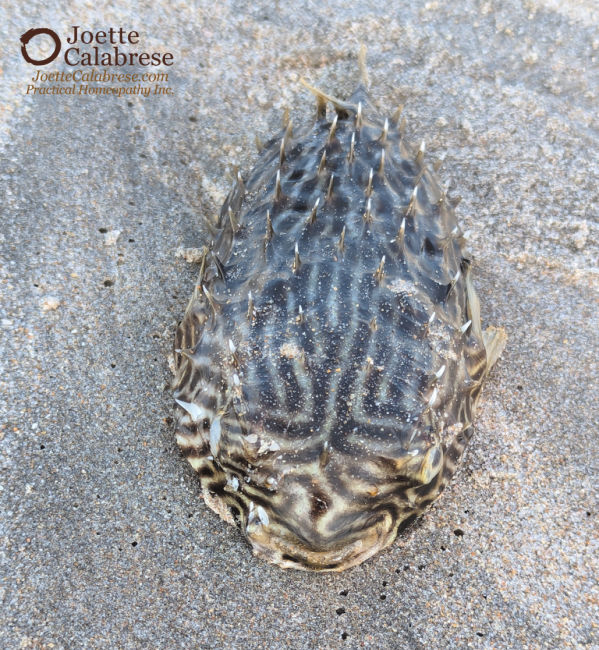

My Friend is Deathly Afraid of Bird Flu. I’m Not; I’m Empowered.

Joette Calabrese, Practical Homeopathy®, Bird Flu

A friend of mine has read all the news reports about bird flu, and the fearsome words in the headlines have triggered her anxiety. The latest warning from the CDC came out just last week, driving her to become overly egg-cited about the dangers.

While the risk to humans remains low, once the media realized this news attracts readers, they’re practically billing it as the next pandem … Never mind, I’m not even going to say it.

Meet my friend, Fluenza. (In the privacy of her coop, we call her “Fluzie.”)

No doubt bird flu — also known as avian influenza A(H5N1) — may be more of a concern for her because, let’s face it, she’s chicken.

The powers-that-be have destroyed entire flocks when bird flu is discovered, leading to dramatic price fluctuations in poultry and eggs, as well as the decimation of affected farmers’ livelihoods. The disease has crossed into livestock as well, leading even normally mild-mannered cows to become concerned.

But if we read the articles carefully, we find that only 13 cases of bird flu have been reported in humans … since April! Does that statistic warrant all the scary headlines?

What are the reports of bird flu symptoms in people?

  • Cough
  • Headache
  • Shortness of breath
  • Sore throat
  • Fever, chills
  • Fatigue
  • Congestion
  • Runny nose
  • Muscle and body aches

Holy Toledo! That sounds like a rare condition, doesn’t it?! Those symptoms don’t sound like anything else we’ve ever heard of before, do they?

Of course, they do. (I’m being facetious, my friends.)

Obviously, those are the same symptoms as every other flu condition we’ve dealt with since the beginning of time.

In Practical Homeopathy®, it doesn’t matter what scary descriptive terms the flu name contains (old, new, rare, common, numerical, Greek). Nor does it matter in which animal the flu is reported to originate (cows, ducks, chickens, or even bats). In Practical Homeopathy®, we look at the symptoms.

We choose our medicines based on the symptoms.

When Fluzie first complained of not feeling well, I immediately offered her the Banerji Protocol for respiratory illness: Aconitum napellus (Aconite) 200 mixed with Bryonia alba 30, mixed together in her beak. (A human would mix them together in their mouth.)

Again, I employ this protocol at the very first inkling of illness. The sooner, the better! In my experience, the more quickly we can address the condition with our well-chosen homeopathic medicines, the faster and easier the course of illness will be.

Joette Calabrese, Practical Homeopathy® Bird Flu

In Fluzie’s case, her bird-like symptoms were mild, not alarming. So, she utilized the medicine every 3-4 hours until she felt better. If her symptoms had slammed into her like a rogue rooster, then perhaps she might have taken it every hour or so for a few hours.

The beauty of this protocol is that Aconite not only politely nudges the body toward restoring respiratory health but also helps calm the undue angst surrounding  illness.

Indeed, Aconite smoothed Fluenza’s ruffled feathers. In effect, we were killing two birds … No, wait, what am I saying? We were SAVING a bird! However, we were addressing and uprooting two different symptoms with one medicine.

As we all have experienced, as most respiratory conditions progress, the symptoms change. Were Fluzie to develop a gagging cough, I would consider adding Ipecac. If she had severe body aches, I would most likely add Eupatorium to her medicine schedule.

My friends, my approach to a chicken’s health is the same as my approach to my human family’s health. Whether a hen or a husband, homeopathic medicines stand ready to act.

In my Monday Night Live event, “Hens. Husbands. Homeopathy,” Fluzie and I had a little too much fun exploring this subject in more depth. I went through additional symptoms of bird flu along with the corresponding homeopathic medicines.

I also spent a bit of time considering the use of homeopathy as a prophylactic against disease. That, in itself, is a valuable discussion from which you’ll benefit.

In the meantime, Aconite 200 and Bryonia 30 are two homeopathic medicines that no home should be without. In combination, this Banerji Protocol is useful at the onset of most respiratory illnesses, no matter their name.

For more information about respiratory, gastrointestinal and other common illnesses, consider my course, The Antibiotic Alternative: Balance Your Bugs Without the Drugs. If nothing else, download my free infographic from that page. Post it on your refrigerator. The fearmongers can’t get to you if you’re prepared!

I also suggest my magnum opus, The Survivalist Guide to Homeopathy, to help prepare for almost any eventuality. This invaluable guide contains 9 ½ hours of video (available to stream and on physical disc) and over 400 pages of information in print in a hard-backed binder (in case the internet goes down). By providing both digital and physical access, you and your family can refer to this guide in the best and even the worst of times.

There’s no need for fear or panic. We are empowered … with Practical Homeopathy®.

Pass on the good news!

Warmly,

Joette Calabrese, Practical Homeopathy®

Joette Calabrese, Practical Homeopathy®
Why are more and more mothers, fathers and grandparents turning to homeopathy? Find out on Wednesday, August 21, 2024, at 8 p.m. EDT, as I explain how homeopathy can be easily taught, learned, and utilized, with a special focus on medicines to address gut issues common among older populations. Register now for this free webinar hosted by the National Center for Homeopathy and sponsored by Boiron USA, world leader in homeopathic medicines.


50+ Homeopathic Medicines: How to Create an Economical, Well-Curated Homeopathy Kit

Joette Calabrese, Practical Homeopathy®, Homeopathy Kit

What good does knowledge about homeopathic medicines do if we don’t have the remedies on hand when they’re needed? Not much. That’s why I encourage my clients and students to create a well-curated homeopathy kit — an inventory of the most utilized medicines for common injuries, illnesses and complaints.

Over the past year and a half, I have been writing specific blog posts about homeopathic medicines that everyone should own. It’s not an exhaustive list — only you can know what your family may specifically need. However, these 50+ remedies lay a substantial groundwork for developing a powerful at-home inventory, enabling you to have what you need when you need it!

Granted, homeopathy is sold in many local health and wellness stores, and reliable homeopathic manufacturing pharmacies can ship rapidly in an emergency. However, in my experience, the clock never moves more slowly than when a loved one is sick and the mail carrier hasn’t yet arrived.

Plus, overnight shipping can be costly, and that defeats the purpose. One of the many desirable aspects of homeopathy is how economical it is — when you plan ahead.

So, at my readers’ request, here is my list of the 50+ homeopathic medicines I’ve recently written about. In my opinion, these should be included in any well-curated homeopathy kit.  I hope you’ll add additional ones you know will be indispensable to your family’s health autonomy.

How do you learn what your family may need?

Why through a Gateway to Practical Homeopathy® study group, a subscription to my Mighty Members, and individual protocol courses on specific areas of concern (like gut issues, pain, allergies, women’s health and more found in my Learning Center). Or take a deeper dive into The Academy of Practical Homeopathy®.

Meanwhile, the most important thing is that we have what we need at the moment we need it. Addressing an acute condition immediately can help us get through the disease or injury faster and with fewer symptoms.

Joette Calabrese, Practical Homeopathy®, Homeopathy Kit

50+ homeopathic medicines to include in a well-curated homeopathy kit

Click on the remedy name to be taken to the corresponding blog post.

  1. ColdCalm®
  2. Ruta graveolens
  3. Symphytum officinale
  4. Arnica montana
  5. Hypericum perforatum
  6. Oscillococcinum®
  7. Arsenicum album
  8. Aconitum napellus, Aconitum napellus
  9. Hepar sulphuris calcareum
  10. SleepCalm®
  11. Pulsatilla nigricans, Pulsatilla nigricans, Pulsatilla nigricans
  12. Ignatia amara
  13. Rhus toxicodendron
  14. Helleborus niger
  15. Euphrasia officinalis
  16. Lycopodium
  17. Nux vomica
  18. Sepia
  19. Cantharis vesicatoria
  20. Cyclease® Menopause
  21. Sulphur, Sulphur
  22. Bryonia alba
  23. Berberis vulgaris
  24. Ledum palustre
  25. Belladonna
  26. Gelsemium sempervirens
  27. Hyoscyamus niger
  28. Coffea cruda, Coffea cruda
  29. Calendula
  30. Cina maritima
  31. Natrum sulphuricum
  32. Ammonium carbonicum
  33. Cuprum metallicum
  34. Apis mellifica
  35. Caulophyllum
  36. Silicea
  37. Veratrum album
  38. Staphysagria
  39. Urtica urens
  40. Sanguinaria canadensis
  41. Kali phosphoricum
  42. Natrum muriaticum
  43. Natrum phosphoricum
  44. Aurum metallicum
  45. Chamomilla vulgaris, Chamomilla vulgaris
  46. Petroleum
  47. Camphor
  48. Ipecacuanha
  49. Spongia tosta
  50. Mercurius solubilis or Mercurius vivus
  51. Cimicifuga racemosa
  52. Lachesis mutus
  53. Cinchona officinalis (China)

Again, this is not a comprehensive list of either must-have remedies or blog posts containing information on these subjects. I’ve been writing a weekly free blog since 2008, so there is too much valuable information here for one list to include. I recommend you also use the search feature on my site to glean more from my earlier blog posts.

I will undoubtedly add a few more over time and update this list. However, I hope giving you this information all in one place will inspire you to collect as many homeopathic medicines as you can afford. There is no better place to invest than in your education and the remedies that your education calls for.

Pass on the good news of Practical Homeopathy®!

Warmly,

Joette Calabrese, Practical Homeopathy®

P.S. My latest article, “Include Homeopathy as an Adjunct to Any Practice” is now featured in the July/August 2024 issue of Energy Magazine.

I look forward to sharing the article with my Mighty Members later in the week. Extra content is just one of the many benefits they receive.

Do you know of a publication that would welcome an article about homeopathy? If so, please let me know in the comments. With your help, I want to spread the word far and wide!


Podcast 123 — Practical Homeopathy®: Joette Answers Your Questions

Joette Calabrese, Practical Homeopathy® Podcast 123
IN THIS PODCAST, WE COVER:

01:30   Introduction to Practical Homeopathy® Podcast #123

02:00   How Long Does It Take for a Remedy to Act?

04:41   … in Acute Conditions (e.g., a Cold)

06:10   … in Chronic Conditions (e.g., Arthritis)

10:00   If It Comes Back

13:12   Food Allergies

16:09   Remembering to Take Your Homeopathic Medicines

18:11   Homeopathy Can’t Help You If You Don’t Have the Knowledge to Use It
            The Academy of Practical Homeopathy®
            Joette’s Mighty Members

ADDITIONAL RESOURCES:

Joette’s Learning Center

Gateway to Practical Homeopathy®: A Guided Study Group Curriculum

Joette Calabrese on YouTube


Kate:

This is the Practical Homeopathy® Podcast, episode number 123, with Joette Calabrese.

Joette:

This is Joette Calabrese, and I welcome you to our health care movement — yours, mine and the countless women and men across the globe who have re-taken control of their families’ health with Practical Homeopathy®.

So, for the next few minutes, let’s link our arms together and embrace health care freedom.

Join me as I demystify homeopathy — what was once considered an “esoteric” paradigm — into an understandable, reproducible, safe and effective health care solution available to everyone. This is the medicine you’ve been searching for — my unique brand of homeopathy — PRACTICAL Homeopathy®.

Whether you have tried homeopathy in the past and were frustrated, or you are examining the possibilities of caring for your family yourself for the first time — you’re in the right place.

In this podcast, I will offer you my decades of clinical experience as a practicing homeopath and years of teaching tens of thousands of students, so that you can become the hero of your family and community.

This is true health freedom, my friends. This is my PRACTICAL Homeopathy®.

INTRODUCTION

Kate: (01:30)

Hi, Joette. We’re here in another podcast, and I want to know what’s on your mind. What would you like to talk about today?

Joette:

Hi Kate. A couple of things. I like to be able to discuss things that I think are going to be the most useful for the largest number of people.

HOW LONG DOES IT TAKE FOR A REMEDY TO ACT?

Joette: (02:00)

One of the things I want to talk about is how long does it take for a remedy to act? I hear it often.

And given this background: that there are thousands of conditions. Some say there are about 6-10,000 human sufferings/diseases (maybe it’s closer to 6,000). And there are just about equally the same number of homeopathic medicines.

Now, we’re not going to cover all of these human conditions, and we’re certainly not going to be talking about 6,000 homeopathic medicines. But given that there’s such a grand landscape, we have to get what can seem complex (because it’s so voluminous) and focus it down so that it makes it easier. And so, when someone asks me, “How long does it take for a homeopathic medicine to act?” It depends on a number of factors.

The first one is, is this condition that the person is about to approach an acute or is it a chronic? and that really matters. Now, sometimes, it’s a species of both. But let’s not go with the outlier. Let’s go with something that’s pretty obvious.

For example, you’re driving home. And you’re in the car and suddenly — here’s the key word —suddenly you feel ill. Something’s wrong. “It feels like maybe I caught something.” That kind of feeling. “I feel as though something’s going on in my sinuses or my chest, and I feel weakened.” And you were just caught in the rain the day before or the night before, and it feels as though you’re going to be strapped with a flu or a cold or something.

That is an acute. Because if you left it alone, you would not have it if you took nothing, and you just went to bed when you got home — which is not a bad idea. But if you did nothing, it’s not going to live with you for the rest of your life. It’s going to be over with in a few days or a week or maybe two weeks. But it will be over with. That is one of our definitions of an acute.

If, on the other hand, you’re driving home. And you’re seated in your car, and your back is aching like it always does when you sit in your car for any length of time. And you can feel that it’s kind of arthritic in your hips and in your knees and in your back. That is generally … if it’s happened time and again, and it’s — for the most part, every time you get in your car, it occurs. That tells us that it’s likely a chronic. And it could be muscle weakness; it could be arthritis, could be tendon pain, et cetera.

… IN ACUTE CONDITIONS

Joette: (04:41)

So, if we have an acute condition — generally speaking — and we use a homeopathic medicine to treat it, it works pretty quickly because the disease is not going to last very long. The condition’s not going to last long anyway, even if you did nothing.

So, our expectation is that within a few doses, the person can start feeling somewhat better. And when I said earlier, when I described it that it came on suddenly, the first remedy I think of when someone feels something suddenly coming on — when it feels like a cold or flu is coming on chesty, throaty, sinusy, ears, et cetera — I think of Aconitum 200.

In fact, I have Aconitum 200 in my purse at all times. It’s the only remedy that I carry with me always. I mean, I might carry others if something else is going on for my husband or me. But generally, that’s the only single medicine that I carry with me.

So, one could take that every couple of hours and assume that within a shorter amount of time … how much time? Could be, sometimes, someone takes the remedy Aconitum, and they feel better within half an hour. Other times they Aconitum, and they need to continue taking it, say, every few hours or so. And it takes a few doses. Two, three, four doses, and they start improving.

… IN CHRONIC CONDITIONS

Joette: (06:10)

So, that’s for an acute. Now, let’s go back to the chronic. Now, let’s talk about that person who has arthritis. Let’s label it arthritis. Let’s not talk about it as a muscular or tendon issue. It’s the joints and the knees and the hips and the back. It’s an arthritic sensation, and it’s worse upon sitting too long. And once the person gets out of the car, then she or he feels like they’re creaky. And once they get moving … now they get going … and okay. Now, they feel better once they start moving about. But once they get back into the car again, it doesn’t take long before that achiness can start again.

Now, we would use a medicine, for example, like Rhus tox, and we would use it in a 30th potency — sometimes a 200. But more often, we would use it in a 30th potency. And we’re not taking it for that moment in time because when she gets out of the car — because once she’s out of the car and starts moving about — she limbers up, and the pain is gone.

No, what we’re doing with this instead is using it twice daily — 12 hours apart. Because we know that she suffers from this every day. Every time she gets into the car, every time she gets out of bed in the morning, every time she’s seated on the sofa reading to her children, she gets up — or to her grandchildren (it’s more likely to be an older woman) — this happens.

We don’t use it at that moment. That would do it no good. Instead, we know it’s chronic. So, we would use it twice daily for many days.

How long does it take? Well, sometimes it only takes a couple doses. Monday and Tuesday and the deed is done. That means that when she gets out of the chair, gets out of the car, gets out of bed, that pain is pretty much gone. But we might need to repeat it from time to time, so twice a day for a few days. If that does it, then she stops.

Then a couple, a week later, she notices it’s kind of creeping back in again. She does it again: twice a day for a few days. So, if that’s the case, and she finds it keeps creeping back in again once she stops, it might behoove her to take it twice a day every day for, say, a month. And now assess it. Instead of assessing it after two or three days, she’s assessing it after a month or two. And if she’s much improved, she does not carry on with the medicine. She stops it once again, but she’s pushed it a little bit further this time.

So, now we’ve dealt with a chronic that we can probably see she’ll get relief from having used Rhus tox 30 twice daily or 200 depending on how severe. If it’s much more severe than the little bit that I’m describing, 200 twice a day can do a lot of good as well.

But we don’t carry on with it. The beauty of homeopathy is its goal is to uproot. Will it uproot to perfection? There’s no such thing as perfection. So, don’t expect to feel perfect. Instead, expect to feel relatively improved.

Kate:

Well, something else always creeps in, right? You take care of one thing and then … something else.

Joette:

Oh yeah. And then a Zamboni comes rushing at you on an ice rink, and you get smashed like a mosquito. So yeah, there’s always something else.

So, you can forget about Rhus tox 30 or 200 twice daily in a couple months. You forget all about it. “Oh my gosh, it’s gone!”

In fact, a lot of times, people don’t even notice it’s gone because the reminder is the suffering. And if we don’t have that reminder, we’re just living our lives and not realizing until perhaps it comes back again or something else. “Oh my gosh, look how limber I am. I’m able to get up out of a chair more readily. I can go up and down the stairs. I can pop out of bed like a piece of toast out of a toaster. I can really move my body again.”

IF IT COMES BACK

Joette: (10:00)

But if it comes back — and my friends, if you have a propensity for this to occur, indeed, it may come back. But when it does, we’re not going to say, “Oh no! Now what?”

No. We know what to do. We use exactly the same medicine in exactly the same fashion. And most likely when it does return, it’s a lesser suffering. It’s — instead of that creaky and achiness that used to be say a 6 or a 7 on a scale of 1 to 10 — now, when it returns, it’s just a whisper. It’s a little cameo appearance of maybe a 3. Worthy of taking the medicine again? Perhaps, for a while.

I know people — including myself, I might add — who have had to take Rhus tox from time to time, and I no longer have to do that any longer. It’s gone! At my age, my friends — my contemporaries, if they’re not using homeopathy (if they’ve not figured out how to do this yet) — are suffering from what I’m just describing to you, and I am not.

Very occasionally, if I really work arduously in the garage, and really clean hard and long, and pick up this and move that, and rake the leaves, and do a lot of work all in one day, then indeed I may need it again. A couple doses, and I’m right as rain.

And so how long does it take? I just gave you the entire scenario. It can take an hour. It can take five hours. It can take two or three days. It can take a week or two of using a medicine. Sometimes, it even needs to be taken longer than that.

How long it takes for a chronic condition depends on the person, the extent of the suffering …

Kate:

The condition.

Joette:

… the abuse, even of their own body and the condition. That’s right. Thank you.

Kate:

Yeah, because things like chronic allergies, that could take a year or longer to uproot possibly.

Joette:

It could. Then again, I’ve seen allergies addressed within a week — even lifelong allergies. It’s gone! And if we use a combination medicine for the acute condition … the acute symptoms that happen to present, such as lacrimation (watery eyes) and itchy eyes and swelling and runny nose and sniffling, and we use a medicine like Arsenicum, or we even use AllergyCalm® by Boiron or something like that … we can see that abated within a day.

Now, to get to the bottom of it — not unlike what you are referring to, Kate — to get to the bottom of it, yes, it may take up to as long as a year to see that the allergies are subdued. And I don’t mean suppressed. Suppressed is different. Suppression comes from drugs of commerce that are synthetic.

These are not synthetic; they are not patented. These are medicines that are made from nature. They just happen to be diluted and succussed in such a mathematical, pharmacological, and intelligent way that it stimulates the body’s natural ability to cure itself.

FOOD ALLERGIES

Kate: (13:12)

I guess I was thinking about food allergies specifically. Do you see that those take a little longer to uproot than a seasonal allergy?

Joette:

Sometimes, food allergies can take longer because most food allergies, my friends, are really the effects of being poisoned. What kind of poison might I be talking about? Are we talking about food that’s poisoning? No, antibiotic poisoning.

Antibiotics might kill the infection or might be the preventative for potential infection, but the poisoning of antibiotics causes food intolerances. We are not supposed to have food intolerances, my friends. We are supposed to be able to eat wheat —even though it’s not the best wheat in this country … in the U.S. I realize that it’s highly processed and even it’s GMO, et cetera, et cetera.

We should be able to withstand even that. Not that I want you to eat that. I would like to see that removed from the market completely in our country. But until it is, we should be able to withstand it from time to time. But we can’t because the gut has been denatured. It’s been tinkered with. It’s been … well, tinker sounds like it’s just like gentle little events. But an antibiotic is not a gentle little effect. An antibiotic is like napalm. It’s like an atomic bomb in the stomach.

Just because someone doesn’t have nausea or vomiting or diarrhea shortly after doesn’t mean that antibiotic is not doing great damage. Now, having said that, there are times when an antibiotic can be useful. So, we save that. We save the need for an antibiotic for times when there is no choice. If you’re in an automobile accident, and a lot of surgery has to be performed, and infections are ensuing, and you don’t have access to a homeopathic hospital (which is the way we must live in this country at this time in history), then, indeed you are going to need antibiotics.

So, we don’t want to take them for every little other issue such as those acutes that homeopathy can treat — such as an ear infection or strep throat or a urinary tract infection or a laceration. We save the use of an atomic bomb for when there is something that is truly potentially life-threatening.

Those conditions I just mentioned, my friends with the use and the understanding of how to use these medicines and owning them — owning the knowledge and the remedies in your hands — can save you, can protect you against the use of a drug that will cause food intolerances and other gut issues.

REMEMBERING TO TAKE YOUR HOMEOPATHIC MEDICINES
Kate: (16:09)

I am wondering if you can share your thoughts on — or your tips on — how a person can remember to take the correct medicine. So, say, you know the condition, you know the protocol, and you know you’re supposed to take it every day, say, twice a day.

What do you tell your clients about how they can remember to take this? Because correct me if I’m wrong, but if you are not consistent in taking your medicines for this chronic condition, you may not see the results as if you were consistent.

Joette:

Well, the best way is to suffer. The suffering reminds you. “Oh my gosh. This is really painful!” or “Really uncomfortable,” or “I don’t like the way I feel. Oh yeah, that’s right. I’ve got to take my homeopathic medicine.” That is the best way to remember.

But let’s say you’re moving along, and you need to go just a little further, and you’d forgotten that you’re going to get some indigestion if you don’t take the medicines that are specific to help uproot the food intolerances. Then, you buy a couple of doses of the same medicine, perhaps, and keep one dose by the bedside and another dose on your desk.

And sometimes, you know how when you have things arranged on your bedside — your clock and maybe, I don’t know, your lamp and those kinds of things. And after a while, if you keep the remedy there, you don’t see it anymore because it becomes a part of the way the room is arranged.

Kate:

Right.

Joette:

So instead, when you take it before you go to bed at night, instead of putting it back in a place where you might not notice it, put it on the floor right in front of you so that when you step on the floor, you see it. You’ll step on it. You pick it up when you see it — because it doesn’t belong on the floor — and then you take it at that moment.

You can do that right there in the bedroom. You can put it on the floor in front of the sink in the bathroom. Put your remedies in an unusual place that would force you to have to pick them up. It’d force you to notice them because they’re in a slightly different place than they ought to be. I hope that helps.

Kate:

That’s great information. Joette, great tips. What else would you like to say to wrap up this podcast?

HOMEOPATHY CAN’T HELP YOU IF YOU DON’T HAVE THE KNOWLEDGE TO USE IT

Joette: (18:11)

The only other thing I would like to say is, my friends, homeopathy cannot help you if you don’t have the knowledge or you don’t know where to look it up (because you don’t know that I have a blog that has all the names of — not all, but many names — of many conditions and their appropriate remedies). And you don’t own the medicines.

So, you can’t own necessarily every single homeopathic medicine. But you ought to know what the main medicines are for your family, and then not only own the medicines but own the knowledge of where to find the information so that you’re not frightened or overwhelmed and forced to fall back on the synthetic — the suppressing, the drugs that we are all so ardently trying to get away from.

Kate:

And this is just a little taste of the things that you teach in The Academy. Because as you were talking about these expectations, I kept thinking about the lessons that you do in The Academy, and we actually have titled them, “Expectations.” So, you go much further. There’s much more to be said on this topic.

Joette:

Well, there’s always more. It never ends. I still read every day. I just, in fact, I’m going to be posting soon. I think I’ve got 11 books that I plan on reading this summer [information contained in Memo to Mighty Members #212], and I’ve already started into three of them.

So, it never ends. We must always be curious. We must always be learning and growing and even changing our thinking. Be willing to realize that “Maybe I was thinking about that incorrectly, and I think I’ll arrange it a little differently in my thinking in my life.

Kate:

Alright. Great to talk to you today, Joette.

Joette:

Yeah, it’s always good to talk with you too, Kate. Take care.

It is my honor to share as many Practical Homeopathy® protocols for simple conditions as I can — for free, without affiliates or advertising — here in my podcasts, blog posts and Monday Night Lives.

But it’s critical that you learn how to use these medicines properly. These podcasts should serve as only the beginning of your training. Peruse JoettesLearningCenter.com to find fun study group opportunities and in-depth courses developed by subject.

With the proper training, you can join the thousands of students before you in developing the confidence and competence to protect the health of your family and loved ones with my brand of homeopathy — Practical Homeopathy®.

Kate:

You just listened to a podcast from internationally acclaimed homeopath, public speaker and author, the founder of The Academy of Practical Homeopathy®, Joette Calabrese. Joette’s podcasts are available on all your favorite podcast apps.

To learn more and find out if homeopathy is a good fit for your health strategy, visit PracticalHomeopathy.com.