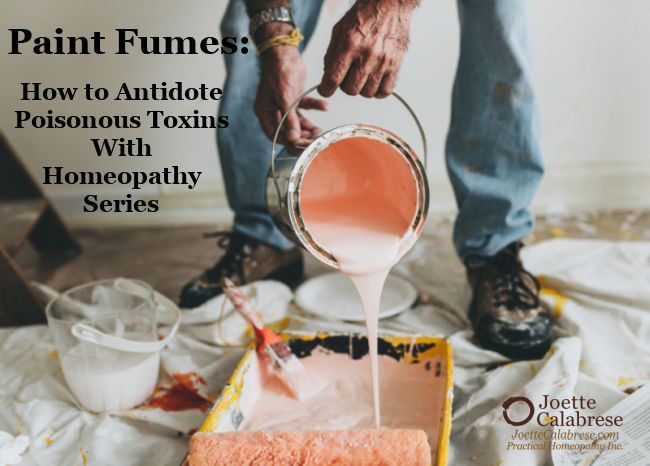
3. Paint Fumes: How to Antidote Poisonous Toxins With Homeopathy Series

Joette Calabrese, Practical Homeopathy®, Paint Fumes: How to Antidote Poisonous Toxins With Homeopathy Series

Nothing can revive a home or office more than a fresh coat of paint. However, paint fumes can cause miserable and often deleterious side effects.

Because oil-based paints contain chemicals such as benzene, formaldehyde and toluene, their fumes can adversely affect almost anyone and cause serious health issues over time.

Granted, water-based paints and acrylics are generally less aggravating. While they may not emit the same level of dangerous fumes that cause health problems, even the smell of water-based paint can be problematic for sensitive people.

How toxic can paint fumes be?

The symptoms of paint fume poisoning can be:

  • Headaches
  • Dizziness
  • Nausea
  • Irritation of the eyes, nose and throat
  • Breathing difficulties
  • Coughing
  • Lightheadedness
  • Allergic skin reactions
  • Fatigue
  • Memory loss
  • Long-term health problems, such as liver and kidney damage, cancer and respiratory problems

Looking at that list, I realize why the first four letters of the word paint are “pain.” It should serve as a good reminder to adequately consider the pain and illness that toxic paint fumes can cause.

Protection from direct inhalation of the fumes is undoubtedly the best avenue. “An ounce of prevention is worth a pound of cure,” as they say. But what if you can’t avoid exposure? That’s when homeopathy comes into play.

But first things first …

Joette Calabrese, Practical Homeopathy®, Paint Fumes: How to Antidote Poisonous Toxins With Homeopathy Series

If you missed the introductory post in this series, “How to Antidote Poisonous Toxins With Homeopathy,” I strongly urge you to read it now. The background information I provided will enhance your understanding as you proceed with the rest of this series.

Understanding the methodology behind using homeopathy to antidote a poison or toxin is equally important as knowing which condition-specific homeopathic medicine to consider.

A case of toxic paint fumes

In my practice years ago, a chemically sensitive woman (we’ll call her Martha) in her 50s came to me complaining that she became weak, cold and anxious anytime she was exposed to the smell of fresh paint. She could detect fresh paint many months after it had been applied.

Martha had developed extreme sensitivities. She could identify paint fumes long past the time others could.

I found Arsenicum album to be effective in this case. Martha chose to employ Arsenicum album 30 once or twice each day (depending on the severity of her symptoms) until she felt very much better. Over a period of many months, indeed, the previously weakened Martha grew stronger and less sensitive.

Granted she might not consider a new career as a painter, but she no longer reacts adversely if she happens to come across a freshly painted room. She can live her life with freedom.

Joette Calabrese, Practical Homeopathy®, Paint Fumes: How to Antidote Poisonous Toxins With Homeopathy Series

Rethinking Detox

Protocols for other poisons and toxins are provided in my course, Rethinking Detox with Practical Homeopathy®: How to Stop Stressing About Toxins and Fearlessly Achieve Health the Simple Way. By learning about this gentle, efficacious, and time-tested medicine, you can give yourself and your family the freedom to cope with a toxic world.

And remember — all my Mighties (Joette’s Mighty Members) qualify for a 10% discount on course purchases.

Pass on the good news of Practical Homeopathy®!

Warmly,

Joette Calabrese, Practical Homeopathy®

P.S. Don’t forget that my social media updates are now featured on TikTok!

Unfortunately, my Monday Night Live events can’t stream live there until I have a certain number of followers.

So, can you help me? By following me on TikTok @joettecalabrese, soon you and other TikTok users will be able to join my MNL events live, just as users of the Joette Calabrese Facebook page, YouTube, X (formerly Twitter), Rumble and Instagram already do.

Of course, the best way to watch my Monday Night Lives is through their Mighty Members dashboard.* Members can stay online after my public presentation to enjoy an exclusive, more candid Q&A regarding that evening’s topic.

If you’re not yet a Mighty Member, learn more about our community by clicking here.

*You must be logged in for this link to take you directly to the latest Monday Night Live.


03.16.25 3. Paint Fumes: How to Antidote Poisonous Toxins With Homeopathy Series


Podcast 139 — Cavitations Healed! What Dentists Think Prevention Is: Fluoride, Pastes, Rinses, Flossers, Brushes, Scrapers and Sealants

Joette Calabrese, Practical Homeopathy® Podcast 139: Cavitations Healed! What Dentists Think Prevention Is: Fluoride, Pastes, Rinses, Flossers, Brushes, Scrapers and Sealants

IN THIS PODCAST, WE COVER:  

01:00   Introduction: Cavitations Healed! What Dentists Think Prevention Is: Fluoride, Pastes, Rinses, Flossers, Brushes, Scrapers and Sealants

01:45   Joette’s Dental “Adventure”

05:30   What Is a Biological Dentist?

06:45   I Unknowingly Traded My Wisdom Teeth for Cavitations

            The Antibiotic Alternative: Balance Your Bugs Without the Drugs

09:54   Surgery or Homeopathy for the Infections

14:02   The Connection Between Dental Necrosis and Chronic Conditions

16:22   Homeopathy for Dental Conditions
            Gelsemium 30
            Aconitum 200
            X-ray 30

ADDITIONAL RESOURCES MENTIONED IN THIS PODCAST:

Joette Calabrese on YouTube (Monday Night Lives)

Joette’s Learning Center

The Academy of Practical Homeopathy®

PracticalHomeopathy.com

Gateway to Practical Homeopathy®: A Guided Study Group Curriculum

Find a Practical Homeopath® (for consultations or for educational study groups led by my Discovery Ambassadors)

Joette’s Study Group, Find Your New Study Group Friends

Joette’s Mighty Members

Kate:

This is the Practical Homeopathy® Podcast, episode number 139, with Joette Calabrese.

Joette:

Hi, I’m Joette Calabrese, and I welcome you to our health care movement — yours, mine and the countless men and women across the globe who have retaken control of their families’ health with Practical Homeopathy®.

So, for the next few minutes, let’s link our arms as I demystify homeopathy — what was once considered an esoteric paradigm — into an understandable, reproducible, safe and effective health care solution available to all.

This is the medicine you’ve been searching for — my unique brand of homeopathy, PRACTICAL Homeopathy®.

INTRODUCTION: CAVITATIONS HEALED! What Dentists Think Prevention Is: Fluoride, Pastes, Rinses, Flossers, Brushes, Scrapers and Sealants

Kate: (01:00)

This is Kate. I want to welcome you back to the podcast.

I’m here today with Joette. Hi, Joette!

Joette:

Hi Kate.

Kate:

And we love doing these podcasts because we have a lot to share. You have so much wisdom that you have really gained over your many, many years in practice and teaching.

And so today, we want to welcome those of you who maybe are listening to the podcast for the first time. You are in the right place, and you’re going to love what is shared today. It’s information that you are going to be able to use right away.

And for those listeners who’ve been with us for a while, we want to welcome you back. Thanks for being here.

So, Joette, you have an adventure that you went on recently. I called an “adventure,” but you may not. Tell us what you’ve been up to.

JOETTE’S DENTAL “ADVENTURE”

Joette: (01:45)

Well, I just got back from the dentist.

Kate:

Ewww. Most people are thinking right now, ugh!

Joette:

Ugh. I know. So, I don’t go to a local dentist. I actually travel five and a half hours to get to this dentist in Ohio, and it’s worth it to me.

My husband drives. I sit in the car. I often work, and I see the dentist, and then we turn around and drive another five and a half hours to get back home again.

Kate:

Okay, so why travel five and a half hours?

Joette:

The reason I travel that far is because I don’t find someone locally that I have the same kind of regard for. I find that a dentist is worth spending the time traveling to get to because I want good quality care, and I want someone who thinks like I do.

And this dentist is a Weston A. Price Foundation contributor. He believes in the Weston A. Price Foundation methods, and he’s seasoned. He’s got a nice amount of gray hair. So, he has a lot of experience, and I’ve been going to him for a few years. I don’t go very often. I only go once a year now.

But he’s a unique man. Interestingly, his father was a dentist. But his father was a conventional dentist, and I would call this particular dentist “biological.” And that’s the only kind that I would ever consider going to.

So, his father was a conventionally trained dentist and remained so. But his grandfather associated with Dr. Weston Price, and they knew each other! And that influenced what this dentist is doing.

So let me also say parenthetically, if you think you’re only influencing your children with your ideas, with your use of homeopathy, with your nutritional information, you are wrong. You’re actually influencing the next generation after them because it’s not uncommon for children to question or even deny what their parents have been teaching them. But the grandchildren often listen to their grandparents instead of their own parents. And this is a case in fact.

Kate:

I think it’s true. Grandparents have a large influence on grandchildren, for those grandchildren who spend time with them. I remember spending a lot of time with my grandparents and how the traditional cooking methods that they used … the farming. And I got a lot of those skills and the desire to do things that way from my grandparents.

So, it’s very interesting, isn’t it, Joette?

How does that relate to you with your grandmother?

Joette:

It works that way for me, too. Now, my grandmother died when I was a teenager, but my mother gave birth to me and my brother in a hospital, and she was given drugs. And she nursed us, but not for very long because she was pressured away from it.

On the other hand, my grandmothers — both sides — gave birth to their children in their own bedrooms. And they nursed their children for long periods of time. And they also eschewed drugs and medicine of commerce. They felt it was their duty to figure it out on their own. And when their child was sick, they gave them chicken soup. And they went into the backyard and pulled up mint or basil or garlic or cardoons.

And so, I learned a lot from them — actually through my mother, because my mother did start taking on her mother’s ways as she aged. She reverted back. And so, it was taught to me a little bit by my grandmother and even more from my mother.

WHAT IS A BIOLOGICAL DENTIST?

Kate: (05:30)

So, Joette, what is a biological dentist?

Joette:

Well, the term biological dentist means that the dentist is looking at the whole person, and they recognize that what’s going on in the mouth is keenly connected to the rest of the body.

Now, some dentists call themselves biological because they’ve been to some courses. But others don’t even call themselves biological, and yet they do carry on that tradition of looking at the person as a whole person.

What that means is that we can make the association between sinus concerns and chronic dental conditions. That makes rather good sense, right? It’s only millimeters away — the separation between the sinuses and the teeth.

But how about looking at chronic fatigue as part of, say, a long-term infection? Many times, dental infections go unnoted because X-rays show them, but unless the dentist is trained — such as most biological dentists — they don’t see an infection that is below the gum, well into the bone and is barely noticeable at all unless someone is trained specifically.

I UNKNOWINGLY TRADED MY WISDOM TEETH FOR CAVITATIONS.

Joette: (06:45)

So, the reason I go to this biological dentist is because he was trained that way. He can see a necrosis of the bone — another way of saying it is cavitation; another way of saying is osteomyelitis — that other dentists in my life never saw, but he did see it.

What he saw in my mandible was actually three infections. Two of them that were as a result of having my wisdom teeth extracted back in 1979. Those two sites of the wisdom teeth became infected. I knew it at the time they were extracted. I might say parenthetically, superfluously.

There was nothing wrong with my wisdom teeth. I didn’t even know I had them. I was being what I thought was “smart” in applying preventative medicine and just having them out because that’s what you did when you were in your twenties.

And so, I had all four of them extracted, and two of them got infected. I was followed up with antibiotics, and I thought that was it. Bob’s your uncle. I’m done.

However, what happened was they festered, and they stayed infected and grew to a larger infection. And one of them then led to the next adjacent area of the jaw. And I ended up with three infections.

So, I had one in number 32 and 31, as well as number 17.

Kate:

Did you feel the pain or anything? Did you know you had this?

Joette:

I had no idea. I never felt any pain. I never noticed anything.

Now, if I really thought about it, I might’ve noticed that sometimes my jaw clicked on one side occasionally, but that was about it. And it wasn’t until the adjacent tooth got infected because it was cracked, and I actually had a fracture … that when that was extracted (that was number 31) I had seen another dentist who said, “This is a pretty deep infection you’ve got here.”

So, he extracted the tooth. I asked him to please scrape the bone and remove the ligament to make sure that there was no infection remaining. And yet, it festered and stayed down into that bone long after.

And that’s what this dentist (that I travel so far to get to) found on an X-ray.

But what I also like about the dentist that I see is that he also saw it on a sonogram. The sonogram is sometimes called a CAVITAT™, and it shows on the screen the density of the bone. And it was quite alarming what I saw on that. Not only the X-ray that he pointed out to me (and showed me how to read this X-ray), but also on the sonogram.

It really looked like I probably didn’t have much bone left at all on my right side. Quite alarming.

Kate:

And there are pictures, actually, of your sonogram in the Antibiotic Alternative course for those people who do want to know more about Joette’s story and what she did. You can find that information in Antibiotic Alternative.

SURGERY OR HOMEOPATHY FOR THE INFECTIONS?

Joette: (09:54)

Yeah, I’m not going to go into exactly how I approached it because it takes a little bit more information than we’ve got time for on this podcast. But I will tell you that most dentists want to debride.

Of course, there’s an infection. Debriding means that the area is surgically opened, and the “necrosis-ed” bone is removed. But I have to say, my friends, it’s not a bone after 30-some years of infection. It’s really necrosis.

And so that is what this dentist, who I hold in high regard, wanted to do. But he was also willing — because he knew that I used homeopathy — he was willing to go along with what I wanted to do. And that was I wanted to treat it homeopathically only.

Homeopathy — no surgery — using only homeopathic medicines that I had learned by observing the Banerjis in Calcutta when they treated osteomyelitis time and again. And let me say what I saw in the Prasanta Banerji Homeopathic Research Foundation, I never saw them use this method for someone who had their wisdom teeth extracted. It is a distinctly American thing to do … to have your wisdom teeth extracted for no reason other than they exist.

What I saw, instead, there was laborers who had an injury to a bone — the tibia, for example. And not long after — maybe six months, eight, 10 months later — there was an infection. Perhaps there was a swelling; perhaps, there was a fever. The person was fatigued, and they knew that ever since that bone injury that they haven’t been well. And it was pretty clear that, indeed, there was an infection in their bones. They would come with the X-rays.

So, I saw what Dr. Pratip Banerji used for those kinds of infections and then applied that same information for the infections in my mandible.

It took time. I had to use the medicines for a couple of years. But over that period of time, things changed for me.

I used to get a little stiff neck, which I associated more with sleeping incorrectly, but actually, I believe was associated with the infection on that side. I was returned to more energy. My thinking became clearer. I was able to get more done during the day, and in general, I felt improved.

That’s the best way to put it. I just felt improved.

Now, what I was experiencing before was — and I’ll go back to that — I had fatigue, and I often found that it felt like I kept saying to myself, “It feels like I’m getting an infection.”

Every time I said that, I would rub the back of my neck on the right side because that’s where the two were located. I would rub the back of my neck, and it felt like I was catching something. And then it would go away for a while, and then it would come back a few months later, and then it would go away.

And I now know that that was the infection in my jaw that was probably working very hard to be resolved. But your body can only do so much with a bone infection.

And had I gone back to another dentist, I would’ve been given exactly what I was given originally in 1979 — an antibiotic. And antibiotics, my friends, rarely work for bone infections because they have to go into the bloodstream, and the bloodstream then has to take it through the veins into the area.

And the jaw — the mandible and the maxillary — have very little to do with the vascular system. The veins simply can’t carry into the bone. And it’s not just for mandible and maxillary in the mouth. It’s also for the tibia and any other bones in the body. Which is why when we see someone has a bone infection — whether it’s from diabetes in the toes or it’s an injury in the tibia, for example, or again in the mouth, we see that antibiotics don’t act. And then more of the bone has to be removed because, again, it turns to gangrene.

THE CONNECTION BETWEEN DENTAL NECROSIS AND CHRONIC CONDITIONS

Joette: (14:02)

That’s what necrosis is. It’s gangrenous.

So, over the years, I would go see this dentist. He would take an X-ray — and sometimes, we didn’t even use the X-ray; we just used the sonogram — and it would show that there was improvement. The bone was growing back, the infection was not as noteworthy.

The sonogram showed that there was density building in again. And I would stay with the homeopathic medicines, and I’d go back again 6, 8, 10 months later. And indeed, it was growing back even further.

And so, although I don’t like going to dentists in general, I really enjoy going to this dentist because I just got back, and it showed that my bone is completely grown! It’s been like that now for about three years. It has filled in. The infection is gone.

Three infections are gone. That is remarkable. As I said, I won’t go into exactly how I did it. I’m sorry. You’ll have to go to the course that I teach more about it because it is rather extensive, but it’s worth knowing about.

And ever since this occurred years ago, when I’ve taken any new cases on with clients, I always ask them for their dental history. Because a lot of times, if we use a homeopathic medicine — for, let’s say, for chronic fatigue or joint pain or stiff neck or even many other conditions — we use the medicines that are appropriate, yet they’re not acting as they should. My thought then is, “So tell me about how many teeth you’ve had extracted.”

And more often than not, they tell me, “Oh, yeah, well, I had seven teeth extracted when I was a teenager because my jaw was too narrow, and I had to have orthodontal work, et cetera. And ever since then, I’ve never been quite the same.”

So, I am now a suspicious homeopath. I’m suspicious anytime someone has had a tooth extracted, and they have chronic illness … and again, that’s what a biological dentist is looking for. What is the chronic illness that could be associated with an old cavitation that is still bubbling over many, many years, even decades later?

Mine was over 33 years old before I found it, and it made a huge difference in my overall well-being.

HOMEOPATHY FOR DENTAL CONDITIONS

Kate: (16:22)

I think we can leave listeners, Joette, with a tip about going to the dentist, and how you might use homeopathic medicine. If they’re going to the dentist and they need to get X-rays, what would you suggest?

Joette:

Let’s pull back from this a little. I kind of gave you a pretty heavy story that … By the way, I have to say, that this story about old cavitations causing chronic illness … I’ve seen it over and over and over again in my practice. And since I started to teach it in our Academy and elsewhere, people report to me regularly that by using the specific protocols for cavitations, that they have seen a big shift on many levels.

Okay, now let’s say you’re going to the dentist, and you’re nervous. One of the best ways to treat that anxiety before going to a dentist is to use Gelsemium 30 the night before — maybe and the morning of. That will calm down the angst that often accompanies having to approach an anxious event that’s forthcoming.

But let’s say the person is past that. It’s not just anxiety; it’s downright panic.

Then, instead of Gelsemium, we would use Aconitum 200, say, the morning of and perhaps, if it’s needed, another dose just before they get into the dentist’s chair if they’re super anxious and panicking.

So, now let’s also talk about, like you said, an X-ray. When I get X-rays — and I don’t get them very often … once a year, and even that, I think, is a little bit over the top. (And I have not had it done for many years now because we know that everything is in order now.)

Then, I would use the medicine X-ray 30. And that can be used just before the X-ray, and then just after the X-ray and then maybe once or twice a day for the next several days up to about a week. And that can approach the fact that X-rays have been used.

Kate:

Well, that’s really helpful. And what an amazing story about healing something that I don’t think most dentists would say could be healed without medicine or a surgical procedure.

Thank you for sharing. That was really incredible. And I bet you were beyond thrilled to get that news.

Joette:

Oh, I was. My husband usually sits in the car and waits for me there while I go in to see this dentist. And he sits there with his computer on his lap, and he’s working. And I often come back practically skipping out of the office because I’m always so delighted with every time — the last three years — the sonogram shows, indeed, bone has grown back, and the infection is long gone.

Kate:

Just another win for homeopathy!

Joette:

Again and again.

Kate:

Never gets old …

Joette:

Right? It doesn’t. It’s fresh every time. Good information.

I hope you folks can learn from this and that you pass it on to your children. Not unlike my dentist, it’s not just about teaching your children, it’s about teaching your grandchildren, too.

Kate:

Yes. Thank you, Joette.

Joette:

Thank you, Kate.

It’s my honor to share many lessons on this simple method of using homeopathy for free —without affiliates or advertising — here in my podcasts, but also my blog posts and Monday Night Lives.

But it’s critical that you learn how to use these medicines properly. These podcasts should serve as only the beginning of your training. Peruse JoettesLearningCenter.com to find fun study group opportunities and in-depth courses developed by subject.

So, with the proper training, you can join the thousands of students before you in developing the confidence and competence to protect the health of your family and loved ones with my brand of homeopathy, Practical Homeopathy®.

Kate:

You just listened to a podcast from internationally acclaimed homeopath, public speaker and author, the founder of The Academy of Practical Homeopathy®, Joette Calabrese. Joette’s podcasts are available on all your favorite podcast apps.

To learn more and find out if homeopathy is a good fit for your health strategy, visit PracticalHomeopathy.com.


Pain From Out of Nowhere? Practical Homeopathy® Counters Polymyalgia Rheumatica

Joette Calabrese, Pain From Out of Nowhere? Practical Homeopathy® Counters Polymyalgia Rheumatica

We’re taking a break from my series on antidoting toxins today to discuss myalgia, a 25-cent word for muscle pain. According to Johns Hopkins, this condition can “involve ligaments, tendons and fascia, the soft tissues that connect muscles, bones and organs. Injuries, trauma, overuse, tension, certain drugs and illnesses can all bring about myalgia.”1

Speaking of Johns Hopkins, as an aside, let me remind you that it was Dr. William Osler, a founding father of Johns Hopkins, who said, “The person who takes medicine must recover twice, once from the disease and once from the medicine.”

What a revolutionary observation from a conventional physician, well-respected as an expert diagnostician. In fact, Dr. Osler went even further by saying, “No individual has done more good to the medical profession than Samuel Hahnemann.”

Had I been born in the late 1800s, I think Dr. Osler and I would have gotten along just fine!

But I digress.

Polymyalgia rheumatica

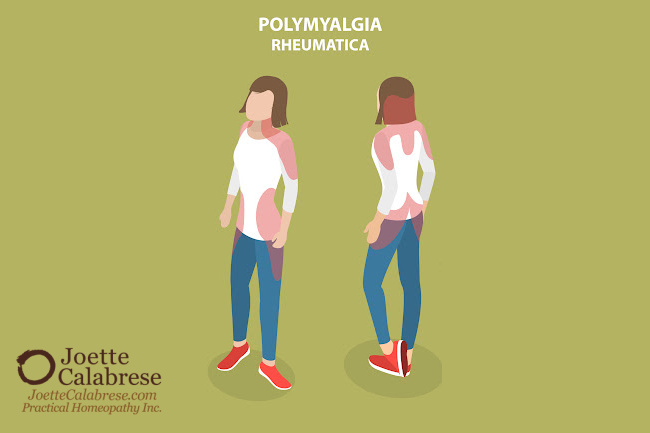
There are several different types of myalgias. Today, I’d like to address polymyalgia rheumatica, a condition that causes pain and stiffness in large muscle groups, such as the shoulders, neck, hips, thighs and back.

Cold, damp weather can exacerbate polymyalgia rheumatica — precisely like the weather they’re having up north right now. (And, I suspect, one of the reasons so many snowbirds come to our warmer climes during the winter).

The condition is usually worse in the morning but, generally, may improve with movement during the day. (If you’ve been reading my blogs for some time, which homeopathic medicine does that symptom bring to mind? If you don’t know, keep reading. The answer will come.)

Perhaps you’ve not heard of polymyalgia rheumatica. Symptoms of polymyalgia can be quite similar to the more well-known fibromyalgia. However, they are clinically different. For instance, sufferers of fibromyalgia experience pain throughout the body rather than only in large muscle groups.

Pain from out of nowhere!

Pain in the joints, tendons, bones and muscles can come on unexpectedly. BAM!

Let me give you an example from my practice. One of my clients (we’ll call her Nancy) was fine until she attended a party one day. The party was chock-full of junk food that Nancy just couldn’t resist. She ate some bad stuff and a lot of it!

The very next morning, BAM! Nancy awoke with rheumatoid arthritis that lasted for almost a year. She was convinced that evening of junk food gluttony had done her in, particularly since she had experienced food intolerances in the past. But interestingly, her previous symptoms were related to swelling of her lips, tongue and throat — not muscle pain.

So, does that mean we’re risking a disease every time we eat ourselves silly at a Christmas party, a Superbowl party or an Easter picnic? Of course not. But for Nancy, it was her personal tipping point.

Don’t assume.

Now, in Practical Homeopathy®, we don’t generally need a condition’s etiology — the cause. However, knowing what triggered the condition can sometimes be significant. For example, “Ever since that car accident, I’ve never been the same.” Or, in Nancy’s case, “I’ve never been well since eating that food.”

However, the reason for the suffering need not be our first concern. I encourage my students not to go down unnecessary rabbit holes trying to postulate a cause for their suffering. If you know what it is — the exact moment the suffering began — fine. If you don’t, don’t assume!

Clients and students say to me, “It must be Lyme,” or “It must be heavy metals,” or “It has to be  parasites.” No. We never start determining the appropriate homeopathic medicine by leaning on assumptions. If we have exhausted the logical approach first with no results, then perhaps we can make some assumptions. But until then, “Just the facts, ma’am.”

We need the name of the condition (from a conventional diagnosis) and/or the symptoms being experienced. Assumptions often lead folks to choose the wrong medicine.

I can’t tell you how many times a sufferer has said, “I tried homeopathy once with no success. I used the protocol for eczema and got no relief.” Then it turns out they didn’t have eczema; they had psoriasis. Or …

“The arthritis protocol didn’t work for me! Homeopathy doesn’t work.” Then it turns out they didn’t have arthritis; they had polymyalgia rheumatica.

Do you see where I’m going with this? They’re blaming homeopathy when it was their assumptions that were wrong. This is so common.

Joette Calabrese, Pain From Out of Nowhere? Practical Homeopathy® Counters Polymyalgia Rheumatica

Homeopathy works!

So, let’s talk specifically about how we would approach a diagnosis of polymyalgia rheumatica with Practical Homeopathy®.

For the muscular, tendon and bone pain of polymyalgia, homeopaths have historically called for Symphytum officinale 200C mixed together in the mouth with Calcarea phosphorica 3X. (If one cannot purchase it in a 3X, Calc phos 3C will do, or even Calc phos 6 will suffice.) This mixture would generally be utilized twice daily until very much better.

Because movement throughout the day can lead to improvement in the pain (better from movement), Rhus toxicodendron 200C is also generally added to the schedule.

Hypericum perforatum 200C may be employed as an SOS medication — meaning, when pain is acute and debilitating, one may need a few doses of this dependable homeopathic to nudge the body in the right direction.

Choose the most appropriate homeopathic medicine for the specific condition.

I’ll let you in on a little secret: This protocol may also be effective in cases of fibromyalgia as well. To see the similarities, read my previous blog, “How I Cured My Fibromyalgia With One Simple Medicine.”

If the diagnosis is instead arthritis, then turn to my other blogs, such as “Symphonic Symphytum for Pain” or “Ouch, My Back, Joint and Bone Pain Is Killing Me!” Or listen to my Monday Night Live from April 12, 2021, entitled “Arthritis. Joint pain. Muscle and Ligament Pain. Overused Joints and Muscles.”

Better yet, my friends, if chronic pain is bedeviling you, consider a deep dive into my course, Make It Stop! Escape From the Prison of Chronic (and Acute) Pain Using Practical Homeopathy®: Learn Effective Methods to Uproot Pain, Often for Good.

Not only do I cover specific protocols for polymyalgia rheumatica, fibromyalgia and arthritis, but I also instruct on headaches, frozen shoulder, shingles, back pain and various organ pains — just to highlight a few. (And remember — all of my Mighties (Joette’s Mighty Members) qualify for a 10% discount on course purchases.)

I’ll discuss this subject further on Monday, March 10, at 8 p.m. EDT, within my Joette’s Mighty Members site or on our simulcast network through the Joette Calabrese Facebook page, YouTube, X (formerly Twitter), Rumble and Instagram. Join me!

Pass on the good news of Practical Homeopathy®!

Warmly,

Joette Calabrese, Practical Homeopathy®

P.S. If you’re not quite ready to consider a course, joining a Gateway to Practical Homeopathy® study group may be just the learning opportunity you’re looking for. It’s the same way I began my studies — except you’ll benefit from my years of teaching experience. The curriculum, which I recently revised to reflect my current teaching methods, is easy to follow. Plus, you’ll make lifelong, like-minded friends who will support you throughout your genuine health care path.

I offer something for every level of interest in homeopathy. So, join me today and learn how to become your family’s trusted health care provider!

1 https://www.hopkinsmedicine.org/health/conditions-and-diseases/myalgia#:~:text=What%20is%20myalgia%3F,can%20all%20bring%20about%20myalgia


2. Carbon Monoxide: How to Antidote Poisonous Toxins With Homeopathy Series

Joette Calabrese, Practical Homeopathy®, 2. Carbon Monoxide: How to Antidote Poisonous Toxins With Homeopathy Series

Carbon monoxide poisoning often creates a pathology that can last for months — even years — after the initial poisoning.

Obviously, severe exposure that causes unconsciousness may require a trip to the Emergency Room. However, as we’ve discussed, much good can be done by administering a well-chosen homeopathic medicine on the drive to the hospital.

As has been my experience, often the homeopathic will act quickly enough to perhaps eliminate the need to go inside and seek treatment. (Hear about one of my many experiences in the ER parking lot in Podcast 21: When to Use a Doctor; When to Trust Yourself.)

First things first: No shortcuts!

But before I continue this ongoing series, “How to Antidote Poisonous Toxins With Homeopathy” …

If you missed the introductory and background information I previously provided, click here to read it before proceeding to the rest of this series.

Why? Understanding the methodology behind utilizing homeopathy to antidote a poison or toxin is equally important as knowing which condition-specific homeopathic medicine to consider.

Carbon monoxide poisoning is stealthy

Joette Calabrese, Practical Homeopathy®, 2. Carbon Monoxide: How to Antidote Poisonous Toxins With Homeopathy Series

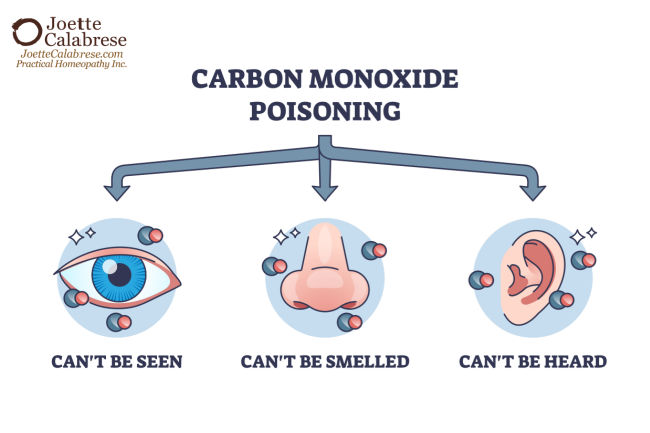
Carbon monoxide is odorless, colorless, tasteless and deadly. That’s why an entire industry of carbon monoxide detectors has burgeoned over the last few decades.

Even with an alarm, damage can be done by this highly toxic and poisonous gas. However, as usual, homeopathic medicines can gently assist the body return to homeostasis.

Symptoms of carbon monoxide poisoning

Joette Calabrese, Practical Homeopathy®, 2. Carbon Monoxide: How to Antidote Poisonous Toxins With Homeopathy Series

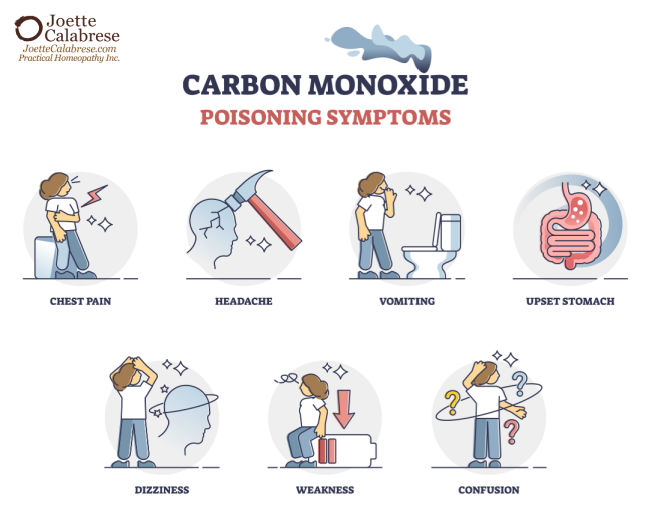
Carbon monoxide poisonings often create a pathology that lasts for months, even years after the initial poisoning. Breathlessness, fatigue, general weariness, or weakness can be easily mistaken for chronic fatigue syndrome. However, if the illness can be traced to carbon monoxide poisoning, it can be resolved homeopathically — even when the poisoning occurred in the distant past.

Let me share a case in point with you.

Consider Carbo Vegetabilis

A woman contacted me some years ago for crushing chronic fatigue and nauseating lightheadedness.

As we talked, I connected critical information to a well-known homeopathic medicine. She reported that she had never been well since an incident nearly 20 years ago when she stayed in a cottage heated by a faulty kerosene room heater. It was in this cottage that a near tragedy ensued.

Neighbors found her — unconscious — as a result of carbon monoxide poisoning and, luckily, dragged her outside to safety.

She escaped from a near-fatal incident, but the pathology had only shifted gears and grown into a chronic condition that impacted her life enough that she was unable to work.

Carbo vegetabilis has been used for decades to antidote the ill effects of such an occurrence.

After she took Carbo vegetabilis 200C, twice daily, she was free of her heavy lethargy, nausea and light-headedness.

Indeed, her condition was resolved within days of taking the remedy!

It was a stunning recovery.

 Homeopathy works sometimes even beyond our expectations.

(You can learn more about the restorative power of the homeopathic medicine Carbo veg in “A Tale of Two Kiddies.”)

Rethinking Detox

This protocol for carbon monoxide poisoning is provided in my course, Rethinking Detox with Practical Homeopathy®: How to Stop Stressing About Toxins and Fearlessly Achieve Health the Simple Way.

If toxins concern you and your loved ones, this course will help you avoid overreactions and eliminate fear. By learning about this gentle, efficacious, and time-tested medicine, you can give yourself the gift of education to cope with a toxic world.

Pass on the good news of Practical Homeopathy®!

Warmly,

Joette Calabrese, Practical Homeopathy®

P.S. In answer to numerous requests, my social media updates are now featured on TikTok!

Unfortunately, my Monday Night Live events can’t stream live on TikTok until I have more followers. So, help me get the word out to a whole new demographic by following me. Once my account reaches a critical mass of followers, TikTokers will be able to join my MNL events live, just as users of the Joette Calabrese Facebook page, YouTube, X (formerly Twitter), Rumble and Instagram already do.

Of course, the best way to watch my Monday Night Lives is through their Mighty Members dashboard.* Members can hang out there after my public presentation to enjoy an exclusive, private Q&A regarding that evening’s topic.

Learn more about membership by clicking here. It’s a great way to stay Mighty!

*You must be logged in for this link to take you directly to the latest Monday Night Live.


Podcast 138 — Peek Inside Joette’s Passionate Mastermind Group: 7 Women, 7 Homeopathic Success Stories

Joette Calabrese, Practical Homeopathy®, Podcast 138 — Peek Inside Joette’s Passionate Mastermind Group: 7 Women, 7 Homeopathic Success Stories

IN THIS PODCAST, WE COVER:

01:00   Introduction: Peek Inside Joette’s Passionate Mastermind Group: 7 Women, 7 Homeopathic Success Stories

01:32   Meet Some of My Mastermind Students

03:20   Success Story: Blood Clots, Infection, Heart Failure, Pain From a Possible Brown Recluse Bite

09:00   Success Stories: Pneumonia and a Nonverbal, Autistic Child

            About Sheena

18:15   From Student to Teacher

            Gateway to Practical Homeopathy®: A Guided Study Group Curriculum

            About Noreen

23:30   Success Story: Depression

            About Ingrid

26:11   Success Story: Avoiding Hip Replacement Surgery

29:30   Canine Success Story: Dog With Conjunctivitis, Body Odor and Back Cyst

34:00   Success Story: Diverticulitis and Orthopedic Pain

            About Kirsten

ADDITIONAL RESOURCES:

Joette Calabrese on YouTube (Monday Night Lives)

Joette’s Learning Center

The Academy of Practical Homeopathy®

PracticalHomeopathy.com

Joette’s Study Group, Find Your New Study Group Friends

Joette’s Mighty Members


Kate:

This is the Practical Homeopathy® Podcast, episode number 138, with Joette Calabrese.

Joette:

Hi, I’m Joette Calabrese, and I welcome you to our health care movement — yours, mine and the countless men and women across the globe who have retaken control of their families’ health with Practical Homeopathy®.

So, for the next few minutes, let’s link our arms as I demystify homeopathy — what was once considered an esoteric paradigm — into an understandable, reproducible, safe and effective health care solution available to all.

This is the medicine you’ve been searching for — my unique brand of homeopathy, PRACTICAL Homeopathy®.

INTRODUCTION: PEEK INSIDE JOETTE’S PASSIONATE MASTERMIND GROUP: 7 WOMEN, 7 HOMEOPATHIC SUCCESS STORIES 

Kate: (01:00)

Hi, this is Kate, and I’m so glad that you’re here with us again today. We love it that you are learning about homeopathy — that you are excited and want to know more. And today, we have a very special treat for you. Joette, we’re here together!

Joette:

Hi, Kate.

Kate:

Yes, in person.

Joette:

I know. It’s usually not in person.

Kate:

I know!

Joette:

We meet often, but it’s on Zoom.

Kate:

It’s great!

Joette:

Yeah, it’s really great.

Kate:

So. Exciting thing, that we’re just finishing up a big weekend for us. We have some amazing students gathered together. Can you tell us a little bit about what we’ve done this weekend and what the listeners are going to hear?

MEET SOME OF MY MASTERMIND STUDENTS

Joette: (01:32)

Well, what we’ve finished — and I’m pretty excited about it because it’s been such a spectacular weekend — we have 12 people, and it’s called Mastermind. And it’s our second year of doing this. And in order to be in Mastermind, you have to go through The Academy (which is a year long) and then Mastery (which is 11 months long). And then this just happens to be the second year of working together in Mastermind with a really tight group of ladies.

And it’s always exciting because we get to know each other really well, and we help each other. That’s a big part of this. And the goal is to move people along in their lives as quickly as we possibly can so they can achieve their goals: whether they’re for teaching, whether the goals are to help their family, or the goals are to become a better practitioner, or wherever they are in their lives. We want to move it along faster.

So, today, you’re going to be listening to a number of the students who are willing to share some ideas and some information about how homeopathy — especially Practical Homeopathy® — has touched their lives.

Kate:

And I think one of the things that’s exciting, Joette, is that this isn’t someone who is a doctor or a nurse or a professional, necessarily. These are people from all different walks of life, from all over the country, really. And some of them are stay-at-home moms, as you’ll hear. Some are professionals working in the medical field, some are …

Joette:

… physical therapists, nurses. That’s right. Educators. Yes.

Kate:

Real estate. Yeah.

So, you’re going to hear from a number of different people, and I want this to be encouraging to you because you don’t have to fit into a certain mold in order to learn homeopathy or even, for that matter, go through these steps and into the Mastermind program. You, too, can do it.

Joette:

That’s true. That’s true. Yes.

Kate:

Let’s get started. Let’s take a minute and hear from some of the students who are in Mastermind.

Joette:

Let’s go.

SUCCESS STORY: BLOOD CLOTS, INFECTION, HEART FAILURE, PAIN FROM A POSSIBLE BROWN RECLUSE BITE

Joette: (03:20)

I’m Joette Calabrese, and we’ve just had our first meeting of our second year of Mastermind. And I’m here with one of my students who I’ve gotten to know quite well through the years because she’s been through The Academy and Mastery and Mastermind last year, and now we’re starting Mastermind this year. And her name is Lorraine.

Hi, Lorraine.

Lorraine:

Hi, Joette. It’s really a pleasure to have been able to study with you all these years, and what you’ve taught me has been, I would say, invaluable.

Joette:

I want to hear your story.

Lorraine:

My husband became really critically ill the middle of last year, and he had to be hospitalized for two weeks. There was some heart failure involved.

Joette:

He’s not an elderly man.

Lorraine:

No.

Joette:

He’s in his forties.

Lorraine:

Yep. Late forties. And he had blood clots, and he had had a serious infection. And we believe that led to all these events.

Well, throughout the hospital stay, we were able to minimize a lot of the medications. He emerged from the hospital on three drugs. Over the course of the next six months. We were able to get him off of all the drugs.

Joette:

Slowly, carefully with the guidance of the doctors, but you were really leading the charge on many levels.

Lorraine:

Yes. We saw that they were creating negative side effects. We also saw that he seemed to be recovering beautifully, and that was born out with some of the diagnostic testing that we did at the end of the sixth-month period.

He is basically restored to full health at this point. He does not need the drugs. He doesn’t need a lot of homeopathy, either, at this point.

Joette:

And the prognosis was that he was going to have to stay on these drugs for the rest of his life.

Lorraine:

Yes, that is definitely what the cardiologist believed.

Joette:

Now, may I say what you believe the cause was? There’s the potential that this was a brown recluse spider bite.

Lorraine:

That’s what we think. We never saw the spider. We …

Joette:

That’s why they’re called “recluses.”

Lorraine:

But it was some kind of — it appeared to be some kind of — bite. And our best guess was it was a brown recluse.

Joette:

And that turned into an infection, which then created clotting and cardiac …

Lorraine:

He was actually in heart failure.

Joette:

Oh, in heart failure.

Lorraine:

And he did have a rapid heartbeat, but more seriously than the rapid heartbeat, he was in heart failure.

Joette:

Yes. Do you mind telling folks just a few of the medicines that you ended up using from the beginning and then the pain remedies, et cetera?

I want to recall … I think it’s important for folks to understand that your husband, Lorraine, was under the care of a doctor at all time — a cardiologist, an infectious disease. He was in critical care for a short period of time in the hospital. You never left the care of a doctor.

And then you also hired another doctor who was a student in our class with you, who also supported you a great deal. And it was her work as well that helped you get through all of this. And so much of this was under her tutelage, as well as your studying.

Lorraine:

So, for the heart failure, in his particular case — well, really, in any heart failure case, I would think, you would always want hawthorne tincture (mother tincture), Crataegus as a baseline.

We also used Lachesis.

Lachesis was additionally useful because we had some severe wounds. We had the infection, and we had some issues with the lungs. So, it was a very good choice.

Obviously, his heart rate was very elevated, and with the heart failure, Digitalis was very logical as well.

Joette:

And then he had pain.

Lorraine:

Yes.

Joette:

A lot of pain at the site that was shooting down and up and down that leg.

Lorraine:

So, because of the clots, we had the development of venous ulcers. (As far as we can tell, that was the cause of them.)

We surprisingly found he was already taking Calendula 200 internally to aid with the healing and to help with the pain. And even for infection, Calendula internally was indicated in the materia medica.

When the pain was not managed by some of the other remedies (Hypericum, and I used Chamomilla.

Joette:

Coffea? Did you use Coffea?

Lorraine:

I used Coffea.

Anyway, we were having some trouble managing it, and we found that Staphysagria was helpful, even though this was not a surgical, clean-cut wound. It was actually very helpful. We used that, and it was incredibly helpful.

Joette:

So, now after all these months, you were the bedside prescriber, essentially with the help of the doctor who was also a homeopath and part of our group, and also the doctors in the hospital.

And so now he’s doing pretty well. He’s working. There’s still a little residual problem at the site of the ulcer, but now the pain is more than managed. It’s gone.

And he’s no longer on any conventional drugs and with, actually, the blessings of the doctors because he doesn’t need them. In spite of what the original prognosis was, he doesn’t need them.

And you’ve also backed off of many of the homeopathics.

Lorraine:

Yes.

Joette:

All I can say, Lorraine, is nice job.

Lorraine:

Well, thank you, Joette. And really and truly, your system of education and the protocols you’ve given us and just the general understanding of homeopathy and how it works from a high level as well as a very baseline level — just covering the whole gamut. I think that has been incredibly helpful to being able to wrestle a case like this to the ground, so to speak.

Joette:

And it’s been done.

Lorraine:

Yes.

Joette:

Thank you for sharing it, Lorraine.

SUCCESS STORIES: PNEUMONIA AND A NONVERBAL, AUTISTIC CHILD

Joette: (09:00)

I’m with one of my students who I love, and her name is Sheena. Some of you may already know her. She’s gone through The Academy (year one), and Mastery™ (that’s the second year), and Mastermind first year, and now, Mastermind second year.

So, welcome, Sheena.

Sheena:

Thank you. It’s great to be back in Mastermind again.

Joette:

Well, we’re here because people like to hear stories of success, even if it’s only partial success. We don’t expect perfection in homeopathy. We expect some shift.

And so, tell us a story that … perhaps, a case that you’ve been working with or someone that you’ve helped.

Sheena:

So recently, a lot of people are getting pneumonia, and it’s really sticking in there. It’s lasting a long time, and they’re trying different remedies. But I’ve had some really good success with that recently with a couple of clients.

Joette:

Now, pneumonia is one of those things that can last for weeks, even months. So, what are you seeing?

Do you see that homeopathy … you give the first medicine, and bam, it’s gone? Or do you see that you have to move it along, and you are pivoting at certain points? And then you get to another point, and now the person’s a little better, et cetera, et cetera.

Tell us what the process is.

Sheena:

Yeah, it definitely takes some time, especially because they have been generally struggling with this for a while before they come get homeopathy.

Joette:

Before they come to you, they’ve already been suffering.

Sheena:

They’ve maybe had antibiotics, maybe even steroids, and none of those things seem to be working for the pneumonia that I’m seeing.

And so, I have to kind of hit it at a couple levels. And I do keep in contact with these clients pretty closely. Their rib cage is generally tight and tense.

Joette:

Painful.

Sheena:

Painful.

Joette:

Sometimes, even a fracture.

Sheena:

Maybe cracked a rib. Yep. That’s pretty much everyone so far has had a cracked rib by the time they get to me. So, we have to do remedies for that and loosen that up.

And then, oftentimes, it’s coming from the sinuses. And we forget about that because the lungs are so scary, and they can’t breathe. But we have to address the mucus that’s …

Joette:

Draining.

Sheena:

… draining down the back of the sinuses. So, I generally will give them remedies for that.

And then, of course, hit the cough straight on, based on how it’s presenting for that person.

Joette:

Particularly when the cough is racking or painful or causes breathlessness that’s frightening, that’s when we really have to hit hard with the remedies for tha.

Sheena:

And give them an emotional remedy because they’ve been sick for a long time. They’re desperate. They’re afraid they’re not going to get better. They’re afraid they’re not going to breathe. So, there’s a lot of fear involved, especially when it’s been going on for months.

Joette:

Well, breathlessness can be a very frightening experience … and especially, when you’re coughing, and you need to get that breath in, and you can’t get it in enough to be able to push out again and clear the chest. So yeah, it’s a big deal.

What are you seeing with these? You’re getting the case after it’s already commenced for say, a couple of weeks?

Sheena:

A couple months.

Joette:

A couple months, first? Okay. Then you get the case.

Sheena:

Then I get the case.

Joette:

Okay.

Sheena:

It would be easier …

Joette:

Wouldn’t it be nice in the very beginning? But I think most people don’t seek help necessarily right away because they feel as though they can handle it. And that’s what we all want to be able to do. “It’s just a little cough. I’ll take some Aconite and Bryonia, maybe ColdCalm® or something like that.

But sometimes, it does progress, and that’s when people need help. They need help from a professional such as you.

Sheena:

And sometimes it wax and wanes, so they’re like, “Oh, I am getting better. Oh, wait. Nope, I’m not. Oh wait, I am getting better.” And then finally, they’re like, “Yeah, I’m definitely not getting better.”

Joette:

And then at the end, usually you find people who are left with a certain set of symptoms after pretty much the pneumonia has cleared. What do you see is left in the end?

Sheena:

The rib pain.

Joette:

Yep.

Sheena:

That takes a while because you’re healing bone at that point. If they’ve got a cracked rib and the congestion seems to linger, so it takes a while to fully get that congestion out … especially because they no longer can cough very well because it hurts because they have a cracked rib.

So, we have to sort of process each thing and keep going back with the pain, with the pneumonia, with the emotions.

Joette:

And then there’s that fatigue.

Sheena:

And the fatigue. Yes. The extraordinary fatigue.

Joette:

Yes. And that other level that you mentioned, and that is the anxiety that remains. The fear of, “Oh my gosh. What if this happens again?” Or “What if I’m not done? What if this goes on forever?” What we all think as humans, we automatically go there.

Sheena:

The fear of never getting better is big. And then, it may trigger an exacerbation of an underlying condition because they’ve been sick for so long. As soon as pneumonia or whatever starts to dissipate, I think it’s aphorism 35. Right? Then, the conditions that they had before come back, full strength may be even worse.

Joette:

Sheena’s referring to aphorism 35 is referring to Samuel Hahnemann’s “Organon.” He is the founder — or the discoverer and developer — of homeopathy back in the 1700s. So, he has these aphorisms.

I think you’re right … I think it’s aphorism 35. I’m impressed. You studied well in The Academy, Sheena.

Sheena:

I studied. Well, I found that aphorism so interesting because it says if there’s two — and I’m paraphrasing — two distinct diseases, the stronger one will be the only one really presenting symptoms. Doesn’t mean the other one’s gone. As soon as the stronger one is gone, the other one just comes back.

And that really tells us that these things are symptoms. And then it’s the body communicating with us — and it’s not the illness — because otherwise, one wouldn’t go away and then come back.

So, it’s the body’s like, “Pay attention to this for right now; I’m going to set this aside.” As soon as that’s taken care of, then the body’s like, “Hey, now, you need to get back to this.”

Joette:

Well, what I love about these acutes — which could also, by the way, represent a chronic condition, which is what you’re saying — is that on the other side of it, we often see a shift that is an emotional or even a developmental shift that leads the person to feel, “Okay, I have just gotten through this. Now I’m done. I’m really done.”

It can take weeks, months, perhaps, depending on the person, but “I’m really finished with this.” And now they see things differently in their lives. I have it reported to me all the time, “Oh my gosh. I feel like a different person. Not in my fears but rather in my leap forward.

And we see this in children when they have fevers. And just before they mount a fever, they can’t accomplish something. For example, they say, “I can’t tie my shoe” (and that’s not a good one because no one has tie-shoes anymore.)

“I can’t Velcro my shoe.” (It’s not quite the same.)

So, I guess we have to go to “I can’t ride a bike like all the other children in the neighborhood. I can’t do it. I can’t get on it. I keep falling.”

Then, they get sick, and they get a fever. And on the other side of the fever — if it is not suppressed by antibiotics, steroids, et cetera — what we often find is once that fever has mounted and completed itself with the use of homeopathy — or perhaps not even homeopathy … just letting it be and letting the child sleep and get well on his own — on the other side of it, now the child, when they get outside and they’re back into their normal lives again, they can get on the bike and start riding the bike. So, there’s that developmental leap. And I believe, and I’ve seen it happen in adults as well.

Sheena:

I’ve seen it all the time with adults. They may make a really huge shift in their relationships or something that is not right emotionally. For some reason, after these illnesses, it’s like a wake-up call, and they move into a much better place. Generally.

Joette:

Maybe they can make a decision differently. Something that’s been plaguing them for a while now, they can actually lean into it and make the decision. Yeah.

Sheena:

Yeah. It seems to be.

Joette:

Yeah. Yeah, yeah.

Sheena:

So, I had another case that’s pretty cool. I was working with — or still I’m working with — a young boy who’s four and a half nonverbal autistic and worked with him. On the third month, I get on Zoom, and he says, “Hi, Sheena.” And honestly, for a minute …

Joette:

Goose bumps!

Sheena:

Well, I was like, “Wait, I’m pretty sure he is nonverbal!” So, I’m trying to play it cool. Looking at my notes …

Joette:

“Wait a minute. Did I get it right last time? Is he nonverbal?”

Sheena:

I was like, “Wait. Am I confused? What’s happening?”

But he had just started talking a week before the appointment, and of course, parents were thrilled. He has continued. He’s talking; he’s reading; he’s writing; he’s spelling.

A hundred percent to the homeopathy.

Joette:

And the parents would agree with that.

Sheena:

Oh, a hundred percent. No doubt.

Joette:

Yes, yes, yes. Well, when you see a case like that, and you’ve just changed the trajectory of a little boy into manhood someday, you know this medicine can’t be beat.

Sheena:

It was incredible. I mean, I was surprised. I almost fell off my chair, but I was trying to keep it cool.

Joette:

I know. Great story. Well, thank you, Sheena.

Sheena:

You’re welcome.

Joette:

They just got aphorism 35 and a whole lesson.

Sheena:

That’s right.

Joette:

Thank you.

Sheena:

And thank you. This has been the most amazing decade of learning homeopathy, and it’s literally changed my trajectory in my life. Thank you.

Joette:

I love it. I’m glad that you’re with us.

FROM STUDENT TO TEACHER

Joette: (18:15)

Okay, back again, folks. Now I’m with Noreen. And Noreen has been with me through The Academy, Mastery™, Mastermind last year, Mastermind this year … and we just keep going on together. Don’t we, Noreen?

Noreen:

You’re right, Joette. I just thank you for having this conversation, and I just want you to know how much I appreciate you.

Joette:

Well, and I appreciate you too, Noreen. We could just stand here and talk about that all day.

So, let’s talk about maybe a story, something, a testimonial on something that’s worked nicely in your life. Or how you’ve used homeopathy, what you’ve learned, and how it’s affected someone that you care about.

Noreen:

Well, I didn’t know anything about homeopathy until about 2019 when my son got stung by wasps, and his hand inflated like a balloon, and I didn’t know what to do about it. And somebody said, “Oh, well, just get this stuff. It’s called Ledum and use that.”

And so, when I got it, I looked at these silly little white pills, and I thought, “This is supposed to do something?”

But I gave him two doses, and in the morning, his hand looked almost normal! Where the evening before, it had been swollen, red, a streak going up his arm. It was hot; it was nasty, and I was very concerned.

So, when that happened, I went, “I really need to learn more about these funny little pills.”

Joette:

Well, that’s interesting because 2019, I was … 2025, just the beginning of 2025 … so it was only six years ago. Right? Some people have been doing this for 30, 50 years. But you’re six years in, and you’re committed. You’re all the way in because you teach Gateway groups, don’t you?

Noreen:

Right. So, that was my first thing. I took a Gateway class. And then I took another Gateway class with different people. And from that, I was just hooked.

And then, when you started The Academy, I decided to dive in and do The Academy … and only for my family. I had no intention of becoming a practitioner. I only wanted to learn it to help my family.

At some point, going through The Academy and Mastery™, I decided that teaching was the thing that I wanted to do. So, right now, what I’m doing is I’m teaching Gateway Is, Gateway IIs, and teaching through the protocol courses.

That’s my goal this year is to get through all the rest of the protocol courses.

Joette:

And you’re teaching groups of people in your home, in their home, online? How do you normally do that, Noreen?

Noreen:

Well, mostly online. But I did it at a church, so, I did do it in person for the particular group. They wanted their church group to have it in person. They were very adamant about doing it in person. So, I did theirs in person, but mostly, I do it online.

And that works out good because people can be in different time zones. I can do it in the evening or in the morning. They can come in their pajamas or whatever.

Joette:

So, who are these people? These are mothers, grandmothers? What kind of people are they? Who wants to learn homeopathy from you?

Noreen:

A lot of different people. Usually, I really have a heart for young moms because I want young moms to be able to avoid the antibiotic merry-go-round … when you go in for an ear infection and the next thing you know, you’re taking something for your stomach because the antibiotic gives you a stomach ailment. All that kind of stuff.

I want them to be able to avoid that kind of merry-go-round. So, I like to do young moms, but I seem to end up with a lot of grandmoms. I’ve done it for teenage girls because they’re going to be, hopefully, moms and get them trained up early.

Joette:

These are people who are often independent thinkers who step outside of the box and say, “You know what? I think I have a duty that’s greater than just taking my family constantly to the doctor’s office and waiting in waiting rooms. I think I’ll learn how to do this myself. Only, I’ll do it with a homeopathic medicine instead of whatever.”

Noreen:

And in the beginning, I was trying to convince my family and friends to do it. But you can lead a horse to water, but you can’t make them drink.

Joette:

Not always.

Noreen:

So, sometimes, you have to wait for them to come around. And sometimes you just have to look for the “lookers.” There’s people out there that want this. And if someone says, “No, thank you,” I say, “Oh, okay. Next!”

Joette:

Well, I know you’re doing a lot of these groups, and hopefully, we’ll have it linked down below so that people know where to go to find out more. And thank you so much, Noreen. It’s always great to have you in our group. You add a level of, shall I say, wisdom, as it was said earlier, and knowledge. So, thank you for joining us.

Noreen:

Well, thank you very much, Joette.

I’m super-happy to be here, and I can’t even express how you’ve changed my life. I don’t know where I would be if I didn’t have this aspect of teaching in my life. It’s very fulfilling.

Joette:

Yeah. Thank you.

Noreen:

Thank you.

SUCCESS STORY: DEPRESSION

Joette: (23:30)

Hi, Ingrid.

Ingrid:

Hi, Joette.

Joette:

So, Ingrid, you’ve been with me first year, Academy, right? Twelve months. Then, second year, Mastery™. That’s 11 months now. Mastermind last year, which was a year, and now Mastermind, the second year. And so, you’ve been for some time …

Ingrid:

I have. And even longer before then, when I found you through Weston A Price.

Joette:

Oh, that’s right. Because you were practicing as a GAPS practitioner, right?

Ingrid:

Yes.

Joette:

Okay. So, you have some …

Ingrid:

And nutritional therapy.

Joette:

Yes. And you also have a good experience in being in practice and working with other modalities.

Ingrid:

Yes.

Joette:

Yeah, yeah.

So, Ingrid, tell us your story. I like to hear this story. I know this now. So, go ahead and share it with us.

Ingrid:

Okay, great.

There are so many, but one that really stands out because it not only impacted the person themselves, but it impacted the entire family … and then that person’s entire department at work.

So, I was working with a young mom whose husband was having some depression and maybe some suicidal ideation. And in his line of work — a first responder — there are so many instances of people taking their own lives because they’re just so depressed from everything they’re seeing, the PTSD, the number of hours that they work in a row. So, they’re sleep deprived …

Joette:

The responsibility.

Ingrid:

The responsibility, for sure.

So, I was working with her, and first, we — since it was depression — put him on Aurum metallicum. But it really didn’t budge it.

So, we decided to pivot after maybe two months and moved to Ignatia because there was such a strong element of PTSD. And it really worked quite quickly, even in a matter of a week or two.

Joette:

That’s what I was going to ask you, how quickly did it?

Ingrid:

Very quickly.

Joette:

Beautiful.

Ingrid:

And within a month, it was pretty much a hundred percent improvement. So, not only did he improve, but the life was improved in the family.

Joette:

Of course, it trickles throughout the entire family.

Ingrid:

And then he became an advocate for homeopathy, telling his department and different people about this and then some other maybe digestive things that we were working on.

So, it not only worked with that family — which I’m so pleased about — but it also … You know, once people find out about homeopathy, they want to tell everybody.

Joette:

Yeah. And you can’t stop! Not only can she not stop — his wife — but his excitement and, of course, yours. Because once you’ve touched a life like this so deeply, there’s no stopping us. We really want to learn more and do more and experience more and share it even further.

Ingrid:

So true.

Joette:

Yeah. Thank you so much.

Ingrid:

Thank you so much. And thank you so much for just everything you’ve done. Just knowing you has been such a pleasure in my life.

Joette:

Oh, you’re very sweet.

Ingrid:

And changed my life.

Joette:

Well, I love that you’re with us.

Ingrid:

Thank you.

SUCCESS STORY: AVOIDING HIP REPLACEMENT SURGERY

Joette: (26:11)

We’re now with Laurie, who’s been through The Academy, Mastery, Mastermind last year and now Mastermind this year. And so, thanks for joining me, Laurie. You’ve got a story to share, haven’t you?

Laurie:

Yes. Hi, Joette.

Joette:

Hi.

Laurie:

This is about my husband. So, about a year ago, I saw him putting on his shoes to go somewhere. I’m like, “Where are you going?”

He goes, “I’m going to the ER.”

I’m like, “What? I’m going with you. What’s wrong?”

Basically, he was in a lot of pain with his hip.

Joette:

Was this a previous injury or something?

Laurie:

Nope.

Joette:

Just out of the blue, pain in his hip?

Laurie:

Yes.

Joette:

Okay.

Laurie:

So, we get to the ER, and basically, long story short, the doctor tells him it’s arthritis …

Joette:

Arthritis.

Laurie:

And that he needs to see an orthopedic doctor. She got him into a very well-known doctor the very next day, which was great.

Joette:

Now, orthopedic doctor is usually a surgeon.

Laurie:

This was a surgeon.

Joette:

Right.

Laurie:

So, we go to the appointment together, and basically, my husband is demanding a hip replacement. He just thought that would fix everything for him.

Joette:

Just get rid of that and get a new one.

Laurie:

Yeah. And the doctor looks at me, he goes, “Is he serious?”

I’m like, “Yeah, he’s serious.”

So, he grabs his pamphlet — and well, he talked to my husband — but he grabs a pamphlet, and he says, “I want you to take this home. I want you to read it. And if you still want this surgery, come back, and we’ll talk.”

And my husband read the pamphlet. He goes, “Yeah, I don’t want a surgery.”

Joette:

Yeah, do a little homework, and you might see a little differently.

Laurie:

So, I put him on the arthritis protocol. And this is now a year later, and he basically tells me often he’s got zero pain now. It’s gone.

Joette:

That’s fabulous. But what does that mean by “often”? So, in other words, he still has pain from time to time.

Laurie:

Occasionally. But lately, he’s been saying, “Yeah, I have no pain.”

He’s amazed. He’s pretty thrilled and pretty amazed by it. So …

Joette:

When you can turn someone around — who was really excited about the idea of a hip replacement — to taking the little pills that actually taste good, and turn them into someone who’s now a believer and says, “Yeah, I don’t have pain very often at all,” that’s when you know you’ve done your job.

Laurie:

And he’s learned how to use them as SOS when he needs them. So instead of …

Joette:

Okay. How often might that be, Laurie?

Laurie:

It kind of depends on what’s going on. If there’s something that triggers or aggravates that he ends up having to go in tight spaces sometimes with his job. And so, if there’s something that aggravates that hip, sometimes it could be daily for a few days.

Joette:

What kind of work does he do?

Laurie:

He’s an electrician.

Joette:

Okay. So, he …

Laurie:

He goes up into attics and …

Joette:

Okay. Crawl spaces. Yes. Right. Okay.

Laurie:

Yeah.

Joette:

He’s carrying those big, heavy cables on his shoulders. Does he have to do that kind?

Laurie:

Yeah. Yeah, he does.

Joette:

Yeah. It’s a rigorous job.

Laurie:

Yeah. Sometimes, he’s digging ditches to run a line.

Joette:

Yeah.

Laurie: 

Yeah.

Joette:

Wow. So, if he takes the homeopathics occasionally, we’re pretty happy about this.

Laurie:

He’s thrilled. Yes.

Joette:

Yeah, we’re thrilled, too.

Nice job, Laurie.

Laurie:

Thank you.

Joette:

Thanks for sharing.

Laurie:

Thank you.

CANINE SUCCESS STORY: DOG WITH CONJUNCTIVITIS, BODY ODOR AND BACK CYST

Joette: (29:30)

Okay. Now I’m with Charis. Hi, Charis.

Charis:

Hi.

Joette:

I’ve known Charis a long time, not only because you’ve been in The Academy and Mastery™ Mastermind and Mastermind, et cetera, but you’ve been a client and have become a friend.

So, it’s a joy to have you here, and I’d love to be able to ask you questions. So, share something with us, Charis, about what you do and how homeopathy has been instrumental, perhaps, in your life.

Charis:

Well, I am a stay-at-home mom. I am a real estate investor. I have honeybees. I have a lot of people in my life that I’m always doing stuff with. So, yes.

Joette:

You help a lot of people. You’re not in real, actual practice.

Charis:

No.

Joette:

Right? But you help your neighbors and your friends and your family … have an extended family. There’s always somebody you’re treating.

Charis:

Absolutely.

Joette:

Yes, very … you don’t think so, but you’ve a very organized setup for your medicines, right?

Charis:

That’s true.

Joette:

Yes.

Charis:

But you know, it’s never enough to a mother, but yes.

Joette:

No, I know. We can never have enough.

Joette:

So, now you have a story about Blake. Now who’s …

Charis:

That’s my dog.

Joette:

What does he look like?

Charis:

So, Blake is a mini-Australian shepherd mixed with a poodle. He’s a little black dog.

Joette:

Yes, yes. He’s very cute. I’ve seen him on Zoom. Yes.

Joette:

Okay. So, tell us about Blake.

Charis:

So, Blake … I’ve used homeopathy a lot with Blake, and so I’ve used it for various reasons.

So, he’s a young dog. He’s a male dog. Occasionally, male dogs can get a bit frisky. So, I’ve used Stramonium with him. When he stinks, I use a little bit of Sulphur with him.

Joette:

You mean his skin has a bad smell?

Charis:

Yeah, like when his fur and his skin … and there’s sort of an odor coming off of him — emanating from him — I’ll use Sulphur with him. And then he gets back to that sweet, cute little puppy smell.

Joette:

Yes.

Charis:

And then I’ve used Mercurius with him when he’s had bad doggy breath.

Joette:

Okay.

Charis:

And then one time he actually had an infection in his eye, so he started getting a conjunctivitis infection. And I used the protocol for conjunctivitis, and it went away.

But at the same time, he also had a cystic little growth in his back. And that actually went away at the exact same time.

Joette:

So, what protocol did you use for his eye and …

Charis:

It was Pulsatilla.

Joette:

Was it Silica? Did you use Silica?

Charis:

Yeah, but it was also Hepar sulph. I did use Hepar sulph.

Joette:

Okay. That’s the back.

Charis:

And I use Belladonna with him, too.

Joette:

Okay. Belladonna, for the pain and the redness, perhaps the heat.

Hepar sulph was specific for the fact that it was an infection in the eye — conjunctivitis. Do you think it was the Hepar sulph that actually did the work on his back?

Charis:

Honestly, I think it was the Belladonna — adding the Belladonna in — because I’d used Hepar sulph before on the spot, and it wasn’t moving it.

It was getting a little bit less. But then, when I used the Pulsatilla with the Belladonna and the Hepar sulph, then, it went away.

Joette:

Beautiful. Sometimes, one medicine doesn’t do it.

Charis:

Yeah.

Joette:

Sometimes, we need to use two — alternating. Sometimes, even three.

Now, I would not go into 20, but I would certainly say that as we use the medicines, we pivot and move on to the next. Or we might even use two somewhat simultaneously. Yeah.

Charis:

Yeah.

Joette:

Nice job. So, is he less frisky now?

Charis:

Yes, he actually is. And the funniest thing was that I had a little bottle of Chamomilla on the counter. He grabbed it, took it down, ate the bottle, and then, he was relaxed — sleeping, just chilling out on his dog bed.

Joette:

Ate the plastic bottle? I hope it was a plastic bottle.

Charis:

No, he ate it enough that the pills came out, and then he ate all the pills. And then he was just totally chill for the next two days. And I was like, “I guess he needed it.”

Joette:

Well, he just said, “That’s my medicine. There’s my remedy. That’s what I want.”

Charis:

Yes.

Joette

That’s really sweet. Was he by any chance teething at the time?

Charis:

He could have been. It’s funny. I bet he was. Because he was just … that could have, yeah.

Joette:

Yeah. Well, and Chamomilla fixes teething and also the friskiness and maybe being a little bit too — what was he, irritable? Was he touchy?

Charis:

He was just like running around, kind of … he growls. He’s getting grumpy.

Joette:

Oh, grumpy. Okay. Grumpy poodle.

Charis:

Yeah. Not an angry growl. Like a …

Joette:

Yes. Irritated.

Charis:

Yeah.

Joette:

Yeah. Good. Chamomilla put him right down.

Charis:

So he knows what he needs.

Joette:

Yeah.

Charis:

Yeah.

Joette:

We all kind of do when we really do our work.

Charis:

Yes. Yes.

Joette:

Thank you. Charis. This is great. Thank you.

SUCCESS STORY: DIVERTICULITIS AND ORTHOPEDIC PAIN

Joette: (34:00)

Hi, Kirsten.

Kirsten:

Hi, Joette.

Joette:

Nice to see you here.

Kirsten:

Thank you.

Joette:

Love having you here. Yeah, it’s really great.

And so, what you were just saying was that you got a case of diverticulitis that you would like to share. And I love what you just said. This protocol that you’ve used — and I know because I’ve used it for years myself — never fails you. And it is true. This is not as complicated as people would make it out to be.

So please, Kirsten, share this with folks.

Kirsten:

Okay, sure. So, I’ve had several different cases of diverticulitis.

I’ve had one that actually had a microperforation, and this person decided not to do the bowel resection. That is all that was offered to them. And so, I’ve worked with them with homeopathy, and they actually went for years without another occurrence. But as soon as they started to exhibit the symptoms, we administered the medicines, and within two days, the symptoms were gone. There was no lingering symptoms.

I’ve had other clients that were actually running a fever. So, we did the baseline diverticulitis protocol. It is Staphysagria and also Lyco/Plumb. And then, they were also running a fever. So, we added Pyrogenium. Again, in days, those symptoms resolved.

So, I have never had that protocol not work for someone.

Joette:

Well, and the reason you can say that is because you’re a practitioner, and you’re working with folks daily. And you’re so funny because you said you’re not working full time, and then you told us it was 60 hours.

Kirsten:

Well, that’s not every week. But my husband … he was watching. And then, he made me clock my hours. So, I had resisted that, but yes. But I’m getting tidier, so I’m working on that.

Yes. I love seeing clients. I love teaching. I love that we can teach other people how to do this. They don’t always need to rely on me. We can do Gateway classes, can do protocol classes, and then they learn how to do it themselves. And then they learn how to teach others and to help their families and their community.

Joette:

You bet. You bet. You have another case?

Kirsten:

Oh gosh, there’s so many.

Joette:

That’s the problem. When there are so many, it’s hard to remember something that stands out because they all stand out, really, when you think about it.

Kirsten:

They do!

I think orthopedic pain is a wonderful thing. I just had somebody that had a total knee replacement, and they used nothing but homeopathy. They didn’t need the painkillers. They came home; they recovered quicker; they had less swelling.

And when they returned to the doctor, the physician wanted to know what they did and actually said, “Can you give me more information?”

So, I think we’re making inroads into the allopathic community … being able to share these medicines. And then even the doctors are seeing the benefits with their own patients.

Joette:

You bet. You bet. They should all … all orthopods should have this information.

Kirsten:

Absolutely.

Joette:

It would be really great. Yes, yes.

Thank you, Kirsten.

Kirsten:

Oh, you’re welcome.

Joette:

It’s really great. I loved, loved having you.

Kirsten:

It’s great. It’s great being here. It’s great being with these women. They are the cream of the crop. I learned so much, and we, of course, have learned so much from you. And thank you for sharing your knowledge and wisdom.

Joette:

Well, you’re a blessing, too.

Kirsten:

Thank you.

Joette:

I’m so glad that I could get this group willing to share with you some of their stories. Now, you know what it’s like to be around people of excellence, people who have really put a lot of effort into learning and putting this into place in their lives.

What I love about this group is that this is our second year. We plan on meeting every year. And so, I just wanted to share those stories with you.

It’s my honor to share many lessons on this simple method of using homeopathy for free —without affiliates or advertising — here in my podcasts, but also my blog posts and Monday Night Lives.

But it’s critical that you learn how to use these medicines properly. These podcasts should serve as only the beginning of your training. Peruse JoettesLearningCenter.com to find fun study group opportunities and in-depth courses developed by subject.

So, with the proper training, you can join the thousands of students before you in developing the confidence and competence to protect the health of your family and loved ones with my brand of homeopathy, Practical Homeopathy®.

Kate:

You just listened to a podcast from internationally acclaimed homeopath, public speaker and author, the founder of The Academy of Practical Homeopathy®, Joette Calabrese. Joette’s podcasts are available on all your favorite podcast apps.

To learn more and find out if homeopathy is a good fit for your health strategy, visit PracticalHomeopathy.com.


1. Smoke: How to Antidote Poisonous Toxins With Homeopathy Series

Joette Calabrese, Practical Homeopathy®, Smoke: How to Antidote Poisonous Toxins With Homeopathy Series

At least we don’t live in the mid-20th century. Exposure to second-hand cigarette smoke was practically unavoidable, especially in the 1940s through the 1970s. I remember.

Imagine being in a commercial aircraft — a tube of communal air — with people smoking all around you. I remember. <cough, cough>

Imagine being in a restaurant with cigarette smoke wafting over the back of your booth, right over your food as you ate. I remember. <gag, gag>

First things first.

This week, we continue my ongoing series, “How to Antidote Poisonous Toxins With Homeopathy.” If you missed the introductory post last week:

Joette Calabrese, Practical Homeopathy®, STOP: How to Antidote Poisonous Toxins With Homeopathy Series

First, read the introduction and background information I previously provided before proceeding to the rest of this series.

Why? Understanding the methodology behind utilizing homeopathy to antidote a poison or toxin is equally important as knowing which condition-specific homeopathic medicine to consider. No shortcuts!

Cigarette smoke. Blech.

Even though we have more opportunities today for avoidance, any discussion of noxious inhalants must include the issue of cigarette smoke as number one on our list.

Some folks are highly sensitive to cigarette smoke. It can cause watery eyes, runny nose, chest congestion, difficulty breathing, coughing or trigger an asthma attack.

For those who find themselves in a smoke-filled environment (think Southeast Asia, the Balkans, France, Chile or even grandpa’s den), a dose of Natrum muriaticum 6X every few minutes, until very much better, will often protect from respiratory discomfort.

Joette Calabrese, Practical Homeopathy®, Smoke: How to Antidote Poisonous Toxins With Homeopathy Series

Smoke is smoke is smoke.

I’ve also written about Nat mur 6X for aggravations from smoke previously in The Best 4th of July Remedy. Nearly every 4th of July when our children were young, we’d gather with hundreds of others to enjoy the local fireworks display. Because of the tight space for each blanket or chair on the vast lawn, inevitably, someone would be smoking upwind of us.

A few doses of Nat mur in a bottle of water sipped regularly did the job of making the smoke more tolerable for my entire family.

Lest we forget that, in homeopathy, there is often more than one way to skin an eggplant. I also mentioned alternative homeopathic medicines for those affected by large-scale, catastrophic fires in Where There’s Smoke There’s Fire.

However, Nat mur 6X has been successful for my family in smoke-filled situations. It should be part of your well-curated homeopathy kit for the next time you need to antidote this noxious toxin.

If you’re trying to encourage a smoker to quit, you might refer them to Get Ready, Get Set … STOP Smoking! While we have the confidence of knowing homeopathy is available to help antidote the effects of cigarette smoke, there’s nothing more healthful for everyone involved than cutting off the toxin at the source!

Pass on the good news of Practical Homeopathy®!

Warmly,

Joette Calabrese, Practical Homeopathy®

P.S. While we’re on this topic, I’ll also give my Mighty Members another use for Nat mur 6X that might surprise you. It’s an issue that impacts many families when they eat out.

What? You’re not yet one of my Mighty Members? Do you realize you have missed out on almost 250 extra weekly blog posts? Yes, each week in my exclusive Memos to Mighty Members, I discuss something either more complex or more personal than I am willing to broach in a public forum. I also provide them with a searchable database of all the previous Memos as an ongoing reference. Plus, I often cover topics that my members specifically request.

There’s so much more to a Mighty membership that I can’t even describe it all here. Why not check it out for yourself?


How to Successfully Antidote Poisonous Toxins With Homeopathy

Joette Calabrese, Practical Homeopathy®, How to Antidote Poisonous Toxins With Homeopathy: Introduction

Cigarette smoke … cough, cough! Carbon monoxide … gag! Paint fumes … faint! Drugs … ugh!

The poisonous toxins in our world make you want to ditch modern society and move to an island in the Pacific. It’s a scary world out there.

Or is it?

Well, it is unless you know the antidotes to address a reaction to such contaminants. Then, they just don’t seem as hostile.

It is so empowering to have the ability to restore someone you love from a sickness caused by a toxic poison.

I don’t spend time fretting about toxins.

That’s certainly not news. You can follow my path to my current mindset about toxins in Podcast 70 — Rethinking Detox.

Even though toxins are the media’s trendy health topic du jour, they can be as much a part of nature as they can be a result of manmade materials. Let’s face it: Toxins are all around us! (Hence, the title of one of my previous blog posts, “I’m Toxic. You’re Toxic. We’re All Freakin’ Toxic!!”)

In fact, you could even say that I love toxic substances when they’re so diluted they become our homeopathic medicines.

Over the next few months, I will offer you a blog series on specific homeopathic medicines that have been shown to antidote toxic poisons’ unpleasant — sometimes even life-threatening — effects.

In today’s introduction to that series, let me first give you a little background. So, bookmark this blog post; I’ll refer to it often in upcoming posts.

Really? Is antidoting a toxin or poison with homeopathy even possible?

Can such potent toxins actually be antidoted so readily, permanently and without side effects? Yes. In fact, up until the late 1940s, there were over 100 homeopathic hospitals in the United States, and these were precisely the kinds of solutions physicians employed.

Their emergency rooms were stocked with hundreds of homeopathic remedies at the ready in the event of poisoning.

The reason these smart little pills are no longer found in hospitals or most any modern medical settings in the U.S.) is because there was a nasty divide between conventional (allopathic) and homeopathic medicine.

You can probably guess why. Yes, the burgeoning pharmaceutical industry booted homeopathy out of its place of prominence in medicine. A very organized, well-funded and diabolical campaign was undertaken to rid the U.S. of homeopathic physicians, hospitals, clinics and pharmacies.

All for market share.

So, today, we are left with the fallout of that strategic battle to form a monopoly. Now, we’re left to fend for ourselves to learn what the homeopathic physicians, nurses and many everyday folks of the last century knew.

No matter. We’re fully able to take it from here by learning as much as we can to protect our families.

Before we proceed in examining some of the most important remedies to have on hand in case of toxic poisoning, allow me to make one point clear:

With any severe poisoning, one should immediately get underway to a hospital.  

Joette Calabrese, Practical Homeopathy®, How to Antidote Poisonous Toxins With Homeopathy: Introduction

However, this doesn’t mean one can’t accomplish a great deal in the car on the way. In fact, a number of my students have reported turning around a condition after administering the correct remedy a few times while in the hospital’s parking lot. They never even needed to step in!

However, in cases where, perhaps, the wrong medicine is chosen or the homeopathic doesn’t act quickly enough, the sufferer is conveniently located right outside the door of the ER. The good news is that homeopathic remedies will not interfere with any allopathic medicine or methods.

Isn’t this a great strategy to have at your fingertips?

How to administer these homeopathic medications.

The most common way to administer a homeopathic remedy for an acute situation, particularly one with potentially life-threatening ramifications, is to repeat the chosen medicine every few minutes to every half hour.

As one witnesses improvement, gradually lengthen the time between doses. When the illness is resolved, stop administering.

Now, improvement doesn’t necessarily mean complete recovery within minutes. It can mean the sufferer falls asleep, where healing often occurs. It can be represented by a change in behavior. For example, if someone is anxious and vomiting, and the anxiety is relieved, then that’s a move in the right direction.

One might also note that the vomiting occurs less frequently or less dramatically. These are examples of indications that the correct remedy has been chosen.

Once we know the remedy we’ve chosen is correct, we can continue administering it. When the illness is resolved, we stop.

Avoid undue expectations on the timing of healing.

I know, I know, we love to see dramatic results when remedies are used, but there are plenty of situations in which there is only slow, steady improvement. This, too, is valuable.

Whether there is a rapid recovery or a return to homeostasis that is not as dramatic, homeopathy has a reputation for addressing illness in all its complexities. It can stand proud as the medicine that antidotes toxins yet leaves the person in a more advantageous posture than even before the poisoning.

Homeopathy does this by righting the wrong in the first place! Can you think of any other medicine that can deliver such results?

Me either.

What toxins will I discuss in this upcoming series?

We will examine 10 of the most common poisons and their antidotes:

  1. Cigarette smoke
  2. Carbon monoxide
  3. Paint Fumes
  4. Pesticides
  5. Medications
  6. Bee venom
  7. Food poisoning
  8. Alcohol overuse
  9. Sugary overindulgence
  10. Poison Ivy

For every toxin, for every ill, for every human suffering, there is a homeopathic remedy.

Did you hear me?  Just in case you didn’t, I’ll repeat it.

For every toxin, for every ill, for every human suffering, there is a homeopathic remedy.

So don’t stop learning.

Sometimes, the correct medicine is not easily discernible; sometimes, it’s obvious, especially with the practical protocols I teach. As always, I urge you to learn more. The vast subject of homeopathy will empower and delight you.

When you feel overwhelmed by the toxicity in our world, smile. Now you know there are solutions at hand, and they are only a homeopathic remedy away. Stay tuned!

Pass on the good news of Practical Homeopathy®!

Warmly,

Joette Calabrese, Practical Homeopathy®

P.S. If this topic interests you or your family, consider taking a deeper dive with my protocol course, “Rethinking Detox with Practical Homeopathy®: How to Stop Stressing About Toxins and Fearlessly Achieve Health the Simple Way.” (Also, click here to download an infographic I designed just for this course to give you hope that gentle, effective homeopathic medicines do exist.)

And remember — all my Mighties (Joette’s Mighty Members) qualify for a 10% discount on course purchases.


Podcast 137 — Learning Practical Homeopathy®: ‘Where Do I Go From Here?’


Joette Calabrese, Practical Homeopathy, Podcast 137 — Learning Practical Homeopathy®: ‘Where Do I Go From Here?’

IN THIS PODCAST, WE COVER:

01:00   Introduction: Learning Practical Homeopathy®: ‘Where Do I Go From Here?’

01:24   I’m New to Homeopathy. Why Am I Here?

06:30   I’m New to Homeopathy. Where Do I Go From Here?

            Free Weekly Blogs

            Joette’s Learning Center

            Gateway to Practical Homeopathy®: A Guided Study Group Curriculum

09:37   Where to Buy Homeopathic Medicines

            Monday Night Lives on Facebook

            Joette Calabrese on YouTube (Monday Night Lives)

            Free Podcasts

11:06   I Know a Bit About Homeopathy. Where Do I Go From Here?

            Joette’s Mighty Members

            Feminopathy: How You Can Correct Female Ailments Using Safe, Inexpensive and Effective Homeopathy

            Good Gut, Bad Gut: A Homeopathic Strategy to Uproot Seemingly Unrelated Illness in Body and Mind

            Allergic?! Escape Allergies, Chemical Sensitivities, Food Intolerances, and More with Homeopathy: Practical Protocols to Get Your Life Back

14:20   I’m Ready to Dive In: The Academy of Practical Homeopathy®

18:30   Expectations

            Mindful Homeopathy: Practical Protocols for Mental and Emotional Conditions

            FindAPracticalHomeopath.com

22:17   Embrace an Autodidactic Lifestyle

ADDITIONAL RESOURCES:

Joette’s Study Group, Find Your New Study Group Friends


Kate:

This is the Practical Homeopathy® Podcast, episode number 137, with Joette Calabrese.

Joette:

Hi, I’m Joette Calabrese, and I welcome you to our health care movement — yours, mine and the countless men and women across the globe who have retaken control of their families’ health with Practical Homeopathy®.

So, for the next few minutes, let’s link our arms as I demystify homeopathy — what was once considered an esoteric paradigm — into an understandable, reproducible, safe and effective health care solution available to all.

This is the medicine you’ve been searching for — my unique brand of homeopathy, PRACTICAL Homeopathy®.

INTRODUCTION: LEARNING PRACTICAL HOMEOPATHY®: ‘WHERE DO I GO FROM HERE?’

Kate: (01:00)

Hi, I am Kate, and I want to welcome you back to the podcast. We are so glad that you’re here.

And if you are new to this podcast, this is the perfect podcast for you because we’re going to be giving you some direction about how to learn homeopathy if you’re new.

But if you’ve been studying homeopathy for a while — or even many years — this is also for you.

So, Joette, let’s get started.

Joette:

Yeah, let’s, Kate. We have a subject, right?

I’M NEW TO HOMEOPATHY. WHY AM I HERE?

Kate: (01:24)

Yes. We’re going to talk about “Where do I go from here?” And so that might be someone who is new or has been using homeopathy for a while or even many years.

So. let’s start off, Joette, with someone who is brand new to homeopathy. Maybe they just found homeopathy or just found you and learned about it. Where does that person get started? How do they learn more?

Joette:

Let me start half a step back. Why is it that they’re here in the first place?

Usually 90 — probably 90% … I don’t have numbers, but I can take a pretty wild guess — is that the reason that they’re here looking at what we have to offer is because they’ve already suffered under the hands of another method.

They’re tired of the old way. It’s like having a wound, and instead of it healing, it gets rubbed with salt. And it’s being rubbed and abrased. And so that the person is constantly suffering or frequently suffering, or they’re observing their family suffering from something. And gee, darn it, those drugs just don’t seem to pull it all the way to the end.

Instead, drugs cover up. They make somebody a little more comfortable for a short period of time, and then in the long run, they suffer even grander.

So, they’re looking for the same thing that you’ve looked for, that I looked for, that all of us who have found homeopathy were looking for. And some people come to it sooner and some people come to it later.

And so, I welcome all of you who are new to this. Welcome! The water is just fine. It’s really comfortable on this side of the discussion.

So, what people are looking for is, “What do I use? What can I give my child, who has frequent ear infections?”

Or, “What can I do about these aches and pains that I have all the time? Isn’t there another way other than just taking acetaminophen?”

Or, “Is there not another way to deal with these allergies that are driving me crazy so I can never leave the house — and I can’t eat this, and I can’t go here, and I can’t go there, et cetera, et cetera — because I am so sensitive to the world around me. There’s got to be another way other than these insufferable shots that I get every month that I’ve been taking for the last 15 years of my life. There’s got to be another way.”

And so, there is another way, and that’s homeopathy. Now, many times, people get homeopathy. The word … unfortunately, it’s a word that includes the word “home” in it, and people think it means home remedies or holistic.

Kate:

Yeah, that’s so common.

Joette:

It does not. It does not mean holistic. Could it be under the holistic umbrella? Perhaps. Does it mean home remedies? No. But then there’s a little aspect of it in a way. It kind of lends itself to that thinking, but it’s not home remedies.

It is a specific medicine. And you can find out more about what homeopathy is on my website, and it will give you a lovely direction.

Kate:

Yes. So, there is a bar at the top of your website with different areas like Home, New to Homeopathy, Shop, Free Resources, et cetera. So, you just click on that “New to Homeopathy” tab at the top. It’ll get you started. It’ll take you through all the information about what homeopathy is and what it is not.

Joette:

So, one of the things that I’ve noticed in not only in myself but in others through the years is that we’d think, “Well, why can’t we just use a little homeopathy and a little drug therapy and a little bit of essential oils and a little chiropractic, et cetera?”

And in some situations, we can do all of that. But as the person travels down this pathway, they will discover something that they never expected. And that is that homeopathy covers just about every condition known to mankind.

And so, it becomes, as you move along in this, you’ll find that, “Oh my gosh, I was able to take care of my child’s otitis media in three doses. Oh my gosh, I can’t believe it.”

Or “That arthritis that I have in my knees is gone. I’ve been dealing with this for five years and taking all kinds of drugs that are affecting my liver,” et cetera.

So, as you’ve traveled down this path, you may find yourself more and more excited about this because you’ll see, “It helped my husband’s shin splints, and it helped my daughter’s eczema and my mother’s insomnia and my father’s anxiety,” et cetera, et cetera.

And so, what happens is that you get so wrapped up in it, and you see how many things — so many sufferings — that you can remove in your family’s life that it starts to become a lifestyle, and those other paradigms often fall to the wayside.

Now, I’m not saying that that’s necessary. I’m just kind of warning you that that’s probably forthcoming in your life. You’re going to see such remarkable results as long as you follow the directions properly — and you do have to follow the directions properly! But you’re going to see such remarkable results that you’re going to question why you ever used anything else.

Then you’ll also have some failures as well. But you’ll be spurred on by your successes enough times, is my guess — which is an educated guess because I’ve been observing this in others and myself for close to 40 years — that you’ll find yourself looking to homeopathy first instead of second or third.

So, where do we begin? That’s the question, right, Kate?

I’M NEW TO HOMEOPATHY. WHERE DO I GO FROM HERE?

Kate: (06:30)

Yes. Where does someone begin? How do they learn more about homeopathy if they’re new?

Joette:

Let me start with this: We have so many avenues from which to choose. There isn’t one specific avenue. It depends on how fast you want to move along.

If you have a condition or someone who has a condition and you’re trying to figure out what homeopathic medicine to use for that, it’s very easy just to key into your browser, “Joette Calabrese”, and then the name of the condition. Because I have an article on so many conditions because we’ve been producing — and I’ve been authoring this blog — for, I think we’re at 14 years now. Every single Sunday for 14 years, and it’s a different subject every week. So, it’s likely you’ll find a good answer in that blog.

That’s free! And I don’t have any affiliate program with the companies that I direct people to purchase their medicines from. So, it is pure information, and that’s it. I get no kickbacks.

So, that’s one place to use. Not just first but even simultaneously as you go through the other ways of learning this.

So, another way is to go to Joette’s Learning Center and scroll down to Gateway to Homeopathy. And there you’ll find a way to learn homeopathy — some simple measures that affect most families — and you’ll study that with other people online or maybe even locally.

And that’s a great way to learn it because you’re learning with someone. There’s someone who guides the group. And it makes it so much easier when you see that other people have had success, and then you get to know them.

And those people, if you stay with these groups long enough, become your friends. It doesn’t matter that you live in Alaska, and this new friend lives in Manhattan. It doesn’t matter that the person who you’ve just been meeting with within this study group lives in Liverpool, and you live in Chicago. Doesn’t matter … because now you’ve made friends with people of like-mind and people are coming into this for the same reason you are. They’re looking for a solution to their own or their family’s health problem.

Kate:

I want to add, Joette that on your website, JoetteCalabrese.com, there’s a tab at the top that says “Shop” and under “Shop,” there’re the Gateway study group books that you can purchase, and, then, get connected with other groups through that. [Editor’s note: You may also find Gateway to Practical Homeopathy® study guides on JoettesLearningCenter.com.]

So yeah, there are many ways to get connected, but this is a great way to start. Like Joette said, you are going to love the support that you get from these relationships that you build doing these study groups.

Joette:

Can you imagine a world in which those people around you think similarly about health? That they’ve had the same kind of problems that you have, and you can discuss it with them and not feel alone and feel shamed for questioning?

That’s this world.

That’s the world I’m describing right now, and it really is girding to anyone’s life who’s questioning whether or not they should be moving in this direction and away from the old chemical-burdened drug method.

WHERE TO BUY HOMEOPATHIC MEDICINES

Kate: (09:37)

Can we take a step back again for just a minute?

And you might be wondering, “Okay, I’m learning by reading the blogs or in a study group how these medicines work, and I really want to get started.”

So, if you’re looking where to purchase these medicines, you have a blog, Joette, and it’s titled “Where to Buy Homeopathic Medicines.” That’s on your website.

So, if you’re wondering how to know what the best place is to purchase your medicines, you can go there.

But also, homeopathic medicines are, I would say, becoming more and more prevalent in the stores like your mainstream stores and your, of course, health food stores. So, you can often get homeopathic medicines there as well.

Joette:

Yes, and I also direct in the blog — when you use my name and then the name of the condition, and it opens up the article — I almost always include a link that will direct the reader to a place where it can be purchased.

Kate:

So, let’s go back to those who are new. You had said you can utilize the free resources, the Facebook Lives [Editor’s note: also archived on other sites as Monday Night Lives], the blogs, the podcasts, and also get connected with a group of people studying homeopathy. And you can do that through your Gateway to Practical Homeopathy® study groups.

I KNOW A BIT ABOUT HOMEOPATHY. WHERE DO I GO FROM HERE?

Kate: (11:06)

Now, let’s talk about those who’ve learned some about homeopathy, and they want to go the next step and learn more. What do you suggest?

Joette:

Well, there’s Gateway I. And then, of course, there’s Gateway II, so you can go on to that.

But then the next step — and I don’t even know if it’s a next step. It could be, as I said, a simultaneous step — to go to Joette’s Mighty Members, where you get information from me on a monthly [even weekly] basis.

And then there’s Joette’s Mighty Members Plus, and you get even more information and information that I’m not comfortable readily putting out to the general public.

Kate:

And even get to meet with you live once a month [Exclusively in Mighty Members Plus].

So, that’s exciting! Students can ask you their questions and connect with you that way. And plus, there’s so much more for Mighty Members and Mighty Members Plus. So, check out those resources as well if you’re interested in going further.

What else?

Joette:

Well, there are, of course, these podcasts where you can learn. I mean, we’ve been doing these for many years, and so there’s lots of information on the podcasts for you to learn and build your knowledge day by day.

I know some people who tell me they listen to these podcasts and any of the other (even) videos. They listen to them on a day-to-day basis so that they can increase their knowledge without putting an awful lot of effort into it.

Instead of … while you’re baking your bread, while you’re raking the leaves, while … whatever … you’re making the beds, then you can be learning on a regular basis.

Well, then the next place might be going to Joette’s Learning Center and scrolling down and looking at the courses that I offer that are protocol-specific courses. Actually, what I should say is that they are condition-specific courses that teach protocols that are useful in these particular conditions.

So, for female conditions, we have a course titled “Feminopathy.” For gastrointestinal conditions, we have, “Good Gut, Bad Gut.” Et cetera.

You’ll get lost in those. There are a lot of them, and so there are enough that could keep you busy for quite some time. So, once you delve that far, now I would go not just to one course, but consider maybe even two.

So, for people who have allergies and food intolerances, which are so closely related, they might want to take the “Allergic?!” course as well as the “Good Gut, Bad Gut” course.

So, that’s how you build the knowledge: one brick at a time.

Kate:

Joette, I want to jump in, and I want to tell people also how to find those courses.

If you go to your website, you can click on the “Shop” button again at the top of the website, and then the top listing there is called “Courses,” and that is where The Learning Center is. And all of those courses are explained, and you can find out more about them there.

But Joette, I want to mention that some of your students don’t go this route. They go directly from the Gateway to Practical Homeopathy® study groups to your Academy.

So, whether or not you go from the Gateway to The Academy, or take some courses and then go into The Academy, I would like you to explain a little bit about what The Academy of Practical Homeopathy® is and what kind of person might be interested in that.

I’M READY TO DIVE IN: THE ACADEMY OF PRACTICAL HOMEOPATHY®

Joette: (14:20)

Well, The Academy of Practical Homeopathy® is an intense 12 months of rigorous study. Some of it is recorded, some of it is live, where we actually meet — as a student body with me — every week. And it is an in-depth study of homeopathy for one purpose and one purpose only, and that is to learn how to be able to use it, whether it’s use for your family as a practitioner.

We’ve had a lot of doctors and nurse practitioners and pharmacists graduate from our Academy. Also, we’ve had farmers. We’ve had folks who have no interest in ever practicing homeopathy. They just want to know more because they’ve been bitten by the bug. And that’s often what happens.

The Academy curriculum is, as I said, it’s rigorous. We teach history in depth. We teach the “Organon,” which is the essence of where homeopathy began, by Dr. Samuel Hahnemann. We teach it aphorism by aphorism.

We teach how to navigate the repertory, which is important for people who are looking to really understand how far to go with a case. We teach case management. So, what do you do when you don’t know what to do?

We teach more protocols. So, to make it easy — at least to take that first step.

I teach materia medica so that you understand the medicines thoroughly.

And we require that every member of the student body join a study group that’s within The Academy so that they’re learning with others. And we actually have assignments for each of the study groups to complete by the end of, usually, a couple of weeks.

So, it’s intense, and it’s glorious. It’s intellectually delicious, as I say. So, if you have a hunger for learning more, or you want to incorporate this into your already existing medical practice, or you want to begin a practice, or you simply want to be able to take care of your family with more aplomb … this is the place to go.

Now, you would think that would be the end of it, right? It’s 12 months of intensive work. After that, we have a second year called Mastery™. And that is an 11-month program in which we take what you learned — the academic that you learned in the first year — and take it to the next level and put it into application even more in-depth.

So, it’s study of cases, case management, what to do even further when you don’t know what to do. We navigate the repertory even more in-depth. We study even more in-depth materia medica.

There are interviews. I’ve interviewed important people in homeopathy in today’s world … some of whom have passed on, and so we’re lucky to have them as part of our curriculum. And the amount of information that is brought to the student’s awareness is more than most students would have expected to learn.

Many people come in thinking, “Oh, this is going to be a simple little few months or a year or so.” No, this is very in-depth.

I take this seriously, and I hope that the student does as well, but it’s complete joy of learning. This is for the person who enjoys learning.

Kate:

So, if this sounds interesting to you and you want to know more about The Academy of Practical Homeopathy®, we’re going to put a link on the page where this podcast is found on Joette’s website, and it will be to what we’re calling the Founders’ list. And that will put you on the list that you will get emails with information about The Academy.

Once we are starting our enrollment period. We start every year in July, and so, up until that point, we are taking applications. You submit an application, and then we go from there. And we always have an amazing class of students, so it’s very exciting.

EXPECTATIONS

Kate: (18:30)

All right, we’ve covered, you’re a new person to homeopathy and you’ve known about homeopathy for a while, want to go deeper. And then for those who really want to learn more, then it’s The Academy of Practical Homeopathy®, or just taking all of your courses as well would be another thing.

But I want to mention that all of Joette’s courses, like Allergic?! and Mindful, they’re all in The Academy. So, if you want to go through all those courses as well as learn more, then The Academy is a great place to do that.

Anything else that you want to add as far as tips about learning homeopathy for those who want to go deeper?

Joette:

Well, one of the things that I find happens commonly is that people can have unrealistic expectations of what is going to happen after they’ve used a homeopathic medicine. And part of the problem is that, more often than not, homeopathy is taught to the general public using an acute condition as an example.

So, for an acute condition — let’s say it’s a child with a fever of 104, 105 — and you use the homeopathic medicine, you’re going to see a shift within an hour, sometimes even minutes. Maybe only two or three doses of the medicine. Sometimes only one.

And so, it’s so remarkable that that expectation then becomes transferred to what the person can count on for chronic conditions. And chronic conditions can be much different, and even some acute conditions can be much different. So, the expectations are based on … I wish I could give you absolute 100% parameters, but I can’t always do that. I’ll give you some generalized ones.

If it’s an acute condition, such as a fever or relentless vomiting or an earache or a panic attack, we might see (giving them homeopathic medicine) … we might see a shift within very short amount of time. And then, we don’t continue with the medicine. We just make note of what helped: what the medicine was that was used that brought about that resolution of the condition so that it can be used again at a later date should it need to be used again.

But when it comes to a chronic condition, it can take some time. So, for example, psoriasis, my friends, can take a year — sometimes longer than a year. Even eczema can take many months. We often see a shift in short order. We see a little bit of a difference.

But expectations are huge. Because too often people expect that just a couple of doses of a remedy for something that they’re suffering … if they don’t see a change within those three or four doses, that means it’s not going to work.

But that usually is related to something acute, meaning a very short-lived condition. Not a chronic condition that’s been going on — perhaps on and off — for many years.

So, expectations matter. So, we have to know what it is we’re looking for so that we can observe the improvement or the lack of improvement after using a homeopathic medicine.

Kate:

Really good point. And I know it’s interesting because you always say that, “Give me a good UTI, and it’s easy. And a cold or a flu, though, can be complicated.” So, I think it’s important to keep that in mind that sometimes we think what’s simple isn’t simple.

And I want to also mention that if you have a very complex case, and you’re just needing some help or want to know how to get started with a certain condition or someone in your family is very sick and you need help, there’s a website, and it’s FindAPracticalHomeopath.com. And that’s where there’s a listing of the students who have gone through and graduated from The Academy or The Academy and Mastery™ programs. And those who are taking clients have their information. And so, you can connect with someone there, a homeopath — or I should say a Practical Homeopath® —who can help you and take your case.

EMBRACE AN AUTODIDACTIC LIFESTYLE

Joette: (22:17)

Thank you for saying that, Kate. That’s good information.

And I want to appeal to those who believe in autodidactic lifestyle, which means self-learning. Finding that the best way to grow as a human being is to constantly be learning. And it is a joyous way of living to be constantly curious and finding solutions for those problems that are the most noteworthy in our lives at this moment in time.

So, I believe that homeopathy offers that — not only the fact that it often gives us solutions.

It’s not a hundred percent. Let me just remind everyone that this is not magic; it’s medicine. And because of that, it takes care of a lot of conditions but not all conditions. And so, I want you to approach this as something that will help your family as well as quench that thirst for learning and growing and becoming a more capable human being.

Kate:

What’s that saying, Joette, that you said that I think it was Dr. Prasanta used to say that homeopathy has been known to …

Joette:

So, I believe it was Dr. Prasanta Banerji who told me once that homeopathy has been known to cure all of human suffering, but not every person who has that condition will be cured with homeopathy.

So, some people who have psoriasis will be cured using homeopathy, while others who have psoriasis may not. So, we have to keep that in mind as well.

However, having said that, the beauty of homeopathy is that it doesn’t cause side effects. You can overuse it; you can use it incorrectly. But it does not cause side effects because it’s not synthetic; it’s not patented. It’s natural, and it’s also something that in the home can wield great results.

Kate:

So, no matter where you’re at, we welcome you to this community. And if you get plugged in, you won’t regret it. There’s so many opportunities to learn and to grow and to connect. So, thanks for joining us today.

Joette:

It’s my honor to share many lessons on this simple method of using homeopathy for free —without affiliates or advertising — here in my podcasts, but also my blog posts and Monday Night Lives.

But it’s critical that you learn how to use these medicines properly. These podcasts should serve as only the beginning of your training. Peruse JoettesLearningCenter.com to find fun study group opportunities and in-depth courses developed by subject.

So, with the proper training, you can join the thousands of students before you in developing the confidence and competence to protect the health of your family and loved ones with my brand of homeopathy, Practical Homeopathy®.

Kate:

You just listened to a podcast from internationally acclaimed homeopath, public speaker and author, the founder of The Academy of Practical Homeopathy®, Joette Calabrese. Joette’s podcasts are available on all your favorite podcast apps.

To learn more and find out if homeopathy is a good fit for your health strategy, visit PracticalHomeopathy.com.

Laryngitis: Reclaim Your Voice With 3 Natural Homeopathic Remedies

Joette Calabrese, Practical Homeopathy®, Laryngitis: Reclaim Your Voice With 3 Natural Homeopathic Remedies

They say silence is golden, but I’m pretty sure they didn’t mean laryngitis.

Especially during cold and flu season, laryngitis can add insult to injury. One of my Mighty Members recently wrote me asking how this common ailment might be addressed with homeopathy.

Generally speaking, laryngitis that accompanies an acute respiratory illness is not particularly serious, but yes, it’s annoying.

Keep in mind, however, that today we are discussing loss of voice (aphonia) or hoarseness of voice (dysphonia) due to respiratory conditions rather than other causes, such as covered in “Spasmodic Dysphonia: Robert F. Kennedy Jr.’s Rare Voice Condition. Can Homeopathy Help?”

As I’ve said before, there is more than one way to shear a sheep in homeopathy. That’s why, in the absence of a specific practical protocol, it’s essential to own a materia medica to help you discern the best option. Reading the entry of each potential homeopathic remedy for the symptom makes it easier to “home” in on the best choice for the entire condition being addressed.

Indeed, many remedy choices may be appropriate for a loss of voice. Consequently, we would be well advised to consider the complete picture accompanying it to differentiate between our three top medicine choices.

Laryngitis accompanied by excess salivation

In fact, I spoke about excess salivation as a common symptom of respiratory illness in my Monday Night Live on January 13, 2025, regarding strep throat. (Mighty Members can find that recorded event through the MNL search function on their Mighty Dashboards and listen to the private follow-up conversation I have each week after I sign off with the public. I’m inclined to answer their questions more candidly on our private servers, away from the prying eyes of public social media.)

When excess salivation is an issue, Mercurius solubilis 30 or 200 (depending on severity) is often our tightest fit. (Note: Mercurius vivus and Mercurius solubilis are generally considered to be interchangeable.) Other accompanying symptoms that may call for Mercurius sol for laryngitis are halitosis, pustules on the throat or tonsils, or even ulcers in the mouth and throat.

Laryngitis accompanied by chest involvement

When aphonia or dysphonia is associated with a “chestier” sensation — meaning that the condition is not exclusively focused in the throat, we may consider Phosphorus 30 or 200 (depending on severity). This would be our top medicine to explore when laryngitis results from bronchitis.

Joette Calabrese, Practical Homeopathy®, Laryngitis: Reclaim Your Voice With 3 Natural Homeopathic Remedies

Laryngitis accompanied by painful sore throat

Occasionally, aphonia can be intermingled with an excruciating sore throat. The throat may also feel as though a stick or a splinter is stuck in the throat. Often, in these cases, the lymph nodes under the ear and the tonsils may also be extremely swollen. These symptoms are a clear indication that Hepar sulphuris calcareum (Hepar sulph) 30 should be considered.

Why? Read more about this powerful homeopathic medicine in my previous blog, “Hepar sulph: The Homeopathic Antibiotic?”.

Determine the frequency for the chosen homeopathic medication

In any acute situation (meaning not a chronic illness that has lasted for months or longer), the medicine is best used at a frequency that meets the severity of the condition. That’s a fancy way of saying that if the condition is reallllllly serious — and I do mean several “Ls” — the medicine may be used more often. As the condition begins to improve, dial back the frequency.

For example, if a sufferer has a bloody nose with just a little bit of blood that can be controlled with a dab of tissue, they might take the appropriate homeopathic medicine only twice a day. (And probably for only one day.)

However, if the blood is streaming from the nose — it won’t stop bleeding — the medicine may need to be utilized every 15 minutes  or less to address the acute condition!

Likewise, if garden-variety laryngitis is merely annoying, one may employ one of the medicines mentioned above twice daily.

But if it’s serious — with intense pain and/or difficulty swallowing — the sufferer may use their chosen remedy every 3-6 hours, depending on severity.

Isn’t that just common sense? That’s one of the beauties of homeopathy — one of the many beauties, I might add. It’s a sensible medical paradigm. We only utilize medicines to address a presenting condition and use them according to our observations as the illness changes.

Pass on the good news of Practical Homeopathy®!

Warmly,

Joette Calabrese, Practical Homeopathy®

P.S. Learn more about this gentle, natural, sensible and effective medicine in one of my Gateway to Practical Homeopathy® study groups. In this fun, guided curriculum, you and your study buddies will learn the basics of homeopathy, plus protocols for common conditions that you and your family experience.

Whether you are new to homeopathy or have tried it in the past with mixed success, you will benefit from learning my brand of Practical Homepathy®, a less esoteric, more accessible approach to the paradigm. Plus, you’ll be given the opportunity to meet with me for a live Zoom meeting to ask me your questions.

In fact, one of my recent students sent this email to my study group coordinator:
“The Live Q & A with Joette was a positive experience.  Joette is a great teacher and speaker.  She is very enthusiastic about homeopathy and answered everyone’s questions in a way that we could understand.  The experience motivated me to continue to learn more.  It was nice to be surrounded with so many like-minded people (students) who want to use homeopathy to improve their health and the health of their families and communities.” — Sharon S.

Won’t you join us?


Hand Foot and Mouth Disease: Soften the Symptoms With Practical Homeopathy®

Joette Calabrese, Hand, Foot and Mouth Disease: Soften the Symptoms With Practical Homeopathy®

Surprise! Hand, Foot and Mouth Disease (HFMD) is making the rounds again.

Well, let’s face it… it’s no surprise. This childhood condition is quite common, usually causing fever, mouth sores and a nasty skin rash.

I’ve covered it once before, about nine years ago, yet I’ve continued receiving questions about it. My friends, don’t forget to use the search function on my website or even Google (along with my name). Searching for the name of a condition, a symptom or even a homeopathic medicine can bring up a treasure trove of past articles — all available for free.

But for the newcomers among us, let’s refresh our conversation on this viral condition, shall we?

What is Hand, Foot and Mouth Disease? Hand Foot and Mouth Disease

First of all, while it sounds (and looks) scary, Hand, Foot and Mouth Disease should not be confused with the more serious Hoof and Mouth Disease (also called Foot and Mouth Disease, leading to the confusion). Hoof and Mouth affects cattle and livestock, not your adorable child.

Hand, Foot and Mouth Disease is a self-limiting condition that will pass naturally in a week to 10 days. However, why wouldn’t we allow homeopathy to soften the symptoms and perhaps shorten the suffering?

What should be considered?

Well, I have previously mentioned my clinical success with the Banerji Protocol of Mercurius solubilis 200 and Antimonium crudum 6.

Merc sol is generally used twice daily, and Ant crud is added according to severity — every few hours for horrible itching or as infrequently as twice daily.

So, that’s the “what,” now, here’s the “why.”

Mouth ulcers

Mercurius sol is one of the premier medicines for ulcers and other conditions of the inside of the mouth and throat, which is usually the most bothersome aspect of the HFMD condition.

Joette Calabrese, Hand, Foot and Mouth Disease: Soften the Symptoms With Practical Homeopathy®

Maddening itch

In many conditions, aggravating, itchy rashes on the skin are the hallmarks of Antimonium crud. HFMD is no different. Using Ant crud as an SOS, as needed for the acute itching, can help calm down the crazy-making itch, allowing the child to relax a bit, rest and recover naturally.

Joette Calabrese, Hand, Foot and Mouth Disease: Soften the Symptoms With Practical Homeopathy®

As with all homeopathic medicines, observation is key. Observe the symptoms to determine how often the Antimonium crud is needed. When the symptoms calm, this indicates that the medicine will not be required as frequently. Also, the sufferer’s overall demeanor should be observed to determine whether or not to continue the medicine. When they are very much better, it’s time to halt the medicine.

As an adjunct to the Banerji Protocol of Merc sol and Antimonium crud, one may also choose to address additional symptoms such as severe pain or a high fever. However, before deciding to tackle the fever, I encourage you to read my blog post, “Get Your Kids High: Fever Is Good.”

Fever

If, after reading that article, you feel you must address the fever — if you just can’t help yourself — then Belladonna 30 is my usual go-to for extreme fever. It’s also often indicated for pain relating to soft tissue conditions, such as tonsillitis or strep throat and tooth pain (among many others). Consequently, Belladonna, twice daily until very much better, may be a consideration for the painful mouth ulcers caused by HFMD, as well as the fever. A win-win.

Pain

Another historically proven medicine for pain — most notably nerve pain — is Hypericum perforatum 200. This is an essential homeopathic to have in your well-curated kit. Hypericum is most often considered for painful conditions occurring in nerve-rich areas, such as the mouth and the tongue, which are greatly affected by the ulcers from HFMD.

Be sure to read up on these medicines in your materia medica, such as my Materia Medica: Practical Homeopath® for Busy Families, to determine if they are the best fit for your situation.

My friends, the most important thing is not to panic. Kids get sick! Although it’s not always pleasant, sickness can be valuable for our bodies. I discuss this in greater depth in Podcast 133: The Intriguing Story of Georgie and Bryonia. I hope you’ll listen to that podcast when your initial reaction is to panic. I plan to discuss this concept further with my Mighty Members in an upcoming Memo.*

The bottom line with Hand, Foot and Mouth Disease is that this too shall pass. However, homeopathy can help soften the symptoms, make your little ones less uncomfortable, and help mommy feel less worried.

Meanwhile, pass on the good news of Practical Homeopathy®!

Warmly,

Joette Calabrese, Practical Homeopathy®

*What? You don’t receive my extra blog posts in your inbox each week? I encourage you to join my Mighty Members to receive the weekly Memo to Mighty Members. Learn even more about homeopathy in our private, secure enclave, where I can speak more candidly. Click here to discover even more benefits.