Podcast 178 — Types of Sore Throats and Their Associated Homeopathic Medicines


Joette Calabrese, Practical Homeopathy®, Podcast 178 — Types of Sore Throats and Their Associated Homeopathic Medicines

In this podcast, we cover:

01:00   Introduction: Types of Sore Throats and Their Associated Homeopathic Medicines

02:24   An easy go-to combination medicine for sore throat

04:09   A painful, fiery red, quick-onset sore throat

07:45   Infected sore throat with a splinter sensation

09:40   A sore throat with excessive saliva and odor

12:22   When to stop the chosen homeopathic medicine and when to pivot

13:42   Two more considerations and some supportive tips

14:49   A sore throat recap

Additional resources:

Joette Calabrese on YouTube (Monday Night Lives)

Joette’s Learning Center

The Academy of Practical Homeopathy®

PracticalHomeopathy.com

Gateway to Practical Homeopathy®: A Guided Study Group Curriculum

Joette’s Study Group, Find Your New Study Group Friends

Joette’s Mighty Members

FindAPracticalHomeopath.com

Kate:

This is the Practical Homeopathy® Podcast, episode number 178, with Joette Calabrese.

Joette:

Hi, I’m Joette Calabrese, and I welcome you to our health care movement — yours, mine and the countless men and women across the globe who have retaken control of their families’ health with Practical Homeopathy®.

So, for the next few minutes, let’s link our arms as I demystify homeopathy — what was once considered an esoteric paradigm — into an understandable, reproducible, safe and effective health care solution available to all.

This is the medicine you’ve been searching for — my unique brand of homeopathy, PRACTICAL Homeopathy®.

Introduction: Types of Sore Throats and Their Associated Homeopathic Medicines

Kate: (01:00)

Welcome back to the Practical Homeopathy® Podcast. I’m Kate, and I have a question for you, Joette.

Joette:

Let’s go.

Kate:

I’ve been thinking. A sore throat is one of those symptoms that seems so ordinary, yet it can keep you from everyday things like talking, eating, sleeping, even sometimes thinking clearly.

So, I want your perspective. When that annoying sore throat occurs, many people reach for lozenges, maybe a saltwater gargle, sometimes even an antibiotic.

Joette:

Exactly. But we know, of course, with Practical Homeopathy®, we have some really efficacious solutions. We don’t think of a sore throat as just a sore throat, regardless of the presentation. We often look at the kind of sore throat that’s in front of us.

Because a fiery red, sudden, painful sore throat is not the same as one that’s pus-filled, splinter sensation in the throat, and neither is the same as the one that makes the pillow wet from drooling.

They’re all a little different.

Kate:

I’d like to ask you, Joette, to give us some homeopathic solutions to different kinds of sore throats. Can we look at three very different sore throat pictures, and will you share the medicines that might match those pictures?

An easy go-to combination medicine for sore throat

Joette: (02:24)

Sure. I’ll give you some clear practical tools you can use the next time a sore throat shows up in your home. But let me also say, before I discuss the different types of sore throat, I’d like to share an easy go-to combination homeopathic medicine by Boiron. It’s called ThroatCalm®.

Now, I also have to say parenthetically, Boiron’s not the only manufacturing homeopathic pharmacy that we can buy combination medicines from. But this is just one of them that I’d like to talk about today.

So, these combination medicines, I think, have extraordinary value because they’re so easy to use and easy to share with loved ones and friends.

So, I’m looking right now at the back of the box of the product called ThroatCalm. Every ingredient is, of course, homeopathic. There’s also a spray that they call ThroatCalm Spray. And what’s interesting is that remedies that are in it are Echinacea 1X and Plantago major 1X.

Kate:

And that’s the spray, right?

Joette:

That’s the spray. Yes. I should have made that clear. Yes. Yes.

Kate:

I love these combination medicines from Boiron and other manufacturers, like you said, Joette, but can you share some specific types of sore throats now and what specific single homeopathic medicine we might consider for each of those types of sore throats?

And friends, I just want to mention that we’re coming into cold and flu season, depending on when you’re listening to this podcast, of course. So, I want to suggest that you have these medicines on hand so you don’t have to try to get them when someone comes down with a sore throat.

Joette:

That’s prudent. No doubt about it.

A painful, fiery red, quick-onset sore throat

Joette: (04:09)

So, the first homeopathic remedy I think of for a sore throat, especially if it’s really painful and fiery red, and especially if it has a quick onset. In other words, one minute the child or the person (whomever it might be) is fine, and then the next minute, oh my gosh, it is really, really painful.

And so, it’s a quick onset. It’s sore, it’s bright red, sometimes with high fever. Sometimes, it’s a high fever.

Now, if it’s an adult, usually there isn’t a high fever, but the face can be flushed, red — and face or skin. For those of you, my friends, who have been studying homeopathy, you probably already have figured out that it’s likely Belladonna.

So let me go further with it.

Tonsillitis, it can have that. There can be little or no pus. The throat might be dry, and it’s painful. Swallowing is painful. Even warm liquids can be painful.

So, you might think, “Well then, but why Belladonna?”

Well, it’s the first remedy to consider when the inflammation is intense, sudden-onset and dry and red.

And then the next question is, “Well, if I decide to use this, how do I administer it?”

Well, I like a 30th potency — 30C. If you happen to only have 30X, that’s really great. And it can be taken every four hours, for example.

At the height of pain — let’s say it’s very severe in the very beginning — you might use it every few hours, and for one to three days you might need to take it … to use it that long.

And a lot of times people think that if the first dose doesn’t do it, then it’s not working. No, you really need to show some repetition, not over a period of many days necessarily, but at least enough repetition to allow the medicine to act fully.

Kate:

I just want to clarify, Joette. You had said that you might take it up to maybe every two hours if it’s really painful, but you wouldn’t do that for three days.

Joette:

No.

Kate:

It’s generally, you’re going to see improvement, right?

Joette:

Yes. Yeah. I would like to see some improvement over a period of a day or so.

So, in the beginning, we might use it more frequently. And then as the symptoms back off a little bit — not just the pain in the throat, but also the well-being of the person (maybe they have a little more energy or the fever’s not as high or et cetera) — then we’re going to back off and use it less frequently.

One of my important teaching points is if it came on like a lightning strike and everything looks red and hot, Belladonna is a good medicine to consider. So, it’s a good way to differentiate from others.

Kate:

Okay. Do we have to have all of those symptoms that you just mentioned to warrant the use of Belladonna, or how do we determine how many of these symptoms we need to lead us to consider this medicine?

Joette:

Well, when I’m describing a homeopathic medicine picture, you don’t have to have all the symptoms to warrant the use of the medicine. But if this general picture occurs or develops — perhaps two to three of these or other symptoms — that might indicate the use of this medicine … actually could be a good indication that this medicine would be a good fit.

So, the symptoms I just mentioned are just a few of the keynotes of this medicine.

And as I always say, it’s always prudent to do your due diligence, my friends, and look up these homeopathic remedies in a materia medica. And if you don’t own one, you can look up one online for free. Just Google the name of the homeopathic medicine and the word “materia medica” and you’ll likely find some good information there.

Kate:

Okay, let’s go on to the second type of sore throat and what homeopathic medicine you might consider.

Infected sore throat with a splinter sensation

Joette: (07:45)

The next one is a sore throat that’s infected. There might be a splinter sensation in the throat.

First medicine that I think of for that is Hepar sulph. The full name of the remedy is Hepar sulphuricum calcaria [Hepar sulphuris calcareum], but Hepar sulph, for short.

So, in this information — this picture — we get severe, infected feeling. There can be swollen tonsils with pus or just plain old swollen tonsils. There might be a sensation of something stuck in the throat like glass or a splinter or even a fishbone. And the pain, often it can extend to the ears.

And when someone has this, we often see, not always, but we can see someone who might be irritable, or chilly, or worse from cold air or cold drinks, or warm drinks make them feel a little more comfortable.

So, let’s talk about why Hepar sulphuricum calcarea [Hepar sulphuris calcareum].

When the throat feels infected, and there’s a certain sensation to that … might say, “Well, isn’t Belladonna infected too?” Yes, but there’s a sensation, and the pain has a distinct, sharp, stuck quality.

And I also want to point out that the lymph nodes might be swollen as well (tonsils are lymph nodes) and not only on the inside, perhaps on the outside under the ears.

So, when we’re using this, the same general frequency, adjusted according to the intensity of the symptoms, as we discussed for Belladonna. Pretty much they’re all about the same.

So, let me give you one more teaching point. If the person is crabby or cold and describes a splint or a stick in the throat — just to reiterate it again — I want you to think of Hepar sulph.

Kate:

That stick or splinter feeling is such a great indication for that remedy.

All right, let’s move on to the third type of sore throat.

A sore throat with excessive saliva and odor

Joette: (09:40)

The third one has often a distinct set of symptoms. One of them is that the person can be drooling either in their sleep, or they find that they have excessive saliva, and they have to kind of suck the saliva in so that it doesn’t come out of the sides of the mouth.

There can also be bad breath. And some people call this the way it looks. If you look at the throat, it looks like pizza throat. And so, what that means is it looks like it’s all red and white and pussy, and it really looks bad. And when they open their mouth, there’s an odor.

The picture is that the glands are swollen, not unlike Hepar sulph, but there’s these other pictures that help you distinguish between the two. There’s raw, sore, smarting, burning throat, and it’s also pretty painful.

But in this case, there’s often a desire to swallow, sometimes even constant. Perhaps it’s because of the excessive saliva that’s being emitted from the mouth.

So, there can also be painful dryness of the throat. And again, the throat looks bright red and pustular and puffy, like pizza or macerated meat.

And again, profuse salivation that’s excessive. The pillow might be wet because of the drooling, and there might be a constant need to swallow. And again, there’s an odor from the mouth, and the voice might be rough and/or hoarse.

It might often be — if we need to use Mercurius — we’re going to be looking at how often it is worse at night.

So, just to reiterate a little bit, why Mercurius sol? There’s another name for another remedy that is very closely related. It’s called Mercurius viv. They are different homeopathic remedies, my friends, but they are so closely related that they’re pretty much interchangeable.

So, there’s excessive saliva, foul odor are prominent alongside the sore throat.

And how often is it used? Well, it’s usually used in a 30C. That’s the way I like to use it. Again, the same way that we would use Belladonna and Hepar sulph. And they space out and use the remedy less frequently as the condition improves.

So, just a little quick teaching point again — reiteration. If the pillow is wet and the breath is offensive, Mercurius is usually the remedy.

Kate:

And again, this is just a reminder that you don’t have to have every symptom Joette just listed to warrant the use of this particular medicine. We look at the overall picture, and if the sore throat has two or three or more of these indications, this could be the homeopathic medicine for the type of sore throat that you’re experiencing.

Joette:

Yes. And it’s always good to read up on that medicine again in the materia medica and see if the picture fits.

When to stop the chosen homeopathic medicine and when to pivot

Kate: (12:22)

Joette, can you explain how we know when to stop using a medicine if it’s not acting or when we would try a different homeopathic medicine?

Joette:

Well, when using homeopathy, especially in an acute situation such as this, we don’t keep repeating a medicine indefinitely hoping it will eventually work. For acute conditions, we generally give the chosen remedy a fair chance, often about four doses, based according to the intensity of the symptoms.

And if after those doses there is still no clear improvement — we want to see even just a tiny bit — we might stop that medicine and move to, perhaps, a better-matched one, one that is now presenting because the symptoms may have changed.

On the other hand, once we see that the remedy is acting and the person is becoming a little better or even very much better, then when it’s very much better, we’re going to stop using it because its work is done.

And then we should know that we go back to it again should it return, say, two or three days later.

The key is observation, my friends. Continue only while meaningful improvement is occurring and switch promptly when there is no response or the condition is very much improved.

Kate:

Okay, great. Are there any other medicines, Joette, that you want to mention for sore throat before we finish today?

Two more considerations and some supportive tips

Joette: (13:42)

Well, there are plenty of homeopathics that could be used for a sore throat, but let’s just go to two more because they’re pretty common.

One is Arsenicum album, and then Arsenicum album’s keynote is it has a burning pain. And often the person can be restless, and they can be chilly with a fever. They want a drink. They want a warm drink, and they want to sip it. They don’t drink long drinks; they drink little sips. So, Arsenicum album is another consideration.

Then another is Phytolacca, and that’s when the sore throat has a dark or red or purple hue to it, and the throat and body aches are prominent as well as the sore throat and, of course, then swollen glands.

So, in all of these, a good supportive measure is to gargle with warm salt water to keep the throat clean and don’t push foods.

If someone doesn’t have an appetite, it is an indication that they don’t need to eat, even if it goes on for a few days. Oftentimes, the body just needs to correct what’s going on, not to take on the digestion from eating.

A sore throat recap

Kate: (14:49)

Okay, so I want to recap what you just said, Joette: the three pictures that we covered today for sore throat.

The first is, of course, Boiron’s combination remedy ThroatCalm, and that covers a wide range of symptoms.

But the three specifically you spoke about: one is the Belladonna sore throat, which comes on suddenly. It’s dry and a fiery red sore throat.

The next is Hepar sulph, and that is often a pussy, has a splinter sensation, and the person is irritable and chilly.

And the third is Merc sol or Merc viv. And that might be indicated by drooling, bad breath, and a puffy or pizza-looking sore throat.

You also mentioned that the person should stop taking the homeopathic medicine when very much better or after about four doses if the condition shows no improvement, and at which point, we reassess and pivot.

Joette:

Yes. Yes, I would say that’s a really good recap, Kate.

So, when you see the difference between these presentations, you can stop guessing and start matching the correct homeopathic remedies with how the sore throat presents.

And I’d like to ask that if you found this podcast helpful, friends, please consider sharing it with a friend who may need this information. They’ll not only thank you, but then, you’ll have a friend in alignment with the way you are thinking and being able to share this kind of information back and forth can really encourage your learning curve.

So, until next time, keep your kits stocked and your observation skills sharp.

It’s my honor to share many lessons on this simple method of using homeopathy for free —without affiliates or advertising — here in my podcasts, but also my blog posts and Monday Night Lives.

But it’s critical that you learn how to use these medicines properly. These podcasts should serve as only the beginning of your training. Peruse JoettesLearningCenter.com to find fun study group opportunities and in-depth courses developed by subject.

So, with the proper training, you can join the thousands of students before you in developing the confidence and competence to protect the health of your family and loved ones with my brand of homeopathy, Practical Homeopathy®.

Kate:

You just listened to a podcast from internationally acclaimed homeopath, public speaker and author, the founder of The Academy of Practical Homeopathy®, Joette Calabrese. Joette’s podcasts are available on all your favorite podcast apps.

To learn more and find out if homeopathy is a good fit for your health strategy, visit PracticalHomeopathy.com.

Disclaimer: Joette is not a physician, and the relationship between Joette and her clients, students and followers is not that of prescriber and patient, but that of educator and learner. It is fully the learner’s choice whether or not to take advantage of the information Joette presents. Homeopathy doesn’t “treat” an illness; it addresses the entire person as a matter of wholeness that is an educational process, not a medical one. To be treated or diagnosed, Joette believes that the advice of a holistic physician is in order.
Claims based on traditional homeopathic practice, not accepted medical evidence. Not FDA evaluated.


The Inconvenience (and Misconceptions) of ‘Tiny Bladder Syndrome’


Joette Calabrese, Practical Homeopathy®, The Inconvenience (and Misconceptions) of ‘Tiny Bladder Syndrome’

I recently overheard two different women complaining about suffering from “tiny bladder syndrome,” as they darted away from their friends to find the public restroom. Indeed, of all the inconvenient urinary conditions a woman can experience, TBS may be one of the most common (especially among women of a certain age).

Because we live in a society that likes to name our woes, someone came up with the cute moniker “tiny bladder syndrome.”

What is TBS?

However, in reality, TBS doesn’t exist per se. Sufferers assume that their bladders are too small. But how would they get small? Did they shrink after drinking hot water … like a wool sweater?

No, no, no, these bladders are not small. Human bladders are all generally about the same size.

The more likely diagnosis is overactive bladder.

So, even though the bladder is a normal size, for one reason or another, these individuals experience the sensation of needing to urinate more often than their friends. This sense of urgency can be inconvenient, restrictive and even embarrassing.

Consequently, some sufferers don’t even stay hydrated because they don’t want to have to go to the bathroom. “If I don’t drink anything, I won’t have to go!”

Well, that’s one way to solve the problem, but it’ll create many other problems in its place.

Joette Calabrese, Practical Homeopathy®

What causes “tiny bladder syndrome”?

If there’s too much frequency at night — you know the drill, up and down, up and down, up and down — it could be from drinking too much liquid at the end of the day. (A common problem with TBS sufferers, thinking they can hydrate at night to make up for a day without liquid).

However, it could also be a result of caffeine, alcohol, medications or, often, high blood sugar.

Here’s the thing: Most people think, “I haven’t changed my diet one whit, but now I’m getting this. Obviously, that means it can’t be what I’m eating or not eating because it just started!”

If only life worked that way. My friends, you could have been eating the wrong stuff — not what you should have been — all along, and it’s just now caught up to you. In our older age, that’s when we realize the accumulation of all the poor decisions we’ve all made. We’ve all made. (I’m not cutting myself out of this picture. We’ve all made mistakes.)

Bladder urgency can also result from medical issues: hormonal changes, spinal compression affecting the nerves, an enlarged prostate, pelvic organ prolapse, or urinary tract infections (UTIs).

Now, because frequent urination can sometimes be a signal of a UTI, you may want to get a diagnosis.

The good news is that these days you don’t have to go to a clinic for testing to find out if you have a UTI. You can buy effective diagnostic kits at the drugstore. (Several brands are available to choose from.)

Cantharis 30C

However, the even better news is that the homeopathic medicine we generally employ for a garden-variety UTI is the same medicine we would consider for an overactive bladder (“tiny bladder syndrome”).

In my experience, Cantharis 30C, twice daily for a few days, is generally sufficient to resolve “tiny bladder syndrome” or overactive bladder. (However, as always, observe carefully and halt the medicine when very much better.)

Does Cantharis help the bladder to grow larger? No … but that’s an interesting visual.

Instead, Cantharis works with the body to nudge the bladder to function properly. Don’t forget: The body wants to return to homeostasis. That’s how it’s built. Sometimes, all it needs is a little homeopathic reminder, and the body will do the rest.

Should the UTI test come back positive, the Cantharis will continue its good work. However, you can also read more on urinary tract infections in my previous blogs, Practical Homeopathy® for UTIs, UTI Conundrum: When a Common Condition Lacks the Common Symptom, and Recurring UTIs and Antibiotics: Stop the Cycle.

Remember, when I teach a medicine or protocol, it’s not the only one for that condition or symptom. In this public venue, I generally relay the most commonly useful medicines — ones that act for the vast majority of people. If they stop acting, or fail to act altogether, then there are other remedies to consider.

For instance, women dealing with “tiny bladder syndrome” and other common conditions we ladies face might want to take a deeper dive into my course, Feminopathy: How You Can Correct Female Ailments Using Safe, Inexpensive and Effective Homeopathy. Of course, if you want to truly develop your skills for the entire family (or even go into practice), there’s no other place in the world to learn my methods than The Academy of Practical Homeopathy®.

If you enjoy this content, please share it. Also check out my podcasts, Monday Night Lives, and connect with me on YouTube, Instagram and Facebook.

Pass on the good news of Practical Homeopathy®!

Warmly,

Joette Calabrese, Practical Homeopathy®

P.S. And remember — all my Mighties (Joette’s Mighty Members) qualify for a 10% discount on course purchases. Plus, my Mighties get an extra blog post each week, bi-weekly video lessons, exclusive time with me after my Monday Night Lives, and much more. Won’t you join us?

Disclaimer: Joette is not a physician, and the relationship between Joette and her clients, students and followers is not that of prescriber and patient, but that of educator and learner. It is fully the learner’s choice whether or not to take advantage of the information Joette presents. Homeopathy doesn’t “treat” an illness; it addresses the entire person as a matter of wholeness that is an educational process, not a medical one. To be treated or diagnosed, Joette believes that the advice of a holistic physician is in order.
Claims based on traditional homeopathic practice, not accepted medical evidence. Not FDA evaluated.
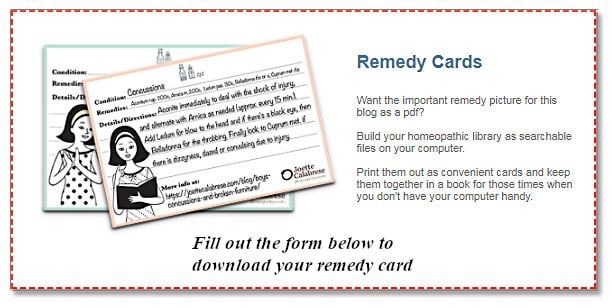
As you download your Remedy Card, remember:

The beauty of homeopathy is that there is often more than one way to butter a biscuit. I may teach additional medicines, alternative combinations, or even protocols with established variations to consider in The Academy of Practical Homeopathy®, Mastery, and my Protocol Courses. Stay curious and never stop learning.


Dr. Constantine Hering: From Determined Skeptic to Dedicated Homeopath


Joette Calabrese, Practical Homeopathy®, Dr. Constantine Hering: From Determined Skeptic to Dedicated Homeopath

My husband and I recently visited Philadelphia. While most tourists headed toward Independence Hall, the Liberty Bell or the Rocky statue, Perry and I set off on a complicated search for the gravesite of an American hero, Constantine Hering, known as the Father of American Homeopathy.

Born in 1800 in Saxony (now eastern Germany), his story is fascinating. In the 1820s, Hering was a medical student — an allopathic medical student — who was charged by his mentor with the job of writing a paper to discredit homeopathy.1

Hering began as a skeptic and jumped at the opportunity to try to prove that homeopathy was worthless. But then something interesting happened. He set out to disprove homeopathy — then devoted his life to it.

Homeopathyworks®

As part of his campaign to discredit Hahnemann, Hering, a diligent researcher, successfully replicated Hahnemann’s experiments with homeopathically prepared substances, such as Cinchona and others. Hering soon discovered — as we already know — that homeopathy works.

As a result, he abandoned his task, and the assigned book discrediting both Hahnemann and homeopathy was never published.

A couple of years later, Hering injured a finger on his right hand while dissecting a corpse for his medical training. The cut became infected — gangrenous, in fact — and he and his medical colleagues couldn’t cure the infection.

Rather than resort to the treatment of the day — amputation — which certainly would have ended his dream of a surgical career, Hering instead turned to homeopathy.2 (A prime example of TEETH, right Mighty Members? You just learned about this concept a week ago in Memo to Mighty Members #331*)

Within a day, I think it was, Hering started to notice a big shift in his injury. Then the next day, it was better yet, and soon enough, Dr. Hering’s gangrenous hand was cured.

From staunch opponent to continuing Hahnemann’s work

Through his research and diligent documentation, Dr. Constantine Hering added additional homeopathic medicines to the materia medica.

For instance, we have him to thank for uncovering the power of potentized Lachesis mutus,3 one of our premier remedies. I’ve written about Lachesis several times previously, but now you can think of Dr. Hering when you reach for that particular medicine.

After Dr. Hering’s conversion to homeopathy, he eventually moved to the United States in 1833, where he not only practiced as a homeopathic physician but also formed the Hahnemannian Society, the North American Academy of the Homeopathic Healing Art, and later the Homeopathic Medical College of Pennsylvania.4

His work was so influential, and his promotion of this paradigm was so robust, as I said earlier, he became known as the Father of American Homeopathy.

He also introduced “Hering’s Law of Cure,” a fundamental principle describing the direction in which healing should proceed — from the deepest, most vital organs outward and in reverse order of symptom appearance.”5 This law is a foundational concept in homeopathy that is still in use today.

Hering_INTERNAL

On the hunt for Dr. Constantine Hering’s grave

Dr. Hering practiced in Philadelphia. I knew that. I also knew he was buried there. So, during my recent trip to the area, I wanted to find his gravestone to pay my respects.

Unfortunately, there were two burial grounds with very similar names, but they were at opposite ends of town. Naturally, as luck would have it, we went to the wrong one first. Yet, undaunted, Perry reassured me, “I think I can find it.”

He went online, dug around using various resources, and tracked down the correct cemetery.

Once we made it there, we went to the cemetery’s map. Sounds like it should have been easy from that point, right?

Wrong.

Because there were no names for the streets — the roads weren’t named or numbered or anything — we resorted to starting at one specific place, and then we just tried to follow the curves in the road as we matched them to the map.

It was a convoluted “scavenger hunt,” to say the least. We easily spent two and a half hours searching.

But as you can see in the picture, we eventually found him. With no accolades or fanfare, Dr. Hering rests in a rather unpretentious grave, belying the importance of the man and his life’s work.

It had been a long day, but I was honored to be at the grave of such a revered homeopath, whose lasting legacy has paved the way for us today. We stand on Mighty shoulders, my friends.

Pass on the good news of Practical Homeopathy®!

Warmly,

Joette Calabrese, Practical Homeopathy®

  1. https://www.hahnemannhouse.org/constantine-hering-and-homeopathy/
  2. https://drexel.edu/legacy-center/blog/overview/2013/december/constantine-hering-the-father-of-american-homeopathy/
  3. https://www.ovid.com/journals/holin/abstract/10.1055/s-0040-1705145~dr-constantine-hering-18001880
  4. https://maescenter.com/blog/f/constantine-hering-md-founder-of-american-homeopathy
  5. https://heringshomeopathy.com/the-legacy-of-dr-constantine-hering/

*You must be logged into your Mighty Member account for protected links to take you directly to the offering.

Disclaimer: Joette is not a physician, and the relationship between Joette and her clients, students and followers is not that of prescriber and patient, but that of educator and learner. It is fully the learner’s choice whether or not to take advantage of the information Joette presents. Homeopathy doesn’t “treat” an illness; it addresses the entire person as a matter of wholeness that is an educational process, not a medical one. To be treated or diagnosed, Joette believes that the advice of a holistic physician is in order.
Claims based on traditional homeopathic practice, not accepted medical evidence. Not FDA evaluated.


Podcast 180 — Pets, Parasites and Practical Homeopathy®


Joette Calabrese, Podcast 180 — Pets, Parasites and Practical Homeopathy®

In this podcast, we cover:

01:00   Introduction: Pets, Parasites and Practical Homeopathy®

01:38   Cooper’s doing the bum-scoot boogie

03:07   Symptoms are important, but sometimes a diagnosis is needed

05:26   The premier homeopathic medicine for parasites

07:14   Homeopathy doesn’t kill parasites

09:04   The same homeopathic medicine is for animals and humans alike

10:44   Choosing between a mother tincture or potentized homeopathic medicine?

11:31   Other remedies to consider

            Parasites!

14:33   Would the whole family take this remedy?

            FindAPracticalHomeopath.com

16:10   Closing advice

Additional resources:

Joette Calabrese on YouTube (Monday Night Lives)

Joette’s Learning Center

The Academy of Practical Homeopathy®

PracticalHomeopathy.com

Gateway to Practical Homeopathy®: A Guided Study Group Curriculum

Joette’s Study Group, Find Your New Study Group Friends

Joette’s Mighty Members

Kate:

This is the Practical Homeopathy® Podcast, episode number 180 with Joette Calabrese.

Joette:

Hi, I’m Joette Calabrese, and I welcome you to our health care movement — yours, mine and the countless men and women across the globe who have retaken control of their families’ health with Practical Homeopathy®.

So, for the next few minutes, let’s link our arms as I demystify homeopathy — what was once considered an esoteric paradigm — into an understandable, reproducible, safe and effective health care solution available to all.

This is the medicine you’ve been searching for — my unique brand of homeopathy, PRACTICAL Homeopathy®.

Introduction: Pets, Parasites and Practical Homeopathy®

Joette: (01:00)

Welcome, friends. I’m Joette Calabrese, and this is the Practical Homeopathy Podcast.

Today, we’re talking about something that makes people a little squeamish. We’re talking about worms — not earthworms — parasite-type worms. And we’ll be specifically about pinworms in this particular podcast.

Now, Kate is joining me with a case about a dog who has pinworms. So, Kate, let’s get started.

So, Kate has a dog. Kate, tell us about this dog. What leads you to believe that the dog even has pinworms?

Cooper’s doing the bum-scoot boogie

Kate: (01:38)

Yeah, his name is Cooper. He’s super cute. He’s a mid-size mix, about four years old. And it makes me a little embarrassed to share this, but for the last couple of weeks, he’s been scooting across the rug. You know what I’m talking about?

Joette:

I do.

Kate:

And I’ve seen him licking back there a lot, too.

Joette:

Yeah, don’t be embarrassed, Kate. No, no. Itchy bottoms have been around as long as there have been bottoms.

So, what else is going on with this Cooper?

Kate:

So, at night he seems restless, and I’ve been Googling a lot and trying to figure out what’s been going on. And everything I read points to him having pinworms.

Joette:

It’s not been officially diagnosed by a veterinarian?

Kate:

No, I haven’t taken him to the vet yet. It’s just the signs of the pinworm — or I assume that’s what it is.

Joette:

Well, assumptions are where we get into trouble. Have you actually seen pinworms?

Kate:

No, I looked, and I haven’t seen any of those white threads or anything yet, but I thought maybe I just missed them.

Joette:

So, what makes you think, though, that they’re pinworms, or maybe they’re a different kind of a parasite?

Kate:

Yeah, I guess it could be. It’s the scooting, the licking, and once I thought I saw something in his stool, but I don’t know for sure.

He’s a little hungrier than usual, and I know that can be a sign. I’ve seen him rub his face on the carpet like he does when …

Symptoms are important, but sometimes a diagnosis is needed

Joette: (03:07)

Like his nose itches, which is a part of this. Yes, yes, yes.

Kate:

Right.

Joette:

Well, listen, we really do go by observation. Symptoms are very important. We don’t want to make assumptions.

However, I have to say scooting — especially if it’s happening a lot — and the itchy bottom could also be anal glands. It can be something else entirely.

That’s why an official diagnosis is so useful. A fecal exam could tell you whether you’re dealing with worms at all, or if so, which kind.

Now, true pinworms, Enterobius, are mainly a human story. Dogs more often have other intestinal parasites, but the picture people describe — rectal itching (because this is a human concern, too), restlessness, sometimes grinding teeth, sometimes a ravenous appetite, or the other way around, there’s no appetite.

That picture is one homeopathy has spoken to for a very long time — and in people and in animals.

Kate:

So, you think I shouldn’t just treat Cooper based on what I think it might be … a hunch?

Joette:

Well, you can start observing, and you can learn. But these are medicines, these homeopathics. And I always prefer that we know a condition is present before we use a homeopathic.

Now look, if you’ve seen this before in him and you said, “Oh my goodness, I’ve had a diagnosis, it was … that’s exactly what it was before,” that would be a slam dunk.

If you had a number of dogs and the other dogs have had this, and you witnessed it a number of times, I think that that’s a pretty decent diagnosis.

It doesn’t necessarily need to be from a professional, but I do like to be as specific as we possibly can, mostly because I guess I’m gun-shy. I’ve heard far too many people say, “I have a thyroid problem.”

“What do you mean?”

“Well, I think I have hypothyroidism.”

“Well, what do you mean you think? Has it been tested?”

“Well, no. But then I used the homeopathic medicines, and it made it worse.”

“Well, it’s probably because in the end it wasn’t a thyroid problem. It was maybe a polyp or mucus that was gathering at the back of the throat, and you were using the wrong medicine. And it can indeed confuse the picture and cause proving. So that’s why I like to emphasize the importance of really knowing what the condition is that you’re treating.

The premier homeopathic medicine for parasites

Kate: (05:26)

Okay. So, you’re saying that I should probably take him to the vet, and if it is worms, what would I use homeopathically? And then I’m concerned about my family, and what if we got these worms?

Joette:

You’re right. Yeah. That’s a concern. Yes. It’s not a horrible concern.

Pinworms are not very common in dogs in the first place, but you don’t want the … scooting across the carpet leaves the eggs behind on the carpet. That is something to be concerned about.

So, in my experience with clients, students, and even my own family — and yes, animals — the first medicine we would consider for parasites — pinworms or otherwise — is Cina, C-I-N-A.

So, people sometimes get this medicine mixed up with China, but don’t. It’s Cina.

And sometimes — just so that you know when you go to purchase it — it’s called Cina meritima or it’s Cina artemisia. It’s pretty much one in the same. They’re just different locales is the way that I remember this.

So Cina is [one of] a number of homeopathic medicines I consider for intestinal parasites such as pinworms. By the way, pinworms and threadworms are the same thing. Then, there are also roundworms in that whole gastrointestinal neighborhood.

You don’t need every keynote, my friends. And what I mean by a keynote, if you’ve studied homeopathy over any period of time and you have a materia medica, you’ll know that a keynote are the most noteworthy symptoms that the medicine addresses.

So, the grinding of teeth, itching of the nose, picking the nose — if it’s a child, picking the nose — itching of the rectum, I think we said earlier, a ravenous appetite … and those can all be there. They don’t all have to be. But sometimes all you know is … I just know that there are worms, and that’s good enough.

Homeopathy doesn’t kill parasites

Joette: (07:14)

So, homeopathy doesn’t kill parasites the way a vermicide does. I don’t know. I guess the best way to put it is it “evicts” them. It makes the body an unfriendly place to live, and then they leave.

That’s the idea.

And I’ve seen it work so many times. Sometimes, you can see the pinworms as they’re expelled. Sometimes you never see them again, and the symptoms simply abate and eventually — or maybe not so eventually — go away.

Kate:

So, how does that work if it doesn’t kill them?

Joette:

Well, it’s not a chemo — doesn’t burn. And sometimes, as I said, it will extract, but that doesn’t happen as often as you might think.

I guess the best way is just to repeat what I said. It nudges the living system, the gastrointestinal system, so the terrain is no longer hospitable, and the parasites leave, or they don’t propagate.

It’s not always, that I’ve noted, that you actually see an exit. Sometimes you can see the pinworms evicted rectally. But that’s one way you know the medicine is certainly acting, but it’s an eviction notice — not a pesticide. And the way that you’re going to know if you never see them is to just see that the symptoms start abating.

Conventional vermicides have that word that I caution people about all the time, “cide.” Vermicide. It’s in the name for a reason. We want the worms gone without treating the body like a battlefield.

Vermicide is a pesticide. “Verma,” meaning, well, vermin generally, but it actually means worms or parasites. And it can cause a lot of trouble, these kinds of drugs. Some people have no trouble at all, but for those who are sensitive, it can cause some pretty uncomfortable symptoms, if nothing else, as a side effect.

The same homeopathic medicine is for animals and humans alike

Kate: (09:04)

Okay. So, if my dog has these parasites, these worms, can I use the same medicine for a dog or a human?

Joette:

Yes. Yes. Homeopathy works on the same principle in animals as in people.

For pets with that parasite picture, I have long started with Cina and often in Cina mother tincture (so that would be MT). It’s been used for centuries for parasites in humans and animals.

And typically, it’s given twice daily for a minimum of two months. We must carry on for two months and stop with the animal — the dog — is very much better. Stop if there’s no change after a fair trial or if things have gotten worse.

I’m going to repeat that though, minimum two months, because that’s the life cycle. It’s a 30-day life cycle, and you need two 30-day cycles. Sometimes I go a little longer, even though the symptoms are much improved. Still, this is one of those situations in which you don’t go strictly by symptoms to know when to stop.

This is one of those situations that, if they are indeed parasites, you’re going to need a minimum of two months of using this.

I often use Cina in a potentized, which makes it purely homeopathic, and I use it in a 3C, a 6C. I’ve used it in a 30C, but I usually like to go with lower potency, like a 3 or a 6.

So, I urge it being used twice daily for minimum of two months, more likely three months because these parasites have a life cycle, and it’s, usually, it’s a 30-day cycle. But that means there are eggs. And just in case there are eggs that remain, by all means, I would carry on for the longer period of time just to be extra safe.

Choosing between a mother tincture or potentized homeopathic medicine?

Kate: (10:44)

Okay. So, I know you mentioned Cina mother tincture (MT) and then Cina 6 or 3. How do I choose which to use?

Joette:

Well, Cina mother tincture has been used for centuries. And of course, homeopathy has been used for at least two centuries as well. So, you really do have a choice.

Now, mother tincture means it’s in alcohol. So, if you don’t want the animal to get any alcohol, you wouldn’t put it directly into their mouth anyway. You’re going to put it in water, but they might not drink the water because of the taste.

That could preclude the decision, help make the decision, firm it up so that it’s pretty clear that we’re better off perhaps just using it potentized because then there’s no awful taste.

Kate:

So, if it’s for the dog, I could choose a 3C or a 6C potency.

Joette:

That’s what I would use. Yes, for a dog. Yes.

Other remedies to consider

Kate: (11:31)

And what if Cina — after that two to three months — what if the dog, I go maybe back to the vet and confirm that the dog still has these parasites, what would I do then?

Joette:

Well, let me just say that in my experience, it doesn’t fail.

However, should it fail, just be sure that … are you treating the condition you thought you were treating?

But then there is another medicine to consider, and that’s Teucrium, Teucrium marum. And the keynotes can include intense rectal itching — again, not a little rash itch, but more like a pinch itch. That’s the way it’s been described to me … and sometimes that shudder-like involuntary movement.

But Teucrium marum, twice daily for several months, has also been used in my practice.

Now, if Cina and Teucrium have both had their due time, a third consideration might also be Spigelia, Spigelia anthelmia [anthelmintica] 200C. And that’s also twice daily for several months because Spigelia too is noted for worms, including pinworms.

But I’m going to revert back again, and I’m going to say even with all of these medicines — I’m going to also talk about Sulphur here as well — Cina has not failed me.

I’ll give you one more medicine, just in case. So further down the line, if needed, Sulphur 30C can be considered when the itching has a burning quality.

Now, you wouldn’t know that if it’s a dog, but you may see it in other respects. They might have other aspects of Sulphur presenting.

They could be, maybe, a dirty dog. I mean, they don’t want to be washed, or you wash them, and they get dirty immediately. Or they’re very hot; they have an odor; they don’t like to be washed, et cetera.

So, I’m kind of giving you a broader picture of Sulphur, particularly because Sulphur is such a great homeopathic remedy on all fronts for many dogs — especially mutts — whether it’s for parasites or even other conditions. So, that’s why I wanted to spend a little bit more time on considering knowing how to use — or what is incorporated under — the category of Sulphur.

And one other thing: They could be a very lazy dog. They gobble their food. They have other skin conditions or itching.

So, those are the top medicines to consider. And again, I hope I’ve emphasized it enough that Cina usually does the trick.

Kate:

So, I think I’ve seen on your blog, Joette, that you’ve written about this as well. Would you recommend I go and do some more research there, or …?

Joette:

Well, definitely use my blog. There it is for the asking. It’s free. It’s readily available.

You can send people to it if they have a concern — or whether it’s on parasites or whatever it might be — but always read more on the topic, always. You want to know what you’re using because again, we don’t want to take this frivolously.

These kinds of conditions … they might be a little annoying, but parasites left untreated can cause more havoc than you might think in some people, in some dogs.

Would the whole family take this remedy?

Kate: (14:33)

So, if it’s confirmed that my dog has parasites, would I have the whole household take this Cina, or what would you suggest?

Joette:

Yeah, good question. So, pinworms can spread from animal to human. If one pet or one person truly has them, it’s not unusual for others in the household to have them as well.

So, hygiene still matters. Clean hands, clean nails. Don’t be reckless … shared bowls of popcorn.

Don’t become a prisoner of boiling every sheet at midnight, however, because that can drive you crazy. If you look up pinworms and what has to be done in a household to address them, you might be absolutely made into a neurotic mother.

It doesn’t take much because they talk about boiling the sheet every day. If it’s a family, if it’s a dog, then you’re boiling the dog’s bedding; you’re scrubbing all around the area. It’s really maddening.

Homeopathy, however, brings us peace of mind. And again, know what you’re treating. Often a test is using a tape test or a proper stool test is not old-fashioned.

It’s just clarifying, so you may want to go that far.

Kate:

Okay. So bottom line, my homework is: Get Cooper checked out and get a diagnosis.

Joette:

Yes, yes. And watch him. Write down what you see: the scooting, the licking, appetite, sleep, the visible worms, itchy nose, et cetera.

And then you and your veterinarian — if you study homeopathy or work with a homeopath who understands Practical Homeopathy® — you can choose from the knowledge instead of a late-night search on TikTok.

Kate:

Okay. Sounds great, Joette. Thanks for your help.

Closing advice

Joette: (16:10)

Alrighty. So, friends, let me say this plainly as we close. Often, an official diagnosis is important and helpful. It keeps us from treating the wrong thing. It keeps us from calling every itch, itchy rear end or itching anywhere else as pinworms. It gives the medicine a fair job and gives you a fair jump ahead.

You do not need to be frightened by parasites. The internet will try to frighten you: shopping cart handles, schoolyards, et cetera. Use common sense, wash your hands, observe.

And remember, we have a method that is gentle and, in my clinical experience, powerfully reliable when it’s used as a medicine and not as a usual or casual cleanse and not as a just-in-case.

So, my friends, you are capable: your care for your pets, for your family, your children. And your children will grow up watching you solve these conditions with this method, Practical Homeopathy®. And they’ll learn by watching because this is what their family simply does.

So, share what you learn with your family and friends and your children and grandchildren. Share your successes because with Practical Homeopathy®, you’ll be able to enjoy an itch-free life of health freedom.

So, if you know someone who might benefit from listening to this podcast, take a minute now and share this episode with them. And once again, thank you for being willing to ask the awkward question. And Kate, thank you for being willing to ask that question. That’s how families learn.

It’s my honor to share many lessons on this simple method of using homeopathy for free —without affiliates or advertising — here in my podcasts, but also my blog posts and Monday Night Lives.

But it’s critical that you learn how to use these medicines properly. These podcasts should serve as only the beginning of your training. Peruse JoettesLearningCenter.com to find fun study group opportunities and in-depth courses developed by subject.

So, with the proper training, you can join the thousands of students before you in developing the confidence and competence to protect the health of your family and loved ones with my brand of homeopathy, Practical Homeopathy®.

Kate:

You just listened to a podcast from internationally acclaimed homeopath, public speaker and author, the founder of The Academy of Practical Homeopathy®, Joette Calabrese. Joette’s podcasts are available on all your favorite podcast apps.

To learn more and find out if homeopathy is a good fit for your health strategy, visit PracticalHomeopathy.com.

Disclaimer: Joette is not a physician, and the relationship between Joette and her clients, students and followers is not that of prescriber and patient, but that of educator and learner. It is fully the learner’s choice whether or not to take advantage of the information Joette presents. Homeopathy doesn’t “treat” an illness; it addresses the entire person as a matter of wholeness that is an educational process, not a medical one. To be treated or diagnosed, Joette believes that the advice of a holistic physician is in order.
Claims based on traditional homeopathic practice, not accepted medical evidence. Not FDA evaluated.


What Constitutes a Homeopathic Protocol: A Peek Into Practical Homeopathy®


Joette Calabrese, Practical Homeopathy®, What Constitutes a Homeopathic Protocol

The mission of Practical Homeopathy® — my mission — is to demystify homeopathy and make it an understandable, reproducible, safe and effective healthcare solution available to all, especially mothers and their families.

However, I face a conundrum as I write these weekly blog posts. You see, when writing for the general public, I’m addressing a broad audience.

One reader might be brand-spanking-new to homeopathy with no foundational information whatsoever. Zip, zero, zilch. They may not even know how to pronounce the word. For them, I must constrain myself to providing simple guidelines they can follow.

Another reader could have decades of experience with this paradigm. Maybe they were using the classical methodology and are coming over from that. Maybe they’ve been in Gateway study groups and taken a few of my courses. Maybe they’re graduates of The Academy of Practical Homeopathy® who still want to read everything they can get their hands on.

I always endeavor to strike that balance. This is a heavy task when you think about it — trying to get this information out in the simplest way possible.

What is a homeopathic protocol?

I use the term “protocol” quite often. However, it recently came to my attention that not everyone has a firm grasp on exactly what that means.

Homeopathic protocols are clinically proven methods of treatment stipulating specific homeopathic medicines, with specific potencies and frequencies, to address specific conditions and symptoms.

Being considered a protocol also means it has a history behind it. Established homeopathic protocols are based on data accumulated over decades, if not centuries. For instance, the French Protocols were developed in the mid-20th century. The Banerji Protocols have been proven over the last 150 years.

Protocols are well-documented, data-driven formulas developed by practicing homeopaths around the world. When followed precisely, their results are historically shown to be reproducible.

That means no tinkering, my friend. If the protocol says to use the medicine twice a day, we use the medicine twice a day. If the protocol calls for the medicine to be in liquid, we purchase the remedy in liquid from a reputable pharmacy. If the protocol says use a 200, we use a 200. Not a 6. Not a 30. Not a 1M.

When we follow established protocols exactly as outlined, we can expect the same results. (Download your free Remedy Card below, which details one of our most trusted protocols for the onset of colds and flu.)

Joette Calabrese, Practical Homeopathy®

Are protocols the only choice for a condition?

The Banerji Protocols have an astonishing success rate: 80-85% of cases will respond to the first-line Banerji protocol (the most highly recommended). So, by utilizing a protocol, healing can often be that simple.

Yet, the beauty of homeopathy is there is often more than one way to butter a biscuit. I may teach additional medicines or alternative combinations of remedies in The Academy, Mastery and even my Protocol Courses. I will even point out that there are protocols with established variations.

So, a serious student should always rely on what they learned in class, understanding that information in blogs and other free lessons must be distilled down into the simplest, easiest-to-follow information. Other alternatives in my formal classes are designed for those with a deeper foundational education in case management.

Just because a medicine acts doesn’t make it a protocol

I’ve had students tell me that they’ve come up with their own protocol. While indeed they may have found an effective medicine choice that works in their particular setting, they have not developed a protocol as such.

There are many instances in which a particular remedy works splendidly for a sufferer, but success alone does not a protocol make.

Remember: A protocol is a standardized remedy choice proven over years of repetition and clinical observation. Skilled homeopathic experts have made that choice formulaic, giving us the name of the condition, the medicine that’s been most successfully used, the potency in which we use it, and the frequency with which we use it.

To learn more about protocols, listen to Podcast 146 regarding my Gateway to Practical Homeopathy® study groups. If you’ve not yet been a member of a study group, that is the next step to learning foundational information and protocols that your family may most commonly need.

Tens of thousands of folks just like you have stepped through my Gateway to become the healers in their family. Many of those students move on to a deeper education to gain the skills to meet almost any condition — whether there is an existing protocol or not.

This method — my method — of practicing homeopathy, including protocols, is not esoteric. It’s not quixotic. It’s practical. Practical Homeopathy®.

Warmly,

Joette Calabrese, Practical Homeopathy®

P.S. If you enjoy this content, please share it. Also check out my podcasts, Monday Night Lives, and connect with me on YouTube, Instagram and Facebook.

And remember — all my Mighties (Joette’s Mighty Members) qualify for a 10% discount on course purchases. If you need assistance getting your discount, email [email protected] for more information.

Disclaimer: Joette is not a physician, and the relationship between Joette and her clients, students and followers is not that of prescriber and patient, but that of educator and learner. It is fully the learner’s choice whether or not to take advantage of the information Joette presents. Homeopathy doesn’t “treat” an illness; it addresses the entire person as a matter of wholeness that is an educational process, not a medical one. To be treated or diagnosed, Joette believes that the advice of a holistic physician is in order.
Claims based on traditional homeopathic practice, not accepted medical evidence. Not FDA evaluated.


Bronchitis, Epithelial Cells, and a Stubborn Cough Only When Lying Down


Joette Calabrese, Practical Homeopathy®, Bronchitis, Epithelial Cells, and a Stubborn Cough Only When Lying Down

Remember the KISS Principle? It’s a clever acronym from the 1960s for “Keep It Simple, Stupid.” It means the least complicated solution is probably the best solution.

The KISS Principle applies across many industries — aircraft design, software design, technology and even marketing — and it equally applies in Practical Homeopathy®, too.

Some time ago, I received an interesting question: “What homeopathic remedy applies to bronchitis with epithelial cell involvement?”

Wow. That sounds so specific and complex, doesn’t it? But in reality, it’s not telling me much.

To quote the National Institutes of Health, “Epithelial cells of the lung are located at the interface between the environment and the organism and serve many important functions including barrier protection, fluid balance, clearance of particulate, initiation of immune responses, mucus and surfactant production, and repair following injury.”1

In other words, epithelial cells exist as a natural part of lung health.

I am not a pulmonologist

My friends, I’m not a doctor. I don’t even play one on TV, as the old joke goes. So, I am in no position to argue the validity of a conventional diagnosis.

What I am is a wife of an athletic, adventurous husband, a mother of three adult boys, a grandmother of two, and a Practical Homeopath™ who’s been in practice for almost 40 years. From all that life experience and homeopathic clinical expertise, I can tell you we needn’t always bog ourselves down in the complex terminology of a conventional diagnosis.

People often try to extract the words the doctor used to describe their condition and insert them right into homeopathy. For instance, this reader was saying, “Okay, the diagnosis mentioned epithelial cells, so what’s the remedy for epithelial cell bronchitis?”

Is that the question we should be asking? Is that really what we should infer from the diagnosis? Or is the condition simply garden-variety bronchitis (KISS)?

Look, sometimes, we can use the conventional diagnosis, and it slips right into place in homeopathy. Other times, it simply overcomplicates the issue.

Doctors often include medical adjectives to describe a condition. It’s not that the doctor is wrong; it’s that the person getting this information doesn’t know how to translate the descriptives into the homeopathic world.

How is the bronchitis presenting?

“What’s happening with the lungs? Are you saying that there’s a cough?”

“Yes, there’s a cough!”

“Okay, now tell us what the cough is like. How did you describe the condition to the doctor?”

“I’ve got this cough, and it’s always when I lie down. I can’t stand it! I only cough upon lying down.”

Ah-ha! Now we’re getting somewhere.

Joette Calabrese, Practical Homeopathy®, Bronchitis

Bronchitis, epithelial cells … or, more simply, a cough that occurs when lying down

Although I often say you want to use the diagnosis, sometimes we benefit more when we translate medical language into plain language that better describes the symptoms. The extraneous twenty-five-cent terms in a diagnosis may be fascinating in the conventional medical world, but they don’t give us what we need.

In other words, we have to get down to brass tacks. What is this? It’s just a cough that’s worse when lying down.

I’ll share with you a remedy from a case I don’t believe I’ve ever talked about before: Aralia racemosa 30C.

Aralia is a great remedy for coughs that occur only when lying down. Sometimes the cough begins as soon as the sufferer reclines into bed. Other sufferers start coughing upon waking, after they’ve been asleep for a bit.

Generally, Aralia racemosa 30C would be employed upon commencement of the cough and repeated according to severity. If the cough continues, another dose may be required in short order. If the cough resolves for the night, another dose may not be required until the next evening.

Then, when very much better (meaning the cough doesn’t occur upon lying down anymore), we halt the use of the medicine. We can always take it up again, if necessary, should the condition arise again.

“Keep It Simple, Stupid” in every condition

I’ve often said my best clients were the Amish men who plowed the fields. They didn’t overcomplicate things. They’d say, “I’ve got this pain in my shoulder every time I move, and it feels like it’s grinding.”

That’s it!

If his shoulder pain only hurts with movement (when plowing), it’s very likely the joint.

If it’s joint pain, it’s arthritis.

Therefore, we immediately consider the leading homeopathic remedy for arthritis, Rhus tox.

KISS. That’s your lesson for today, my friends.

In Practical Homeopathy®, we need a simple diagnosis and, perhaps even more importantly, the presenting symptoms. We can then determine which potential homeopathic medicine is the tightest-fitting, most appropriate for the condition as it is being experienced. (Epithelial cells notwithstanding.)

Pass on the good news of Practical Homeopathy®, and if you enjoy this content, please share it. Also check out my podcasts, Monday Night Lives, and connect with me on YouTube, Instagram and Facebook.

Warmly,

Joette Calabrese, Practical Homeopathy®

P.S. I taught this same concept to my Mighty Members back in 2023, in Memo to Mighty Members Tip #150.*

Would you believe that since that time, my Mighties have received 180 additional exclusive blog posts and lessons? If you are not a Mighty Member yet, think of everything you are missing.

Join us today and delve into the archives to enhance your homeopathic education. All that knowledge is just waiting for you.

  1. https://pmc.ncbi.nlm.nih.gov/articles/PMC4457445/

Disclaimer: Joette is not a physician, and the relationship between Joette and her clients, students and followers is not that of prescriber and patient, but that of educator and learner. It is fully the learner’s choice whether or not to take advantage of the information Joette presents. Homeopathy doesn’t “treat” an illness; it addresses the entire person as a matter of wholeness that is an educational process, not a medical one. To be treated or diagnosed, Joette believes that the advice of a holistic physician is in order.
Claims based on traditional homeopathic practice, not accepted medical evidence. Not FDA evaluated.


Podcast 179 — Practical Professionals: Combining Nursing, Faith and Practical Homeopathy®


Joette Calabrese, Practical Homeopathy®, Podcast 179 — Practical Professionals: Combining Nursing, Faith and Practical Homeopathy®

In this podcast, we cover:

00:58   Introduction: Combining Nursing, Faith and Practical Homeopathy®

02:49   Faith community nursing

10:33   Incorporating Practical Homeopathy® into nursing

            The Academy of Practical Homeopathy®

12:15   Success Story: Aches, pains and anticipatory anxiety

14:09   Success Story: Eczema

            Escape Allergies, Chemical Sensitivities, Food Intolerances, and More with Homeopathy: Practical Protocols to Get Your Life Back

            A Success Story: Atopic Dermatitis

            JoetteCalabrase.com

            Joette’s Learning Center

            FindAPracticalHomeopath.com

17:53   Jump. Leap into Practical Homeopathy®. Don’t look back.

20:19   Closing Advice

Additional resources:

Joette Calabrese on YouTube (Monday Night Lives)

PracticalHomeopathy.com

Gateway to Practical Homeopathy®: A Guided Study Group Curriculum

Joette’s Study Group, Find Your New Study Group Friends

Joette’s Mighty Members

Kate:

This is the Practical Homeopathy® Podcast, episode number 179.

Joette:

Hi, I’m Joette Calabrese, and I welcome you to our health care movement — yours, mine and the countless men and women across the globe who have retaken control of their families’ health with Practical Homeopathy®.

So, for the next few minutes, let’s link our arms as I demystify homeopathy — what was once considered an esoteric paradigm — into an understandable, reproducible, safe and effective health care solution available to all.

This is the medicine you’ve been searching for — my unique brand of homeopathy, PRACTICAL Homeopathy®.

Introduction: Combining Nursing, Faith and Practical Homeopathy®

Kate: (00:58)

Hi everyone, and welcome to the Practical Homeopathy® Podcast.

I’m Kate, and I am so glad you’re here with us today. This is the place where we show you how Practical Homeopathy® can become a real, everyday tool for taking care of yourself and the people you love.

Whether you’re brand new to homeopathy or you’ve been studying it for a while, these conversations in this podcast are meant to encourage you, equip you, and remind you that you are not alone on this journey.

Today, I have the pleasure of talking with Kena. Kena has been married nearly 40 years. She’s the mother of three adult children and a proud grandmother. Arizona has been her home most of her life, and faith, family and nursing have always been the foundation of who she is.

After years of working as a nurse, Kena discovered faith community nursing, and immediately, she knew it was where her heart for people and faith could come together. She’s currently serving as a volunteer faith community nurse in her church, caring for others physically, emotionally and spiritually.

Her path to homeopathy began when her aunt received a serious diagnosis and conventional medicine offered limited options. Watching her aunt improve with homeopathy and lifestyle changes lit a fire in Kena.

She spent years searching for solid homeopathic education until she found Joette’s podcast a little over a year ago, and she just recently finished The Academy of Practical Homeopathy®.

She’s seen beautiful results with homeopathy, and I can’t wait for her to share some of her stories, including a story about eczema. Her heart’s desire is to blend her nursing experience with Practical Homeopathy® so she can serve her family, friends, church, community and the next generation.

Kena, welcome to the podcast.

Kena:

Hi, thank you. Thanks for having me.

Faith Community Nursing

Kate: (02:49)

Absolutely. I can’t wait to get into your story.

So, let’s start out by — if you wouldn’t mind — sharing a little bit about your journey. And I’m really interested in that nursing component where you made a little bit of a shift after a career in nursing, and now you went into faith community nursing, and now that’s becoming integrated with your homeopathy education. So, talk to us a little bit about that journey.

Kena:

Sure. Interestingly enough, my mother was also a registered nurse, so it kind of runs in the family — or a miasm, I guess. (A little humor there.) But that to be said, I did traditional bedside nursing, medical floor, went through the AIDS epidemic at bedside, so it was really relevant to things that we’ve encountered in more recent years with that experience.

But somewhere along the way, I knew that I wanted to take the education I had and be of service to others outside the hospital setting, with people that would come to me saying, “Well, you’re a nurse, what do you think?” And I had to be so thoughtful about what to do with that.

So, I discovered that there was a way to combine that with my faith. It used to be called parish nursing, but they broadened that term to be called faith community nursing. And every state board of nursing is regulated differently, so it may not apply to every state.

In the state that I reside in, which happens to be Arizona, it is a recognized discipline and a scope of practice that they apply to nurses who want to pursue that to maintain an active RN license, which is what I chose to do.

And my reason for doing that was so that I could bridge the gap with the people that I had a lot of relationship and conversations with, within an appropriate way … in terms of how do I bridge the knowledge and experience I have with my nursing, coupled with the unique community that I have a relationship with.

In order to do that, there was a group — I don’t think they’re offering it now, probably because of funding — where I did some training that taught me basically how to apply my experience and knowledge in a faith community setting. And so that’s pretty much how I stepped into that … and to this day.

Kate:

So, for those people who might be listening to the podcast, and they’re a nurse, and they want to explore this option in their state or maybe even Arizona: What tips do you have to help them explore this option?

Kena:

Great question. There’s a couple of organizations. If you do an internet search and insert the term either “parish nursing” or “faith community nursing,” and a couple of organizations will pop up.

From there, you can read through educational opportunities. You can get very certified, so to speak. You can make it very technical, but it’s not required for all boards of nursing. It can simply be a declaration of what you’re doing.

Now, it is important for those that choose to do that, at least in my state, to keep records of your hours, whether you’re employed in that role or, in my case, I volunteer those hours. So, it’s recorded and documented to show that I’m actually providing that kind of education to the folks that I serve.

Kate:

That’s so interesting, and thanks for that information. I’m sure there are people who want to look into this.

What is the highlight of this new direction that you’ve gone with nursing and working with your faith communities?

Kena:

Highlight is, I think, it’s a really necessary gap. It’s a bridge of trust. And so, it also is very weighty in that I think it takes you to the highest standard of accountability personally, morally.

Kate:

Yes.

Kena:

I don’t know how else to say it. At least that’s how I feel about it.

Just because of the familiarity of knowing somebody, I always have in the back of my awareness that they’re viewing me through a different lens — a trusted lens. And it certainly is not my desire in any way, shape or form to ever needlessly betray that out of stepping out of my scope of practice when I’m in that role or otherwise.

Kate:

So, do you have any tips for nurses who want to do this now that you’ve made that transition and been doing this for a while?

Kena:

I think every individual is unique, and also how they connect that with their expression of faith.

But I guess for me, if I were to say, “tips” and put it in that way of thinking, I would say it has to come from your heart. It’s not just a technical skill. It’s not as simple as taking vitals at bedside, so to speak, or hospital-setting type interests. It’s a deeper level.

It has to be something where you feel really connected with from an innermost being, in service to others with respect to who they are, where they’re at, but also remembering it is still a scope of practice, and with that goes an understood code of conduct.

So, it doesn’t give you permission, so to speak, to step into clergy role unless it’s defined in some particular way by a body, I would assume, or a group. I don’t know.

In my case, it’s strictly understood when I do that in terms of more health education — a bridge of understanding — but someone that understands how that works within the expression of faith for that group.

So, I think it’s really important to be connected to the group and share a common set of values and stay within what is defined as within that group.

Kate:

What does that look like on a regular basis? Do you go to a building to see people? How do they come to see you, or do you go to their homes, or what does that look like?

Kena:

Typically, someone is reaching out by email, text, phone calls — all those kind of ways — and it can be all of the above. It could be a phone call; it could be an email.

Or, for example, a situation I can think of that illustrates this: They had their extended family member in a hospice setting. And so, I came in service as a faith community nurse to the congregational members to support them in terms of that environment. Even though they didn’t have a lot of questions, just to support them in that environment and answer any questions that would be helpful for them in that setting.

And so, that’s going to a physical place when that’s requested, or in the home or in the hospital. I’m very comfortable in that environment. And so sometimes, it’s just reassuring to have somebody that you kind of feel like is on your side that can bring clarity to what’s going on with respect to where you’re at at that time.

Kate:

Kena, this sounds so beautiful. I get chills just listening to you talk about this.

What if I’m a person who wants to, say, look for someone like that in my community … someone, a faith community nurse? How would I go about finding that? Do I talk to a local churches and just see if they know of anything, or how do I find someone like you?

Kena:

Well, that probably would be a bit of a challenge. I wouldn’t say it’s the majority of folks out there. In fact, a lot of nurses I’ve encountered had no idea that it even existed.

So, I think the first place I would stop … if I was really trying to choose, I would reach out to the state board and see if there’s any way that they provide a list.

If not, I would start out with my local place that I participate in, a place of faith, or ask if anybody there knew of a congregation of some sort that supported that.

But typically in my experience, nurses know each other. Word gets around. Especially if you say it’s a secret, we’ll find out.

Incorporating Practical Homeopathy® into nursing

Kate: (10:33)

All right, let’s transition a little bit because now you’ve been learning homeopathy for quite a while, and you’ve recently just completed the final exam for The Academy of Practical Homeopathy®.

It’s a whole new world that has opened up now that you’re not studying all the time, I can imagine.

So, tell me about how you are integrating homeopathy in with what you do, and what would you say that that advantage that that provides you and those that you help?

Kena:

Great question. First, I start with family. Always starts at home for me. I just absolutely believe that. If it’s not happening at home, I’m not really feeling too encouraged to take it anyplace else because that’s where my heart is.

So, for me, it’s been applying the principles of homeopathy and all the good it does for my immediate family and my extended family.

Then from there, in terms of how that extends further now with the faith community piece, my primary role is education and making people aware of options, choices, answering questions more so than anything else. It’s giving people the information that allows them to make a truly informed decision about their healthcare, what might be a fit for them or not.

For example, I’ve done this several times, and it feels so good when I can direct them to Joette’s website. They can read for themselves, and then, if they have questions, then they can refer those questions back to me for context.

So, it’s not a whole lot different than what I’ve done with the faith community nursing at bedside in a conventional setting. Now it’s a bridge of understanding from, I feel, trusted sources like Joette and The Academy to expand that knowledge when they’re making decisions about their well-being.

Success Story: Aches, pains and anticipatory anxiety

Kate: (12:15)

Yeah, that’s great.

So, speaking of starting at home, I know you have some stories to share.

Kena:

That’s true.

Kate:

So, would you just get into a couple of those ways that you’ve used homeopathy to help with various conditions?

Kena:

Sure. Try to go through every possible way it’s been used, but I’ll give you some quick ones.

I do have a few aches and pains here and there. I do a lot of physical work, and, so, I use Rhus tox, and it works for me consistently. I’m telling you, I feel like I’ve lost 10 years off of my body in terms of aches and pains. It’s just wonderful.

Here, though, we don’t get a lot of rain in Arizona. We talk about wishing for it often. When we do get what we call our monsoon season, it’s notable, and a lot of us feel it before it starts.

And so, Kali bichromium [bichromicum] to the rescue for headaches that I sometimes experience with the rare rains that we get … which was recent.

So, that was just about three weeks ago. I thought, “I know what to do for this.” And so, the rain is truly a blessing, with something to calm the other part that comes with it.

Another thing, which is so relevant … and I laugh: Before our recent exams, I thought, “Gosh, I think I’m really nervous about this. I haven’t been this nervous since I took my state boards for nursing a really long time ago.”

And so, I thought, “Wait, I know what to do for this.”

I took Gelsemium. And I am not making this up, guys — I know you all believe me — but after about three doses, I felt like I could think again. I almost didn’t recognize myself. I thought, “Gosh, guys, you say it, but this really works!”

I mean, it really worked. I felt about as calm as a person could.

Kate:

What potency did you use? Gelsemium 30?

Kena:

I did Gelsemium 30. I took it twice a day, and by the third dose the next morning, I could really tell that all was much better.

Kate:

Wonderful.

Success Story: Eczema

Kate: (14:09)

You also have a story about eczema, and it seems like so many people deal with eczema these days. So, share with us what you did for your granddaughter.

Kena:

One of the things that … I’ll just say she’s one of my “whys,” as you might imagine.

She has had quite a bit of issue with eczema since she was a toddler, I would say, that was distinguishable. It was brutal at times, all the way to waking up at night with the bleeding and all that one can know about that, either reading or experiencing it. It was heartbreaking to me.

And so, once we had enough information from our coursework, I knew exactly where I wanted to go with that. So, I introduced our granddaughter to the homeopathy, basically. (Parent approval … and that’s very important. You got to honor your family at all ages, including adult children.)

It was a slow process, but it started improving … started improving slowly, started improving slowly. Obviously, there’s dietary considerations and gut health issues there, but it got better and better and better. And it’s very minor now, is what I’m going to say.

And so, if nothing else was accomplished this whole year, just that for her is enough to bring tears to my eyes.

I feel like she got her life back. I’m so grateful. No words.

But yeah, the protocols work. Balancing that out with a bigger-picture course material — so important because everybody’s so unique in their situation. I just couldn’t be more grateful.

Kate:

So, for those people who might be listening and wondering, “How do I help my daughter or granddaughter or relative? What information can I share with them about eczema?”

Kena:

What I think is so important … and I’m going to go back to my roots about informed decision-making. I think education and information is a starting point. The “a pill for every ill” is not relevant here. It doesn’t work. But when you take it in context of reading and understanding from trusted resources, then you can step into what works more safely.

Instead of just throwing random darts at a wall, so to speak, you can have a strategic way to see if something’s working for your needs.

So, for example, if someone came to me and I didn’t have this experience and I hadn’t had the schooling yet, what would I do? Let’s say I was in the discovery phase of that. I would immediately go to Joette’s website. Why? Because I can reference material there and get context. If I felt like I had enough base on that to at least take steps forward, I might start there.

If not, I would reach out to see if there’s somebody they could recommend that could guide me in that process if I didn’t have a way to do that myself. That’s exactly what I would do.

Kate:

I know Joette has a blog called A Success Story: Atopic Dermatitis. People could just search for even “eczema” in the search function at JoetteCalabrase.com.

Also, I think the Allergic?! course is really great. Lots of information about allergies, eczema, and those kinds of issues. And I know that’s one of the courses that you went through in The Academy, Kena, correct?

Kena:

Yes.

Kate:

And that’s a course that you can take. You don’t have to go through The Academy to take that course. You can just go again to JoettesLearningCenter.com, and there you’ll find all of Joette’s courses.

And as you mentioned, if they wanted help because this is something that they didn’t feel like they wanted to take on, there are homeopaths such as yourself at FindAPracticalHomeopath.com. You can go there and look at those who have graduated from Joette’s Academy of Practical Homeopathy® and Mastery and choose a homeopath that could help you.

Jump. Leap into Practical Homeopathy®. Don’t look back.

Kena: (17:53)

I’d also like to add, this has been quite a year of learning and growing filled with gratitude that will last the rest of my life. It will allow me to impact those that I most care for and those that I’m privileged to care for with what I feel are the best tools available.

However, one thing, if I could share with anybody who might be listening to this and even thinking about The Academy of Practical Homeopathy® or just taking an individual class: I did not have a wide background before starting.

I think I heard of Joette’s blog and podcast a few months before enrollment began, and I looked at it, thought about it, prayed about it, talked with my husband about it, and then I dove in.

And I could not possibly say enough that if you’re even slightly thinking about it, I’d encourage anybody to pursue it, to dive in with both feet, with both hands, whatever part of your body, jump, leap, don’t look back.

Why I say that is this: Everything that was shared to my experience has been true. When Joette says, “I know how to teach this,” she knows how to teach this. All different learners.

When it was emphasized your study group is so important, it’s the truth. It’s the absolute truth.

I learned so much and continue to from my study group classmates. I couldn’t have done it without them. I couldn’t have done it without … obviously, with The Academy, couldn’t do it without any of you. But it truly becomes a different family of care.

It’s a shared journey, and that alone is going to help you with anything else that’s going on in your life — not only for your own well-being — but putting you in a position to be of service to others in a way you couldn’t achieve any other way without this Academy.

Kate:

Oh, that’s so special. I’m glad that you shared that. It’s really exciting to hear students talk about their study groups and how close they’ve gotten with their study group members and how, like you said, it’s become lifelong friends and a second-almost family that they get to do life with and help each other and support one another, share information.

So, yeah, I’m so glad that you had that experience, and I can’t wait to see where this takes you in the future now. Hopefully you’ll be graduating soon. And then are you moving on to Mastery?

Kena:

I’m waiting to see how it turns out.

Closing advice

Kate: (20:19)

Okay. Well, so that decision is yet to come.

But do you have any final thoughts, Kena? I’m grateful for what you shared and wondered if you had anything else that you wanted to talk about before we end the podcast.

Kena:

No, just to say thank you from the bottom of my heart — and whether they keep it or not — Kate, you need to know what a blessing you are. You’re the person that I talked to first. You’re the person that I talked to a month ago, and now this is full circle for me, so my cup is overflowing. Thank you.

Kate:

Oh, you’re so sweet. Yes, you’re so welcome. It’s very special to be able to interview you and to watch you grow and see where this takes you. Thanks for sharing, Kena.

Kena:

Thank you so much.

Joette:

It’s my honor to share many lessons on this simple method of using homeopathy for free —without affiliates or advertising — here in my podcasts, but also my blog posts and Monday Night Lives.

But it’s critical that you learn how to use these medicines properly. These podcasts should serve as only the beginning of your training. Peruse JoettesLearningCenter.com to find fun study group opportunities and in-depth courses developed by subject.

So, with the proper training, you can join the thousands of students before you in developing the confidence and competence to protect the health of your family and loved ones with my brand of homeopathy, Practical Homeopathy®.

Kate:

You just listened to a podcast from internationally acclaimed homeopath, public speaker and author, the founder of The Academy of Practical Homeopathy®, Joette Calabrese. Joette’s podcasts are available on all your favorite podcast apps.

To learn more and find out if homeopathy is a good fit for your health strategy, visit PracticalHomeopathy.com.

Disclaimer: Joette is not a physician, and the relationship between Joette and her clients, students and followers is not that of prescriber and patient, but that of educator and learner. It is fully the learner’s choice whether or not to take advantage of the information Joette presents. Homeopathy doesn’t “treat” an illness; it addresses the entire person as a matter of wholeness that is an educational process, not a medical one. To be treated or diagnosed, Joette believes that the advice of a holistic physician is in order.
Claims based on traditional homeopathic practice, not accepted medical evidence. Not FDA evaluated.


A Breast Biopsy Story: ‘To Everything There Is a Season’


Joette Calabrese, Practical Homeopathy®, A Breast Biopsy Story: To Everything There Is a Season

Whether you have drawn your philosophy from the Bible or from The Byrds’ 1965 song, the message is the same.

Both Ecclesiastes 3:1-8 and “Turn, Turn, Turn” reflect:

“To everything there is a season,
A time for every purpose under heaven:
A time to be born,
And a time to die;
A time to plant,
And a time to pluck what is planted;
A time to kill,
And a time to heal; …”

And there is a time for conventional medical procedures.

A student and friend (we’ll call her Tammy) recently contacted me about discovering a lump in her breast.

Now, we can’t tell whether a lump is benign or malignant by the way it feels to the touch. We don’t have X-ray vision, so we can’t examine the tissue beneath the skin. When we feel something is wrong — a pathology exists — a diagnosis is warranted.

My friend, that’s where conventional medicine can shine: diagnostics.

A wise conventional doctor in California (the same one who carried Arnica montana in his scrubs’ pocket) once said, “Simply seeing a doctor for a diagnosis doesn’t mean you’re committing to following all their subsequent recommendations. Getting a diagnosis is often the only way to get the facts you need to make informed decisions.”

Indeed, there’s a season for everything.

Choose your doctors well

I was lucky when I was younger. If I had a medical issue, I was able to go to my cousins who were doctors. They’re gone now, but if I had something wrong, I counted on their honest and candid opinions. With me, they didn’t have to worry about protecting themselves legally as most doctors must in our litigious society.

If something similar were wrong with me now, I would choose a nice, old, gray-haired OB-GYN who has palpated so many breasts that they would say, “I don’t know. It doesn’t seem like we should get overly upset about this. On the other hand, when these show up, it’s a good idea to have them checked.”

That’s what we’re looking for: a doctor who has the experience and ability to communicate without fearmongering. I like the old gray-haired doctors who are almost on their way out the door. They’ve seen it all, and they don’t overreact.

Homeopathy works in tandem with conventional medicine

So, without surrendering her healthcare autonomy, Tammy approached her doctor with one goal: to find out what she was dealing with.

After a diagnostic mammogram and a follow-up ultrasound, the medical team still couldn’t completely rule out a malignancy. Tammy agreed that the only way to identify the lump — for sure — was to submit to a needle core biopsy.

Test after test after test. That’s a lot for a breast to go through in short order.

So, what did Tammy do homeopathically to bolster her body’s ability to recover quickly from the procedures?

We spoke the week after the biopsy. Tammy wanted to confirm she had chosen the correct homeopathic medicines she learned about through her reading on my free blog.

Arnica montana 200

Tammy reported to me, “After the biopsy, I took Arnica … just because, well, it’s Arnica.”

Good choice. Arnica is known to reduce post-op swelling and bruising. That’s why so many plastic surgeons have given the product SinEcch™ (a brand of Arnica) to their patients for years. (I wrote more about this in Is Homeopathy Safe with Allopathic Medicines?)

Staphysagria 200

Tammy also chose Staphysagria 200 because there was a small incision.

Yes, as the name implies, the biopsy is performed with a needle, but a small incision is initially made to allow the large needle to be easily inserted.

Tammy learned the premier homeopathic medicine for pain from a clean-cut incision in my blog post, Surgery? S is for Staphysagria.

Good choice again. (I’ll cover one more reason that Staphysagria was a good consideration in next week’s Memo to Mighty Members #330.)

Bellis perennis 200

Tammy added one more homeopathic medicine to her schedule after the biopsy because the affected breast was understandably sore and, as she put it, “cranky.”

Immediately after the procedure, she utilized Bellis perennis 200 every few hours, reducing the frequency as improvement ensued until, on the third day, she only felt the need to use it twice.

To Everything There Is a Season_INTERNAL

Why Bellis perennis? It’s right there on the Boiron tube: “Relieves post-traumatic breast pain*.”

It’s also detailed in my blog post, Breast Pain: When Even Hugs Hurt.

Ding, ding, ding, ding!! Tammy, this was a stellar choice.

She agreed. Tammy reported that after using these three homeopathic medicines, she experienced no pain at all. Nothing. Zero. Zilch. Plus, there was barely any bruising, and the incision healed in no time.

Tammy proved once again that when conventional medical procedures are needed, homeopathy can be an effective adjunct.

Oh, and I suppose this is what those in the news business call “burying the lede,” but the good news is that Tammy’s biopsy came back clear. No malignancy.

Indeed, “to everything there is a season.”

Tammy’s education made all the difference

If just a little education — from reading my free blogs and listening to my free podcasts and Monday Night Lives — could help Tammy choose the remedies her body needed, imagine what is possible with a lot of education.

My topic-specific Protocol Courses are a great step for those with just a few health concerns.

Even better, The Academy of Practical Homeopathy® provides study of the repertory and materia medica, a deep understanding of case management, teaches how to pivot if the first choice doesn’t act, and provides protocols, protocols, protocols.

As a graduate of The Academy — a Practical Homeopath® — you’ll be ready for almost anything.

Pass on the good news of Practical Homeopathy®!

Warmly,

Joette Calabrese, Practical Homeopathy®

P.S. If you enjoy this content, please share it. Also check out my podcasts, Monday Night Lives, and connect with me on YouTube, Instagram and Facebook.

Disclaimer: Joette is not a physician, and the relationship between Joette and her clients, students and followers is not that of prescriber and patient, but that of educator and learner. It is fully the learner’s choice whether or not to take advantage of the information Joette presents. Homeopathy doesn’t “treat” an illness; it addresses the entire person as a matter of wholeness that is an educational process, not a medical one. To be treated or diagnosed, Joette believes that the advice of a holistic physician is in order.
Claims based on traditional homeopathic practice, not accepted medical evidence. Not FDA evaluated.


Gelsemium 200C for Performance Anxiety: From ‘I Can’t Do This’ to ‘I’ve Got This’


Joette Calabrese, Practical Homeopathy®, Gelsemium 200C for Performance Anxiety: From ‘I Can’t Do This’ to ‘I’ve Got This’

Shirley’s friends call her “The Swan.” No matter how stressful work was, she appeared poised and graceful on the surface. Her officemates teased her that underneath, Shirley’s metaphorical feet were probably paddling like mad to keep her afloat … just like a swan.

While Shirley was normally cool as a cucumber, she met her match with a big presentation she had to give to the bigwigs at work. This acute anticipatory performance anxiety sprang out of nowhere. The angst she felt in the run-up to her big day was so pronounced that she was concerned she wouldn’t be able to perform adequately.

Until she discovered Practical Homeopathy® and Gelsemium sempervirens, that is.

I’ve written about Gelsemium many times before. It’s wonderful for fatigue, travel anxiety, muscle weakness after an illness, fear after disasters, and even for insomnia.

Gelsemium for anticipatory or performance anxiety

However, one of Gelsemium’s most appreciated actions is nudging the body to calm down from anticipatory anxiety before a major event. You’ll see that usage explained in my blog, Back to School Jitters.

Here in my blog, I have often discussed using Gelsemium sempervirens 30C. It’s a historically proven potency for many conditions, and I generally prefer to teach a lower potency to new users (unless it’s part of a specific protocol, of course).

However, in certain instances in my practice, I’ve preferred Gelsemium 200C instead.

Why? Gelsemium 30 is often used when there’s a chronic condition where one might use it pretty regularly. For instance, one might elect to use it every day for a child who’s regularly afraid to go to school. I think of the 30th potency when the anxiety is a more consistent characteristic of the person.

Whereas Gelsemium 200 might be used when it’s an acute-onset condition.

For example, let’s go back to The Swan’s case — oh, I mean Shirley’s. Two days before the presentation, on Wednesday, it hit her, and it hit her hard.

“Oh my gosh, I’ve got a presentation on Friday, and I am not ready. I’m totally freaking. This is too much. I’ve got to cancel.”

That’s when she thought to use Gelsemium in the 200th potency because it’s often more suited for acute situations — an isolated incident — rather than a chronic personality trait.

Indeed, as soon as the anxiety hit, Shirley used Gelsemium sempervirens 200C once a day leading up to her presentation. (So, she only used it for a few days.)


Joette Calabrese, Practical Homeopathy® Home Kit from Boiron

You may recall that after years of weekly blog posts highlighting common conditions — from bee stings to backaches, stomachaches to sleep disorders, and bedwetting to behavioral challenges — I collaborated with Boiron to create a unique Practical Homeopathy® remedy kit.

It brings together many of the trusted remedy suggestions you’ve read about (in the correct potency) in a convenient, well-organized box.

Obviously, we couldn’t include every remedy in every potency, so we worked closely with Boiron to create a special homeopathic kit for everyday family care.

However, we also kept in mind that some of the more common remedy potencies are readily available in other kits or at local grocery and health food stores. So, my kit was designed to go beyond the kits most people already own. That’s why we chose to include Gelsemium sempervirens 200CK. (If needed, Gelsemium 30 is easily procured.)

This isn’t just “another kit.” It’s the one I designed from my experience as a busy mom, grandmother, and homeopath. It contains the medicines I turn to most often, organized so you can find what you need quickly when it matters. Because at the heart of Practical Homeopathy® is one powerful idea: Be prepared for any eventuality.

(One last note: Before you rush to the comment section to ask why the Gelsemium in my kit is a 200CK — rather than just a 200C — let me refer you to the blog post C, CH or CK? The Answer Revealed. You’ll find the answer right there.)

Oh, and what became of Shirley and her presentation? By Friday, Shirley’s natural aplomb had returned, and she knocked that presentation out of the park. The Swan was back!

If you enjoy this content, please share it. Also check out my podcasts, Monday Night Lives, and connect with me on YouTube, Instagram and Facebook.

Pass on the good news of Practical Homeopathy®!

Warmly,

Joette Calabrese, Practical Homeopathy®

P.S. If emotional problems persist or the symptoms mentioned in this post do not reflect your concerns, perhaps it’s time for an in-depth course where I can cover more complex conditions than in a short blog post.

Mindful Homeopathy: Practical Protocols for Mental and Emotional Conditions was designed to educate students on a broader spectrum of conditions, such as anxiety, depression, bipolar disorder, OCD, learning disorders, brain fog, PTSD, addictions and dementia, to name a few.

Homeopathy has a history of uprooting these conditions. I created an infographic to give you hope that real, safe, efficacious alternatives to chemical drugs exist. Click here for your free infographic.

And remember — all my Mighties (Joette’s Mighty Members) qualify for a 10% discount on course purchases. If you need assistance getting your discount, email [email protected] for more information.

Disclaimer: Joette is not a physician, and the relationship between Joette and her clients, students and followers is not that of prescriber and patient, but that of educator and learner. It is fully the learner’s choice whether or not to take advantage of the information Joette presents. Homeopathy doesn’t “treat” an illness; it addresses the entire person as a matter of wholeness that is an educational process, not a medical one. To be treated or diagnosed, Joette believes that the advice of a holistic physician is in order.
Claims based on traditional homeopathic practice, not accepted medical evidence. Not FDA evaluated.


Let’s “Solidify” Our Thoughts on Diarrhea


Joette Calabrese, Practical Homeopathy®, Let’s “Solidify” Our Thoughts on Diarrhea

Diarrhea is everywhere you look. Wait. Let me rephrase that. News coverage of diarrhea is everywhere you look this summer. While it may be the media’s medical darling of the season, the condition is nothing new to homeopathy.

I’ve written about it briefly in Disasters, Diarrhea, Dysentery and a guest blogger covered it in animals (which also works for humans) in Diarrhea Remedy (for Any Kid). I devoted Podcast 176 to the subject, as well as a fairly recent Monday Night Live covering diarrhea from cyclosporiasis or any other cause.

And that brings us to the topic I would like to flush out today. (These puns just write themselves, my friends.)

Indeed, the cause behind many pronounced symptoms — such as diarrhea — doesn’t always matter.

The sufferer has diarrhea.

That’s generally all we need to know.

Other details may help guide us to the most appropriate remedy: Its frequency. Its urgency. Its volume. Its noteworthiness.

But at the end of the day, they have diarrhea. That’s it. Full stop.

Now, they could go to a gastroenterologist — and I’m not saying one shouldn’t — but the gastroenterologist might diagnose it as, say, irritable bowel syndrome. The sufferer didn’t call it irritable bowel syndrome. They called it annoying, life-shifting, downright awful diarrhea.

In homeopathy, must we have the syndrome name, or can we simply use the fact that there is voluminous diarrhea that is frequent with urgency?

For the most part, I’m going to say a resounding yes. That’s the whole idea behind Practical Homeopathy® and health autonomy: We have more control in our lives than we think we do.

Don’t get me wrong, I do believe that often we need a good, solid diagnosis from a health care provider, but many times we don’t need to go that far. (I discussed more on when etiology matters and when it doesn’t in last week’s Memo to Mighty Members # 327.*)

In this case, no matter what syndrome or microorganism is causing the runs to the bathroom, we can simply choose a homeopathic protocol appropriate for voluminous, frequent and urgent diarrhea. Whether it’s called irritable bowel syndrome, garden-variety diarrhea, amoebic dysentery, Montezuma’s revenge, or cyclosporiasis, diarrhea is still diarrhea in the end. (The jokes just keep on coming, don’t they?)

Joette Calabrese, Practical Homeopathy, Diarrhea

Aren’t there nuances?

Indeed, diarrhea can present in different ways. Sometimes it’s associated with cramping. Sometimes it’s associated with grand fatigue. Sometimes it’s associated with fever. We would consider all those nuances.

We might choose China 200 because of dehydration, fluid loss and grand fatigue. Another consideration might be Nux vomica when diarrhea follows too much alcohol consumption.

But why not start with …

Garden-variety diarrhea

We might choose Arsenicum album 30 for diarrhea, as I discussed with my husband’s bout after eating Bad Turkey. This medicine is especially useful when a burning sensation accompanies the diarrhea.

However, I believe one of the top medicines for explosive, severe, debilitating diarrhea is Veratrum album 200.

My friends, Veratrum album 200 and Cuprum metallicum 6 — either mixed together in the mouth or alternating — is a gobsmacking protocol for extreme diarrhea. Generally, this Banerji Protocol is utilized every couple of hours and after each “bathroom visit” until very much better.

In The Academy of Practical Homeopathy® and some of my Protocol Courses, I teach other remedies to consider for diarrhea as different symptoms appear. I also teach a specific protocol for irritable bowel syndrome in my more structured educational offerings. (In the aforementioned Monday Night Live, I misspoke when I recalled having written about IBS in a previous blog. Indeed, that particular protocol requires more foundational knowledge of homeopathy because of the remedies employed, so it is not included in the public blog.)

So, let’s solidify

Even before you know the name of the underlying condition, you know what you’re dealing with. It’s diarrhea. You know exactly what it is.

That doesn’t mean it can’t be useful in certain conditions to know the etiology. For instance, it’s very useful to know that a thyroid problem is Hashimoto’s and not a tumor.

But with a common condition such as diarrhea — especially when you’re just starting out with homeopathy, as many of my blog readers are — just look at it as diarrhea. “Just give me the facts, ma’am,” as Sergeant Joe Friday used to say.

Now go pass on the good news of Practical Homeopathy®!

Warmly,

Joette Calabrese, Practical Homeopathy®

*You must be logged into your Mighty Member account for protected links to take you directly to the offering. If you’re not yet a Mighty Member, you’re missing out on lessons like this and so many other benefits. Learn more and join us by clicking here.

And remember — all my Mighties (Joette’s Mighty Members) qualify for a 10% discount on course purchases. If you need assistance getting your discount, email [email protected] for more information.

Disclaimer: Joette is not a physician, and the relationship between Joette and her clients, students and followers is not that of prescriber and patient, but that of educator and learner. It is fully the learner’s choice whether or not to take advantage of the information Joette presents. Homeopathy doesn’t “treat” an illness; it addresses the entire person as a matter of wholeness that is an educational process, not a medical one. To be treated or diagnosed, Joette believes that the advice of a holistic physician is in order.
Claims based on traditional homeopathic practice, not accepted medical evidence. Not FDA evaluated.