

I recently overheard two different women complaining about suffering from “tiny bladder syndrome,” as they darted away from their friends to find the public restroom. Indeed, of all the inconvenient urinary conditions a woman can experience, TBS may be one of the most common (especially among women of a certain age).
Because we live in a society that likes to name our woes, someone came up with the cute moniker “tiny bladder syndrome.”
What is TBS?
However, in reality, TBS doesn’t exist per se. Sufferers assume that their bladders are too small. But how would they get small? Did they shrink after drinking hot water … like a wool sweater?
No, no, no, these bladders are not small. Human bladders are all generally about the same size.
The more likely diagnosis is overactive bladder.
So, even though the bladder is a normal size, for one reason or another, these individuals experience the sensation of needing to urinate more often than their friends. This sense of urgency can be inconvenient, restrictive and even embarrassing.
Consequently, some sufferers don’t even stay hydrated because they don't want to have to go to the bathroom. “If I don’t drink anything, I won’t have to go!”
Well, that’s one way to solve the problem, but it’ll create many other problems in its place.

What causes “tiny bladder syndrome”?
If there's too much frequency at night — you know the drill, up and down, up and down, up and down — it could be from drinking too much liquid at the end of the day. (A common problem with TBS sufferers, thinking they can hydrate at night to make up for a day without liquid).
However, it could also be a result of caffeine, alcohol, medications or, often, high blood sugar.
Here's the thing: Most people think, “I haven’t changed my diet one whit, but now I’m getting this. Obviously, that means it can't be what I'm eating or not eating because it just started!”
If only life worked that way. My friends, you could have been eating the wrong stuff — not what you should have been — all along, and it's just now caught up to you. In our older age, that's when we realize the accumulation of all the poor decisions we’ve all made. We’ve all made. (I'm not cutting myself out of this picture. We’ve all made mistakes.)
Bladder urgency can also result from medical issues: hormonal changes, spinal compression affecting the nerves, an enlarged prostate, pelvic organ prolapse, or urinary tract infections (UTIs).
Now, because frequent urination can sometimes be a signal of a UTI, you may want to get a diagnosis.
The good news is that these days you don’t have to go to a clinic for testing to find out if you have a UTI. You can buy effective diagnostic kits at the drugstore. (Several brands are available to choose from.)
Cantharis 30C
However, the even better news is that the homeopathic medicine we generally employ for a garden-variety UTI is the same medicine we would consider for an overactive bladder (“tiny bladder syndrome”).
In my experience, Cantharis 30C, twice daily for a few days, is generally sufficient to resolve “tiny bladder syndrome” or overactive bladder. (However, as always, observe carefully and halt the medicine when very much better.)
Does Cantharis help the bladder to grow larger? No … but that’s an interesting visual.
Instead, Cantharis works with the body to nudge the bladder to function properly. Don’t forget: The body wants to return to homeostasis. That’s how it’s built. Sometimes, all it needs is a little homeopathic reminder, and the body will do the rest.
Should the UTI test come back positive, the Cantharis will continue its good work. However, you can also read more on urinary tract infections in my previous blogs, Practical Homeopathy® for UTIs, UTI Conundrum: When a Common Condition Lacks the Common Symptom, and Recurring UTIs and Antibiotics: Stop the Cycle.
Remember, when I teach a medicine or protocol, it’s not the only one for that condition or symptom. In this public venue, I generally relay the most commonly useful medicines — ones that act for the vast majority of people. If they stop acting, or fail to act altogether, then there are other remedies to consider.
For instance, women dealing with “tiny bladder syndrome” and other common conditions we ladies face might want to take a deeper dive into my course, Feminopathy: How You Can Correct Female Ailments Using Safe, Inexpensive and Effective Homeopathy. Of course, if you want to truly develop your skills for the entire family (or even go into practice), there’s no other place in the world to learn my methods than The Academy of Practical Homeopathy®.
If you enjoy this content, please share it. Also check out my podcasts, Monday Night Lives, and connect with me on YouTube, Instagram and Facebook.
Pass on the good news of Practical Homeopathy®!
Warmly,
P.S. And remember — all my Mighties (Joette’s Mighty Members) qualify for a 10% discount on course purchases. Plus, my Mighties get an extra blog post each week, bi-weekly video lessons, exclusive time with me after my Monday Night Lives, and much more. Won’t you join us?
Disclaimer: Joette is not a physician, and the relationship between Joette and her clients, students and followers is not that of prescriber and patient, but that of educator and learner. It is fully the learner’s choice whether or not to take advantage of the information Joette presents. Homeopathy doesn’t “treat” an illness; it addresses the entire person as a matter of wholeness that is an educational process, not a medical one. To be treated or diagnosed, Joette believes that the advice of a holistic physician is in order.
Claims based on traditional homeopathic practice, not accepted medical evidence. Not FDA evaluated.
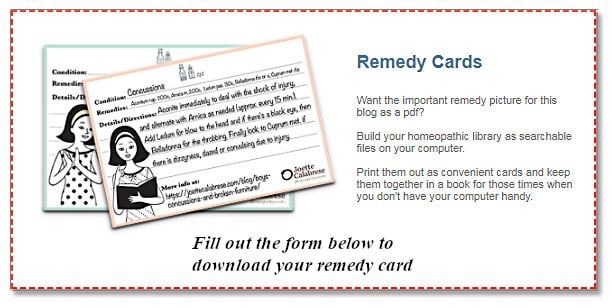
As you download your Remedy Card, remember:
The beauty of homeopathy is that there is often more than one way to butter a biscuit. I may teach additional medicines, alternative combinations, or even protocols with established variations to consider in The Academy of Practical Homeopathy®, Mastery, and my Protocol Courses. Stay curious and never stop learning.
Oh my cantharis 30! Love it. I was having, as you called it, latch-key urgency and as I was just forced onto a diuretic (long story), it was way worse. I read that blog, ordered cantharis, it arrived yesterday, I immediately took a dose at that time, about noon. Later in the day, I realized that when I felt that I needed to go, I could walk calmly and confidently to the bathroom, and make it to the toilet. No more rushing and trying not to flood the little pad. Took a dose last night, then this morning. One more tonight and I think I am good to go, but if I backslide, I have cantharis 30 handy. Ladies, it works!
Does this TBS and cantharis also include sneezing or coughing where if you do either one you have to change your pants?
Its possible but to know for sure, read up on Cantharis in a materia medica to get a full understanding of the remedy’s depth and breadth.
Does Cantharis help with interstitial cystitis?
It’s one of the considerations, but there are others that ought to be used.
I cover this condition in my course titled Feminopathy found on JoettesLearningCenter.com
Hi there okay? I’m 46 years old to be honest with you. The only thing that I am going through pre-menopause is I have vaginal dryness. That’s the only symptoms I have the doctor is putting me on things. God knows what and I’m not really convinced with it. I want to see if I can find another way a clean safe healthy way. I’m only using the vaginal cream, that’s the only thing that’s worked with me. I just need some help.
If you’re interested in knowing how to use homeopathy for such conditions, consider going to JoettesLearningCenter.com and scroll to my course, Feminopathy. I cover such conditions and their protocols.