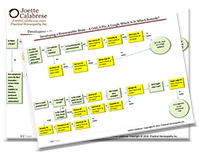

Very little in life is random. Just lay out a timeline of your medical history — your lifetime of ailments and the drugs that were prescribed for each. When we stand back and take a bird’s-eye view, we can see a pattern emerge.
Think about it.
An ear infection at age 3. Antibiotics.
Eczema at age 6. Steroid cream.
Recurring headaches at age 15. Painkillers.
Another illness. Another prescription. Another procedure.
And on it goes.
We tend to remember the illnesses, particularly the unpleasant ones. But what about the treatments we received for those illnesses?
When we take a wider view of our health, rather than examining each illness as an isolated event, we may begin to recognize patterns that have escaped our attention for years. And those patterns may tell us a story worth investigating.
The medical history you didn't know you had
Over the years, I've met countless folks who assured me they rarely take pharmaceutical drugs.
“Oh, Joette, I hardly ever take anything!”
Really? Well, let's put that assertion to the test. Get out a long piece of paper and a pencil. And make sure that pencil has a good eraser because, believe me, you're going to need it.
Now, begin constructing a timeline of your life. Start with childhood, or even before birth if something significant occurred during your mother's pregnancy. Record every illness you can remember, along with the treatment you received.
Antibiotics? Write them down.
Steroids? Add those, too.
Painkillers, injections, daily prescriptions, surgeries, dental procedures, anesthesia, X-rays, colonoscopies?
Yes, yes and yes.
And don't forget medications such as birth control pills, hormone replacement therapy, along with vaccinations and diagnostic procedures. Also include significant emotional events, such as the loss of a loved one, a major life change or a particularly distressing experience.
Don't worry about getting everything in perfect chronological order on your first attempt. (That's why I suggested the eraser.) As memories surface over the following days, keep adding to your timeline.
You may be astonished by what you discover. People who believed they had taken relatively few medications suddenly realize they've undergone far more pharmaceutical treatments and medical interventions than they remembered.
But this exercise isn't about recrimination. Nor is it about second-guessing every decision you or your parents made. It's about understanding your history, and that understanding can be enormously valuable.
Your timeline may contain a few surprises
I once drew a timeline illustrating the medical history of a child whose mother was one of my students.
It was quite revealing. Take a moment to study what occurred in this child’s life. One drug followed by another, then another malady met with another, and another. It reads like a book.

Viewed individually, each event seemed to be a separate chapter. However, when we laid everything out chronologically, we could see the entire story.
Granted, that doesn't mean every subsequent illness was 100% caused by the treatment that preceded it. But the timeline raised questions that deserved attention. Rather than asking, “Why does my child keep getting sick?” the child’s mother and I now had a more complete history from which to begin our investigation.
What exactly is iatrogenic illness?
There's a term I want you to become familiar with: iatrogenic. An iatrogenic condition is one caused by medical care, whether from a medication, procedure or another aspect of treatment.
For example, an antibiotic may cause diarrhea. A statin may produce troublesome leg pain or weakness. A medical procedure may result in an unintended complication. These are recognized possibilities.
While we’re led to believe adverse effects will resolve after medications are discontinued or interventions end, some can persist or have long-lasting consequences. I’ve worked with folks who have never been the same after the use of a drug of commerce — even decades later.
This is another reason your timeline matters.
If you're experiencing ongoing health issues, a careful review of your medical history may help you identify a contributing factor that otherwise might have been overlooked.
Become a detective using your medical history timeline
Once your timeline is set, it's time to do a little research.
Look up the medications you've taken, particularly those that preceded the onset of a persistent health problem. Find the manufacturer's official prescribing information or the FDA-approved drug label and read it.
I mean really READ it. You may discover that a symptom you've experienced is a recognized reaction to a medication you once took. Highlight anything that seems relevant and attach the information to your timeline.
But remember: Finding a symptom on a list of possible adverse effects doesn't necessarily prove the medicament was at fault. We don’t always rely on a condition's etiology before choosing a homeopathic remedy.
Think of yourself as a detective gathering evidence. You wouldn't arrest a suspect simply because he happened to be standing near the scene of the crime, would you? Of course not! But you wouldn't ignore him, either.
What my own timeline taught me
I've done this exercise myself, and I was stunned.
As I've shared before, I haven't taken a pharmaceutical drug since the age of 32, apart from local anesthesia for tooth extractions and medication associated with an unavoidable surgery years ago.
Yet when I examined my earlier medical history, I saw just how much I had experienced. I had eczema beginning in infancy, along with severe allergies that troubled me for years.
Today, in my mid-70s, those conditions are no longer the problems they once were.
What changed?
I changed the way I approached my health.
I learned homeopathy. I paid closer attention to my diet. And I devoted myself to understanding how to care for myself and my family.
In other words, I skilled up.
Become the healer in your home
Why do I spend countless hours writing blogs, recording podcasts, teaching courses, speaking at conferences and sharing what I've learned about homeopathy? Because I want families — like yours — to develop healthcare autonomy by becoming knowledgeable and confident in their use of Practical Homeopathy®.
I want you to understand your options. The process of creating a timeline will hopefully elucidate how important it is to think twice when offered medicaments. Even the CDC admits that “About 30% of all antibiotics prescribed in U.S. acute care hospitals are either unnecessary or suboptimal.”1
This, my friends, is why it is paramount that all families know how to treat common ills so that drugs can be avoided for simple headaches, strep throats, ear infections, mastitis, UTIs, injuries, acne, etc., etc., etc. My family’s approach has long included Practical Homeopathy®, and teaching it to other families remains my passion.
Here’s the assignment
After you’ve constructed the timeline of your life, including your illnesses, treatments, procedures, and other significant events, stand back and take a good look.
What patterns do you see?
What questions emerge?
What might be worth investigating further?
Perhaps you'll discover something important about your health history.
Perhaps you'll simply develop a greater appreciation for everything your body has experienced over the years.
Either way, you'll have accomplished something valuable. You'll have transformed a scattered collection of medical memories into an organized history you can actually use.
And that, my friends, is a very good place to start because sometimes, understanding where you've been is the first step toward deciding where you want to go.
If you enjoy this content, please share it. Also check out my free podcasts, Monday Night Lives, and connect with me on YouTube, Instagram and Facebook. Plus, I suggest considering the Gateway to Practical Homeopathy®: A Guided Study Group Curriculum as an excellent starting point for your homeopathic education.
Pass on the good news of Practical Homeopathy®!
Warmly,
P.S. For more on this subject, listen to Podcast 166: If This Were My Last Podcast, What Would My Message to You Be?
If you want to learn more about health issues affecting your family, peruse my condition-specific Protocol Courses on the Learning Center.
1. https://www.cdc.gov/antibiotic-use/hcp/data-research/antibiotic-prescribing.html
Disclaimer: Joette is not a physician, and the relationship between Joette and her clients, students and followers is not that of prescriber and patient, but that of educator and learner. It is fully the learner’s choice whether or not to take advantage of the information Joette presents. Homeopathy doesn’t “treat” an illness; it addresses the entire person as a matter of wholeness that is an educational process, not a medical one. To be treated or diagnosed, Joette believes that the advice of a holistic physician is in order.
Claims based on traditional homeopathic practice, not accepted medical evidence. Not FDA evaluated.