Acute Conditions Versus Chronic

Joette Calabrese

Hi, my friend. Grab a cup of tea, and let’s chat for a minute.

A couple of months ago, my husband shared an article from The Epoch Times entitled Glaring Problems in Our Health Care System. (If you have a subscription, the entire piece may interest you.)

But the article left me with this question:

When faced with health insurance premiums for a family of four running as much as $25,000 a year with an $8,000 deductible, why wouldn’t the evidenced-based, real health freedom offered by homeopathy be a magnet for folks who want to master and become the healer in their families? Or, at the very minimum, why wouldn’t they want it as a hedge against perpetually riding on the medical conveyor belt?

WHY?

I am doing my absolute best to get the good news of homeopathy out there. My clients, students and Mighty Members are doing their best, too! So, has the general public just not heard about homeopathy yet? Or do they not fully appreciate the range of conditions homeopathy can address?

To be honest, that’s why I started my blog all those years ago. I hoped to get this information in the hands of as many people as possible. Almost immediately, my blog was frequented by moms who had watched their kids’ sore throats or ear infections return time after time. (In fact, to this day, that’s why most people find me.)

Many of them — and maybe you were one — thought that there was something wrong with their child! But no, I say there is something wrong with conventional treatments (antibiotics, for instance).

So, I wanted to help those families get off the Big Pharma train just as I had done with my boys.

Over the years, I have inadvertently tip-toed away from only writing about the more straightforward acute conditions (think of things like colds and flu, ear infections, indigestion, UTIs).

But in recent years, I’ve found that I want to answer all your questions; I want to help you! So here on the blog, I’ve gradually written more about chronic conditions such as bursitis, strabismus, or sundowner’s syndrome.

However, I have to be careful. Chronic conditions often require more education than a cursory blog post can provide. For example, what if someone knows absolutely nothing about provings, but quickly reads a blog post about their chronic condition, uses the medicine and experiences something unexpected? It happens only rarely, but I guarantee you that as sure as eggs is eggs, they would blame me. Or worse yet, they’d blame homeopathy!

Crikey!

My friend, I don’t want to do anything that could hurt homeopathy.

So, it’s more practical for me to teach about acute illnesses and injuries here on the blog. Yes, occasionally, I will address a question about a chronic condition. But please understand if I don’t respond to your requests about a specific chronic issue. That’s what my courses are for.

Whether your concern is chronic allergies, chronic gut issues, skin problems, female conditions, chronic pain, or mental and emotional needs (just to name a few), my Learning Center Course Selector can point you in the right direction. (And remember, all my Mighty Members qualify for a 10% discount on course purchases.)

My more in-depth courses provide critical foundational information that can make all the difference between success and disappointment when using homeopathic medicines for chronic conditions.

For instance, I recall a reader comment posted on my blog post, Abrotanum for Appetite, regarding whether to use Abrotanum or Sulphur. It’s a great question, but it’s not something I can dive into in a blog post. We discuss differentials throughout many lessons in The Academy of Practical Homeopathy®!

It’s very much like if you asked me to explain the difference between New Orleans jazz and Latin jazz. Perhaps, I could consolidate the answer into a few sentences, but that really wouldn’t give you the complete picture, would it?

To innately understand the difference — to assimilate the nuances — why don’t you go listen to both and come back and tell ME!? To really learn music, you have to immerse yourself!

Homeopathy is no different. To truly gain competence and confidence — especially with chronic conditions — you must eventually immerse yourself. If not, you risk simply flying over the condition at 30,000 feet without ever landing on a proper answer.

My blog posts are intended as a high-level overview of some of the easier conditions to address. The Gateway to Homeopathy study groups followed by my protocol courses are the way to succeed with chronic conditions.

Let’s go back to my earlier example of two different medicines addressing appetite. Certainly, I would encourage you to open up your materia medica*. Read Abrotanum and read Sulphur. That’s how I learned!

But why go it alone?

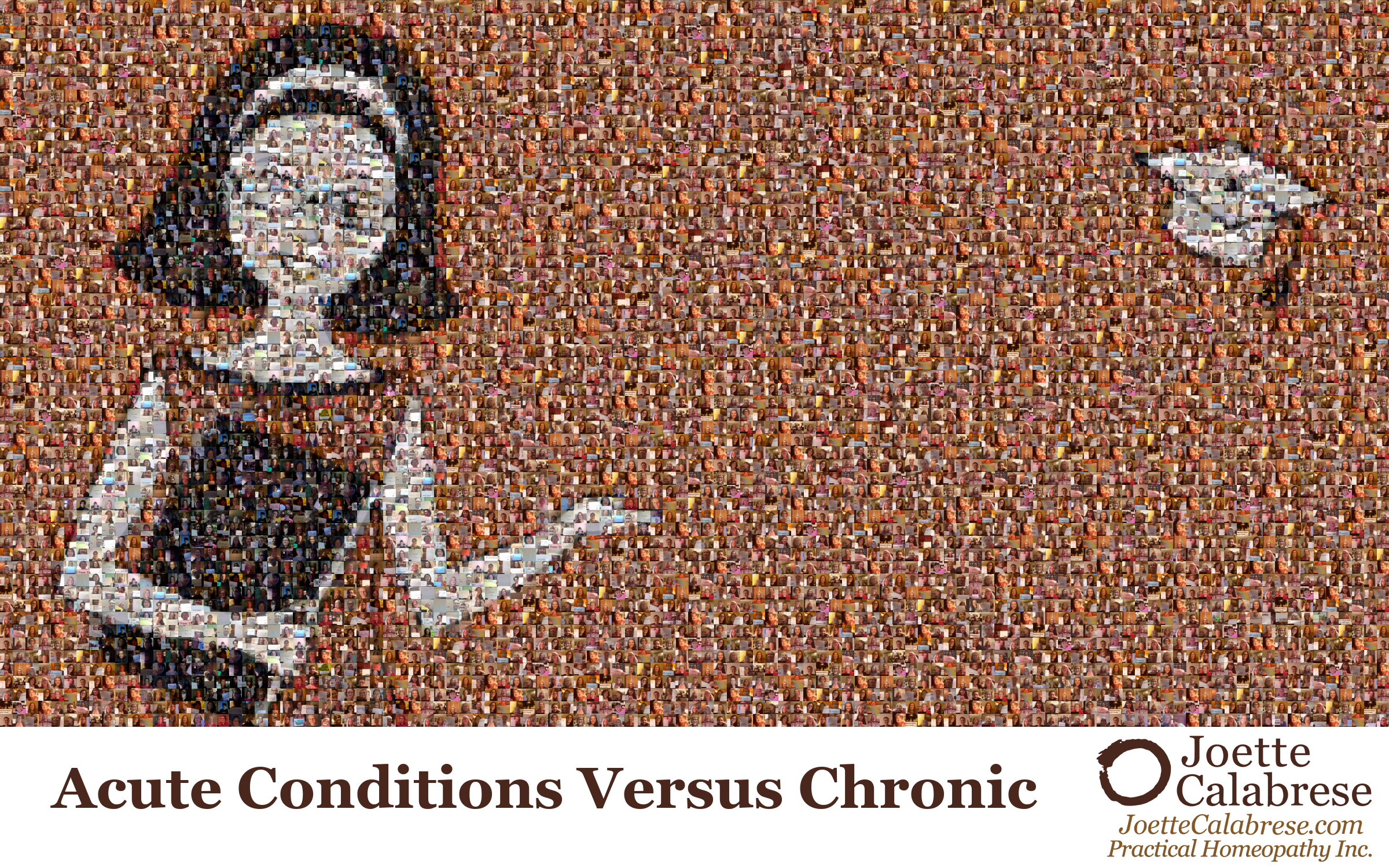
Not only do the study groups and courses allow you to immerse yourself with carefully curated curriculums, but you can also learn with new like-minded friends. Zoom into the collage photo at the top of this post! No, keep zooming! Do you see them? Those are just some of the tens of thousands of folks — just like you — who have joined one or even many of my study groups. And you were wondering why the image had such a stipple-like effect. 

That’s the reason.  Each little splotch is one of my students!

Don’t miss out! These folks are taking matters into their own hands. They are committed to mastering homeopathy and becoming the healer of acute AND chronic conditions in their families! I receive success stories from them every day. In fact, I’m planning to share an inspirational and educational success story with my Mighty Members in next week’s memo.

Now don’t panic!

I’m still committed to sharing as much as I possibly can with you — for free — here on the blog. But please understand that complex chronic issues require more involvement on your part!

Well, I’ve finished my tea, so thanks for the chat. I look forward to sharing more with you next week! Until then, pass on the good news of homeopathy!

Warmly,

Joette Calabrese


*Owning a good materia medica is a necessity for any budding student of homeopathy. If you want an easy-to-understand materia medica, A Materia Medica: Practical Homeopathy® for Busy Families is precisely what you’re looking for. I wrote this with the beginner in mind. But I’ve been pleased to hear that even old hands with homeopathy appreciate it, too!

If you’re looking for a more extensive materia medica, then I highly recommend Robin Murphy’s “Nature’s Materia Medica, Fourth Edition.” We utilize it in The Academy of Practical Homeopathy®, and I can think of none better!

But if money is tight right now, you can find free, more limited, materia medicas online.


Black and Blue

Joette Calabrese

Summertime, and the livin’ is easy …

Well, at least that’s how the song goes. But it seems as though more acute conditions occur in the summertime. The kids are out and about, getting into all kinds of mischief! And that usually translates into plenty of bruises!

So, at times, the livin’ seems anything but easy!

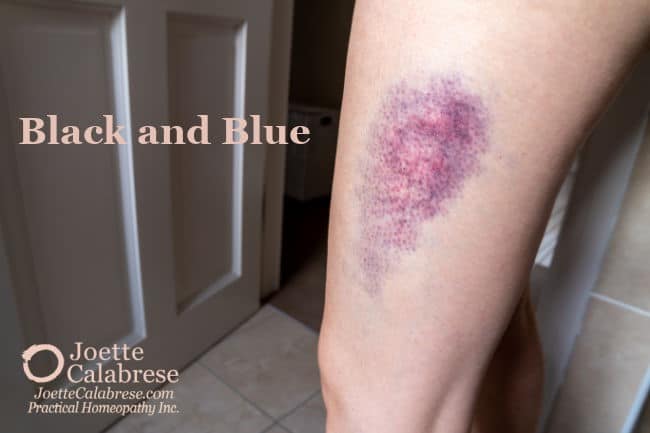
And a rousing afternoon of horseplay is not the only cause of bruising. Has your sofa ever jumped out at you when you least expect it? Or a table? Or door?

Yep, that’s going to leave a mark!

In last week’s blog post, we discussed black eyes. But bruising on other areas of the body requires a different homeopathic medicine.

For severe bruising, we should always think of Arnica montana, in either the 30th or 200th potency (depending on severity), twice daily until very much better. It’s not the only homeopathic medicine for bruising, but it’s certainly our best.

Plus, Arnica creams, gels and ointments, such as Boiron’s Arnicare®, are wonderful for topical application. In fact, these Arnica topicals are often many folks’ first introduction to homeopathy because Arnicare® is so widely available, and it works!

But do we address every black and blue spot just because we know the homeopathic remedy for bruises? No! This is MEDICINE, my friends. Homeopathy is not a supplement or a vitamin or herb. Knowing what to use doesn’t mean you employ it in every ever-so-slight instance. Restraint is a big part of learning how to use these medicines.

Minor bruises, from time, to time are completely natural and no cause for alarm. We save our medicines for more severe injuries or pathologies.

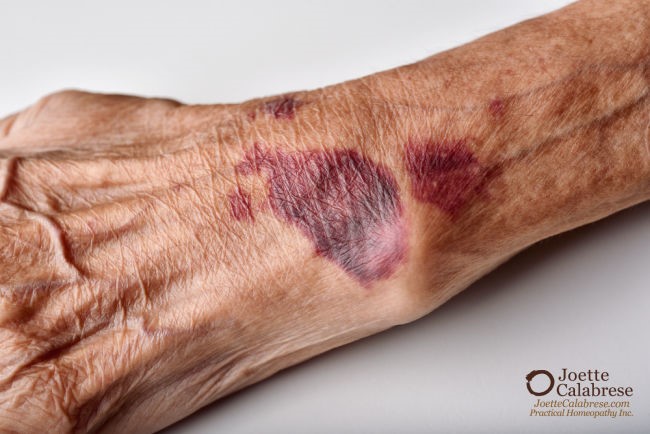
But remember, a pathology of perpetual bruising can be an effect of certain drugs of commerce. The elderly quite often display a patchwork of ecchymoses because, in many cases, their conventional doctors have put them on an aspirin a day or blood thinning drugs.

Joette Calabrese

So, it’s good to be mindful of whether repetitive bruising is a natural occurrence or induced by an unnatural, extrinsic cause. There’s only so much help homeopathy can provide when a daily prescribed medicament is causing the issue!

Unfortunately, there can be controversy surrounding Arnica. Why? Because in its gross form, the plant Arnica montana can cause bleeding. But we’re not talking about Arnica in its gross form — that’s a completely different animal! Instead, we are talking about homeopathically prepared Arnica ­… potentized Arnica … Arnica that has been diluted and succussed until it no longer displays those undesirable properties.

Those who understand homeopathy know that whatever issues these medicines can cause in their gross form is precisely what makes them so effective in addressing similar conditions when they are homeopathically prepared.

However, with Arnica and all homeopathics, we use our medicines judiciously. Not willy-nilly. Again, this is medicine, so we stop using them when the condition becomes very much better.

We also stop using these medicines if we observe no improvement after giving them due time to work. What do we consider “due time” for a case like this? In an acute situation, we would expect to see a shift within a couple of days. If not, then it’s time to stop and move on. Just as with any medicine, we don’t use something that’s not working.

But if it’s a natural pathology (if you can consider a surprise attack from a sofa “natural”), Arnica montana 30 or 200 twice daily should return your skin to its original coloration, rather than a technicolor black and blue.

Pass on the good news of homeopathy!

Warmly,

Joette Calabrese

P.S. For a deeper dive into injuries and pathologies of the skin, I recommend my course, Skin, the Ugly Truth: Safe, Effective Treatment of Skin Ailments, Chronic or Acute, with Homeopathy. In this online course, I cover over 170 conditions along with the most highly regarded homeopathic medicine and protocols.

And remember — all of my Mighties (Joette’s Mighty Members) qualify for a 10% discount on course purchases. If you need assistance getting your discount, email [email protected] for more information.


Baseballs and Black Eyes

Joette Calabrese

Summer and baseball! Don’t you just love this season?

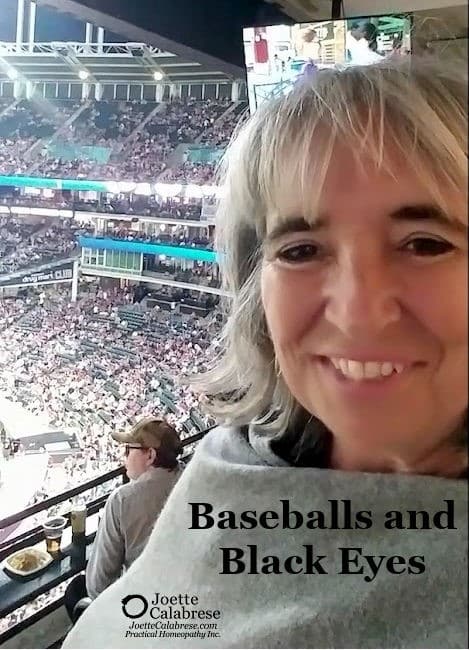
Just about a year ago, I attended a Cleveland Indians baseball game and had the best time (as you can tell from my face in the photo). But we were sitting safely tucked away from where any errant baseballs could pose a hazard.

However, kids throwing the ball around the yard are not quite as safely removed from projectiles! I wonder if there are any statistics on how many wayward balls have plonked their way into kids’ eye orbits? I’m guessing quite a few.

Any blunt force trauma to the eye orbit — like a ball hitting the face — is almost assuredly going to cause some measure of bruising. But even without serious injury, no one enjoys sporting a black eye. So, what should we have on hand to help address the discomfort of bruising from a blow to the periorbital area?

This is not a Banerji Protocol, but in my Academy of Practical Homeopathy®, I teach students the efficacy of utilizing Ledum palustre 200, twice a day until the black eye is very much better. If there is accompanying pain within the eyeball itself, then Symphytum officinale 200, twice daily, may also be necessary.

This combination is most often a home run!

In my podcast, My Sewing Machine Attacked Me, you’ll find that I mention Ledum is great for a “shiner” anytime there’s black and blue around the eye. And I also share a few more tips about eye injuries.

However, be aware that Ledum is not necessarily for EVERY ecchymosis. It is specific to bruising of the area around the eye. In next week’s blog post, I’ll address bruising in general — bruising in other parts of the body.

Until then, as they say in baseball practice, “Keep your eye on the ball!” (Just not literally, please. Ouch!)

And don’t forget to pass on the good news of homeopathy.

Warmly,

Joette Calabrese

P.S. Want to enjoy your own private portal from which to watch my Facebook Live presentations every Monday night at 8 p.m. Eastern — without having a Facebook account? Join my Mighty Members today!

As a subscriber, you’ll also receive access to weekly articles and exclusive videos I create just for my Mighties. And you can make new friends on my private discussion group, safely removed from the censoring eyes of public social media.

Plus, annual subscribers will receive my Remedy Reference Guides — a downloadable 3-volume collection of all my blog posts from 2013 through 2021!

Join in the fun!

And remember — all my Mighties (Joette’s Mighty Members) qualify for a 10% discount on course purchases. (If you need assistance getting your discount, email [email protected] for more information.)


Bunions

Joette Calabrese

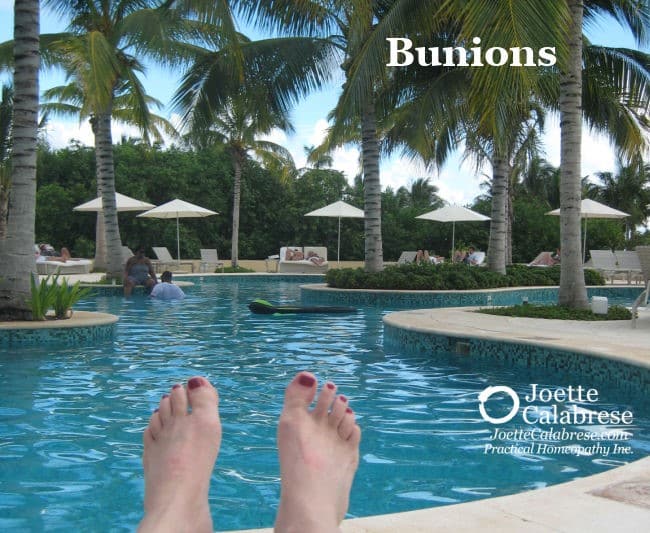
Beth was scrolling through Instagram this summer, getting more and more annoyed. Besides the fascination everyone has with photographing their dinner plates, one of the more ubiquitous photos circulating on social media is a photo of freshly manicured feet overlooking a swimming pool!

“Okay, okay,” Beth grumbled to herself. “I get it! You’re enjoying your vacation! Whatever.”

It’s not that Beth is a grumpy person or that vacation photos annoy her. It was that Beth always hid her feet because of unsightly bunions. So, the constant reminders of well-shaped, healthy feet annoyed Beth to no end.

Not only was Beth embarrassed by bunion disfiguration, but she was also in pain from the displaced toe joint. She couldn’t wear the cute shoes her friends did. She looked like a grandma in her boxy-toed shoes. In fact, Beth looked exactly like her grandmother because they wore the very same shoes!

Bunions ran in the family, it seemed.

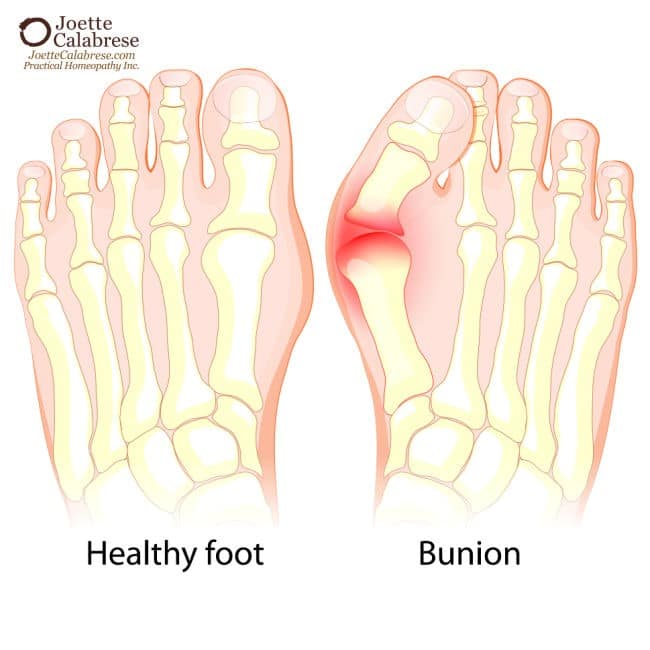
Bunions are a bony protuberance on the side of the great toe (or sometimes the pinky toe). They appear when the top of the toe pulls in towards the other toes, causing the base of the joint to move out of place and jut out.

Joette Calabrese

Complications can include swelling, redness, pain, corns and decreased mobility.

All in all, bunions are no fun.

Luckily, Beth had a friend who “passed on the good news of homeopathy.”

Her friend informed Beth that bunions are a chronic condition and are not something that homeopathy can resolve quickly. In fact, a bunion can take a long, looooooong time to make a difference. However, conventional surgical treatment generally requires months of recovery — and even then, it is not always guaranteed.

So, Beth thought, “Why not give homeopathy a try?” She had nothing to lose — except her bunion.

As with most conditions, a conventional diagnosis is advisable. For example, pain in the great toe can be indicative of a bunion, gout or arthritis. But given the diagnosis of a bunion, in my practice, I’ve successfully relied on Silicea 200, every other day.

Suppose more acute symptoms are present, such as the joint worsening on first movement or a flare-up from overuse. In that case, we may also justify adding Rhus toxicodendron 30 twice daily until very much better.

Rhus tox is especially warranted if there is known arthritis in the toe joint or other joints of the body, concomitantly.

As I’ve mentioned, bunions occasionally may cause extreme pain. A little pain is to be expected. But considerable pain — burning, shooting pains in the joint with an acidic, “crunchy” sensation — may require Hypericum perforatum 200, twice daily until that heightened pain is diminished.

Beth has only just begun her schedule of Silicea 200, but she already feels  some improvement in the joint. And the blisters that the bunion had caused are easing. These are all good signs!

She’s not quite ready to take her own ubiquitous “feet by the swimming pool” photo. But Beth is very hopeful that (thanks to her friend) she’ll be annoying everyone with her own great vacation shots next summer!

See why it’s so important to pass on the good news of homeopathy? You never know who you might help!

Warmly,

Joette Calabrese

P.S. Nothing can turbocharge your homeopathic knowledge better than joining a Gateway to Homeopathy study group. Studying with others can equip you to lay a stronger foundation in homeopathy than any other learning method. They say, “Two heads are better than one,” right? So, imagine ten heads! Or twenty! Learning alongside others exposes you to a broader array of health concerns and solutions.

Plus, learning in a study group reinforces your ability to discover answers to questions others might have — questions you may not have even thought about without them. With the information you’ll learn, you’ll experience the joy of self-reliance as you care for your family’s needs. And you’ll also be able to pass on the good news of homeopathy to others in your community. 

It’s how I learned and how I suggest all of my readers become students. Even if you already know about homeopathy, a Gateway to Homeopathy study group is the perfect place to refresh and organize your knowledge. Almost 10,000 study group members have benefitted from my curriculum. Join their ranks today — develop the confidence and competence you need to care for your family.


Dermatoporosis: Aging, Fragile Skin

Joette Calabrese

“Toughen up! You’re too thin-skinned!”

Have you ever heard that before? Well, maybe we can try to thicken our “psychological” skin with a bit of introspection. But what do we do when our physical skin has become too thin?

As adults age, the skin thickness and elasticity diminish as the body loses hyaluronic acid and collagen. This leaves the largest organ — skin — susceptible to tears, ecchymosis, pressure ulcers, deep dissecting hematomas, and slow-healing wounds. In short, our skin loses its ability to fend off mechanical injury.

The medical community only recently established a name for this natural occurrence — dermatoporosis. (I’d say that’s more than a 25-cent word! Adjusted for inflation, it seems like it’s worth at least 50 cents!)

What does it mean? Well, they borrowed from the term “osteoporosis,” which we all know means a weakness in bones, to imply a similar weakness in skin: dermato (skin) joined with porosis (porous).

Until 2007, when the term was created, this type of skin degeneration was often overlooked as merely a cosmetic issue. But now, it’s generally accepted that weakened skin can eventually lead to problems requiring treatment.

And while conventional medical practitioners readily admit that corticosteroid overuse can hasten the onset of dermatoporosis, they are ready and eager with yet more synthetic treatments! But who knows what eventual conditions those new medications may cause!

(Here’s an interesting PubMed article on the topic, Chronic Skin Fragility of Aging, that explains more.)

But, WE have homeopathy!

If pathology arises from the natural process of aging skin, the Practical Homeopath may turn to the cell salt Silicea 3 or 6, twice a day. Why? Silicea is specific to the skin — or skin that is too thin, breaks easily or doesn’t heal fast enough.

As stated in “The Biochemical Handbook: How to Get Well and Keep Fit With Biochemic Tissue Salts” by J. B. Chapman and Edward L. Perry, Silicea “restores the activity of the skin … it can often initiate the healing process.”

That sounds like just what’s needed when aging skin becomes too fragile. But aging skin isn’t yearning for the treatments the PubMed article highlighted: synthetic topical creams (such as Tretinoin or AHAs) or estrogen hormone replacement therapy.

Eee-you. 

Instead, we look for treatments that are natural and polite. Luckily, the article did mention the therapeutic benefit of an improved diet containing ample animal proteins. (Score yet another point for Weston A. Price!)

Had the researchers consulted a homeopathic repertory for this condition. They would have found a demonstrable improvement in thinning, fragile skin by following the simple regimen of Silicea 3 or 6, twice daily over a period of time.

Now, some people are still concerned about using Silicea because of its ability to press out sharp foreign objects from the skin.

That should not be of significant concern, but I will go into this concept more with my Mighty Members later in the week. So, if you want to learn more, please join us!

Until next time, pass on the good news of homeopathy!

Warmly,

Joette Calabrese

P.S. It’s not only additional articles (such as the one I mentioned in the article above) that my Mighty Members receive. They also have access to exclusive videos I create just for them and a discussion group safely removed from the censoring eyes of Facebook.

Speaking of which, my Mighty Members have their own private portal to watch my Facebook Live presentations every Monday night at 8 p.m. Eastern — without having a Facebook account! Now, that’s a significant benefit, wouldn’t you say?

And annual subscribers will receive my Remedy Reference Guides — a downloadable 3-volume collection of all my blog posts from 2013 through 2021!

P.P.S. If the subject of skin particularly interests you, you might consider my course Skin, the Ugly Truth: Safe, Effective Treatment of Skin Ailments, Chronic or Acute, with Homeopathy. It is chock-full of homeopathic medicines and protocols for a variety of common skin issues. (And don’t forget, all my Mighties also qualify for a 10% discount on course purchases. If you need assistance getting your discount, email [email protected] for more information.


Flynn and the Not-So-Fun Fireworks

Joette Calabrese

Recently, one of my sons shared a story about his girlfriend’s dog, Flynn. Now, if you look at his picture above, little Flynn may not look as intimidating as he thinks he is. But he tirelessly stands guard against squirrels and other equally fearsome creatures.

However, fireworks are another thing altogether! Apparently, they’re way above Flynn’s pay grade.

A week or so ago, perhaps in a practice run for the Fourth of July, poor Flynn’s neighborhood was besieged with bangs, booms and sizzles. And Flynn wasn’t having it. He was upset — really upset.

So, as my son told the group he was speaking with, he used homeopathy and successfully settled Flynn down for the rest of the night.

“Of COURSE, you did! You’re Joette’s son!” said one of the folks in the conversation. “You are so lucky. You can just call your mom, and she’ll give you the exact information you need — whenever you need it!”

“Well, not exactly,” my son admitted. “To be honest, I just looked it up on her website and found the blog post BOOM! It’s Fourth of July! (I’m Not Scared, But Others Are!). I gave Flynn a dose of Phosphorus 200, and he fell right asleep!”

Now as valuable as I know my blog posts are, never in my wildest dreams did I think they would help my own son!

He didn’t even have to pick up the phone to call me. He knew right where to go to uncover what I would say. (Okay, technically, in that blog post, he read Buster, The Bad Office Dog’s recommendation. But luckily, I’m in complete agreement with Buster.)

I bring this up now because tomorrow is the Fourth of July. Very soon, the bangs, booms and sizzles will begin in earnest — maybe as early as tonight in some communities. But our little pets don’t have to suffer. I mean, look at that face in the photo above. Why would anyone want little Flynn to be upset by loud noises?

So, during fireworks, thunderstorms or even construction noise, Phosphorus 200 can be the salvation of our anxious furry friends.

And while we’re on the subject, Argentum nitricum 200 can also be an excellent choice for nervousness due to loud noises, as mentioned in A Dog with Anxiety? There’s a Homeopathic Solution.

See, there’s more than one way to skin a cat with homeopathy … or, perhaps I should say, there’s more than one way to calm a dog!

And remember, these medicines are for people too! Unfortunately, many returning veterans have difficulty with loud firework displays. That’s a regrettable coincidence, considering we are celebrating the very independence for which they fought and risked their lives!

But when one has been immersed in the throes of war, those loud, explosive noises become warnings of impending danger, not of celebration and fun. So, perhaps some humans in your circle might also benefit from these medicines. (While we’re on the subject, if their PTSD is profound, they may benefit from another article, A Salute to Ignatia Real Medicine for Post-Traumatic Stress and More.)

At any rate, if my blog posts are good enough for my son, they’re good enough for everyone! So, I hope you’ll continue to use the search bar at the top of the page on my website to search for conditions when you desire additional education.

Enjoy your Fourth of July weekend! Keep your pets (and friends) safe and secure. And never forget the reason we are celebrating. We are independent — nothing better exemplifies that than our self-reliant use of homeopathy at home! God bless America!

Pass on the good news of homeopathy!

Warmly,

Joette Calabrese


Swimmer’s Itch

Joette Calabrese

It’s summer! It’s hot! It’s REALLY hot!

I raised three boys. I know that when the weather gets hot, kids gravitate to the water — any water. It doesn’t matter if it’s an overcrowded swimming pool, a seaweed-laden ocean or a murky river. Heck, even mud puddles look attractive to kids when the temperature is roasting.

But while bodies of water may look alluring, they can contain microscopic parasites (carried in by certain land animals, snails and birds) that can cause an itchy allergic reaction in sensitive swimmers. The medical name for this condition is cercarial dermatitis, but you’ll often hear it referred to as swimmer’s itch.

And it’s no fun.

Jenny, a 16-year-old I know, was swimming with her family in a man-made lake (a reservoir used for making snow at a local ski hill in the winter). It was a perfect day of water games and frolicking until Jenny started itching.

Even though Jenny’s whole family had been in the lake, only Jenny started itching. Poor girl.

When her mom realized what Jenny had, the idea of waterborne parasites left them so “creeped out” that they didn’t go back to the lake that summer.

Avoidance is certainly one precaution. However, planning for the future didn’t help Jenny’s obsessive itching. It was crazy-making.

A complaint of swimmer’s itch can be somewhat of a broad category. As I mentioned, it’s medically defined as being caused by tiny parasites in the water. But some people use the term more generically, encompassing everything from sensitivity to salt or chlorine to dryness caused by continual evaporation from getting in and out of the water.

But we don’t necessarily need to know the exact etiology. We know what medicine is excellent for itching and rashes in general, don’t we?

And it’s not the cortisone cream suggested by conventional medical websites. Cortisone cream is merely temporary appeasement, not a solution. Plus, the use of steroidal creams can usher in dreadful side effects. It’s like killing a mosquito with a bazooka! Sure, it may momentarily get the job done, but at what price?

Instead, the Practical Homeopath would turn to Antimonium crudum 6, twice daily until very much better. If the itching was severe, overwhelming and maddening, they might consider employing it every 3-4 hours. Then, when improvement is observed, they should back off to utilizing it twice daily.

(If you order this or any medicine from Boiron, use my name (Joette) in the coupon box to receive a 20% discount! I do not have an affiliate program with them. I don’t get kickbacks from them or anyone; I prefer the savings go directly to you!)

Several years ago, you may remember I taught about Ant crud in my blog post, Itchy Skin. Let me tell you, Antimonium crud is a capital medicine for itching and has helped many of my clients and students recover from itchy skin disorders. Earlier in my career, I had previously used other remedies that have a history of addressing itchy, eruptive skin. However, the addition of this medicine (thanks to the Drs. Banerji) has made a significant difference in the number of corrected cases I’ve witnessed.

It’s one of those medicines that should be in every medicine cabinet … because you never know when swimmer’s itch (or something else) will make you (or someone you love) climb the walls.

So, plunge into that pool or lake without fear. Cool off and have fun! Should there be a microscopic annoyance in the water that causes problems later, you’ll be armed with homeopathic medicine to give your body the natural assistance it needs — without risking the side effects of cortisone creams or steroids.

Pass on the good news of homeopathy!

Warmly,

Joette Calabrese

P.S. Should you discover that your skin issue is more than just a transitory bout of swimmer’s itch, I suggest my course Skin, the Ugly Truth: Safe, Effective Treatment of Skin Ailments, Chronic or Acute, with Homeopathy.

Need inspiration? Look at one blog reader’s experience as she became more immersed in homeopathy and found my course on skin issues.

And remember — all my Mighties (Joette’s Mighty Members) qualify for a 10% discount on course purchases. If you need assistance getting your discount, email [email protected] for more information.


The Dad Bod: Urinary Tract Dysfunction

“… In the day that God created man, in the likeness of God made he him;  Male and female created he them; and blessed them …” — Genesis 

Indeed, God created both men and women, and their bodies are gloriously different. Most of the homeopathic medicines I mention here in my blog are not based on the gender of the sufferer. However, I seem to devote more of my attention to conditions of the female body because the vast majority of my readership and students are women.

But men also have their own unique needs! So, in honor of Father’s Day today, let’s take a closer look at the “dad bod.” (And I’m not talking about the average, middle-aged male physique. Today, I’m borrowing the kids’ colloquialism to discuss the bodies of dads!)

You see, as men age, they often find their urinary tract function beginning to slow or becoming less “cooperative.” This is quite natural and is nothing to be concerned about — unless it becomes a pathology.

What do I mean by that? Well, just because an older gentleman can’t urinate with the same force he could when he was 18, or it takes a bit of time for the flow to ensue, there’s no reason for him to panic. That’s life!

But if urination becomes exceedingly difficult or the bladder cannot be emptied completely, then that is a pathology we would want to address. Naturally, we would turn to homeopathic medicines chosen precisely for their efficacy in the male genitourinary system.

As I teach my students, Staphysagria is a capital medicine for male urethral stricture causing slow onset, halting, or incomplete urination. In my practice, I have utilized both Staphysagria 30 as well as Staphysagria 200 for this purpose, employed every other day. However, I suggest that in the case of a chronic condition such as this, newcomers to homeopathy should start with a softer approach by using Staphysagria in the 30th potency.

(Also, you may recall we discussed Staphysagria for post-catheterization complications in Surgery? S Is for Staphysagria.)

The concern of this pathology — besides its sheer inconvenience — is that incomplete emptying of the bladder can eventually lead to urinary tract infection.

On the other hand, if the urine flow is simply weak, then perhaps I would choose Cantharis 30 or 200, twice daily, instead. (Again, I encourage beginners to start with the 30th potency for this particular condition.)

Those two homeopathic medicines can clear up the vast majority of the urinary flow issues that concern male sufferers.

But don’t be misled that these are the only two medicines we have in our arsenal for men’s urinary dysfunction. No, no, no. Staphysagria and Cantharis are simply two remedies that should remain uppermost in our minds. However, there are many more that I simply don’t have the space to discuss in this post.

(To that end, later this week in my Memo to Mighty Members, I will share another medicine that is called for when experiencing a unique but common symptom: urinary flow with a forked stream! I  think you’ll find iit fascinating!)

Now, a conventional diagnosis may be required to determine if prostate issues are the cause of a man’s urinary problems. If that is the case, we would turn to yet other medicines. I wrote about this in more detail in Weston A. Price’s magazine Wise Traditions, Winter 2016. I have archived that article here on my website, entitled In Praise of Menfolk: A Homeopathic Thank You.

So, men, please know that you are highly valued. I want your health to reflect your inner strength, and well-chosen homeopathic medicines can do just that! So, pass on the good news of homeopathy to all the men you know!

Warmly,

Joette Calabrese

P.S. Attention all men! My office is organizing an online study group for you. And not just fathers, I mean ALL men — husbands, sons, uncles, nephews, brothers, and buddies! So, if you’re interested in learning more about homeopathy in a virtual “man cave” environment, please click on this link to learn more. The most productive way to study homeopathy is with like-minded guys just like you!

P.P.S. And remember, My Mighty Members’ private website is an excellent source of additional information that I post each week. I send out Memos and video Musings, speaking more freely on topics that interest us all. Plus, I share clever suggestions and tips from other Mighty Members! It’s an inspirational give-and-take of information.

Plus, there’s also an enjoyable discussion group for you to share freely with like-minded people without the prying eyes of Facebook.

And remember — all my Mighties qualify for a 10% discount on course purchases. So, I encourage you to consider joining the ranks of these extraordinary, dedicated folks by subscribing today!


Homeopathy for Elbow Pain

Joette Calabrese

Some joints are easy to ignore — until they cause problems. That’s true in plumbing, and it’s certainly true in our bodies.

For instance, how often do you think about your elbow?

Well, okay, okay. Maybe you do when you hear your mother’s voice inside your head saying, “Take your elbows off the table!”

But if you hit your funny bone, I guarantee you that your elbow will be the only thing on your mind. (Hopefully, you’ll quickly recall what you learned in the blog post The Funny Bone is Not Funny.)

If you think about it, the elbow is one of the hardest working joints in our bodies. As such, it is quite susceptible to injury from overuse.

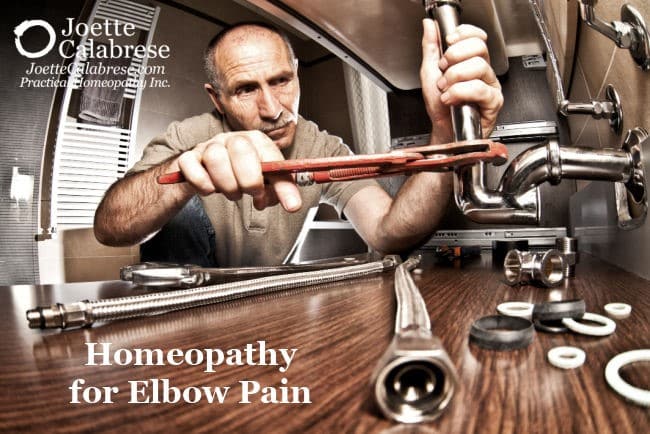
Mike worked as a plumber in a busy community. He suddenly began experiencing burning pain on the outside of his elbow. This was an entirely new sensation for Mike. Heck, the only elbows he ever thought about were the elbow joints he installed under sinks!

But now he couldn’t get his mind off his excruciating elbow pain. He could barely hold his wrench and grimaced when he tried to tighten a fitting. Finally, it got so bad that he could hardly turn a doorknob! Each day, it was getting more and more challenging to do his job.

That’s when his wife convinced him to go to the doctor for a diagnosis.

Now, Mike wasn’t athletic. In fact, he considered himself about as athletic as his wife’s lazy cat. So, imagine his surprise when he was diagnosed with tennis elbow!

“Tennis elbow? I don’t even watch tennis on TV!” he argued.

Joette Calabrese

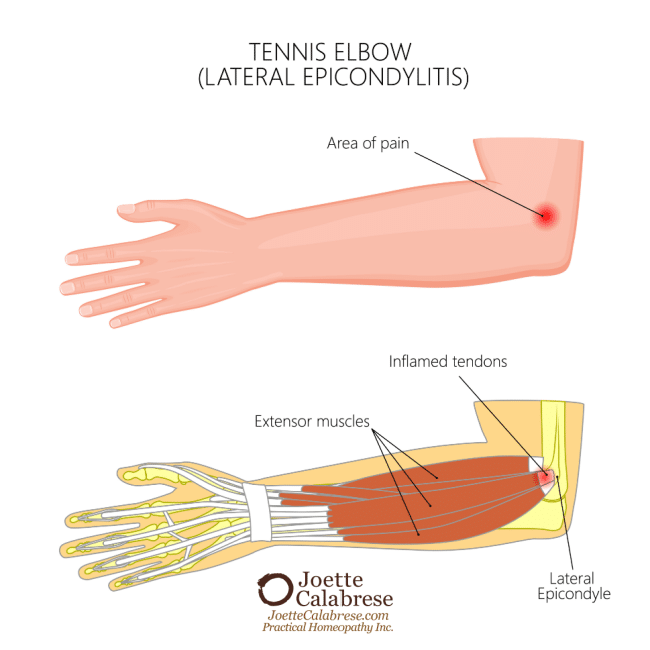
Let me assure you, you don’t have to step on a court to suffer from tennis elbow. It’s just vernacular for lateral epicondylitis (slight tears and inflammation of the tendon that attaches to the bony bump on the outside of the elbow). Tennis elbow is a fairly common condition, especially among those whose occupations require repetitive forearm motion.

Plumbers are especially susceptible, as are butchers, manicurists, mechanics, housekeepers, gardeners, dentists, construction workers, and even those who work all day on a computer (especially if they use a mouse).

Luckily, Mike’s wife had studied homeopathy. So, she started him on a schedule of Symphytum officinale 200 twice daily. As I discuss in A Materia Medica: Practical Homeopathy® for Busy Families, Symphytum is useful for injury to the bones, sinews, tendons, and joints. So, it’s a perfect fit for this elbow tendon condition.

And, rather than overload her husband’s sensitive stomach with ibuprofen for pain (as the doctor had suggested), Mrs. Mike put a little purple tube of Hypericum perforatum 200 in his pocket as he went off to work. When the pain increased during the day, instead of reaching for Advil, Mike took a dose of Hypericum as an SOS (only as needed). And boy, did it work!

Mike was stunned that his “plumber’s elbow” (he refused to give tennis top billing) gradually relented over time.

If the symptoms recur because of an unusually physical plumbing job, Mike simply starts the homeopathic medicines again, and the condition diminishes in short order. Each time his elbow feels very much better, he stops the medicine. That’s how homeopathy works! But more importantly, no synthetic drugs, no surgery, no agony, and over time as the homeopathic is used, (only as needed)  a few doses will be required less and less frequently and the pain will diminish. 

That’s what I mean when I say that homeopathy uproots conditions.  It may take time but, so what? My personal goal is to stay off of drugs of commerce for as long as possible.  It was Mrs. Mike’s idea too. 

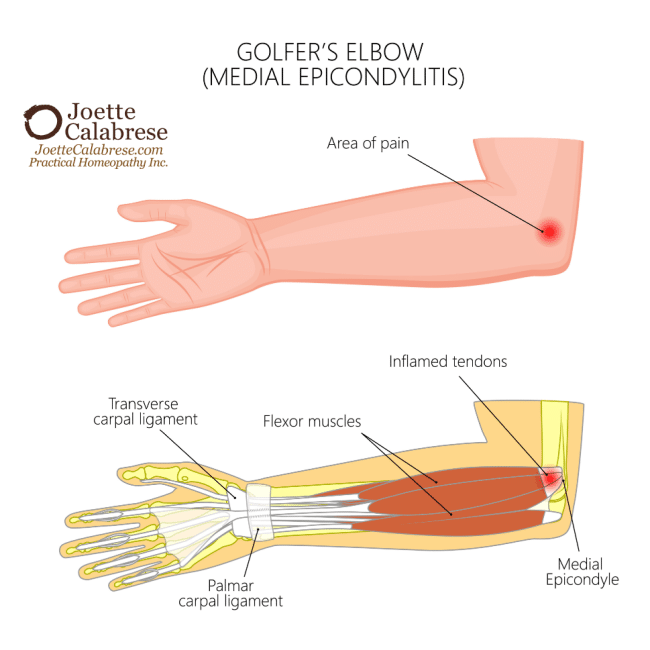
But what if the pain had been on the inside of the elbow rather than the outside? Well, there’s a name for that, too … Golfer’s Elbow also called medial epicondylitis. (Remember, in medical terms, lateral means away from the midline of the body and medial means towards the midline of the body.)

Joette Calabrese

The pain of Golfer’s Elbow symptoms is similar except that it occurs on the connection of the tendon to the bony bump inside the elbow. And, as with tennis elbow, you don’t have to be a golfer to experience this condition. It seems to stem from repetitive motion of the fingers and wrists, especially when excessive force or weight is involved.

Because both conditions involve tendons, the homeopathic medicines would be the same.

So, whether you’re a tennis player or a golfer — a plumber or a manicurist — homeopathy adroitly addresses elbow pain.

The next time you see someone wince and grab their elbow, why not consider passing on the good news of homeopathy?

Warmly,

Joette Calabrese

P.S. Where can you learn homeopathy like Mike’s wife did? I suggest you join one of my online study groups! Sharing information in a group setting can turbocharge your learning. Your group will not only explore the topics that interest you but also will examine subjects you may not have considered if studying alone. Don’t know anyone to start one with? Call my office and we’ll get you set up with an online group. 

So, for a well-rounded homeopathy education, start with Gateway to Homeopathy: A Guided Study Group Curriculum. Even if you already know a bit about homeopathy or even a lot, a study group will provide lifelong friends who can share your journey, trials, and successes. Consider it a strong foundation on which to build a lifetime of homeopathic healing.


Facial Neuralgia: A Torturous Pain

Joette Calabrese

Oh.

My.

Gosh.

The pain from facial or trigeminal neuralgia can be horrendous. It certainly must be a curse on humanity! It can be so bad, in fact, that many sufferers resort to daily ingestion of synthetic drugs, even for years. And you know how I feel about those.

I wish I could tell you that there’s one big, fat homeopathic remedy that will always do the trick, but facial neuralgia is indeed rather tricky!

Granted, homeopathy does have a history of treating facial neuralgia with aplomb. But my, oh my, it can sometimes be trying to find the precise medicine for the precise TYPE of facial neuralgia. 

Let me explain how a homeopath would look at this condition.

The location of the pain will often dictate the remedy needed. For example, is the pain focused on the lower jaw or area around the nose, lips, eyes or ears?

Another consideration is on which side of the face the pain is located.

Then we must determine what kind of pain is experienced. For example, is it stabbing, burning, shooting along a nerve, cutting or jerking?

And lest you think that that’s all that needs to be taken into account when choosing a homeopathic remedy, hold on! Let me also throw in a few more factors to consider: When does it occur? Is it constant? Worse from touch? Worse from heat? Better from cold?

Okay. You think we’re done, right? 

Nope! More questions:

What brings on the suffering? What are the triggers? Cold wind? Allergies? At night, upon lying down? Did the pain follow a dental appointment or whiplash injury?

Okay. Okay. Don’t be discouraged. Indeed, there are ways for the at-home caregiver to tease this apart.

First and foremost, there is a Banerji Protocol for general facial neuralgia:

Having a protocol allows those who practice Practical Homeopathy® to eliminate the guesswork. So, let’s look at those remedies, shall we?

Hopefully, by now, you’ve learned through my blogs and Monday Night Live events that Hypericum is a marvelous medicine for nerve pain in any part of the body. Consequently, Hypericum should always be included in any well-stocked collection of homeopathic medicines.

I’ve not written about Tarentula cubensis here on my blog before. So, it’s a medicine to consider adding to your quiver. One of my team members experienced outstanding success using Tarentula cubensis 200C for her husband’s geniculate neuralgia (severe, debilitating, stabbing nerve pain in the ear caused by a blood vessel compressing a small nerve).

Doctors had no solution to offer except surgery. But utilizing this homeopathic once a week did eventually uproot his relapsing-remitting neuralgia. It took some time  — but the result was well worth the investment in time.

However, as I mentioned before, facial neuralgia (and the myriad ways it may present) can sometimes require a bit more digging to uproot the condition completely. And that’s what I love about homeopathy! There is always more than one way to skin a cat.

So, let’s look at another excellent medicine for facial neuralgia.

Spigelia anthelmia can be especially useful in cases of trigeminal neuralgia (severe, excruciating, sharp, stabbing, burning or shooting pains along the side of the face that often feel like an electric shock). We would consider Spigelia most often for LEFT-sided facial pain along the temple, eye, cheek and even teeth — pain so severe the entire area becomes highly sensitive to touch. If the neuralgia is made worse from cold, rainy weather, then Spigelia should most assuredly be considered.

For this condition, generally, Spigelia is utilized in the 200th potency a few times per day depending on the severity of the attack. And of course, we all know to halt the use of a homeopathic when it’s not helping at all.

Now, for RIGHT-sided facial neuralgia, Magnesia Phosphorica 30 every 3-12 hours, depending on the severity is a good consideration. When warm compresses help this type of facial pain, that is a good confirmation of the need for Mag phos. And when activating the jaw (opening the mouth) triggers the right-sided pain, it’s more often than not a slam-dunk for utilizing Mag phos.

Mag phos is a remarkable medicine for neuralgia and cramps, but in my clinical experience, I have found it becomes even more impressive when dissolved in hot water! That’s why I like to call it “Mug phos.” (To clear up any potential confusion, that article discusses its use for cramps in a 6X potency — not the 30th potency that we are talking about here for neuralgia. But the concept is the same.)

If a sufferer knows they will require several doses over the course of a day, dissolving one dose (as stated on the outside of the tube or bottle) in a few ounces of hot water and keeping that mixture in a thermos nearby is a good way to use this medicine. A few sips every few hours for right-sided facial neuralgia is generally “just what the homeopath ordered” (to spin a phrase).

Now, before I close, one caveat about facial pain: Sometimes, a sufferer may think their facial pain might be caused by a dental infection, but in actuality, it’s neuralgia! Or vice-versa! It’s often very hard to tell because the nerves in the face and mouth can cause referred pain. We should always start with the obvious, but we have to be open to considering other options should we not find the answers. A diagnosis from a well-respected medical doctor or dentist can be invaluable.

And homeopathy provides many more medicines to be considered. Among them are Colocynthis, Verbascum, Hecla Lava, Plantago and Ranunculus bulbosus, etc., etc. But I can’t discuss them all in this short blog post format. As you can see, the details of symptoms do matter. So, I encourage everyone to own at least one materia medica in their homeopathic library to help discern which medicine is the best fit for their symptoms. In fact, there are some available online for free!

If you’re not quite ready for an intense deep dive into a traditional materia medica, I encourage you to consider A Materia Medica: Practical Homeopathy® for Busy Families. I wrote this book, containing over 150 of the most commonly used homeopathic medicines, specifically for you. In it, I present a description of each medicine written in plain English, accompanied by illustrative stories from my practice.

The more you learn, the more you can pass on the good news of homeopathy!

Warmly,

Joette Calabrese

P.S. If pain is a concern in your family, might I suggest my very popular course, Make It Stop! Escape From the Prison of Chronic (and Acute) Pain Using Practical Homeopathy®: Learn Effective Methods to Uproot Pain, Often for Good. In it, I cover all manner of topics from neuralgia to plantar fasciitis, headaches to kidney stones, sciatica to shingles and everything in between.

And remember — all of my Mighties (Joette’s Mighty Members) qualify for a 10% discount on course purchases. If you need assistance getting your discount, email [email protected] for more information.