
On the face of it, “Practical Homeopathy®” sounds like an obvious, natural way to describe homeopathy. However, not so long ago, homeopathy wasn’t considered quite as … well … practical.
So, what is Practical Homeopathy®?
First, let’s start with what it is not.
Homeopathy has been practiced with the “classical” approach since the term was coined in the 1970s. A classical homeopath considers the patient's entire constitution — not just the presenting disease or condition. They rely on the basic tenet of individualization to find the similimum: one all-encompassing homeopathic medicine for that particular patient.
The similimum is determined not only by the symptoms being suffered, but also the individual’s entire physical and mental state, as well as their unique personality traits and personal tastes (likes and dislikes). As you can imagine, determining these factors can only be accomplished through a grueling, abstruse, and lengthy interview with the patient. A typical classical homeopathic consultation takes anywhere from an hour and a half to over two hours! And then comes the equally consuming step of repertorization.
After further research, the classical homeopath will often select a different homeopathic medicine for each individual based on the whole of their unique traits.
It’s a highly variable, customizable and enigmatic process that’s anything but practical. Most importantly, this forced its use to remain in the hands of professional homeopaths only. This meant that it was nearly unused by families.
As I say in my podcasts, homeopathy was once considered by many to be an esoteric paradigm. My mission — and my promise to Dr. Pratip Banerji as well as Joe De Livera — has long been to demystify homeopathy and make it an understandable, reproducible, safe and effective health care solution available to all, especially mothers and their families.
So, what is Practical Homeopathy®?
Well, I confess. We made up the term. We might have called it “Kitchen Table Homeopathy,” or “Family Homeopathy,” or even “Clinical Homeopathy.” However, I decided to use the word “practical” because it befits moms in the kitchen, grandmas in their rocking chairs, children learning personal responsibility, M.D.s in the ER, nurses, naturopaths, veterinarians and farmers. (The applications are endless.)
This unique brand of homeopathy is efficient, scientific, reproducible, and, most importantly, it’s relatively easy for the layperson to learn and soon become the healer in their home. Why? Practical Homeopathy® builds on proven, straightforward protocols developed from the clinical experience of world-class homeopaths.
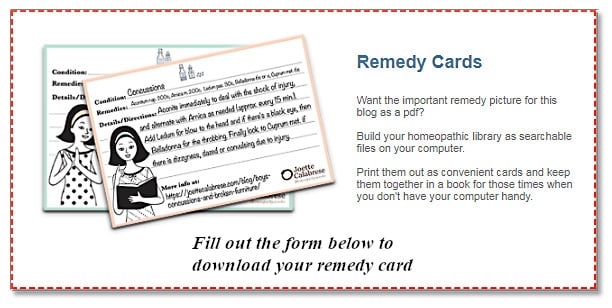
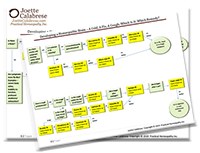
(In this week’s Remedy Card, I give a prime example of a protocol — more specifically, a Banerji Protocol — for the onset of a respiratory illness. Scroll down and download it for free.)
Indeed, protocols eliminate any guesswork or subjectivity, as they are time-tested, reproducible and standardized treatments for specific diseases, injuries and illnesses determined through state-of-the-art diagnosis. Thus, specific medicines, precise potencies, and fixed frequencies are uniformly recommended by the Practical Homeopath™ for specific conditions.
Most likely, you are already familiar with this model, as it closely resembles a conventional doctor’s approach to most medical issues, in which a diagnosis is met with a pharmaceutical prescription.
Protocols and combination medicines made homeopathy much more practical.
By standardizing the practice of the heretofore highly complex system of classical homeopathy, protocols provide practitioners with a collection of specific homeopathic medicines to be prescribed for specific diagnoses without the time-consuming and often enigmatic individualization.
The Drs. Banerji — homeopathic medical doctors in India who created a combined 150-year database of meticulous clinical research and whose clinic treated roughly 1,200 patients a day — explained it perfectly:
“At the clinics of our research foundation, we do not practice classical homeopathy. We have developed a method of treatment in which specific medicines are prescribed for specific diseases. Diseases are diagnosed using modern state-of-the-art scientific methods. This is done because modern diagnostic approaches incorporate and help in the selection of medicines, so that specific medicines can be easily prescribed for specific diseases.
“The use of specific medicines in specific potencies, in fixed dosage patterns, eliminates the necessity for any guesswork on the part of novice practitioners, and is always a tremendous help for even seasoned doctors. Our approach is more diagnostic than individualistic, i.e., more objective than subjective. These protocols are easy to learn, and since the focus is on the diagnostic approach, the case-taking time is shortened. That is why it is easy to disseminate to medical students and the general public. In a short time, more patients can be treated. Consequently, it also makes the treatment affordable to the weaker sections of society, making it the ‘people’s medicine.’ ”
Now, that’s practical!
How my adherence to Practical Homeopathy® developed
I trained for many years in classical homeopathy, and I practiced strictly within its framework. Like many homeopaths, I was immersed in its philosophy, principles, and the deeply held belief in individualization: the idea that each client was unique and that the goal was always to find the one perfect remedy — the similimum — that matched the totality of that individual’s physical, mental and emotional state.
In theory, it sounded elegant. Yet, in practice, it was time-consuming, impractical and even limiting. Remember, classical homeopathy teaches that each sufferer with the same diagnosis may likely require a different remedy (the individualization we discussed), that only one remedy should be given at a time, that remedies should not be combined, and that repetition of the chosen remedy should be minimal, if at all.
However, human suffering is not always that neat and tidy. People don’t arrive with one isolated issue, waiting politely for resolution before developing another. They come with eczema and insomnia. Arthritis and anxiety. Digestive issues and hormonal imbalance. Acute injuries layered on top of chronic disease. Yet the accepted homeopathic dogma at the time insisted that one remedy should encompass it all.

After nearly 15 years of full-time classical practice, I began to feel the strain of this approach. Not because homeopathy didn’t work — it did — but not as often or as quickly as I would have liked. The framework I was working within felt increasingly impractical in real life.
I started to notice something else, too: My clients were “cheating.”
Despite my careful, classical instruction to utilize only the single constitutional remedy and nothing else, they would later sheepishly report that they had also incorporated — on their own — additional remedies for other acute issues (a cold, anxiety, a sprain, a headache or sleepless nights).
And you know what? They often felt better. Sometimes much better. Rather than disrupting the action of the constitutional remedy, these additional remedies seemed to enhance their overall progress.
My training had warned that multiple remedies would “muddle the case” or cause suppression. But that’s not what I was seeing.
I was seeing forward movement.
I was seeing relief.
I was seeing results.
Slowly, and somewhat rebelliously (you know me), I began to experiment. I would still use a constitutional remedy, but I would also add an acute remedy when needed. Sometimes, a cell salt. Sometimes, an organ-specific remedy. Before long, I was using multiple remedies in the same schedule — something I and my classical instructors would have strictly forbidden. Something I, too, forbade my clients and students.
Yet, instead of chaos, I saw clarity.
Instead of suppression, I witnessed resolution.
Instead of stagnation, I observed momentum.
Instead of chasing the elusive “perfect” similimum, I focused on what was obvious: the condition and the unique symptoms. I stopped trying to peer into the deepest recesses of personality (remember my earlier description of those esoteric likes and dislikes) and started addressing the main complaint that brought people through my door.
As Detective Joe Friday would say, “Just the facts, Ma’am.”
For example, with the name of the condition and its symptoms, as well as some conditions peculiar to the case, the Banerjis report that in 80% of the population, this remedy in this potency with this frequency has been shown to act.
If not within that 80%, there’s a second-level protocol.
After adopting this and other protocol methods, my success rate increased. By narrowing the focus and using condition-specific remedies, I saw my effectiveness climb from about 50% to closer to 70%, and often higher. More importantly, people felt better faster.
This method was practical. It was not theoretical. It was not philosophical. It was not esoteric. As I used this method more consistently, I confirmed a distinct pattern: The same remedies worked repeatedly for the same conditions in many individuals.
Yet, I felt like I was committing a quiet heresy. I started asking other homeopaths — carefully, almost in a whisper — whether they ever followed set protocols or combination medicines for specific conditions or used more than one remedy at a time.
Most seasoned homeopaths — from Holland, Ireland, Colombia, Pakistan and India — said yes. They were all doing it. They just weren’t talking about it.
I thought, “Wait a minute. Why is this a secret? Why are we not being told this? Why are we being told that we can only use one medicine — that there’s only one medicine that will attend to the whole of the individual’s suffering?”
That’s when I realized something important: classical homeopathy, as it is taught, is not always how homeopathy is actually practiced. And that realization changed everything for me.
Protocols, the use of more than one medicine per schedule and combination medicines make more practical sense. I can assure you, if Practical Homeopathy® weren’t efficacious — if it didn’t act, if it didn’t work — I’d head right back to my classical training.
But it does work — and it works better because it takes much of the mystery out of homeopathy.
And then something even more significant dawned on me:
I realized I could teach this more accessible method to others, just like you

Early on, I was teaching homeopathy in a college nursing program. When I taught classical theory, students struggled. They were overwhelmed by the complexity, the endless variables, and the years of study required before they could hope to help someone. Many simply gave up. I watched potential practitioners walk away because the system felt unattainable.
But when I began teaching what I was actually doing in practice — addressing the chief complaint, using specific protocols for specific conditions, repeating when needed, combining when appropriate, utilizing combinations — something shifted.
Suddenly, my students could often comparatively help people. Quickly. Confidently. Successfully.
This was the beginning of what would become Practical Homeopathy® — the paradigm I teach in my blogs, podcasts, courses, and The Academy of Practical Homeopathy®.
Now, does this mean I have completely abandoned my original training? No, if none of the available protocols act sufficiently, of course, I happily jump to my repertory and consider all other available options. (Just as I taught my Mighty Members how to do in last week’s Memo to Mighty Members. Join them now, and you can read all 293 extra blog posts in the Memo archive*, including #293, which addresses how to choose a homeopathic medicine when we don’t have a protocol.)
However, my more practical thinking was further solidified a few years later after searching countless books that included protocols of old and culminated further when I met Drs. Prasanta and Pratip Banerji. Their methods neatly tied up all the observations I had just touched upon myself.
But that’s a story for another day.
In an upcoming post, I’ll share how I synthesized my clinical observations, my work with the Banerji doctors in India, the French protocols, Joe De Livera’s “Joepathy,” and a full measure of repertorization into a fully realized system — Practical Homeopathy®. I believe this simplified method is not only practical but also essential for the future of homeopathy.
Pass on the good news, my friends. This is the medicine you've been searching for — my unique brand of homeopathy, PRACTICAL Homeopathy®.
Warmly,
P.S. Want to learn more? The perfect place to step onto the path of Practical Homeopathy® is through the Gateway — The Gateway to Practical Homeopathy®: A Guided Study Group Curriculum. Using the same methods I used when I first learned homeopathy, you can gain a foundational understanding of how Practical Homeopathy® works and how to integrate it into your family’s health.
Join other curious, like-minded folks just like you — mothers, grandmothers and others — who want health freedom for their families.
If you enjoy this content, please share it. Also check out my podcasts, Monday Night Lives, and connect with me on YouTube, Instagram and Facebook.
I have had some classical homeopaths trying to make me bad because I follow you. So would it be ok if I shared some of this with them?
Certainly. There are many classical homeopaths who are students in my academy.
For a chronic (electrical) heart issue, I have been consulting with one of your graduates, who is listed among those on the “Find a Practical Homeopath” site. She is super nice and very knowledgeable and an EXCELLENT teacher — but it has been a year now, and the protocols we’ve tried have brought no improvement. I was very careful to follow the recommendations to a “T” and kept careful records. I am almost 70, so I didn’t anticipate a quick fix. But, I’m wondering at what point I should try to find a classical homeopath.
No improvement on any level even satellite conditions that are seemingly unrelated? You mean, your energy, your sleep, your disposition, your joints, etc. etc. have not shown improvement?
I hope you’re including all of these and other conditions in your assessment.
And, I don’t recommend the classical method.
Soy médico general,convencional,sin embargo siempre me ha atraído la limpieza del método homeopatico,quiero usar la homeopatía en mis pacientes,de que manera podría iniciar el estudio de la misma?
¡Bienvenido!
After writing a long comment, the system kicked me out before I could post my comment. I am suffering greatly due to a car accident that occurred 2 and half years ago. I have the Banerji protocols book, but lack the confidence. I just received the book, so I need to learn first.
Consider going to JoettesLearningCenter.com and joining a Gateway to Practical Homeopathy Study group.
OR… take a look at my online courses such as “Pain; Make it Stop” found also on that page.