What Else? The Sweeping Ability of Homeopathy


Joette Calabrese, Practical Homeopathy®, What Else? The Sweeping Ability of Homeopathy

No doubt, as you have become more accustomed to the advantages of time-tested homeopathic medicines, you have discovered the sweeping ability of homeopathy.

For instance, Arnica can be good for soft tissue injuries, pain, sleep, jet lag, head injury, blood disorders, angina, influenza, eczema and a long list of conditions that I presented in my blog post, When in Doubt: Arnica!

I was recently teaching a group about when and how to assess a sufferer’s condition after having utilized homeopathic medicine. I was discussing the three Magic Markers we watch for after starting a homeopathic medicine regimen. (If you’re not familiar with the Magic Markers, please read What to Expect When Using Homeopathy: Part 2.)

This is case management, my friends, and it’s one of the most challenging aspects for new users to learn.

Part of the problem is that I have said — and not only I but others have also said — “Yeah, we used this particular medicine and look at that! Look how fast that acted!”

That’s true for certain kinds of conditions, especially acute ones. However, even though some acutes resolve quickly, don’t make that your expectation for every condition.

It’s All About Assessment.

If we’re talking about arthritis, we’re likely going to see a change in a couple of weeks. Even irritable bowel may resolve pretty quickly. But ulcerative colitis? That could take some time.

Eczema sometimes clears up quickly, while at other times it may take six to eight weeks before a noticeable change is observed.

Consequently, the careful reader of my blog may see different recommendations for a reassessment.

In the case of most chronic conditions, I generally recommend reassessing at six to eight weeks. For moderately acute conditions, we may need to look sooner. Therefore, we’ll shorten up that reassessment timing to perhaps two to three weeks.

However, in a severe acute condition, such as an ear infection in a child, we don’t expect to wait six to eight weeks to assess. We’re not even waiting two weeks. No, we’re assessing it that night or the next day. Therefore, assessments are typically conducted sooner for most acute conditions.

Unfortunately, some of my newer readers read a story of a condition resolving with one dose of homeopathic medicine, and they extrapolate that to mean all medicines should work almost immediately.

Worse yet, they hear me say, “Assess it in about six to eight weeks,” regarding one condition, and they think that applies to every condition.

Unfortunately, they then think that if their condition has not fully resolved in six to eight weeks, they’re done. It must’ve been the wrong remedy.

But that’s not so. When we assess, we examine everything.

What Else?

We are looking for improvement, not necessarily full resolution, to confirm that we are on the right track. We’re looking for improvement even in satellite conditions, not just in the main complaint.

For instance, one appropriate medicine may or may not have significantly helped the condition that we were targeting. Still, it might have helped in other ways, as observed by the softening of the satellite conditions.

Let’s say the sufferer’s sleep improves, their behavior is better, and their digestive system is less uncomfortable — even though we weren’t specifically targeting those symptoms.

As we assess, if we notice an improvement in those kinds of things, we consult our materia medica to read up on the totality of what else that particular medicine, which we are using for the primary complaint, can address. If, in this case, sleep, behavior and gut health are also listed as being covered by that medicine, then the medicine is working!  And I must add that if there is improvement in these other areas that are not even addressed by the medicine at hand, that too has the potential to indicate that we’re on the right track. It would behoove us to stay on course.

We’re always looking for what else this medicine could have done. What else is improved? What else?

We shouldn’t say, “But I still have frequent bowel movements!” Instead, we must note that there is no more blood in the stool, and the nausea has subsided. Yes, we may still have the frequent bowel movements — for now — but let’s not get hung up on that. There has been improvement surrounding the condition — around the edges of the main complaint, as it were.

Joette Calabrese, Practical Homeopathy®, What Else? The Sweeping Ability of Homeopathy

The Sweeping Ability of Homeopathy

My friends, the only way we can accurately assess our conditions over time is to understand the medicine’s full capability, and to do that, you have to read a materia medica … or two … or even three to flesh out our understanding.   

Indeed, many of these medicines have comprehensive abilities, as I mentioned with Arnica at the beginning of this post. Even so, I’ve heard people ask, “How can one medicine do so many things? How can one remedy do all that?”

I suppose I might’ve asked the same question years ago, but now it seems foreign to my thinking. That’s because I scour the materia medica. I know what’s in there. I am aware of the vast capabilities of these medicines. Homeopathically prepared plants, minerals and animal products are capable of much more than a synthetic pharmaceutical would ever be.

Keys to Proper Assessment

Stay Curious

So, remember to manage — and adjust — your expectations. Homeopathy is not necessarily going to act immediately or even overnight. (Sometimes, it may, but that should not be our general expectation.)

Remember to assess the condition after giving the medicine its due time. (Sometimes, that may be daily, as in the case of the severe acute ear infection. Sometimes, that may be in two to three weeks, as in a moderate acute condition. However, assessment might need to occur in six to eight weeks for a chronic condition.)

Pay attention to the three Magic Markers:

  1. Symptoms are now appearing with less intensity. 
  2. Shorter duration of the hallmark events of the condition.
  3. Longer periods between occurances.

Then, reassess by looking at what symptoms and conditions remain — even satellite conditions. If there’s been an improvement, consider to what extent it has improved. According to our findings, we either halt the medicine (because its job is done), carry on because there’s still plenty more work to be completed, or pivot to another well-chosen medicine if we see no improvement in any area.

By the way, if we halt the medicine and the condition returns, we can always resume using the medicine that worked for a few weeks more, while continuing to observe.

Clear as mud? Well, let me tell you, case management can be tricky for the uninitiated. This is why I encourage taking a deeper dive into the homeopathic topics most affecting your family, such as my condition-specific courses found in Joette’s Learning Center.

Better yet, discover homeopathy’s sweeping abilities by enrolling in The Academy of Practical Homeopathy®. Students learn from these very same protocol courses, plus instruction in human pathophysiology, a study of The Organon by Dr. Samuel Hahnemann, interviews with world-renowned figures in homeopathy, and much more — a year’s worth of valuable lessons and live meetings with me.

If you apply now for the next graduating class, you’ll be treated to my special upcoming student Engagement Center and begin learning even before The Academy classes start.

The more you know, the more you’ll be able to competently pass on the good news of Practical Homeopathy®!

Warmly,

Joette Calabrese, Practical Homeopathy®


Practical Homeopathy® for Folliculitis: Achieving Skin Health Without Antibiotics


Joette Calabres, Practical Homeopathy®, Homeopathy for Folliculitis: Achieving Skin Health Without Antibiotics

Let’s talk about folliculitis … small, rough bumps that generally form on the upper arms, thighs or buttocks.

“Joette, hold on. Didn’t you discuss this condition last week as keratosis pilaris?”

Not to worry, my friend. I’m not getting forgetful. Folliculitis is often confused with keratosis pilaris. The resulting bumps are quite similar in presentation, but completely different in causation.

Joette Calabrese, Practical Homeopathy®, Folliculitis

Folliculitis vs. Keratosis Pilaris

Now, etiology doesn’t always matter in homeopathy because we often choose a medicine based on the symptoms. However, given similar symptoms, the name of the condition — the diagnosis — can often make a difference.

Folliculitis is characterized by small pimples on the arms, thighs and buttocks. Often (but not always), it displays a white head, much like teenage acne. However, folliculitis generally does not blanket the skin on the arms, legs and buttocks, but instead occurs in small groups of often tender pimples.

Whereas the similarly presenting keratosis pilaris is caused by clogged hair follicles, folliculitis is actually caused by an infection in the hair follicle, most often from the Staphylococcus and Pseudomonas bacteria. Consequently, the conventional medical solution for this condition is an antibiotic ointment or — perish the thought — systemic oral antibiotics.

I ask you, my friend, why pollute one’s entire body — healthy gut biome and all — with an antibiotic for a skin condition? Doesn’t that feel like killing a fly with a hand grenade?

Instead, we can turn to homeopathy and not have to worry about unwanted side effects.

The Natural, Polite, Efficacious Homeopathic Medicine: Hepar sulph

In my clinical experience, spanning decades of professional practice, I have utilized Hepar sulphuris calcareum (Hepar sulph) in several different potencies in response to folliculitis. However, since most folks have it in their well-curated homeopathic kit or inventory, Hepar sulph 30C  is a good consideration, twice daily, until very much better.

Avoid the Usual Bacterial Suspects

Of course, avoiding common places where folliculitis-causing bacteria thrive is a smart preventive measure. Public hot tubs can be a culprit, as are barber shaves. Those,  I suppose, are easily avoidable. However, I don’t want to encourage a fear of germs, so let’s pretend I didn’t even say that. 

 Folliculitis can also be found in individuals who are wheelchair- or bed-bound. The trapped, immobile skin remains warm, moist and without air circulation, allowing infection to develop if the bacteria are present. If left untreated, relatively minor folliculitis infections can deepen to become a boil. (I’ve covered those before in Double, Double, Boil and Trouble: Treat Boils and Cystic Abscesses with Homeopathy.)

Keep in mind, though, I am not talking about bed sores, which are ulcers, not pimples. Bed sores are injuries to the skin caused by prolonged pressure, which cuts off the circulation of blood and oxygen to the skin.

Because bed sores are a different animal, I teach my Mighty Members how to approach them in my Memo to Mighty Members (#277, to be released to the Mighties on Thursday, September 18, 2025).

Stay Curious and Keep Learning

If you’re not already a Mighty Member, can you believe that you have already missed 276 extra blog posts? That’s a lot of education you could have received for the same monthly expense as one Big Mac meal. Nobody needs to spend their hard-earned money on a Big Mac meal when learning homeopathy is intellectually delicious — and much healthier.

Join now and peruse the Memo to Mighty Member archives to catch up on what you’ve missed. You’ll find that I am often more candid and personal in my Memos, as I don’t have to worry about the prying eyes of naysayers and trolls.

Plus, all my Mighties qualify for a 10% discount on course purchases. If skin issues are a significant topic in your life or the lives of your loved ones, my course, Skin, the Ugly Truth: Safe, Effective Treatment of Skin Ailments, Chronic or Acute, with Homeopathy, may be just what you need to find health freedom.

We also need to get the word out that antibiotics are not the only answer to infection (as we’ve just learned in the case of folliculitis). If avoiding unnecessary antibiotics is your family’s primary concern, I suggest my course, The Antibiotic Alternative: Balance Your Bugs Without the Drugs. In it, I cover animal bites, fevers, appendicitis, bone infections, bronchitis, cavitations, cellulitis … and that’s only a few conditions culled from just A to C! I will provide you with a list of 321 timestamps, marking the various conditions and their corresponding “antibiotic alternative” contained in this video.

Learn as much as you can, my friend, and then pass on the good news of Practical Homeopathy®!

Warmly,

Joette Calabrese, Practical Homeopathy®


Podcast 152: I Can Predict Your Future


Joette Calabrese, Practical Homeopathy®, Podcast 152 — I Can Predict Your Future

In This Podcast, We Cover:

01:00   Introduction: I Can Predict Your Future

02:21   The Art of Observation: What Are We Looking For?

05:34   Just Observation, Not Assumptions

06:30   Real-Life Examples of Observation

08:29   Prediction by Looking at Clues

12:12   We Have to Fight for Our Own Health, Yet Not Everyone Is Ready

18:07   How Can We Change?

            Aurum metallicum 200C

21:20   One Step at a Time

23:58   Closing Advice

            Joette’s Learning Center

            Gateway to Practical Homeopathy®: A Guided Study Group Curriculum

            Joette’s Study Group, Find Your New Study Group Friends

Additional Resources:

Joette Calabrese on YouTube (Monday Night Lives)
PracticalHomeopathy.com
Joette’s Mighty Members
FindAPracticalHomeopath.com

Kate:

This is the Practical Homeopathy® Podcast, episode number 152, with Joette Calabrese.

Joette:

Hi, I’m Joette Calabrese, and I welcome you to our health care movement — yours, mine and the countless men and women across the globe who have retaken control of their families’ health with Practical Homeopathy®.

So, for the next few minutes, let’s link our arms as I demystify homeopathy — what was once considered an esoteric paradigm — into an understandable, reproducible, safe and effective health care solution available to all.

This is the medicine you’ve been searching for — my unique brand of homeopathy, PRACTICAL Homeopathy®.

Introduction: I Can Predict Your Future

Kate: (01:00)

Welcome back to the Practical Homeopathy® podcast with Joette Calabrese. I am your co-host, Kate. And I’m thrilled to be here with Joette, our homeopathy expert, who always shares her wisdom and practical insights and experiences so that you can become a confident healer in your family.

Today, we’re diving into a fascinating topic: the art and power of observation and homeopathy, or what we’re calling “I Can Predict Your Future.” I know you’ve got some insights, Joette,  to share about how observing people — and even pets — can reveal so much about their health and guide us to the right remedies.

So, let’s get started, right?

Joette:

Yes. Hi, Kate.

Kate:

Today, you’re going to tell us how we can predict our future or the future of someone else.

Joette:

That’s right. As you know — I have to say this — that one of the most powerful tools in homeopathy isn’t a remedy bottle necessarily, or repertory, or even a materia medica. It’s our ability to observe.

So, within a few minutes of meeting someone, I can often get a sense of whether they’re headed toward a robust, vibrant life or if they’re veering towards illness.

And it’s not about judgment. It’s about noticing patterns and priorities that tell a story about their health and their thinking.

The Art of Observation: What Are We Looking For?

Kate: (02:21)

That’s so interesting. Tell us more about that. What kinds of things are you looking for when you observe someone?

Joette:

Well, sometimes it starts with the little details.

For example, what are they drinking? Are they sipping sparkling water, or is it a martini? (And maybe the second or third one.) What they choose gives a window … What they choose to drink gives us a window into their priorities.

Are they reading a book on self-improvement? You can find that out by talking to them and asking them what they do in their spare time.

Are they consumed — you can see this immediately — by gossip or about complaints.

And are there conversations focused on problems like an upcoming … an event? Caring for a loved one? And it depends on how they care for that loved one. Is it done with joy? Is it done with humor? Is it done with a burdened attitude?

Or raising their children. Raising their children with intention or saying, “Well, I don’t know how to do that, so I just go to the doctor and get a medication for the child. I don’t have any interest in learning how to take care of this or that. That’s the doctor’s job.”

But I also notice physical cues, and those are the ones we see right away. I mean — these others that I’ve just discussed — are, really, once you get into a conversation with someone.

But physical cues: Where is their weight distributed? For example, if the weight is all in the belly, then we start thinking about insulin resistance.

How they carry themselves: Are their shoulders back or their shoulders leaning forward?

And how they speak: If they look you in the eye, and they speak to you with intention.

These things aren’t just random. They’re clues to their overall, I don’t know, shall we say, vitality and their overall attitude towards life.

Now, I don’t want to be unfair. I have to say this, that there are times when we all have downsides in our lives. To catch a vignette of someone’s life could be unfair.

They might’ve just gotten really bad news. And they’re normally buoyant, but right now they’re thinking differently, and it feels as though the weight of the world is on their shoulders. And so, we do have to take that into consideration.

But generally speaking, observation is our cornerstone.

It’s like being a detective. When you’re taking a case and working on someone to help them with using homeopathy, it’s actually even more important to observe the person or the animal or the baby than it is to ask questions because the baby, the animal, the sleeping person can’t give you an answer. So, we must spend a lot of time concentrating on observing people or animals: what they do when they give us information about themselves.

And it doesn’t have to be verbal, as I’m saying, it’s just observational. They’re really handing us their pearls, their unique symptoms and behaviors. And as long as we’re there to observe on it, we’re not going to interpret. We’re just observing.

We’re not thinking, “Well, that person must be toxic,” or “That person must have parasites,” or “That person must have, et cetera, et cetera.”

We’re only going by what we observe.

Just Observation, Not Assumptions

Kate: (05:34)

So, we’re not making assumptions.

Joette:

That’s right. We’re not making assumptions.

If we were taking it as a case, we’re just jotting down what is noticed, not what we think it is that’s causing it. Now those details guide us to the right remedy.

And what I’m talking about is when someone walks into my office or when I meet someone on Zoom the first time taking a case, but I’m also talking about meeting someone at a party. You can get a lot of this information just by meeting someone, talking to someone after church over a cup of coffee. You can get a lot of where this person is headed, where they are, where they’ve been, and where they’re headed by just observing and listening.

Kate:

That makes so much sense. Joette, I love how practical this is. It’s about paying attention to what’s right in front of us, from what you’re saying.

So, I’d love to hear an example of how this can play out in real life.

Real-Life Examples of Observation

Joette: (06:30)

Well, yes. I was taking the case of a woman not too long ago, who I noticed her eyes were kind of half-masked. They were not open all the way. She pointed it out to me, but I had just noticed it not too long before she said it.

It wasn’t because she was tired necessarily, although she does complain of fatigue from time to time. But it really has to do with what medicine we’re going to choose for this.

So, it might look to others as though maybe she’s on a drug or something. I know she’s not, but what I’m looking at is … I don’t know exactly the reason why, but I do know that eyes that are half-closed while speaking is a specific medicine, and it’s often Gelsemium, for example. And Gelsemium is also wonderful medicine for fatigue that she also complains about.

Now, let me also go back and say her eyes were not half-closed because she was fatigued. Even when she wasn’t fatigued … even when she isn’t fatigued, her eyes are half closed.

So, we might also chalk it up (if we were not homeopaths) to saying, “Well, that’s just the way she is. Her eyes have always been like that. Perhaps her father’s eyes were like that, et cetera.”

What we’re looking for is noting characteristics, idiosyncrasies, little issues that can be useful to us.

Someone, for example, who’s always licking their lips might be because they have excessive saliva, and then we think of something like Mercurius sol. Or they might be licking their lips because their lips are dry.

So, once they start licking their lips, the next thing that should be noted by the homeopath is to see if the lips do look dry. Is it because it’s dryness and the person is trying to relieve that discomfort?

Or is it when they speak that they kind of suck in saliva or that it collects around the corners of the mouth, and they’re compensating by licking their lips?

All of this is very useful information for us as homeopaths.

Prediction by Looking at Clues

Kate: (08:29)

Okay. Joette, let’s expound more on the prediction part of our message. And how can you predict, looking at these clues, what is going to happen in someone’s life?

Joette:

Well, one of the greatest predictors is what people are interested in and how they spend their time during the day … and the night, for that matter. So, what they’re reading, what their interests are.

If we are talking to someone who doesn’t seem to have any interests, then that’s a clue that we have somebody who may not have the wherewithal. Maybe they’re not well enough to reach out and look for an interest or a hobby.

And then again, in juxtaposition to that, when we talk to someone and they can expound on history, and we note that they read a lot about history, you don’t even have to ask that question. You simply note their level of understanding of history. And so that tells me that the person — generally speaking — has a more robust intellect.

Now, it doesn’t mean that for the person who doesn’t have a robust intellect that we are casting dispersions.

What we’re saying is that, as I said, it might be they don’t have the wherewithal. They have a foggy mind; they have difficulty processing their meal; and now their thinking is foggy. Or they don’t have enough energy to get through their day and then read as well.

So, if someone is interested in a subject that would bring them to the point where they become nearly an expert — at least socially — on the subject of say, history or health, for that matter, then we know that they are more likely to when they chomp down on a subject, they’re going to go all the way.

And so that gives me a measure of information telling me that if I suggest to them that they watch this particular video or read a paragraph that I send them in an email or something like that, that they’ll actually view it or read it and then follow through.

Because a lot of health has to do with follow-through, and that is a predictor — that behavior can predict whether or not that person is going to follow through.

They often can look burdened. And when someone is burdened, I actually hope that there’s someone nearby — their spouse, their parent, their adult child — someone to hold their hand and carry them through this difficult time in their life that may have been happening for a long period of time — it could even be years — will carry them through. And they will make sure that this person is carried through to a better state, eating better meals, cutting out superfluous drugs, learning how to use a couple of homeopathic medicines that could be of use, knowing that it’s important to get outside and exercise, walk, move, et cetera.

Kate:

So, Joette saying that when a person is involved in learning in outside activities and they have a desire to be active, whether it’s mentally and/or physically, that is a prediction of the fact that they are probably — even though they’ve come to you with a health concern — they’re probably going to take that seriously and dig in and use the medicines and likely do well with using homeopathy as their medicine.

Whereas if the other person, maybe, is just not in a place where they’re learning and growing and active, then you’re not saying that that person cannot heal. You’re just saying that, then, that tells you some information about the homeopathic medicine to use, and also seeing if there’s someone in their life that can get involved and boost that person and encourage them until they’re well enough or have the capacity to do these things on their own.

Is that what you’re saying?

We Have to Fight for Our Own Health, Yet Not Everyone Is Ready

Joette: (12:12)

That’s exactly what I’m saying. Because if we want to find health, we pretty much have to do it ourselves … unless we’re lucky enough to have a spouse, a parent, an adult child to carry us along until we can get to that point.

But it’s really unfortunate that many times people believe that it’s not really their job. It’s up to the doctor to figure it out. It’s up to the drug company to give them something that makes them more comfortable. It’s up to someone else. It’s up to the government. It’s up to someone else.

As I say, I can predict whether or not they’re going to fight their weight to the finish, or they’re going to be nonchalant about it.

Now, I’m kind of giving an extreme example of someone who’s kind of soporific — not very excited about life at all. And that is when we see those people really need someone else to take their hand and carry them through.

But you can also tell by people who are just not interested in learning a little bit more.

For example, if I’ve met someone — and this has happened to me socially, especially when family events (have come from a big family of a lot of cousins, et cetera) — and they often, they’ll ask me about a homeopathic medicine for a specific condition. They might say, “I have this indigestion, do you have anything for that?”

And I would tell them, “Yes, there’s Nat phos, or there’s Iris ver,” or something like that. And when I say it, I can see that … I can tell by whether or not they’re going to go ahead and use it by the fact that they’re going to write it down.

“Where do I get this?” And I tell them where to purchase it.

“How often do I use it?” Et cetera.

I can tell by the way they act whether or not they’re going to carry through … that they’re going to carry out this plan that we’ve just put together in our conversation.

Now, others might say, “No, that’s what I get. Yep, yep. That’s how I … and I take my Rolaid. I take my Rolaids or something like that, and then, you know, it works well enough.”

Now, my prediction is that that person’s gut issue is going to get worse because they’re depending on drugs. They’re not willing to learn something new that could be useful to them.

Yet the person who’s written down the remedy — and sometimes I write it down, but I find that if I tell them to write it down, and I spell the word to them (even though it’s slower getting it out because our homeopathic medicines are all in Latin) … I find that if they write it down, however, it entreats them to make the move to go further.

But I also have to say that if they don’t ask any more questions of me or they don’t … when I watch what they’re eating at the picnic, and I see that they’re eating Twinkies, or I don’t think … they’re eating food that’s really not very good for them, I can tell that — even if they purchased the remedy or even if they have it written in their pocket — they’re probably not going to follow through.

I can tell that they don’t want to know more about this and understand further. They’re not at that point now.

And again, I’m not disparaging them. They may not be sick enough to have to go that far, but I can tell that where they’re headed is not going to be very good.

And it’s not just a simple prediction that I’ve just thought I’d make up. I see it over and over and over. And I hear from them later, or I run into them, or run into someone closely related to them … ask how they’re doing. And now they have, “Well, that gut problem really got worse. Colitis and then ulcerative colitis,” and now they’re in the hospital.

I could have guessed because of the lack of interest in the subject to figure it out themselves or to learn something new.

Let’s say I’m invited to that person’s house. Let’s say it’s a relative. And I go into the living room — and I know this is probably going to upset some people — but I see a huge television screen. And what’s on the coffee table are, I don’t know, Hollywood magazines.

I have to say that I don’t expect that this person is a reader, a striver, someone who wants to learn more, who wants to delve deeper into subjects that are meaningful. Perhaps it’s meaningful to me, but it should be meaningful to anyone in society to want to strive.

If they’re spending their evenings watching movies or only watching sports, and their reading material is fluff, then I expect that their decision to move forward and take control of their lives has already been made. It’s unlikely that that’s going to change.

And so, I would predict that indeed, that person is probably going to have a life that’s probably a good amount of struggle, particularly in relationship to health, but also other areas as well.

On the other hand, if I go into someone’s house that I’ve been invited into, and I don’t find a big screen TV. Or when I look at the books, I see books on Aristotle, or there’s a piano, and there’s  sheets of music there, and I can see that how they’re spending their time … or cookbooks or areas where it indicates that they have a desire to learn and to grow and to strive.

Now, I say there’s hope in this person’s life. There’s hope that since they enjoy learning and growing, that when you bring a new idea to them … such as the importance of staying away from certain foods and concentrating on others, or the importance of trying to stay away from as many over the counter or even prescription drugs as possible and replace them with something wholesome, homeopathy or herbs or something like that, or just exercise. That indicates to me where this person’s headed.

And so just by looking around their environment, we can see: Are there bags of chips everywhere? Are there bags of cookies? Are there cookie jars with Oreos, et cetera?

Or are there items such as butter or meat in the refrigerator? And it’s clear that this person does a lot of cooking and doesn’t go out for all the meals at fast food places, and then comes home and has Oreos.

It’s easy to predict what’s going to happen forthright.

How Can We Change?

Kate: (18:07)

Okay, so Joette, let’s just say that I’m the person listening to this podcast. I’m the person that really has a low amount of energy. I spend my time watching movies. I’m not getting a lot of exercise. I know I’m not eating as well as I should. What do you have for me that could change the trajectory of my future?

Joette:

That’s a good question, Kate.

I would say that it sometimes can look insurmountable. When we look at all of these areas of someone’s life — what they eat, what they read, what they view, what their energy level is like, I would even go as far as saying that the house is untidy, et cetera, if that’s all part of this too — that it seems insurmountable.

But I would suggest that for someone who is in this predicament — perhaps it’s long-term, maybe they’ve always been like this, maybe they grew up this way, or maybe it’s short-term because they’ve just given up after some bad events, some bad luck — is to take one step only. Just do one thing, one thing only.

And that would be, for example, getting some good food in the house and making the meal yourself. And I realize that if someone is greatly fatigued or depressed, that they might find that too grand a step to take, but it isn’t.

And it’s as simple as something like getting some hamburgers and putting them in a frying pan. End of discussion. That’s it. That’s all that needs to be done.

Or getting a dozen eggs and throwing some eggs in the frying pan with some butter or some bacon.

So, what I’m saying is that nothing has to be elaborate, just very simple. Burgers. Burgers every day. Bacon and eggs every day. And that might seem strange to some people. How is it that you could go without vegetables on the side, for example?

But no, the most nutritious food on earth, as far as I’m concerned, is red meat and eggs. So, that’s one place to start.

Another is to learn that there are homeopathic medicines. Let’s say this person is listening to this, and the person is just too depressed to even go any further. Then we always think about the medicine, Aurum metallicum 200C, and that’s often used every other day.

That can snap someone out of this inability to move forward, this inability to strive and to plan ahead in their lives and to note that what they do today will make a difference into tomorrow.

And then I guess the third would be turn off the television. Put away the fluffy magazines. Throw them away. Don’t put ’em away. Throw them away.

And if it means going online and looking for people who are inspirational, Jordan Peterson, for example, someone who can help kick their life into action, even if it’s only for a day or two, starting with something small.

Jordan Peterson always says, “Start your day by getting out of bed and making your bed. That’s the first accomplishment of the day.”

Actually, it’s the second one; the first one is getting out of bed, I suppose. But get out of bed and do something, do something of measure.

Then the next thing might be do some squats. And even if that feels awful, then do simple leg lifts. If that’s still too much, then go down the stairs and then go back up the stairs once.

But these little tiny accomplishments …

And then when you go back down the stairs, you get the frying pan out and get the eggs and the bacon or the hamburger out.

One Step at a Time

Joette: (21:20)

It’s the little steps that we can take that really make a measurable difference, because that’s all life is anyway, is one minute, then two minutes, then an hour, then an afternoon, then a day, then a week.

And even if we have two or three days that push us back again, start again. We have no choice.

I will tell a story about my father having come over to spend the afternoon with me one day. And I had my three sons who were in the house, and I think two of them were, maybe all three of them were sick, and the house was a mess.

We had a litter of puppies at the time, with three puppies and the mother dog, and I was absolutely overwhelmed. Dinner wasn’t made. My husband was coming home soon. The kids were very needy. And I turned to my father, said, “Dad, I can’t do this.”

And he turned to me, and he said, “Honey, you have no choice.”

And he was absolutely right.

Now, I knew that. But to hear it from someone that I held in regard was much different than my saying it to myself.

So, sometimes we need to hear it from someone else, say, “You have no choice. You’ve got to do this. You’re the only one. What are we going to do? Get another mother, find someone else to do this? Can’t be done.”

So, it straightened me out. And it got me thinking that when he came into the house that day, he might’ve predicted that my future was going to be an absolute mess. And that’s, of course, why I mentioned parenthetically earlier that it might only be a vignette.

And it was. It was a vignette that probably lasted for months because of the dogs in the whelping box — the puppies — and my kids having been sick all at that one time.

But whether this is what I’m describing is someone who’s been in this quagmire, in this quicksand for a very long time, or it’s just a moment in time, it is only up to us. We are the only ones who can change this.

And so, I’m delighted that my father didn’t predict that I was going to be a bad mother — an overwhelmed mother — forever. He said, “Just do it. Pick yourself up and do it,” basically. He didn’t have to go any further. He didn’t have to say anything else.

And I so got it.

And so, then, my next job was to do something about it. Get the dogs out of the whelping box in the living room and put them in the garage. So, at least if they make a mess, I’m not seeing it right now.

Then take care of each child one at a time.

Get the hamburger out, throw it in the frying pan, and start making hamburgers for the dinner. Or throw in some eggs with that, too, and make it simple and nutritious and move to the next step.

Okay, now dinner’s made; the whelping box is in the garage; now I can sweep the kitchen, et cetera, et cetera.

One step at a time. Not all of it at once, because all at once is too much.

Closing Advice

Kate: (23:58)

So good. Joette. I am sure this will encourage some people out there. I feel encouraged and inspired.

And I wanted to add that if you are feeling like you’re in this alone, and you want some people to “do life” with, really, and learn maybe what your next steps are, or to be encouraged, or to learn homeopathy together, join a study group. There, you’ll find a group of people that will support each other, that will learn together, that will be there to cheer you on.

So, if you go to JoettesLearningCenter.com, you can find the resources that you need to purchase a Gateway to Practical Homeopathy® study guide and Joette’s Find Your Study Group Friends Facebook page. There, you can find a study group that is meeting and that works with your schedule, and connect with other people who support each other and do life together.

Joette:

Yeah, I think it really makes a difference who you spend your time with, too, and looking to someone who is ahead of you and emulating that. And that’s what comes from community, such as our study groups.

We hear time and again, don’t we, Kate, how people are so encouraged and feel so embraced. And when they’re down, their classmates are right there for them and come back around and pick them up and carry them through.

Yeah, it’s pretty powerful stuff. That’s why we’re all on this earth together. But you just have to find your little group that makes the most sense, or you have to depend on yourself to just pick yourself up. And because “Joette, you have no choice.”

Kate:

Good. Well, thank you, Joette, for sharing your wisdom and insight. As always, we appreciate you.

Joette:

Thanks, Kate.

It’s my honor to share many lessons on this simple method of using homeopathy for free —without affiliates or advertising — here in my podcasts, but also my blog posts and Monday Night Lives.

But it’s critical that you learn how to use these medicines properly. These podcasts should serve as only the beginning of your training. Peruse JoettesLearningCenter.com to find fun study group opportunities and in-depth courses developed by subject.

So, with the proper training, you can join the thousands of students before you in developing the confidence and competence to protect the health of your family and loved ones with my brand of homeopathy, Practical Homeopathy®.

Kate:

You just listened to a podcast from internationally acclaimed homeopath, public speaker and author, the founder of The Academy of Practical Homeopathy®, Joette Calabrese. Joette’s podcasts are available on all your favorite podcast apps.

To learn more and find out if homeopathy is a good fit for your health strategy, visit PracticalHomeopathy.com.

Keratosis Pilaris: Chicken Skin Is Great for Chickens, Not So Great for Humans


Joette Calabrese, Practical Homeopathy®, Keratosis Pilaris: Chicken Skin Is Great for Chickens, Not So Great for Humans

You know what looks perfectly acceptable when it has chicken skin?

Chicken.

But chicken skin — also known as keratosis pilaris — on a human being is less than optimal.


Joette Calabrese, Practical Homeopathy®, Keratosis Pilaris: Chicken Skin Is Great for Chickens, Not So Great for Humans

Is keratosis pilaris dangerous? No. Not at all.

Is it unsightly? Perhaps … depending on its location, which is generally on the upper arms, legs or buttocks.

Is it embarrassing?

And how! I recently learned that the daughter of one of my students — let’s call her Theresa — suffers from chicken skin on her upper arms. At her middle school tender age, she is more than embarrassed about the lumps and bumps on her arms. She’s downright mortified.

Theresa won’t wear sleeveless tops (a distinct disadvantage in Florida’s scorching summer heat). She’s afraid to wear a bathing suit, fearful that the “cool girl” clique will make fun of her. And she’s dreading the day that a boy asks her out, as she knows that her bumpy arms will feel rough and unpleasant to the innocent touch of an arm around her shoulders.

What Is Keratosis Pilaris (Chicken Skin)?

The Cleveland Clinic reports that an astounding 50% to 80% of teenagers and 40% of adults experience chicken skin at one time or another.

Keratosis pilaris (KP) results when excess keratin clogs hair follicles in our skin, causing a build-up of tiny red, white or flesh-colored bumps.

Joette Calabrese, Practical Homeopathy®, Keratosis Pilaris: Chicken Skin Is Great for Chickens, Not So Great for Humans

A Two-Pronged Approach to Resolution: Diet

My first thought with skin conditions, such as this, is diet. Perhaps the sufferer does not eat much protein and animal fat. Let’s face it, animal fats work wonders for healthy, supple skin. That’s why I prefer to use tallow as my skin care regimen rather than the synthetic cream concoctions women spend hundreds of dollars on.

I discuss my usage of tallow in Podcast 135 (also found on all your favorite podcast apps). I also wrote about the success another young lady had with her atopic dermatitis after switching to tallow as her moisturizer. The homeopathic medicine, naturally, had a significant impact on the condition, and eliminating synthetic creams and lotions played a supporting role in her recovery.

However, as good as animal fats are when applied topically, they also provide nutrients and necessary fats when consumed. In my clinical experience, I have observed a correlation between chicken skin and excessive consumption of carbohydrates and sweets in teenagers.

Are the carbs and sugary treats causative? I don’t believe so. It would seem to me that they undermine a person’s diet by filling them up, leaving little or no room for the healthier animal proteins and fats that might assist their body’s metabolism.

There has long been speculation that a vitamin A or B12 deficiency may contribute to the development of keratosis pilaris. Whether that is legitimate or not is a question for researchers, but a better diet would certainly eliminate that concern. (You know I don’t particularly value synthetic vitamin supplementation.)

Joette Calabrese, Practical Homeopathy®, Keratosis Pilaris: Chicken Skin Is Great for Chickens, Not So Great for Humans

A Two-Pronged Approach to Resolution: Homeopathic Thuja

Of course, if the sufferer deems chicken skin to be an intolerable pathology, then homeopathy may be considered.

I automatically think of Thuja occidentalis for most kinds of keratosis. So, for this condition, one of my top considerations would be Thuja 30C, twice a day, for a couple of weeks. Then observe.

If the condition is very much better, it’s time to halt. If the condition is beginning to show improvement — no matter how slight — then continue with Thuja. However, if the condition has made no change whatsoever, then it’s time to pivot to a different medicine.

Skin Conditions and Homeopathy

Again, there are several different medicines that may be employed for this condition. In fact, I discuss a different homeopathic remedy for keratosis pilaris in my course, “Skin: The Ugly Truth – Safe, Effective Treatment of Skin Ailments, Chronic or Acute, with Homeopathy.”

If skin issues are a concern for you or your family, this course is jam-packed with education, protocols, and remedy considerations for many varied conditions. Learn about homeopathy for specific skin problems such as eczema, psoriasis, melasma, rosacea, ringworm, vitiligo, urticaria, warts, fungal infections, herpes and diaper rash, just to name a few.

And remember, all of Joette’s Mighty Members qualify for a 10% discount on course purchases. If you need assistance getting your discount, email [email protected] for more information.

Pass on the good news of Practical Homeopathy®!

Warmly,

Joette Calabrese, Practical Homeopathy®


Happy Labor Day … and a Happy Day of Labor (and Delivery)


Joette Calabrese, Practical Homeopathy®, Happy Labor Day … and a Happy Day of Labor (and Delivery)

Happy Labor Day, my friends. Tomorrow, we will honor hard-working Americans, both past and present, who built this nation with equal parts elbow grease and ingenuity. I’m sure many of you have the day off. Have fun. 

But today, I’m thinking of a different kind of labor. While “Happy Labor Day” may cover the holiday, instead, let’s talk about having a “Happy Day of Labor.”

When moms deliver their babies, it’s traditionally called labor. Why? Well, let’s face it, it’s laborious! It’s work relocating a tiny person from inside our bodies out into the world.

Homeopathy Works During Labor!

The great news is that homeopathy can assist a new mother to give birth without interfering with the natural process. For that matter, homeopathy doesn’t interfere with any potential drugs that might be administered in a hospital setting.

Of course, if you’re a Mighty Member, you have watched my semimonthly Mighty Musings* discussing the perils of hospital deliveries, as espoused by Dr. Robert S. Mendelsohn, renowned pediatrician, in his seminal book, “How to Raise a Healthy Child… In Spite of Your Doctor.” This book is essential reading for anyone with children or expecting a child.  Wait.  Also, for anyone even thinking about having a child. Join me and my Mighties as we break it down. Purchase your own copy here to follow along.

Homeopathy will allow the natural process to proceed with polite and gentle support, facilitating the body’s innate ability to produce a new human being without angst and fear, while reducing pain.

Arnica montana for Labor Pain, Bleeding and Sleep

You’ve heard me say it before, “When in doubt, consider Arnica.” That may sound like a platitude, but I assure you, it often proves true.

In the case of labor, however, we are not in doubt as to Arnica’s sweeping ability to assist us.

At the moment labor commences, Arnica montana 30 or 200 may be considered, every few hours as needed. It serves as a polite prompt to the body, encouraging more efficient handling of this laborious, yet glorious task by addressing several issues unique to delivery.

First, Arnica will tend to that bruising pain and overall achiness caused by muscle overexertion. (And boy, let me tell you, our muscles definitely exert themselves.) That, in and of itself, is enough of a reason to employ Arnica before, during and after labor.

Additionally, Arnica can help regulate bleeding. Now, it’s not going to stop the bleeding, as some bleeding is expected and necessary, but it will help prevent it from becoming too intense.

I like to tell you specific stories to help you remember the effects of certain homeopathic medicines, so let me tell you about someone who had a tremendous experience giving birth and utilizing Arnica montana. Her name is Joette. Sound familiar? You may know her.

Joette Calabrese, Practical Homeopathy®

Indeed, when I gave birth to my first son, I was 35 years old. I didn’t yet have the decades of homeopathy education and clinical experience behind me that I have now, but I knew enough to call upon Arnica after my delivery. (Knowing what I know now, I would have used it when labor commenced and every few hours, as needed, both during and after delivery.)

But, back then, I used it only afterward. Keep in mind, this was a hospital birth (The doctor I chose backed out of the home birth plan a month before the birth — a story for another time.) I  noticed that after I took Arnica moments after my baby arrived, I popped out of bed — just like I was popped out of a toaster. It was all over with!

I was so energetic that I went home with the baby within a few hours. Once home, I did the laundry and made dinner with the baby in my arms.

Now, was that the Arnica or just a natural high? I can’t be 100% positive, but I feel confident that the Arnica was working in concert with my body’s natural rhythms to help me recover posthaste.

Lastly, Arnica can also aid in encouraging restful sleep, which any new mother knows is critical during this time. However, Arnica is not like a synthetic sleeping pill that would leave Mom groggy and disoriented. No. Again, Arnica works with the body to encourage more natural sleep regulation.

Mag phos for Cramps

Cramping is a natural part of labor. We certainly don’t want to halt the cramps, as those muscular contractions are what help us relocate our child from their temporary, forty-week internal home into their new existence in the outside world.

However, even though we need cramps, we really don’t require the pain that accompanies them.

So, at the onset of labor, one might also consider Mag phos, one of our premier remedies for painful cramps.

I like to call it “Mug Phos,” as a reminder of the method I use to employ it, as Mag phos is noted to be more effective when administered with heat.

Dissolve one Mag phos 6X pellet per one ounce of hot water in a Thermos and keep it by the bedside to sip every few hours throughout the labor (and afterward), as needed. It is often fast-acting in providing relief.

But Wait, There’s More …

There’s one more homeopathic medicine I want to discuss regarding labor challenged by an “incompetent” uterus. (Blech. I hate that description.) This medicine will bolster a uterus that’s not fully doing its job adequately, creating a protracted delivery.

However, I always try to save something for my Mighty Members. We’ll talk about this in next Thursday’s Memo to Mighty Members*.

My course devoted to women, Feminopathy: How You Can Correct Female Ailments Using Safe, Inexpensive and Effective Homeopathy, contains much more information regarding labor and delivery as well as many other topics of interest to our sex: menstrual issues, menopause, pelvic inflammatory disease, stretch marks, urinary tract infections, uterine fibroids, infertility, thyroid conditions, hirsutism … the list goes on. I encourage you to take a look.

Pass on the good news of Practical Homeopathy®!

Warmly,

Joette Calabrese, Practical Homeopathy®

P.S. And remember, all my Mighties (Joette’s Mighty Members) qualify for a 10% discount on course purchases, including Feminopathy. Join us today, and avail yourself of all my Memos, Musings and this valuable discount. If you need assistance, email [email protected] for more information. 

*You must be logged into your Mighty Member account for protected links to take you directly to the offering.


Podcast 151 — Chronic Fatigue Through the Lens of Practical Homeopathy®


Joette Calabrese, Podcast 151: Chronic Fatigue Through the Lens of Practical Homeopathy®

In This Podcast, We Cover:

01:00   Introduction: Chronic Fatigue Through the Lens of Practical Homeopathy®

01:31   “Syndrome” Sounds Scary

02:23   Challenging the “One Size Fits All” Definition of Chronic Fatigue

04:55   Practical Homeopathy® Offers Medicines to Consider

07:15   Is a Conventional Diagnosis Necessary or Even Helpful in This Situation?

09:19   When Might We Use the Protocol for Chronic Fatigue?

10:25   Closing Advice

            Gateway to Practical Homeopathy®: A Guided Study Group Curriculum

            Joette’s Learning Center

            The Academy of Practical Homeopathy®

Additional Resources:

Joette Calabrese on YouTube (Monday Night Lives)

PracticalHomeopathy.com

Joette’s Study Group, Find Your New Study Group Friends

Joette’s Mighty Members

FindAPracticalHomeopath.com

Kate:

This is the Practical Homeopathy® Podcast, episode number 151, with Joette Calabrese.

Joette:

Hi, I’m Joette Calabrese, and I welcome you to our health care movement — yours, mine and the countless men and women across the globe who have retaken control of their families’ health with Practical Homeopathy®.

So, for the next few minutes, let’s link our arms as I demystify homeopathy — what was once considered an esoteric paradigm — into an understandable, reproducible, safe and effective health care solution available to all.

This is the medicine you’ve been searching for — my unique brand of homeopathy, PRACTICAL Homeopathy®.

Introduction: Chronic Fatigue Through the Lens of Practical Homeopathy®

Kate: (01:00)

Hi Joette.

Joette:

Hi, Kate.

Kate:

Today, we have a subject that I think a lot of people encounter, and that is chronic fatigue.

We just had a long conversation about it, and you have some amazing insights of how people can think about chronic fatigue, because that diagnosis can sound scary. But it can also be a little misleading and not help us to get to what we should use homeopathically.

So, can you let us know how we should think about it if we hear the words “chronic fatigue?”

“Syndrome” Sounds Scary

Joette: (01:31)

Well, often, it’s called “chronic fatigue syndrome, which means that there are other aspects to the condition other than just the fatigue.

Kate:

Well, and it makes it sound scary too, right? “Syndrome.”

Joette:

Yeah, syndrome, I know.

But syndrome doesn’t necessarily mean that.

It means that there are a couple of additional conditions that are associated with the main condition — kind of like satellite conditions.

In the world of Practical Homeopathy®, knowing the name of a condition or a diagnosis can be useful. After all, there are well-established protocols for many ailments. But sometimes those labels can be misleading, especially when they come from a medical, a conventional or a functional medicine approach.

And they might sound super-precise, but they often fail to give us the true nature of what’s going on so that we can make a good decision on choosing a homeopathic medicine.

Challenging the “One Size Fits All” Definition of Chronic Fatigue

Kate: (02:23)

Well, today we’re going to challenge some of that thinking and those intimidating diagnoses, Joette.

So, help us to reframe our thinking when we hear chronic fatigue or chronic fatigue syndrome, and how do we zero in on the symptoms that really matter?

So, help us to know how do we think about it? How do we frame our thinking so that we can dial in on and find a correct homeopathic medicine?

Joette:

Sure. Well, chronic fatigue. There is a protocol — and there is a Banerji protocol — for chronic fatigue, and you’ll find other protocols as well for chronic fatigue, in general.

But what’s probably more important in this particular situation is what’s happening in that person’s life?

Is this a person … let’s say a woman who just had her third baby, and the baby was born, say, five months ago. And she still feels fatigued after the birth.

We’re really not even supposed to feel fatigue after a birth. We should feel exhilarated, but she’s feeling fatigue after the birth.

We can call that chronic fatigue, but there’s an underlying hormonal issue here.

How about people who eat a lot of carbohydrates? They have Kix for breakfast with skim milk, and then for lunch they have a peanut butter sandwich, and then for dinner they might have a little protein with rice or pasta on the side. And they have chronic fatigue, thinking nothing of those kinds of meals that could be potentially causing a fatigue that’s related to what they’re eating.

And then what about someone who has just come out of surgery — say, a month ago — and ever since then they’ve been fatigued?

Well, first of all, surgery is like World War II on your body. That’s a big deal. You’re being generally anesthesed. You are being cut open! You are being given an antibiotic. You are given an anti-inflammatory, steroids afterwards, et cetera, et cetera. There’s so many drugs: tranquilizer to fall asleep because you’re restless after.

And many times, people are normal. They have a normal amount of energy until they have surgery.

So, it could be the shock of the surgery. But it could also — and this is super common — be a result of the number of medications that they were given. And it may not even be the sheer number (although that would be certainly a priority to consider), but it could have been one particular drug that did it.

We don’t know which one it was. Maybe it was just the general anesthesia. And ever since then, the person is fatigued in hindsight.

Practical Homeopathy® Offers Medicines to Consider

Joette: (04:55)

Now, I’m going to attach some medicines to this. Because in that situation, we might consider Phosphoric acid, where with a mom who had her baby months ago and who still has fatigue, we might consider Sepia.

For someone who’s had a lot of pasta and breads and carbohydrates during the day, you might want to consider Helonias.

But then, let’s go to another condition. How about anemia? What if the chronic fatigue is low-level anemia, and that simply wasn’t tested?

How about someone with chronic insomnia? Now, that would make sense of course, that you’re going to be fatigued if you’re not sleeping properly.

But sometimes the person is getting eight hours, but they’re broken up because they go to bed; they fall asleep; then they wake up; then they fall asleep again; then they wake up; now, they’re up for two hours; then they go back. So, the sleep is broken up, so their rhythm is off. That can cause a concern. And then in that case, we’re talking about perhaps something like Coffea.

And then how about if it’s chronic fatigue resulting from depression? Sometimes people don’t even recognize that they’re depressed. They feel low, loss of interest in life, loss of interest in their work. They have no desire to strive, and they’re fatigued, and they just feel, “I don’t know, I just don’t feel up to it.” That could be something like, for example, Aurum metallicum.

Or how about this? How about just dehydration, living in a hot climate where they’ve perspired a lot. And they’re drinking, but they’re not drinking enough. Or they’re drinking, but they’re drinking only water. They’re not drinking anything with electrolytes or any salt added, and so they’re losing minerals as well. So, they’re dehydrated. In that case, we might consider China.

And how about overstudy? Let’s talk about that one. A lot of times people get fatigued — students get fatigued — from over-studying, staying up too late, thinking and thinking and thinking and memorizing and trying to put to memory many, many concepts into one brain in a short amount of time … say, cramming for exams. In that case, we’re going to consider something like Kali phos.

So, chronic fatigue is really an umbrella for what could be many conditions, and I’m sure there are others here that we could think of — that if you thought about it, what could be causing chronic fatigue?

Is a Conventional Diagnosis Necessary or Even Helpful in This Situation?

Joette: (07:15)

And so, it’s nice to know what it is, I guess. But if you’ve gone in to see your medical provider, and you are going in with a complaint, and the complaint is, “I’m tired all the time,” … I’m tired all the time means chronic fatigue. Means you really didn’t even need to go in to get that diagnosis because all that’s happened is that a label has been placed on top of what you already knew was happening.

You walked in knowing you were always tired, you walked out knowing you have chronic fatigue.

Same thing.

So, if we understand that there are many ways to — I used to say “skin a cat,” but I don’t say that anymore because I’ve been chastised by people who love cats, and I mean, I like cats, too. So, I’m calling it baking a biscuit. There’s more than one way to bake a biscuit.

So, that’s why I want you to look at this from a couple of different angles. Make sure that you’re considering the circumstances.

And not always do we consider circumstances in choosing homeopathic medicine. But certainly, in chronic fatigue, we do want to consider what’s happened before, what led up to this and what the person is suffering from even now as they’re suffering.

So, oftentimes, I do tell people they should know the name of the diagnosis, but that doesn’t necessarily mean that you need to know it in every single case.

So, in this situation, it’s valuable to know the name that you would’ve given it. “I am fatigued.” You already know that. Now we need to look deeper and see what else needs to be considered.

Kate:

Right. So, although we could use the protocol for chronic fatigue, it’s beneficial to look deeper.

Joette:

Particularly in this kind of a condition. Yes.

Kate:

Yeah.

Other times, it might be the reverse, where we get too specific of a diagnosis that can lead us down a rabbit hole.

But in this case, with chronic fatigue, you are saying, Joette, that it’s important to look at the circumstances surrounding that, and that can be useful as well.

Joette:

Yes, that’s so.

When Might We Use the Protocol for Chronic Fatigue?

Kate: (09:19)

When might we use, Joette, the protocol for chronic fatigue?

Joette:

When we look at all of these possibilities that I just named: the anemia after birth, overuse of drugs, a poor diet, et cetera. When all of those are not showing up in the case and simply no place we can actually hang our hat, then I would say you might go ahead and utilize the chronic fatigue protocol. But be certain that there isn’t something that’s obviously underwriting this.

Kate:

So, Joette, if we’ve looked at the surrounding circumstances to the chronic fatigue, and we haven’t identified anything in particular as you discussed earlier, that might be causing the fatigue, what is a medicine that we might consider?

Joette:

There are a couple to choose from, but one of the top ones is Aurum metallicum. But I would not just jump into using something like that until I knew that all the other possibilities have been eliminated, just as you said.

Closing Advice

Kate: (10:25)

So, if you want to learn more about the medicines and the conditions that Joette talked about today in this podcast, you can learn these things by joining a study group and going through the Gateway to Practical Homeopathy®, or taking some of Joette’s Practical Protocol courses, or even joining The Academy, which is a year-long study of homeopathy in depth. And we just started another year, too. So, that’s exciting.

But this is the way that you will learn about the medicines and how to distill your thinking down and really get to the medicines that would distill the information you’ve been given as a diagnosis into what homeopathic medicines can work for you.

So, Joette, what’s the upshot?

Joette:

So, the upshot is it boils down to study, my friends. Learning this.

Even if you can’t join a Gateway to Homeopathy class, even if you can’t join The Academy, the information that I leave available here for you, as your resource, is voluminous. These podcasts and blogs have been published now for well over ten years, and they’re every single week, so take advantage of them.

I believe that when we strive to become the best version of ourselves — to become the person who is the one looked to for help from suffering — that we elevate not only our status in society, but our intelligence and our self-reliance, so that this becomes a lifestyle: knowing how to treat and how to approach all different kinds of illnesses, even those that might be confounding in their title.

It’s my honor to share many lessons on this simple method of using homeopathy for free —without affiliates or advertising — here in my podcasts, but also my blog posts and Monday Night Lives.

But it’s critical that you learn how to use these medicines properly. These podcasts should serve as only the beginning of your training. Peruse JoettesLearningCenter.com to find fun study group opportunities and in-depth courses developed by subject.

So, with the proper training, you can join the thousands of students before you in developing the confidence and competence to protect the health of your family and loved ones with my brand of homeopathy, Practical Homeopathy®.

Kate:

You just listened to a podcast from internationally acclaimed homeopath, public speaker and author, the founder of The Academy of Practical Homeopathy®, Joette Calabrese. Joette’s podcasts are available on all your favorite podcast apps.

To learn more and find out if homeopathy is a good fit for your health strategy, visit PracticalHomeopathy.com.


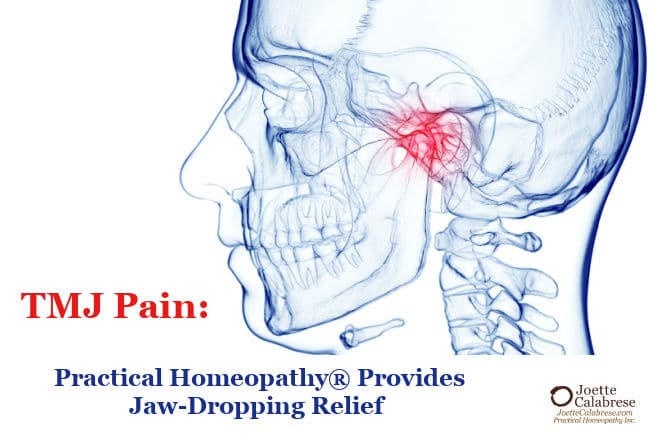
TMJ Pain: Practical Homeopathy® Provides Jaw-Dropping Relief

Joette Calabrese, TMJ Pain: Practical Homeopathy® Provides Jaw-Dropping Relief

TMJ (Temporomandibular Joint) pain can range anywhere from annoying to excruciating. If you’ve never experienced it, count your blessings. Even so, hold onto this article. TMJ pain is so common that you likely know someone who could benefit from this information.

What Is TMJ?

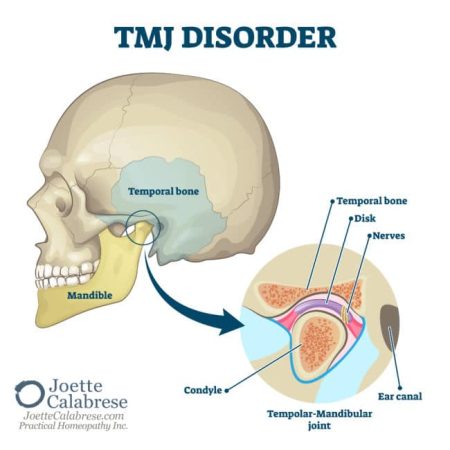
This specialized joint is located in front of the ear, between the temporal bone in the skull and the mandible. It acts as a hinge, connecting the jawbone to the skull and allowing movement for chewing and talking. When it malfunctions, it can cause pain in the joint that radiates into the surrounding muscles.

Joette Calabrese, TMJ Pain: Practical Homeopathy® Provides Jaw-Dropping Relief

What Causes TMJ Pain?

The etiology of TMJ disorder is often hard to pin down. The Mayo Clinic — a bastion of conventional medicine — even admits this issue:

“The exact cause of TMJ disorder is often hard to determine. The pain may be due to a mix of factors, including habits such as teeth clenching, gum chewing and nail biting; stress; and painful conditions that occur along with TMJ disorder such as fibromyalgia, osteoarthritis or jaw injury. The habit of teeth clenching or grinding also is known as bruxism.”1

You may recall that I wrote about bruxism in a previous blog post. Should bruxism be identified as the cause of a sufferer’s TMJ pain, the post offers a unique perspective on teeth clenching and grinding, particularly in children.

However, as you have come to expect in homeopathy, we do not always require complete clarity on the cause of a condition. Instead, we use the symptoms — as our gifts — to determine the closest fitting homeopathic medicine to alleviate the symptoms while also uprooting the underlying condition.

Ask any over-the-counter pain reliever to do that. (Spoiler alert: It can’t.)

Here’s a quick test to determine if you may possibly have TMJ disorder. What’s your first thought when you look at this photo?

Joette Calabrese, TMJ Pain: Practical Homeopathy® Provides Jaw-Dropping Relief

If your first thought is “Wow, that’s a lot of sugar and red dye,” you may be fine. However, if just thinking about the idea of biting into a candied apple makes your jaw hurt, then you might be experiencing TMJ pain.

Now, obviously, that example is more than a little tongue-in-cheek. However, it proves my point that we don’t necessarily need to know the cause. We simply need to know the symptom: jaw pain. If pain results when the jaw attempts to bite something large, chewy or sticky … read on.

Naturally, Practical Homeopathy® Offers Help

My friend, the name of the condition provides a big hint as to which homeopathic medicine we might first consider: temporomandibular joint pain. Take a moment to see if you spot the clue.

Yep … the operative word is “joint.”

Because the nature of this dysfunction and pain occurs in a joint, it may be considered arthritis.

“WHAT?” you may protest. “Joette, my 17-year-old’s jaw hurts every time he eats, but he can’t possibly have arthritis already!”

Stay calm, now. Keep in mind that the word “ ‘arthritis’ literally means joint inflammation.”2 That inflammation is often precisely what causes the pain. And what is our first consideration for arthritis (inflammation) in joints?

If you guessed Rhus tox, you’ve got it!

Rhus toxicondendron is often referred to as the “rusty gate remedy.” Its hallmark is that the pain is generally worse on first movement of the joint, but it becomes slightly better with continued movement. (Just like an old rusty gate.)

Indeed, Rhus tox 200C, twice daily, has been shown to be successful in addressing joint pain matching that description, almost across the board.

Generally, we would employ Rhus tox 200C, twice daily, for about a week. Then reassess the TMJ pain. If the bouts of pain are fewer and farther between, it might be time to halt. (Should the symptoms reappear later, the medicine may be recommenced until very much better once again.)

I’m not saying you’ll run off to the county fair with a candied apple in mind — at least, I hope you won’t. But in my clinical experience, Rhus tox can encourage the pain to subside and stimulate the body to effect healing change.

Pass on the good news of Practical Homeopathy®!

Warmly,

Joette Calabrese, Practical Homeopathy®

1https://www.mayoclinic.org/diseases-conditions/tmj/symptoms-causes/syc-20350941

2https://www.niams.nih.gov/health-topics/arthritis – :~:text=”Arthritis” literally means joint inflammation

P.S. Having a materia medica can help you discern the differences between particular remedies. There are free materia medica online. But I wrote my own, A Materia Medica: Practical Homeopathy® for Busy Families, to instruct you in everyday, easy-to-understand language instead of the complexities found in a professional materia medica.

Mothers and others find this materia medica invaluable when there are several appropriate medicines for a given condition. As you’ve heard me say before, in the absence of a specific protocol, we strive to choose the tightest-fitting homeopathic medicine in each situation by examining all the keynotes of the potential remedies. That’s nigh on impossible to do without a materia medica.


Prostatitis: The Bane of Man’s Existence Alleviated With Practical Homeopathy®


Joette Calabrese, Prostatitis: The Bane of Man’s Existence Alleviated With Practical Homeopathy®

There once was a man named McGee,
Who discovered that he couldn’t pee.
His surgeon said, “Cut.”
His homeopath said, “But …
Let’s first use this great remedy.”

Dad-joke limericks aside, prostatitis is no laughing matter for men.

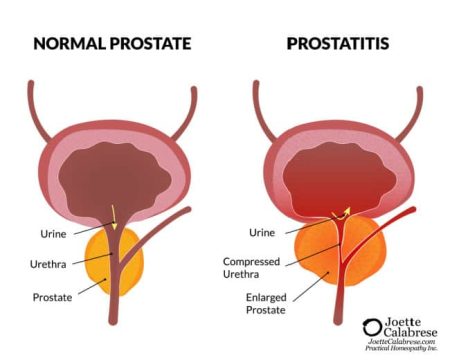
The symptoms can vary between sufferers. However, the main symptoms caused by an inflamed prostate are often urinary-related: inability to urinate, painful urination (dysuria), urinary urgency at night (nocturia) or dribbling.

We’ve covered other urinary difficulties such as strictures and low flow in The Dad Bod: Urinary Tract Dysfunction. However, today, we’ll take a look at how to approach the specific condition of prostatitis.

Joette Calabrese, Prostatitis: The Bane of Man’s Existence Alleviated With Practical Homeopathy®

A Helpful Botanical for Prostatitis

When a man complains of prostatitis, my first thought is always Sabal serrulata Mother Tincture (MT), about 10 drops, once a day.

Now, we are referring to this medicine in Mother Tincture form. That means it is in the gross form — not potentized or succussed. Consequently, it is not to be considered a homeopathic medicine, but rather a botanical.

The botanical Sabal serrulata is also known by its common English name, saw palmetto. Most knowledgeable men have probably heard that this particular botanical supports prostate health.

However, homeopathic medicines are known to do more than support. They address conditions and dysfunctions. So, let’s also consider adding a homeopathic (or two) to the schedule.

Practical Homeopathy® for Prostatitis

First up is Thuja occidentalis 30C. Generally, it could be employed twice daily, until very much better.

Homeopathic Thuja is made from the tree called arborvitae, Latin for “tree of life,” in reference to the many traditional healing properties provided by its leaves, bark and sap. That moniker essentially sums up the importance of this substance, doesn’t it?

However, when potentized and succussed — in other words, made into a homeopathic medicine — its value is increased exponentially. While Thuja has other applications, it is well-known as a great medicine for urogenital issues, particularly in men with such conditions.

Practical Homeopathy® for Accompanying Urinary Urgency and Frequency

Yet another homeopathic consideration may come to mind if the prostatitis is marked by a sense of urgency and a frequent need to visit the bathroom. Many men experience this most specifically at night, disrupting their sleep and, often, that of their partner.

Cantharis 200, twice a day, until much improved, is my go-to medicine for urinary tract infections as well as that torturous feeling of urgency.

As always, we employ our homeopathic medicines until very much better. Then, we step back and observe. If the condition is very much better, we discontinue the medicine. If the symptoms return later, the medicine may be taken up again.

Don’t forget homeopathy is medicine. It is not intended to be taken as a daily supplement — ad infinitum. When the symptoms ease, the medicine is halted. If there is absolutely no change within a few days, one might consider pivoting to another well-chosen remedy. (I teach more on men’s health in my Academy of Practical Homeopathy®.)

We Use Symptoms to Determine the Homeopathic Medicine Needed

My friends, as I’ve said before, symptoms are gifts. They are indeed precious gifts. We utilize them to choose the tightest-fitting homeopathic medicine for any condition. Since each case of prostatitis may vary, it’s critical that you know how to observe and what to do with your observations. There is no substitute for education.

If you’ve not yet joined (or created) a Gateway to Practical Homeopathy® study group, it’s the best way to jump-start your education. By completing both Gateway I and II, you’ll better understand the uses for some of our most common homeopathic medicines for first aid and acute conditions, a few chronic illnesses, and learn more about the ever-useful cell salts (a particular category of homeopathic medicine).

In my next Memo to Mighty Members (which will be emailed to members this coming Thursday), I’ll discuss another homeopathic medicine often considered when the PSA level is elevated.

If you haven’t joined us yet, you should. My weekly Memos are tantamount to extra blog posts. I’m able to discuss subjects much more freely and personally in our private enclave than I am in a public forum.

You’ve already missed 272 of these useful Memos. However, the great news is that they’re all archived with a searchable index on the Mighty Members site. Join today and start catching up.

Once you better grasp how to use homeopathy, you’ll be champing at the bit to pass on the good news of Practical Homeopathy®. Information like this is too exciting and wondrous to keep to ourselves!

Warmly,

Joette Calabrese, Practical Homeopathy®
Joette Calabrese, Practical Homeopathy®, Boomeropathy

P.S. If you were born between 1946 and 1964, you are a member of the Baby Boomer generation, just like me.

Whether you also proudly call yourself a Boomer or whether you know a Boomer, I encourage you to set time aside to listen to my upcoming virtual webinar on August 20 at 8 p.m. EDT, as I delve into the options that Practical Homeopathy® offers for conditions that plague those in the Boomer generation.

I call it “Boomeropathy.”

This webinar is presented by the National Center for Homeopathy (NCH) and sponsored by our good friends at Boiron USA. While the webinar is free, the solutions I’ll present, based on my own case work with clients in my practice, are priceless.

Register here:  https://homeopathycenter.org/free-homeopathy-webinars/

My presentation will be recorded, but you’ll need to register to learn where the replay will be hosted.


Podcast 150 — Moms with Moxie: VOILA! Silicea Helps the Body Successfully Push Out Painful, Embedded Foreign Objects and Much More


Joette Calabrese, Podcast 150 — Moms with Moxie: VOILA! Silicea Helps the Body Successfully Push Out Painful, Embedded Foreign Objects and Much More

In This Podcast, We Cover:

01:00   Introduction: Silicea Helps the Body Successfully Push Out Painful, Embedded Foreign Objects and Much More

01:30   What Is Silicea?

            Silicea 30 and 200 — https://www.boironusa.com/product/silicea/

            Silicea 6X — https://hylands.com/products/hylands-silicea

02:10   Silicea: Bunions (and Pushing Out Glass From an Old Car Accident)

            Gateway to Practical Homeopathy®: A Guided Study Group Curriculum

05:13   Silicea: Straightening Bowed Legs

08:21   Silicea for Pushing Out an Inch-Long Splinter

            The Academy of Practical Homeopathy®

11:30   Silicea for Pushing Out Cactus Barbs

15:38   Silicea for Pushing Out Recently Embedded Glass (and for Fear of Pins and Needles)

19:09   Silicea for Pushing Out Hair Splinters

            Gateway to Practical Homeopathy® II

21:25   Silicea for a Dog Riddled With Porcupine Quills

24:55   Joette’s Closing Thoughts on Silicea

            Free online materia medica — https://www.materiamedica.info/en/free-materia-medica-books.php

            A Materia Medica: Practical Homeopathy® for Busy Families by Joette Calabrese

Additional Resources:

Joette Calabrese on YouTube (Monday Night Lives)
Joette’s Learning Center
PracticalHomeopathy.com
Joette’s Study Group, Find Your New Study Group Friends
Joette’s Mighty Members
FindAPracticalHomeopath.com

Kate:

This is the Practical Homeopathy® Podcast, episode number 150, with Joette Calabrese.

Joette:

Hi, I’m Joette Calabrese, and I welcome you to our health care movement — yours, mine and the countless men and women across the globe who have retaken control of their families’ health with Practical Homeopathy®.

So, for the next few minutes, let’s link our arms as I demystify homeopathy — what was once considered an esoteric paradigm — into an understandable, reproducible, safe and effective health care solution available to all.

This is the medicine you’ve been searching for — my unique brand of homeopathy, PRACTICAL Homeopathy®.

Introduction: Silicea Helps the Body Successfully Push Out Painful, Embedded Foreign Objects and Much More

Kate: (01:00)

Welcome to the Practical Homeopathy® podcast. I’m Kate, and I’m here with Joette.

Hi, Joette.

Joette:

Hi Kate, and actually, hi to many, but we’re going to find out more about that in a minute, right?

Kate:

Yes. Today, we have a very special gathering of some of your inspiring students who are going to share their real stories, their successes, surprises and heartfelt moments. And they’ve been using a homeopathic medicine called Silicea, along with many others. So, we are going to welcome them here to share their stories.

What Is Silicea?

Joette: (01:30)

Hi, ladies.

So, we’re going to talk about Silicea, and there are the top 100 homeopathic medicines we can use. There are the top 300, if we want to go a little bit deeper. There are the top thousand. Silicea is just one of them.

But it was so fascinating when we started to talk about this in one of the classes. Everyone just came up with fascinating stories of their use of Silicea, which is made from flint.

And for those of you who know anything about homeopathy, it is a cell salt. Doesn’t mean it’s any different than any other medicine. It just is in its own special little category.

I’m dying to hear the stories. I’ve kind of heard little bits and pieces, but I haven’t heard the full picture, the full measure of everyone. So, I’m looking forward to getting to know what these stories are.

Silicea for Bunions (and Pushing Out Glass From an Old Car Accident)

Kate: (02:10):

All right, so let’s start with Christy. Welcome to the podcast, Christy.

Christy:

Hi, Kate. It’s so fun to be here today. See everyone and meet some new faces.

Joette:

Christy, you have a story about your mom.

Christy:

Yes, I do.

Joette:

And glass, please relay that. I remember that story. It’s pretty interesting.

Christy:

Yeah, it’s pretty crazy. Yeah. My mother and I were going through the Gateway courses, and we were studying the cell salts. And she’s a nurse, so, she’s pretty self-reliant and used to practicing things on herself. So, she wasn’t shy about diving right in, and she noticed all the things that Silicea was appropriate for.

So, she began to take Silicea, especially for her bunions. After about two weeks, the strangest thing started to happen. She had tiny shards of glass coming out of her face. So, at first, she didn’t know what it was, and then she realized it was glass from a car accident she had been in over 25 years ago. So …

Joette:

She was working on bunions on one end and on the other end …

So, did it frighten her?

Christy:

No, it didn’t frighten her. She kept taking the Silicea, and more and more glass started coming out of her face and her head.

But after a while, she was kind of getting tired of it, so she decided maybe she’d try some higher potencies to see if it moved things along. But what she noticed was that larger pieces were coming out, but that became a little bit uncomfortable. And she just stuck with the 6X because it was working.

Joette:

That’s an amazing story, but it’s not unusual. It’s amazing to anyone who doesn’t know anything about Silicea, but this is what Silicea is known to often produce.

Christy:

Exactly, exactly. So, yeah.

Joette:

She was using 6X. Was she using it once, twice a day? How did she …

Christy:

She was using it a couple times a day for a long time.

This has been over a year now. She still has glass coming out. She even stopped taking the Silicea for a while, and it’s still coming out.

So, we don’t know how much more glass is going to come out, but I’m sure you’re wondering: Yes, it did help with the bunions.

Joette:

Yeah, that is the question, isn’t it?

Christy:

Yeah, it did. In her face, her skin looks amazing. She has less wrinkles than most people her age. She looks great, but she’s ready for the Silicea to finish.

Joette:

To finish. Yeah. All right, “We’re finished now. Can we stop this job now?”

Yeah. What a fabulous story, Christy. So, now she’s hooked.

Christy:

Oh, absolutely.

Joette:

Yeah. That’s what happens when you realize that. And Silicea, then, is known for pushing, causing a superation around a shard, such as a branch, a piece of wood, a sliver, an old needle, a pin, glass. That’s the most common. I love to hear these glass stories.

Thank you, Christy. This was really fascinating.

Christy:

That’s fun. Thank you.

Silicea for Straightening Bowed Legs

Kate: (05:13)

All right, next we have Franicia. Welcome, Franicia.

Franicia:

Hi. It’s so exciting to be here with all of you. I got to do the interview with Kate, and I get to see everybody.

So, this is one of my favorite stories to share. I’m married, and I’m a mom of 10 children with age ranges of a young adult in her early twenties down to the baby who’s almost three.

So, around three and a half years ago, I had most of my children and noticed that one of my little boys had a different kind of walk. He was barely a year and a half, and my son had an unusual way of walking that seemed different than what I was used to as a parent.

And when he would walk, his feet were turned inward and his hips would sort of twist, and he almost looked like he was about to fall. So, not only were my son’s feet pointed inward, but his feet came together, and the rest of his legs were far apart and were bowing. Almost looked like parentheses.

I had been taking Gateway to Practical Homeopathy® classes and was slowly buying remedies and also got a cell salt kit. And when I first bought it, I had many health challenges and found relief by taking some of the cell salts. So, homeopathy was helping me so much that I always wanted to learn more.

So, one day I was reading the handout that came with my cell salt kit, which were all in 6X potency. And I was reading the keynotes and symptoms for each cell salt and noticed it says something like “rickets” under a cell salt called Silica (or Silicea). And I knew it was helpful for teeth, bones, growing children, among many other things in age ranges (and, you know, if it matches). And I decided to try it for my son.

I gave him about two doses in two days, and his legs straightened. And they looked like parallel lines when he would walk, and his hips weren’t swaying like they used to. His feet? They weren’t turned inward anymore. They were turned forward, and he didn’t look like he was going to fall anymore.

And our neighbors even noticed and said something to us. You wouldn’t have known he had a problem walking before, and he hasn’t needed that remedy again for his legs since then.

As a mom, I’m so thankful to learn these things.

Joette:

Franicia, repeat that. In two days?

Franicia:

Two days, two doses. This was three and a half years ago, and I have the videos to prove it. I have videos if you ever want me to share that — privately. It is amazing.

Joette:

That is amazing. Have you noticed anything else with his walking now? You said his legs are parallel. How about your other children? Anything with them?

Franicia:

One of them does have a slight twist, and she’s a fast runner. She’s taking the cavity protocol, which has helped her, but she’s the only other one. And a lot of my children are fast runners, and they love to run. But this boy, he loves to run, and he runs straight. Everything’s straight and parallel.

Joette:

Well, we expect miracles with homeopathy, but each time we hear one, it’s still just as exciting as though we wouldn’t expect it. It’s really fabulous.

Thank you so much for sharing that, Franicia. That’s a beautiful story.

Franicia:

My pleasure.

Silicea for Pushing Out an Inch-Long Splinter

Kate: (08:21)

Alright, next we have Tia. Welcome, Tia.

Tia:

Thank you, Joette. Thank you, Kate.

My story starts while I was in Academy. I had been in karate with my youngest daughter, and one of the little girls was selling Girl Scout cookies. A few weeks later, the mother was dropping them off to me, and I hadn’t been there in a while because Academy was taking a lot of my time up.

And she happened to say how she hadn’t been in karate (mother) because she had been walking around her house one day, and there was a mat (it was like bamboo or something like that). She stepped on it, and she got a splinter in her foot, and it was so bad that she was on crutches.

She went to the doctors, and they said that they wouldn’t do surgery ‘cause it could cause damage. So, she was at a loss.

She tried other things, different oils, and she’d been soaking her feet and all that stuff, and nothing seemed to help.

And she knew that I had been bringing my books every day when I was in class for karate. And she says, “Is there anything that can help me? This is awful. I’m on crutches. It’s been weeks.”

And I said, “Well, yeah. There’s this little thing called Silicea.” And I told her, “Get some in 200.”

And she took it for a week or a week and a half, and it came out. And it was an inch long.

Joette:

Whoa.

Tia:

But it was all the way up in her foot. Yeah, it was like where the arch and the ball of the foot meet. Like I said, the doctors wouldn’t touch it, and she was in so much pain. And it just came out! It had been in there for five weeks.

Joette:

Ooh, that’s a long time.

So, what was left at the end, Tia, when it came out? What was she left with? Was there still an infection? Did the infection just smooth over? Did it just clear up with no residual issues remaining?

Tia:

Nope. It was fine. Absolutely fine. You could just see the hole where it came out. She sent me a picture and everything. Yeah.

Joette:

I’ve seen that picture. I’ve seen the picture of the actual sliver — an inch. That’s a long way to go into a foot. Nice job.

Now you chose 200, instead of a 6. Tell me why. What were you thinking? I’d love to hear your rationale.

Tia:

Well, because you’ve always said that you like 30s and 200s, and I tend to lean more towards 200s.

She was in a lot of pain. It had been in there for several weeks, so she was tired of it and wanted to get it out.

So, I figured, “Okay, let’s hit it a little harder.” And it came out.

Joette:

So, it only goes to show we’ve got two stories of 6s and now a story of a 200. Silicea is Silicea, is Silicea in whatever potency you choose.

So well done.

I just have to ask this question. You brought your homeopathy books to your karate class?

Tia:

Yes. Yep.

Joette:

Did you learn how to chop them or …

Tia:

Well, my youngest would be in class, and then afterwards they would …

Joette:

So, he was in class, and you were studying, right?

Tia:

Yes.

Joette:

That’s the way it works.

Tia, great story. Good job. Thank you for sharing that.

Tia:

Thank you.

Kate:

That’s great.

Silicea for Pushing Out Cactus Barbs

Kate: (11:30)

Alright, next up is Sara. Welcome, Sara.

Sara:

Hi, thanks. Hello, everybody. Super excited to be here, too. That’s kind of got some nerves going, but it’s all good and all fun.

So yeah, my story is a little different. We live in an alpine desert of Colorado, which sounds opposite. Everybody thinks mountains in Colorado, but there is a high alpine desert with tons of cactus and sand, and can get very, very hot here.

Where our house is, we have a little small hiking trail. And my husband — it was a couple of years ago — took our two boys — they were about three and six — out for a quick little hike through the backyard of the house.

And the three-year-old stumbled and fell right into a cactus patch. And this particular cactus patch is one called fishhook cactus. So, it does have the fishhook barb on the end of it and makes them really difficult to remove.

Well, you also have a three-year-old, who gets up out of the cactus, and he starts screaming and crying. But then he starts rubbing wherever he landed in a cactus. And if you know anything about cactus spines, if you rub it, they break off at the surface of the skin instead of pulling out or coming out or anything else.

So, he broke off most of the top pieces of the cactus, where I could pull them out with tweezers. So, we were dealing with a lot.

And a lot of people are like, “Oh, try glue; try duct tape; try all these things.” Of course, that wasn’t going to work. And I knew it because I knew a little bit of homeopathy and knew what Silicea does. I sat him on the little counter, and I was able to pull out a few of them, but I just started to dose him with Silicea in a 30.

I chose a 30 because my only Silicea in a 6 was in Bioplasma®, and I wanted the strict effectiveness of Silicea alone. So, all I had was my kit with 30 in it.

And I gave him two doses over the course of about four or five days. And every single day, I would pull five or six little, tiny spines out of him. And then the next day, same thing, five or six little, tiny spines out of … it was all over: in his arm and his ribs and his leg. I mean, he face-planted pretty much into this poor little cactus thing.

But after about a week, we finally got the last little barb out, and he was so happy about it. He wasn’t in a lot of pain, but he thought that was really cool.

So, now he knows. And he looks at the cactus, and he is like, “Oh, Mom, make sure you have your Silicea in case we go by the cactus again.”

So, he is well-versed now in all of the homeopathy help.

Joette:

What a fun story. Well, it’s fun now. It wasn’t fun for him at the time.

So, let me make sure I understand. If Silicea didn’t push out the barb, you think they would still be embedded in those areas in which he had rubbed and broken off the tops?

Sara:

It very well could be. Sometimes we’ve had them kind of fester up. But they’re really hard to get to fester up. I think for the most part that, yeah, they would be stuck in his skin still to this day. And that was a year and a half ago.

Joette:

Interesting. Wow. Excellent.

So, what would they have done, do you think, if you had taken him to the emergency room?

Sara:

They don’t do much. A lot of times, they will just say, “Hey, we can try to tweeze out what we can. Hopefully, the body does something with it, but …”

Joette:

Hope the body pushes it out on its own. And Silicea did just that. It stimulated the body’s natural ability to do that.

Sara:

Exactly, yes. And made it faster, too. Because my mother-in-law had had this similar thing happen to her years and years ago. And she would visit the aesthetician weekly for them to try to pull them all out, and it took months upon months for her to get them all out.

Joette:

Wonderful. What a great story. The cactus story. So good. Who would think that cactus have barbs that you wouldn’t even think …

Sara:

Those ones are tough.

Joette:

Yeah. Yeah. Great story, Sara. Thank you.

Silicea for Pushing Out Recently Embedded Glass (and for Fear of Pins and Needles)

Kate: (15:38)

Next is Amanda. Welcome, Amanda.

Amanda:

Thanks, everyone. Happy to be here and hear everybody’s stories.

It was probably a year and a half ago, I gobbled up all Joette’s podcast, too, and was like, “When’s the next podcast coming out? I can’t wait for the next one.” So, super-excited to be here. So, I’m glad I wrote up my story because otherwise I think I’d just forget what I was going to talk about.

We’ve been using homeopathy for our family for over 15 years, and with six children, we’ve had plenty of opportunities to use it. So, this story tells the cautionary tale of our three girls who shared one large bedroom. I can’t say they are known for wild antics, but one day, all I heard was a great smash and some blood-curdling screams.

I ran to their room and discovered they had set up a mattress and decided to invent their own bedroom slide, propping it up against another bed.

Well, the fun was quite short-lived as my daughter slid down right into the glass-doored bookshelf, which smashed all over her feet and legs. It was a bloody mess, and shards of glass everywhere, including many stuck all over her legs, plus two large gashes.

I plucked out each glass piece I could see. But, much to her horror, we did have to bring her into the emergency room for some stitches. This child carried big fears of needles. So, that process alone was an event. But many months later, this same daughter started to have a tender spot when putting any pressure on her leg.

So, thinking maybe there was some remaining glass embedded, I gave one dose of Silicea 200, and no more complaints. We kind of totally forgot about it.

A month later, out popped a shard of glass right out of her leg. It was incredible. No bleeding, no pain, no big deal … from the girl who normally went into full freaking mode with any puncture wound. She took it out, and the skin simply just closed up right around it.

And it happened again. It was like, “here a shard, there a shard” for a time.

So yeah, I’m always in awe of homeopathy’s little miracles. But this was just another example of a wonderful result of Silicea’s superb skills, gently putting things out of the body that don’t belong.

Joette:

Well put. So well put, Amanda.

And you know what I think is fascinating about your story? In addition to where we’re going with the shards is that if you look at the psychology of someone who needs Silicea — not necessarily for injuries like this, but if you’re using Silicea for other reasons, such as to give someone kind of more grit. They often — people who need Silicea for whatever reason — they have a tremendous fear of pins and needles. Of stepping on them, of being injected with them.

And they often have … if someone is sewing, they don’t want to be around the pins, or they make sure the pins are all put into the pin cushion in a very tidy fashion because they’re very uncomfortable with it.

And the fact that after you having given her Silicea, she no longer had that fear. Beautiful. It touched her on many levels.

Amanda:

Yeah, I’m so thankful she could see the power of homeopathy. And now if she ever has an issue, her first question is, “Mom, what remedy can I take for this?” And of all the never-ending questions my kids ask me, this is definitely one of my favorites. So, thanks.

Joette:

Yeah, and this is the way to raise them. This is the way to raise kids. There’s no doubt about it.

Good story. Thank you for sharing, Amanda. That was great.

Silicea for Hair Splinters  

Kate: (19:09)

Okay, next is Jessica. Hi, Jessica.

Jessica:

Hi. Thank you guys for having me. I’m excited to hear the other stories, especially Christy’s mom. I have bunions, so … I want my wrinkles to go away. So, I’m going to start the bunion protocol, and then maybe my wrinkles will go away, too. So, thanks for your story, Christy.

Kate:

Well, for those of you who can’t see Jessica, she does not look like …

Joette:

She doesn’t have wrinkles.

Jessica:

No, they’re here.

Kate:

She’s gorgeous.

Jessica:

My Silicea story is actually a friend of mine. She’s a professional hairdresser, and so is her son. He works for her business, as well.

She was taking my Gateway class. And in Gateway II, we talk about the cell salts — Silicea specifically, as we went through the discussion.

He had been having foot pain, persistent foot pain, and she kept asking me, “What could we do  for heel spurs?” Or there were a few different things she was looking at.

And I was like, “Well, we really need to know what’s going on. You might need to go see a podiatrist. We need a diagnosis.”

Well, when we got to the Silicea lesson, she was reading about it. After hearing more about Silicea, she gave him a few doses over a few days. What happened next is wild!

Hair splinters started coming out of his foot, eight in total. So, eight hair splinters came out of his foot. Once they were out, the pain was completely gone.

So, it turns out hair splinters in feet are pretty common amongst hairdressers. I didn’t realize this, and that’s what it was. The foot pain was from the hairs when he was doing haircuts that got into his feet and were causing the pain. So, after that, he’s not been in any pain. It just completely went away.

Eight hair splinters.

Joette:

That’s fascinating because you don’t think of those kinds of problems that are associated with specific occupations. But yeah, I’ve heard that before about hair.

So, they can’t really wear sandals without socks or something because they can often get embedded. And it depends on what kind of hair it is, too. Is it thick? Is it sharp? Is it … et cetera.

Fascinating. So good. So good. Thank you for sharing that, Jessica. It’s a great story.

Yeah, and bunions, we know Silicea is great for bunions. There’s no doubt about it. Yeah, we’ve had some good reports on that as well. Thank you.

Silicea for a Dog Riddled With Porcupine Quills

Kate: (21:25)

All right, let’s finish up with Heather. Hi, Heather.

Heather:

Hi Kate. Thanks for having me.

My story’s regarding my dog. One of my three dogs, Ice, he got into a little bit of a tiff with a porcupine and showed up at my doorstep with 12 quills in his cheek and nose. So, luckily, it was only 12.

And my husband, my daughter, and I had to pin him down and pull them out with pliers. He’s 130 pounds, so a force to be reckoned with. After a while, he did not get used to us. He would run every time he’d see us. So, I had to be quite sneaky pulling them out time and time again. I’d catch him sleeping and rip one out.

I got to the last three, and the last one I broke off in his cheek, so I was quite mad at myself. But then I remember listening to a podcast regarding Silicea and how a little girl got glass in her face, and it forced the foreign objects out of her face. So, I thought, well, this is a perfect opportunity.

So, I had Silicea 30 on hand, and I just dissolved it in water and put it over his food once a day. I wasn’t very equipped with homeopathy at the time. So, I did that once a day for maybe five days a week, here and there, for about four weeks. And then I just figured maybe his body absorbed it. I have no idea. And I gave up.

About five weeks after that happened, he came up to me, and I noticed a hair coming out of the top of his nose. And I thought, well, that’s unusual because the top of a dog’s nose is quite flat and soft. So, it looked as thick as a horsehair. So, it was coming straight up. And I’d try and brush it, and he’d run away from me.

And then finally, after about a week of seeing it grow and grow and grow, it got to about a quarter of an inch high. And I was able to just be petting his ear, and I ripped it out with my thumb and my finger. And sure enough, it was the rest of that porcupine quill. But it had went in the side of his right lip and came out the very top of his nose.

Joette:

Gosh, it migrated.

Heather:

Yeah, it was really cool.

Joette:

Wow. And they’re barbed too, speaking of barbed quills. Yeah, porcupine quills are barbed. I just looked it up. I thought they were. So, did you find the barb? Was it … Did it …

Heather:

Yeah, it was the end that was stuck in. So, it came out the same way that it broke off. It’s really crazy.

Joette:

Amazing. Does he get it? Does he understand what you did?

Heather:

Oh, well, he now doesn’t go near the porcupines. So, I think the lesson …

Joette:

That’s the lesson. Yeah, because dogs sometimes really understand this. And they know that when something’s wrong, they go to the person who has the remedies.

Heather:

Oh, yeah.

Joette:

Great story, Heather. That’s wonderful. And so, it closed up, no infection was remaining.

Heather:

Nothing. No. Being farm dogs — that’s my husband’s thing — is they stay on the farm. We’re not taking ’em to the vet. So, everything I have to treat. So, it’s nice to become their veterinarian from home because I love them like my children.

Joette:

It’s up to you. It’s up to you, Heather. Yeah, that’s the way we all think here, isn’t it? It’s up to us to figure this out.

And the beauty of all of this, too, is that Silicea is wonderful for abscesses. So, if there is the potential of an abscess, or if an abscess begins to form, Silicea can often release that, abscesses in the gums and other areas on the skin as well.

So, great story. Thank you for sharing that. Good one.

Heather:

Thank you.

Joette’s Closing Thoughts on Silicea

Kate: (24:55)

Thank you to everyone who came today and shared their stories. I know it’s inspiring those of the listeners who are thinking about bunions or something that’s embedded in the skin. I really appreciate you being here.

Joette, any final words about Silicea or …

Joette:

Bunions? Abscesses, wrinkles. Right? Pushing out shards, causing a superation to push out shards.

It’s a great medicine for shoring up somebody’s angst and even bones that are forming.

It’s great as a remedy for teeth that are growing and for bones and children.

There’s so much involved in this medicine that I urge the listeners and viewers to crack open their materia medica. And many of them can be found free online, or my materia medica. Wherever you can get this information and read up on Silicea, sometimes pronounced “sili-cia,” depends on whether it’s the Latin version or the English version.

So, this is a great wrap-up. I love what all of you have said. I can’t thank you all enough for sharing this, taking the time out of your day to share this with everyone.

And for those who are listening, thanks for joining us.

Kate:

Yes. And if you want to learn more about other Silicea stories or other homeopathy stories, just go to JoetteCalabrese.com. That’s J-O-E-T-T-E-C-A-L-A-B-R-E-S E.com. And you can type in the search engine at the top of the page and find what to do for colds and sore throats and many other conditions.

So, thanks for being here with us today, everyone.

Joette:

Thanks, Kate.

It’s my honor to share many lessons on this simple method of using homeopathy for free —without affiliates or advertising — here in my podcasts, but also my blog posts and Monday Night Lives.

But it’s critical that you learn how to use these medicines properly. These podcasts should serve as only the beginning of your training. Peruse JoettesLearningCenter.com to find fun study group opportunities and in-depth courses developed by subject.

So, with the proper training, you can join the thousands of students before you in developing the confidence and competence to protect the health of your family and loved ones with my brand of homeopathy, Practical Homeopathy®.

Kate:

You just listened to a podcast from internationally acclaimed homeopath, public speaker and author, the founder of The Academy of Practical Homeopathy®, Joette Calabrese. Joette’s podcasts are available on all your favorite podcast apps.

To learn more and find out if homeopathy is a good fit for your health strategy, visit PracticalHomeopathy.com.
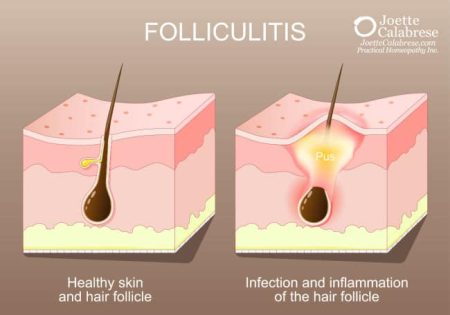

3 Effective Homeopathic Topical Medicines to Make a Boo-Boo Better


Joette Calabrese, Practical Homeopathy, 3 Effective Homeopathic Topical Medicines to Make a Boo-Boo Better

Remember when you were little, and you’d fall and scrape your knee? Remember how Mommy would fuss over you a bit, rubbing a little something on your injury to make you feel more comfortable?

Even though our oral homeopathic medicine pillules and tablets address scrapes, bites, stings, burns and pain, sometimes there is no substitute for a little tactile pampering. There’s just something about applying lotion to a boo-boo.

Enter homeopathic topical medicines.

These medicines are carefully formulated creams, ointments and gels designed to deliver homeopathic relief to external ouchies with pinpoint precision.

While I still prefer to meet the condition with an oral homeopathic, adding this extra step of topical therapeutic attention often makes the sufferer feel a bit more tended to. After all, who doesn’t feel all warm and fuzzy after a little hands-on care from time to time?

Joette Calabrese, Practical Homeopathy, 3 Effective Homeopathic Topical Medicines to Make a Boo-Boo Better

Homeopathic Topical Medicines: Stings and Bites

Have you ever stepped into a mound of fire ants? Believe me, if you have, you will never forget it. The same goes for sitting out on the beach and being consumed by no-see-ums. Of course, all of us have had an itchy mosquito bite or two in our lives.

I’ve kept SssstingStop® by Boericke & Tafel in my medicine cabinet for a long time, as I find it to be very soothing when used in conjunction with my well-chosen homeopathic medicine taken orally.

SssstingStop can be especially comforting to put on stings and bites. This can buy a little time while someone newer to homeopathy takes the time to determine the best matching oral homeopathic medicine for their particular condition. Apis, Ledum, Urtica urens and even Arsenicum album may be considerations. (Insider tip: Click the underlined links to the blog posts on specific biting pests that I previously mentioned in this section. They may help you make your choice.)

SssstingStop does work when I’ve used it in the past. In fact, for just a couple of little mosquito bites — nothing major — it can be very useful even without involving an oral medication.

Joette Calabrese, Practical Homeopathy, 3 Effective Homeopathic Topical Medicines to Make a Boo-Boo Better

Homeopathic Topical Medicines: Muscle Pain, Swelling and Bruises

If you’ve followed me for any time at all, you know that Arnica montana is the gem of our first aid kit. It is the chief medicine to consider for muscle pain, swelling from sprains, and bruises from bumps. I’ve probably written more about Arnica than any other homeopathic medicine. It’s that versatile and effective.

Consequently, it should come as no surprise that topical Arnica, employed directly on the affected area(s), would be an excellent adjunct to one’s use of oral homeopathic Arnica.

Arnicare® by Boiron comes in several different formats (creams, ointments, gels and even a roll-on).

It’s a premier medicine for overuse of muscles. However, I also had someone tell me that she used it on her varicose veins every day, and the topical application seemed to help subdue the condition.

Again, I generally prefer to use the oral method, but I see the topical as an extra bonus.

Joette Calabrese, Practical Homeopathy, 3 Effective Homeopathic Topical Medicines to Make a Boo-Boo Better

Homeopathic Topical Medicines: Scrapes, Chafing, Minor Burns and Skin Irritation

Calendula should be part of any well-curated first aid kit. I often use it in Mother Tincture form, as mentioned in my blog, My Top 5 Sizzling Summer Remedies.

However, the experts at Boiron have created topical Calendula cream, ointment and gel that can be quite handy.

The gel formula is especially cooling, making it a soothing remedy for razor burn. When we think of razor burn, we need not only think of men. It’s summertime, so many ladies are shaving more frequently under their arms, a sensitive area prone to razor burn as well.

Plus, topical application can be very comforting for sunburns as well.

Homeopathic Topical Medicines as an Introduction to Homeopathy

Folks who are new to homeopathy can often be a bit skittish about employing it for the first time. People may say, “I don’t know if I want to put that in my mouth,” or “I don’t feel comfortable taking homeopathy orally yet,” or “The store didn’t have the remedy in pillule form, but they had this.”

So, in my experience, topicals could be a good introduction to homeopathy for people who don’t want to ingest it yet.

Why? Because putting a dab of something on a bug bite, a sore muscle, or razor burn is familiar. That makes sense to most folks.

But to take a few tiny white pills to help your muscles? Sometimes, that can result in a skeptical, “Really? Hmmmm.”

Once they experience how well a homeopathic topical medicine can act, they’ll often be more open to trying the remedies in pillule form.

So, keep some topicals in your well-curated kit. You never know when your family might need a bit of added comfort or when a loved one new to homeopathy may be willing to give it a try.

Pass on the good news of Practical Homeopathy®!

Warmly,

Joette Calabrese, Practical Homeopathy®

P.S. My Memo to Mighty Members #271 last week covered a condition one member asked about: spinal stenosis.

This is precisely the kind of thing we discuss in Joette’s Mighty Members — members’ questions, as well as more personal reflections I don’t feel comfortable sharing publicly.

And yes, you read that right. I’ve written 271 of these extra blog posts for my Mighties to power up their education — with more on the way every week. Mighty Members even have a searchable archive in case they’ve missed one along the way.

What? You haven’t joined us yet? Why not?

Remember, all my Mighties qualify for a 10% discount on course purchases. If you need assistance getting your discount, email [email protected] for more information.