Podcast 136 — Moms with Moxie: There’s Nothing Special About Me; You Can Do Amazing Things!

Joette Calabrese, Practical Homeopathy®, Podcast 136 — Moms with Moxie: There’s Nothing Special About Me; You Can Do Amazing Things!

IN THIS PODCAST, WE COVER:

00:59 Introduction: There’s Nothing Special About Me; You Can Do Amazing Things!

         Wendy Dickens

03:08 Is It Ever Too Late To Learn Homeopathy

03:57 In Search of an Answer to Lyme Disease

         Gateway to Practical Homeopathy®: A Guided Study Group Curriculum

07:23 Joining The Academy of Practical Homeopathy®

08:59 From Learning to Teaching to Hanging Out a Shingle and Working With the Amish

11:54 Success Story: Panic Attacks

         Podcast 129: Overcoming Anxiety and Panic Attacks with Practical Homeopathy®

15:03 Success Story: Ganglion Cyst

15:51 Success Story: Fibromyalgia

         “How I Cured My Fibromyalgia With One Simple Medicine”

17:02 Success Story: Anger Issues

         “The Angry Child”

19:26 Success Story: Incontinence

12:04 Closing Advice

         Joette’s Mighty Members

         Joette’s Learning Center

         The Academy of Practical Homeopathy®

ADDITIONAL RESOURCES:

Joette Calabrese on YouTube (Monday Night Lives)

PracticalHomeopathy.com

Joette’s Study Group, Find Your New Study Group Friends


Kate:

This is the Practical Homeopathy® Podcast, episode number 136.

Joette:

Hi, I’m Joette Calabrese, and I welcome you to our health care movement — yours, mine and the countless men and women across the globe who have retaken control of their families’ health with Practical Homeopathy®.

So, for the next few minutes, let’s link our arms as I demystify homeopathy — what was once considered an esoteric paradigm — into an understandable, reproducible, safe and effective health care solution available to all.

This is the medicine you’ve been searching for — my unique brand of homeopathy, Practical Homeopathy®.

INTRODUCTION: THERE’S NOTHING SPECIAL ABOUT ME; YOU CAN DO AMAZING THINGS

Kate: (00:59)

Hi, I want to welcome you to today’s podcast. I am Kate, and we are so glad that you’re here.

I’m here today with Wendy. She’s going to share some very interesting stories. I can’t wait for you to meet her and hear about how she’s using homeopathy.

But first, I want to thank you for taking the initiative to learn about homeopathy. It will no doubt have an impact on your life and those around you — as you will hear it has in Wendy’s life in just a minute. If you’re new here, we want to welcome you to the podcast.

So, as I said, let’s meet Wendy and get started.

Hi, Wendy.

Wendy:

Hi, Kate.

Kate:

It’s great to have you here. I can’t wait for everyone to hear your story.

So, as always, we like to get to know the people that are joining us on the podcast. Can you tell us a little bit about yourself and your family?

Wendy:

Sure. My husband and I have been married for 30 years. We live in eastern Iowa. We moved back here a couple of years ago to be closer to our parents and young adult children.

We have five kids; three, I still homeschool. They’re 25, 21, 13, 12 and 11. We call ’em our “bigs and our littles” — although the littles aren’t so little anymore.

Our youngest two are adopted from foster care, and I only share that because with that — for anyone who is familiar with adoption — there’s lots of unique things that come out of that, both beautiful and difficult. And so, I have a lot of opportunity to use what I’ve learned. I’ll just say that.

And then we also have kids with different challenges with learning and just different ways of learning — different ways of looking at life that I’ve had lots of practice in that regard as well. So, yeah, I think that covers pretty much mostly about me.

Kate:

Alright, that’s great. Let’s dive into your homeopathy story, as we like to call it, and hear about your journey from not knowing anything about homeopathy until now where you have a business actually helping people with homeopathy.

IS IT EVER TOO LATE TO LEARN HOMEOPATHY?

Wendy: (03:08)

It’s interesting; I feel I’m a little late — compared to some people — to the natural healing modality.

Kate:

You’re not late, let me tell you. We have people who go through The Academy who are in their seventies and even eighties! So, I hear that all the time from people.

So, you are not that old — and not that that’s old. And isn’t it funny what we consider old now?

Wendy:

Yes, absolutely.

Kate:

Yes.  You’re young, and so you’re not late. But I understand what you’re saying … that those who learn it at a younger age or maybe as they’re first starting their families, they have a lot more time.

Wendy:

I think as we get older — if we discover this older — we lament what could have been, maybe, had we known. But that’s okay. We just start fresh from where we are and plow forward.

IN SEARCH OF AN ANSWER TO LYME DISEASE

Wendy: (03:57)

But yeah, my story actually began about five years ago. Well, a little bit prior to that, actually. I took my first Gateway class about five years ago, Gateway I. But a few months before that, our daughter had — just within a period of three days — gotten very ill.

It began with tingling symptoms down her spine, and within three days, she could no longer — without just being in agonizing pain — crawl. It was literally a crawl from the basement of our home where her room was, upstairs.

That was quite alarming, as you can imagine, and we sought help from doctors. That was largely disappointing. We had difficulties getting a diagnosis, finding out what was wrong.

At the back of my mind, thought maybe this is Lyme disease based on her symptoms. A few months later, she was diagnosed with chronic Lyme disease by a doctor. That was based solely on symptoms, which the majority of were joint pain that moved around (wasn’t always consistent in the same joints), fatigue, brain fog, and then that spiraled later into a lot more anxiety and depression. So, that happened.

Her symptoms began in June of 2019. I took my first Gateway class. It was really an answer to prayer that I didn’t know I was looking for. I’d never heard the word homeopathy before, but I dived into that first class, thinking, “Maybe there’ll be something here that would help our daughter.”

Took the class. I was intrigued, kind of excited, but nervous. Began trying it a little bit here and there on just acute things that would come up in our family, and little by little, I began gaining confidence in its effectiveness.

Then, fast forward several months. Meanwhile, I should say, our daughter … we were meeting with a team of doctors. What’s called a “Lyme-literate” medical doctor, a naturopath and then also consulting with a functional medicine doctor.

So, she was on, I think, about seven antibiotics at one time — which makes me cringe now — and lots of supplements. So, she was taking, I bet, 19 or 20 pills of some kind every day. And they weren’t helping, and so we were pretty discouraged.

She was depressed, as I mentioned. And several months later, as I gained confidence in homeopathy, I realized maybe this is really our answer.

And so, she actually decided, “You know what? I’m just tired of this mom. I feel sick all the time. I have to choke down these pills. It’s miserable.”

And so, I just encourage her. I said, “We’ve got a few options. One of them is homeopathy and just going all in on that. What do you think?”

She agreed.

We decided to just go off all the meds. One of them we had to wean off of, but she went off all the meds. And her symptoms, just by doing that, improved about 20%. And so that was a pretty big eye-opener right there.

In the meantime, I had contacted Joette’s office and set up a consultation with her. And we were on the waitlist, and so I was sort of trying a few things homeopathically for her while we waited.

We got in with Joette a few months later, and within probably, I think, four months of consulting with Joette, her symptoms had improved another, at least, 50% … probably more.

And so, at that point, I was like, “This is it! Get rid of everything else.” I was clearing all the other stuff out of our cabinets, and it was just all homeopathy.

JOINING THE ACADEMY OF PRACTICAL HOMEOPATHY®

Wendy: (07:23)

Because of my excitement, I began teaching Gateway classes here and there a little bit, inviting my friends to learn what I was excited about.

And then maybe a year or so after that — I’m trying to remember the timeline — I had been thinking about going into The Academy that first, what was called the Founder’s Year. But I was sort of nervous. I wasn’t sure if I could manage it with homeschooling and all the things we had going on. And so, I didn’t join.

But then, the second year, it came around again, and I think in a consultation, Joette said, “Wendy, you should really think about The Academy.”

And I said, “Well, it’s funny that you say that because I have been.”

And so, I decided, “You know what? Now’s the time. I’m just going to do it. If I don’t do it now, I’m not sure when I will.”

And so, I did join the second year of The Academy, and I’m so glad.

My hopes in joining The Academy were to just know everything I could so I could take care of my family and my friends. I’m sort of a “Don’t tell me you can’t do this” person — as much as possible, especially after our experience with our daughter.

And then all the things that happened in 2020, I thought, “I’m going to do it myself. I don’t know who I can trust, and so I’m going to just do it myself.” That was sort of my thought process.

So, in The Academy, I was learning a ton, enjoying every minute of it. I really, really encourage anyone thinking about The Academy at all to strongly consider it. We need more people who are trained in Practical Homeopathy® and helping the people in their circles. Whether you go on to take clients or not, it is so valuable, and it’s so needed.

FROM LEARNING TO TEACHING TO HANGING OUT A SHINGLE AND WORKING WITH THE AMISH

Wendy: (08:59)

After The Academy, then, my plan was to just keep teaching classes and keep teaching others. My thought was that old saying, “If you give a man a fish …” If you teach a man to fish, then he eats for a lifetime. If you give it to him, he eats for a day. And so, I wanted to teach other people to fish and learn — like I had — to take care of their families. That was my plan.

And then people began contacting me, asking if I could help them with their different chronic conditions or ailments that they just felt were too overwhelming or, for whatever reason, they weren’t comfortable taking care of themselves.

And so, I can’t tell people “no” when they ask. And so, that launched my consultation business as well. It’s been so fun teaching classes that actually led to an opportunity then. So, I had just graduated, was just starting to launch my business. Had taught, I think, maybe my first round of Gateway classes (so, Gateway I and Gateway II).

And then, one of my students approached me, who works with a large Amish community that’s about an hour north of where we live and said, “Would you consider teaching classes to some Amish ladies up here who are interested?”

And so, I thought about it and thought, “Yeah, I would love to do that!”

And so, I went up there. It was one Saturday “fire hose” experience. If I had to do it all over again, I probably would’ve picked two days in which to do that. But I ordered all the books we needed. People signed up ahead of time. I ordered all the books that we needed (because, of course, they’re not ordering things online) and worked with Joette’s office. They were great to help me navigate that process.

And we did a one-day class where we opened our books, and we just went through the material together and with the idea that we would hopefully be able to help teach some of these ladies how to fish and help their own families.

This friend that I mentioned that lives up north near this community has been working with them quite a bit and feeling a little bit overwhelmed at times. And so, I think she was hoping that “Oh, maybe we could get them some education and some knowledge so that they could at least treat some of the acute things that come up in their family.”

So, that was a really neat experience.

Kate:

That sounds really exciting to get connected with a whole other group of people, and, like you said, teach them how they can help their families.

Also, I wanted to point out that I hear often from students who have gone through The Academy and then even Mastery™ or Mastermind, how they started out just thinking they want to go through The Academy and learn more about Practical Homeopathy® and help their family. And then that turns into the next thing, which turns into the next thing. And next thing you know, they’re seeing clients and having a whole business around Practical Homeopathy®.

So, it’s exciting. And now I want to hear some of the stories about the things that you’ve seen and how homeopathy has helped those conditions. So, will you share a few of those things with us?

SUCCESS STORY: PANIC ATTACKS

Wendy: (11:54)

Yeah, I would love to. Before I do that, though, I wanted to just add I realized I didn’t say that our daughter — so that was several years ago — and we still consult with Joette twice a year, mostly because I don’t want to give up that time with her, probably. But our daughter is doing very well. And you would not know today. She, once in a while, might have a faint inkling of one of those past symptoms. Almost never. She’s doing amazing. She’s now married and expecting their first child. So, we’re super excited.

Kate:

Yeah, that’s great.

Wendy:

So, success stories. Back to that.

I’ve got several that are really fun. And it was kind of hard to pick, to be honest, what I wanted to share. But some of them are — or one of them is, I should say:

I have a client that I’ve worked with for a time, but she came to me with panic attacks and anxiety. And she’d been struggling with this for two or three years, I think, at the time that we began meeting, and had tried several things: changing her diet, adding exercise, even counseling, supplements.

And she found some things that helped a little bit, but she still was struggling with panic attacks that would show up sort of out of the blue at least once a week. It made it pretty challenging to just live life as normal. And so, we began consulting, and I suggested that she begin with Aconitum 200.

I think Joette has a blog or maybe some Lives about that. And it was pretty amazing to watch. Within two months, she went from weekly panic attacks to none.

She commented that first follow-up that we had. She said there was one time that she could kind of feel the beginning of symptoms start, and then they just melted away. So, she, of course, was thrilled.

We’ve now moved on to working on other things, but that really resolved. She’d suffered with that for two, three, four years maybe, and that really resolved in a pretty short period of time.

So, she had in her back pocket the remedy she needed in case something would happen, but she really hasn’t needed to use it. We’ve been able to move on to other things that are of concern to her.

Kate:

So, she just took that as she felt like a panic attack was coming on. Is that how she used the Aconitum?

Wendy:

So, she also had anxiety. She described it as “There’s just sort of this hum in the background all the time,” but then a panic attack would come on. And that was, of course, the most debilitating.

She felt like she could sort of manage that anxiety, even though it wasn’t fun. It was the panic attack that just made it impossible. And so, she was taking Aconitum 200, twice a day. And then if she felt an attack coming on … yes, then she would take another dose, and that would take care of it right away.

Kate:

Okay, great.

And you had alluded to Joette having more information on that. I know that there’s a podcast, I think it’s 129, called “Overcoming Anxiety and Panic Attacks with Practical Homeopathy®.” So, that’s another good resource for those who want to learn more about dealing with that.

So, what else?

SUCCESS STORY: GANGLION CYST

Wendy: (15:03)

Okay, so I have another client who had a ganglion cyst on his wrist. He’d had this before and had been surgically removed, but it had grown back. And so, I began having him take Ruta graveolens.

And within a few months’ time … I should say, as we followed up, I had him take measurements of how wide and long and deep it was. And so, we take measurements each time and note any changes. And it gradually was getting smaller and smaller until finally then, I think it was nine months — yes, nine months — the cyst was gone.

The cyst has not returned, and he’s thrilled to have it gone and not have to worry about thinking about surgery or some other means of treating it

Kate:

Wonderful.

SUCCESS STORY: FIBROMYALGIA

Wendy: (15:51)

I have another client who has struggled for some time with fibromyalgia and a few other things. But the fibromyalgia … she would get flares a couple times a month. And those flares would last two or three days and just were very painful and difficult.

We began working on that. She commented that she noticed right away if she felt a flare coming, that if she took Rhus tox, that it would just sort of melt away, and it wouldn’t continue to grow.

This particular client was a little skeptical at the beginning, and that was a pretty big eyeopener for her in realizing, “Oh, this medicine may actually be able to help me, whereas other things have not been helpful.” And so that was really fun.

After about six months, the intense flares stopped altogether, and she reported that only a few minor flares continued. And that at our eight-month check-in, she had not had any flares at all! And so that was really exciting.

Kate:

That is exciting.

And then I think you have someone that had a little boy with some anxiety and rage, I think was the word that you used.

SUCCESS STORY: ANGER ISSUES

Wendy: (17:02)

Yes. So, this is a little boy that our family has some pretty regular interaction with. And when we met them, I noticed pretty quickly that he definitely had some issues with anger. He would get upset very quickly if the other kids were doing something that he felt was not right … and just what could be characterized as a rage.

He would go into a rage and sometimes hurt other children in the process. But then his mom reported that he would be very apologetic and woeful afterward. “Mom, I don’t want to do this. I can’t stop myself. I don’t know why I do this.”

It’s just kind of heartbreaking. So, I didn’t have a close relationship with his mom, but I just sort of hedged the idea: “I’ve been learning about homeopathy. It’s helped my daughter and our family. Is that something you would be interested in trying? I think I know a remedy that might be helpful for him.” And she was all over that.

She was really at her wit’s end because she felt like nothing was really helping him. And she was being pressured to increase medications he was taking, and she didn’t want to do that.

And so, I recommended Stramonium, and she began giving him that. And she told me that she noticed if she saw him beginning to get angry — of course, you don’t catch it all the time — but if she saw him beginning to get angry, she would have him take a dose.

And similar to the fibromyalgia story, she watched it just sort of melt away. He never fully exploded or got fully angry as he used to. And within, I think, it was just two or three weeks’ time, she told me he was doing much better, very few incidents and nowhere near as bad as they were.

So, that was pretty exciting, too, that it could have such a great impact on this little guy’s life because people don’t always understand those behaviors. And so, it’s great to help the behavior melt away. But also … how much more is it also helpful for the way he now can interact with other people that won’t be fearful of him or not want to be around him because of his prior behavior?

Kate:

Right, absolutely.

And there’s also a blog called “The Angry Child” if you want to learn more, and we’ll put a link for that on the podcast notes.

Wow. Yeah. That really — I’m assuming — changed the trajectory of that boy’s life for sure.

Wendy:

Yes. Absolutely.

SUCCESS STORY: INCONTINENCE

Wendy: (19:26)

So, my last story that I have is when I was first learning about homeopathy. Our sweet springer spaniel that we had at the time was having a lot of trouble with incontinence. And that had actually began years prior.

Early on, I had found that just a little supplement for dogs was helpful in curtailing that issue for her. But over time, it began not working anymore. Again, at the time, didn’t know what our options were, and the vet put her on a medication for that issue.

Knowing that it would potentially cause some long-term issues for her, I really didn’t want to put her on it, but we didn’t know what other options we had. And so that’s what we did.

But as I began learning about homeopathy, I thought, “You know what? Maybe I’ll look in to see what I could do for her.”

And so, like I said, I was very new. I wasn’t sure what to do, but I did have a book that I had purchased that was specifically for using homeopathy with animals. And that book was “Homeopathic Care for Cats and Dogs” by Don Hamilton.

After scouring through that book and making some determinations, I chose Pulsatilla in a 30C for her.

And I should add, this was before I got very adept at scouring Joette’s blog for her different resources, otherwise I might’ve chosen something different.

So, I was giving her the Pulsatilla as well as the medication for a while, and then I removed the medication and continued with the Pulsatilla for a couple of months after that. No issues.

And so, then I gradually began backing off the Pulsatilla, and she’s not had another problem with incontinence since that time. So, that was pretty exciting, too, because we don’t have to worry about side effects with homeopathy like we do with other things.

Kate:

Right. I would just like to mention really quickly that there is a blog titled “How I Cured My Fibromyalgia With One Simple Medicine.” And so I know you talked about fibromyalgia just a bit ago, and I wanted to mention that in case people wanted to find out more. You can just go to JoetteCalabrese.com, and you can find all of those blogs that we mentioned.

So, I loved hearing your stories. It’s always so inspiring and encouraging because when we were talking earlier, you said, “There’s nothing special about me.”

Well, of course, I think there’s a lot special about you! But I think you were alluding to the fact that if you can do this — if you can have these successes, if you can go through The Academy — so can others.

So, would you just give those people who are wanting to experience these kinds of success stories or maybe go on to learn more about homeopathy … if you could just give them some of your advice as to how they could go about that, I would appreciate it.

CLOSING ADVICE

Wendy: (22:13)

Well, the first thing is I would say use the tools that are available. And I know there’s lots of podcasts or places that this has talked about, but Joette gives so much away for free that’s so valuable.

And so, just jump in and begin learning at the level that you are at and what you are able to do, whether that’s her blogs and podcasts that are free.

Take good notes. Be a student of those, whether it’s joining Mighty Members and hanging out there and learning from other people there, whether it’s continuing on with her protocol courses or other more in-depth classes, or whether that’s The Academy.

And regarding The Academy, I would just say I had lots of reasons why it didn’t make sense for me to join The Academy in terms of our family dynamics or things we had going on, or you name it. But I just knew this was going to be important for our family, and it has been transformative for our family.

And then there’s that ripple effect of all the students that I’ve now had the privilege to teach and the clients that I’ve worked with and seen amazing things happen. And so, there’s no perfect time.

Back to what you were referencing, there’s nothing special about me. I’m not this major intellectual. I have no background in medical areas. I have no leg up that I could even point to in terms of joining The Academy.

All you have to have is a drive and a willingness to learn, and you can do amazing things and help people in amazing ways.

Kate:

That says it all. Thanks so much, Wendy. I appreciate your time and your willingness to share with everyone.

Wendy:

Thank you, Kate. It’s been my pleasure.

Joette:

It’s my honor to share many lessons on this simple method of using homeopathy for free —without affiliates or advertising — here in my podcasts, but also my blog posts and Monday Night Lives.

But it’s critical that you learn how to use these medicines properly. These podcasts should serve as only the beginning of your training. Peruse JoettesLearningCenter.com to find fun study group opportunities and in-depth courses developed by subject.

So, with the proper training, you can join the thousands of students before you in developing the confidence and competence to protect the health of your family and loved ones with my brand of homeopathy, Practical Homeopathy®.

Kate:

You just listened to a podcast from internationally acclaimed homeopath, public speaker and author, the founder of The Academy of Practical Homeopathy®, Joette Calabrese. Joette’s podcasts are available on all your favorite podcast apps.

To learn more and find out if homeopathy is a good fit for your health strategy, visit PracticalHomeopathy.com.
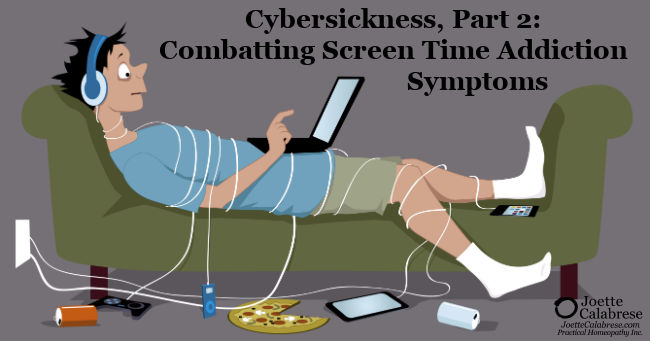
Cybersickness, Part 2: Combatting Screen Time Addiction Symptoms with Practical Homeopathy®

Joette Calabrese, Practical Homeopathy®, Cybersickness, Part 2: Combatting Screen Time Addiction Symptoms with Practical Homeopathy®

Sometimes, humans just don’t know what’s good for them … or bad. Our widespread societal reliance on technology has its good points (it’s easier to deposit a check digitally or borrow a digital copy of a book from the library). Still, that reliance also comes with a potentially heavy price.

Addiction to screen time not only can be a huge time waster, but it also can potentially lead to symptoms resulting from cybersickness.

I discussed vertigo — one of the main symptom complaints — in my previous blog post, Cybersickness: Our Body’s Brilliant Way of Saying ‘Put the Device Down’. But as requested in one of the comments on my post, I’d like to look at a few other common symptoms.

First and foremost, let’s remember that the best way to alleviate the issues from too much electronic device use is so simple it seems as though I shouldn’t need to say it. But here goes:

To reduce cybersickness, reduce your screen time!

Indeed, if a behavior makes us feel unhealthy, why would we continue it? (See the aforementioned, “Sometimes, humans just don’t know what’s good for them … or bad.”)

I discussed a homeopathic medicine for screen time addiction recently with my Mighty Members. (If you missed it, or if you’re just joining our ranks, search the archives on your Mighties’ dashboard for Memo to Mighty Members #241.)

However, what if your job depends on consistent time in front of a screen? Or what if a reduction in screen time does not fully uproot the condition?

Let me offer a few more homeopathic medicines that can be utilized when behavioral modification is impossible or doesn’t fully rectify these symptoms. Each of these medicines might best be utilized twice daily for a few days. Then, step back and observe. If the condition is very much better, discontinue the medicine. If the symptoms return, the medicine may be taken up again.

Don’t forget homeopathy is medicine. It is not intended to be taken as a daily supplement — ad infinitum. When the symptoms ease, the medicine is halted. If there is absolutely no change within a few days, one might pivot to another well-chosen remedy. With careful use and observation, cybersickness and screen addiction can be overcome.

Fatigue, weakness, anxiety

When these symptoms accompany screen time addiction, Arsenicum album may be considered. The sufferer may also experience heaviness in their legs and arms, often accompanied by restlessness. They may demonstrate fussy behavior as though every little thing causes them angst. Even trembling can present.

Food intolerances, irregularity and over-indulgence in foods

When stomach issues such as food intolerances, constipation or sudden over-indulgence in highly processed foods accompany screen addictions, one might consider Nux vomica. Generally, the person who needs Nux vomica is highly competitive. They would most likely be addicted to competitive games or pornography.

It may also be someone who has a history of taking drugs of commerce or is presently on drugs (whether street drugs or prescribed). Even synthetic supplements can be implicated. This is extended to the overuse of stimulants such as alcohol as well as drugs. 

The Nux vomica candidate lives too much in their head and leads a sedentary life. They become irritable and overly focused on winning in video games because they take the challenge too personally. They hate when someone impedes their forward movement in obtaining their goals — including anger in traffic as well as in gaming.

If a child, they are irreverent and ill-behaved towards the parent.

Joette Calabrese, Practical Homeopathy®, Cybersickness, Part 2: Combatting Screen Time Addiction Symptoms with Practical Homeopathy®

Eye strain

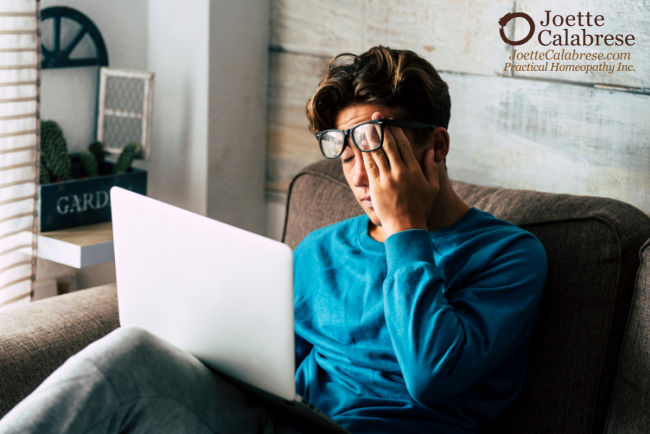
The best remedy by far for eye strain is Ruta graveolens. Eye strain may manifest as itchy eyes, tired eyes or even failing sight from overuse of electronic screens. Eyes may burn and tear. Most often, eyes will feel better from resting them.

Headaches and sore eyes

Overuse of devices may result in red, sore eyes. They may feel as though there’s sand in them. Sometimes, double vision may occur. Also, if headaches present as a result of too much screen time — and the eyes appear dull and “out of it” — we might consider one of our best remedies for severe headaches, Belladonna. It has been shown to not only address the headache but also tackle the sore eyes.

Joette Calabrese, Practical Homeopathy®, Cybersickness, Part 2: Combatting Screen Time Addiction Symptoms with Practical Homeopathy®

Inability to concentrate on mental activities

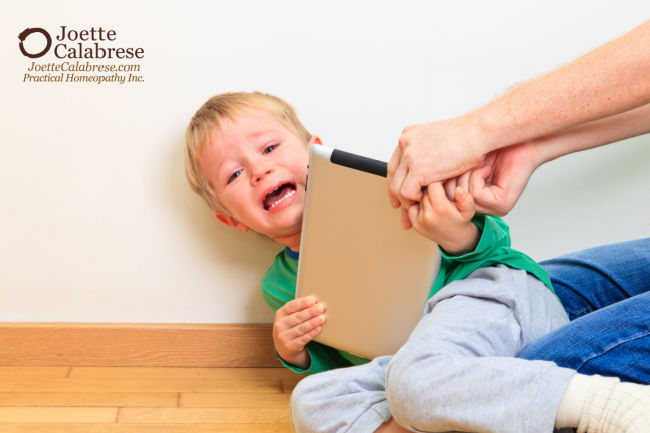
Occasionally, the addiction to video games will override almost everything else in life. It’s difficult to pull this sufferer away from their screen.

When a child loses interest in reading or schoolwork or an adult experiences the inability to concentrate, Natrum muriaticum may be appropriate.

When vision issues are experienced in tandem with a low attention span, slowness of mind or a dull headache, Nat mur may be the preferable medicine. (Be sure to read up on it in your materia medica before making your final decision.)

It has been shown that Nat mur is helpful for the digitally obsessed person who displays an inability to grasp new concepts because their mind is preoccupied with screen, screen, screen.

Nat mur is also one of the preferred remedies for school children who get low grades. The more they play screen-based games, the more their mental capacity slows. Keynotes for this medicine would be “slow and dull.” Although they show no interest in outdoor activity — or perhaps even an aversion to it — physical, outdoor activity is precisely what they need.

My friends, sometimes self-discipline is all that’s required to end cybersickness. However, when it seems impossible to avoid screen time, homeopathy is here to give that natural, gentle boost the body needs to recalibrate.

Pass on the good news of Practical Homeopathy®!

Warmly,

Joette Calabrese, Practical Homeopathy®


Glean From Experienced, Successful Homeopathy Masters

Joette Calabrese, Practical Homeopathy®, Glean From Experienced, Successful Homeopathy Masters

Homeopathy Masters
Our thoughts continue to be with the victims of the ongoing California fires. This week’s Monday Night Live will be devoted to discussing homeopathic medicines for physical and emotional issues stemming from natural disasters. Watch the livestream this Monday, January 20, at 8 p.m. EST, within my Joette’s Mighty Members site or on our simulcast network through the Joette Calabrese Facebook page, YouTube, X (formerly Twitter), Rumble and Instagram. (Or watch the recorded replays on the various venues at your convenience.)

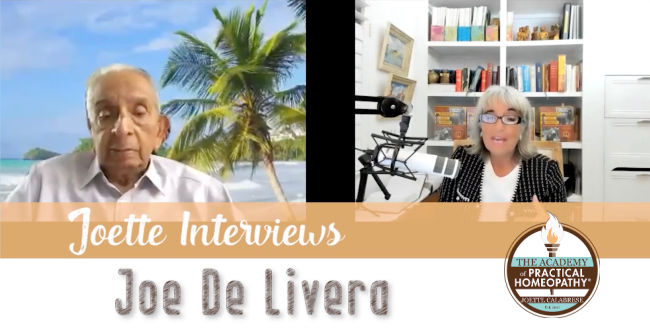
Last week’s blog post on cybersickness triggered a contribution from a homeopathic practitioner whom I greatly respect: Joe De Livera. Now in his 90s, Joe has taken countless cases over decades. Through his experience, he has developed unique protocols and delivery (or should I say, “De Livery”) methods he calls “Joepathy.”

He and I often share similar views on conditions and protocols. Yet, sometimes, we have differing go-to homeopathic solutions.

There’s more than one way to shine a penny.

Professional materia medica contain hundreds of remedies from which to choose. Even my curated, essential Materia Medica: Practical Homeopathy® for Busy Families contains over 150 medicines. Is it any wonder that one practitioner may favor one homeopathic while another may have seen more success with a different remedy?

It doesn’t mean one is right, and one is wrong.

Oh, nay, nay.

It means that homeopathy is a broad, sweeping paradigm that holds possibilities for all sufferers and conditions.

For instance, last week, I mentioned Cocculus indicus 30 helped my team member with her vertigo from cybersickness. Joe De Livera (Joepathy) quickly emailed me with this additional homeopathic information for the condition of nausea and vomiting from inner ear disturbances (along with a couple of other keen suggestions for somewhat related issues):

“Hi Joette,
“I discovered that
Nat Phos 6x is very effective to treat the problem. This seems to stop the regurgitation syndrome of food in the stomach which causes sea sickness.
“Also remember that it was Joepathy that introduced the remedy Arnica 30 for Jetlag to the world many years ago. This also prevents DVT when seated for long periods.
“Love Joe.”

There’s nothing like a friend of like mind that I can count on from across the globe.

My friends, information from a respected practitioner is invaluable. That’s why I am sharing his note with you.

However, this also brings me to a controversial issue that’s been stuck in my craw lately: ANYONE can hang up a shingle and declare themselves a homeopathic educator. Anybody. The anonymity of the internet allows a certain amount of perceived expertise to be created by a flashy website and slick ads.

Marketing does not a homeopathy master make.

Right now, newbies are popping up everywhere. Perhaps they are just regurgitating information they read from a book somewhere. Perhaps they are pirating information from others.

I have looked at some of the websites and found mistakes. That concerns me. Homeopathy’s reputation hinges on the integrity of those on the front lines of the paradigm. As the space becomes crowded with “posers,” it begs the question, “Whom do you trust?”

I trust the homeopathy masters.

I trust homeopaths (whether homeopathic practitioners, M.D.s, naturopaths or even lay practitioners) who have taken cases for a long time. I trust homeopaths who have undergone rigorous training — such as the immersive training from The Academy of Practical Homeopathy®. My goodness, some other schools don’t require their graduates to pass a pathophysiology module or study Dr. Samuel Hahnemann’s seminal Organon, the book detailing Hahnemann’s homeopathic philosophy.

My blood pressure is rising as I think about it.

My students receive a bountiful, well-rounded education in homeopathy and then explore and scrutinize case after case in Mastery™. They are exposed to the masters each week and benefit from guest lecturers and interviewees with differing philosophies from mine. For instance, in interviews, Joe De Livera discusses his well-documented Joepathy with my students.

Joette Calabrese, Practical Homeopathy® Glean From Experienced, Successful Homeopathy Masters

Choose your teachers wisely.

My friends, I urge you to glean from experienced, successful homeopathic masters and practitioners. Boericke, James Compton Burnett, Bönninghausen, Phatak, Drs. Prasanta and Pratip Banerji, and, of course, Dr. Samuel Hahnemann. And my friend, Joe De Livera. Don’t believe just any old thing that you find on the internet.

Next week, we’ll examine some additional symptoms of cybersickness that my readers have mentioned as areas of concern. I want you to keep learning as much as you can from me as I sculpt my experience into your education.

Stay curious! (And pass on the good news of Practical Homeopathy®!)

Warmly,

Joette Calabrese, Practical Homeopathy®

P.S. Remember, Joette’s Mighty Members is an exclusive enclave to join with others of like mind. Have safe discussions in my social center’s discussion groups. Get an extra blog post each week and semi-weekly video teachings from me. Plus, qualify for a 10% discount on course purchases. If you need assistance getting your discount, email [email protected] for more information.


Podcast 135 — Winter and Freezing Cold Is Upon Us. What Helpful Homeopathic Medicines Might We Need?

Joette Calabrese, Practical Homeopathy®, Podcast 135 — Winter and Freezing Cold Is Upon Us. What Helpful Homeopathic Medicines Might We Need?

IN THIS PODCAST, WE COVER:

01:00   Introduction: Homeopathic Medicines for Winter and Freezing Cold

02:29   When the Heat Goes On, Petroleum

05:03   What We Put on Our Skin Is Absorbed

07:57   Catching a Cold?

            ColdCalm®

            Aconitum napellus and Bryonia alba: A Banerji Protocol

09:47   Brrrrr. Frostbite.

            Hamamelis virginiana

            Agaricus muscarius

13:08   Depression and Vitamin D Deficiency

            Aurum metallicum

            Ignatia amara

ADDITIONAL RESOURCES MENTIONED IN THIS PODCAST:

Joette Calabrese on YouTube (Monday Night Lives)

Joette’s Learning Center

The Academy of Practical Homeopathy®

PracticalHomeopathy.com

Gateway to Practical Homeopathy®: A Guided Study Group Curriculum

Joette’s Study Group, Find Your New Study Group Friends

Joette’s Mighty Members

Kate:

This is the Practical Homeopathy® Podcast, episode number 135, with Joette Calabrese.

Joette:

Hi, I’m Joette Calabrese, and I welcome you to our health care movement — yours, mine and the countless men and women across the globe who have retaken control of their families’ health with Practical Homeopathy®.

So, for the next few minutes, let’s link our arms as I demystify homeopathy — what was once considered an esoteric paradigm — into an understandable, reproducible, safe and effective health care solution available to all.

This is the medicine you’ve been searching for — my unique brand of homeopathy, PRACTICAL Homeopathy®.

INTRODUCTION: HOMEOPATHIC MEDICINES FOR WINTER AND FREEZING COLD

Kate: (01:00)

Hi, friends. Welcome back to the podcast. We’re so glad that you could join us today. We want to thank you for taking the initiative to learn more about homeopathy. We know that it’s going to have a huge impact on your life, and so we’re excited for you and glad that you’re here.

If you’re new here today, we want to welcome you. Today’s podcast is going to be about winter remedies. And Joette’s here to tell us about the remedies that are commonly used — or could be needed — in the wintertime.

Joette:

Hi, Kate. So, I’m looking out my window, and there are squirrels running all over the place. It’s beginning of December, and they are fat, fat little squirrels. They’re the chubbiest. They almost look as large as a small raccoon. They are huge where I am, and they look really healthy and robust.

So, it got me thinking about how different it is in the winter — of course, it is because I’m up north — and how they’re preparing. Their cheeks are just loaded with acorns and all kinds of things, and I see them scampering about and planning for the winter.

And so, I thought, why don’t we plan for the winter, too, regardless of where we live … even in the South. Now, certain tropical areas, this may not be a problem, but even where it gets just a little cold — say, even Tennessee and those states do have little cold times. And people complain all the time, and it’s understandable that they don’t feel the same. Well, they always say “when the heat goes on.” So, I thought we’d talk about that.

WHEN THE HEAT GOES ON, PETROLEUM

Joette: (02:29)

And so, one of my favorite medicines in the winter when the heat goes on — and I don’t believe it’s from the heat necessarily, it’s because it’s just winter — and that is the remedy Petroleum. It’s so good for people whose skin gets dry in the winter — even just a little bit. It doesn’t have to crack, doesn’t have to flake. Doesn’t have to erupt.

Kate:

That’s what I was going to ask you, actually. You know how the cuticles of your fingernails, they get dry, and they start peeling and your skin gets really dry, like the elbows and everything. So, you’re suggesting Petroleum could help with even that?

Joette:

Yes. Petroleum 6 is the potency I would like. I’ve used it in a 30; I’ve also used it in a 200. But what I like about using Petroleum 6 is that you could use it twice, maybe three times, in a day.

So, dry lips … if there’s cracking and flaking, we can still use Petroleum. I would start with Petroleum. In a way, it makes a lot of sense because if we’ve been using Petroleum on our skin in the past, it often can cause this problem.

So, I remember years ago — I’m old enough to have been influenced by someone like Doris Day. And for those of you who are my vintage, you might remember that she put out in general to the public — I don’t know why it was that everybody seemed to know this about Doris Day — that she would smear petroleum jelly all over her body in the winter and then wrap herself up in cellophane.

And everybody thought, “Well, if Doris Day does that, and she’s so attractive, maybe that’s what we all should be doing.”

So, I actually remember sometime in the early sixties or so that that’s a lot of what women did, using a lot of petroleum jelly. But the problem with petroleum in its gross form is that it can suppress the condition and drive it to a later date — which is probably why some people who did that, many years later are in need of the homeopathic medicine, Petroleum 6 or 30.

It can be taken twice a day, if the skin is very dry. And then as the skin improves and the skin is not as dry … Or that feeling that my face is tight. And I don’t use soap. (I’ll be honest with you, I don’t use soap on my face. I simply use a washcloth and hot water and then dry off because soap really will make my face feel even more dry.)

Kate:

I do that, too. That’s so interesting. And you have very young-looking skin, so it must be working.

WHAT WE PUT ON OUR SKIN IS ABSORBED

Joette: (05:03)

Maybe. But that’s something that I would urge people to consider using.

Now having said that, let me just go off on a side note, and it has nothing to do with homeopathy, but I suppose in a way there’s some connection. And that is, that I believe that anything we put on our skin is absorbed … readily. And it can cause trouble, or it can be of use to us.

And the way that I learned this was that, years ago, before I knew enough about homeopathy to be able to treat my young son — I only had one child at the time — I used to use garlic. And I would mash it up and mix it in olive oil, and I’d have it sit there and steep for a fortnight or so. And then, when he got sick with a fever or something, I would rub the bottoms of his feet with this olive oil/garlic mixture.

So, one time, he was not feeling well, and I did that. I said, “Okay, now lay still.” He was on his bed, and I put an old rag under his feet, and I rubbed the bottom of his feet loaded up with garlic and olive oil.

And I said, “Okay, now don’t move,” because I didn’t want the mixture to go all over the bed. “Don’t move. I’ll be right back.”

And I ran to the bathroom, washed my hands and came back with a pair of old socks. Put the socks on his feet, arranged his covers and got him all ready for bed. And about two minutes later, I went to kiss him, and his breath smelled strongly — not a little bit, but very strongly of garlic.

And that was when it occurred to me that indeed what we put on our skin is utilized throughout the entire body. And now it was coming out. It wasn’t from his feet. I mean, originally, it was, of course, but now it was in his entire system so that I could actually smell it on his breath.

So, that’s what really made it clear to me that anything we put on our skin should be worthy of our entire body. So, I don’t buy lotions; I don’t buy creams. I rarely use any makeup at all. I do wear lipstick. I’m very careful about that — about what kind I use, and I use it only occasionally. And so, I’m very careful about that.

And instead on my skin — whether it’s dry or not, I just automatically do it — I use tallow. And often, I mix it with olive oil or something, and I use that on my hands. Or after I’ve washed my face, if it seems to be a little dry, I’ll put some on my hands and rub them together and put a little bit of it on my face.

Now, upon first applying it, it feels oily. And it seems like, “Oh my gosh, this is terrible. I can’t walk around being this oily. If somebody kisses my face or my hair touches my cheek, it’s going to stick.” But that’s not so. It seems to absorb quite readily.

Between Petroleum 6 and my homemade lard/olive oil mixture, I find that that really gets me through the winter without having to consider anything that’s storebought with synthetic fragrances and petroleum base and ingredients that are unpronounceable.

So, that’s my skin routine.

CATCHING A COLD?

Joette: (07:57)

Now, let’s go to something else in the winter, and I can’t imagine doing without these two remedies. So, I keep them — well, I used to keep them, I should say — in my purse. I don’t any longer because I simply don’t get sick very often. I think it’s been, I don’t know, five years since I’ve had a cold or something like that or a flu.

But there was a time when I and my children would get a cold once, maybe twice in the winter. And the first one that I used to keep in my purse was ColdCalm®, C-O-L-D, and then calm, C-A-L-M. That’s made by Boiron.

It’s an excellent remedy to have on hand. It comes in a little box, and then there are tabs that are pushed through the little card. And so sometimes, I just take it out of the box, and I slip the little card of pills in my wallet or in my purse. Takes up almost no room at all.

And at the first sign of a cold, that’s what I used to use, and that’s what I encourage folks to use … at the very first sign of it. And the sooner it’s taken more often, the better it acts. So that’s the one medicine for colds that come on in the winter.

The other that I like is Aconitum, A-C-O-N-I-T-U-M. There’s a second word, “napellus.” But if you know just Aconitum, that’s good enough.

Aconitum 200, and I like to mix it simultaneously in the mouth with Bryonia (B-R-Y-O-N-I-A) 30. And that happens to be a Banerji Protocol.

And that, too, can abort a cold or a flu or something that’s going to the throat or the chest. And so, either one of those two to have on hand during the winter is really right as rain for most families. It really puts us in order.

BRRRRRR. FROSTBITE.

Kate: (09:47)

Okay, so what about when you’re outside in the winter? And for those of us that live up north, it can tend to get very cold. I’ve had before where you’re outside for an extended time, and you’re not properly clothed, and your fingers get really, really cold — maybe frostbitten. Or I think there’s a word that you had for that.

Joette:

Chilblains. I love that word.

Kate:

So, what does that mean exactly?

Joette:

Frostbite is when it’s pretty severe. Chilblains is the step just before frostbite. And there’s a step just before that as well.

Some people just have cold fingers in general. Sometimes, they turn a little white, and they often have cold hands and feet. And then, in that case, I’m going to suggest a remedy such as Hamamelis. (We’re going to spell it in the notes instead of my doing it off the top of my head.) Hamamelis … and often it’s used a 200C, twice daily, for someone who has regular cold fingers and toes because it has to do with …

Kate:

Circulation.

Joette:

Circulation. Exactly.

Now let’s say the person goes further and they have not taken Hamamelis or regardless of the Hamamelis, they’ve now subjected their bodies to cold that is unrelenting. Then you might go to the next medicine for chilblains and/or frostbite, and that is A-G-A-R-I-C-U-S, Agaricus.

And that’s not necessarily a preventative. I would consider that more a medicine that’s used when you’re already in a fix. You know, “Uh-oh, I have done it. I’ve overdone it. I’ve skied too long. I’ve shoveled the snow for too long a period of time. I should have worn gloves, and I didn’t, and now I’m paying for it.”

That’s when we use Agaricus, and that would be used as an SOS, kind of, as needed. And in that situation, we might use it in a 30th potency every few hours — excellent for chilblains and frostbite. And as long as it’s used regularly, every few hours and depending on the severity, often the person will feel a great deal of relief.

Frostbite can actually be quite dangerous. We don’t want to go too far with that. So, we want to have that medicine on hand in the ready for the winter months forthcoming.

CONFUSED BY HOMEOPATHIC MEDICINES WITH SIMILAR NAMES?

Kate: (12:05)

Okay. I can see people asking about which Agaricus is it, Joette, because there are many of them in the materia medica and available for purchase. But often, you suggest to students that if you’re uncertain, find the remedy that has the most written about it. In this case, that would be Agaricus muscarius …

Joette:

That’s it!

Kate:

… and that’s usually the one.

Joette:

Yes, it is. Yes, it is.

So, it’s the same thing with a lot of these homeopathic medicines: first word that is common.

And we say, for example, Arsenicum. Someone just says plain old, Arsenicum, and they’re not being specific. They usually mean Arsenicum album, but there’s also Arsenicum iodatum and many other types of Arsenicum. So, you’re going to use Arsenicum that is most commonly used when you look it up in the materia medica. It’s pretty clear that this is the one that is most often used because there’s the most literature associated with it.

Kate:

In general, but it could be something other. But in general, if you’re wondering. Yes, good point.

What else in the wintertime do people suffer from?

DEPRESSION AND VITAMIN D DEFICIENCY

Joette: (13:08)

Depression? How about that? How about lack of sunlight? Yes. Yeah, that lack of sunlight is a big deal.

And so, some people think, well, I’ll just take vitamin D, but I’m not a fan of vitamin D. It’s synthetic. It’s manufactured by an industry.

If you’re looking for vitamin D than you would want to eat foods that are high in vitamin D. And the foods that are high in vitamin D just happen to be winter foods such as meat pies.

And so, we make a flaky crust with lard or tallow, which has plenty of vitamin D naturally in it. And if you’ve ever read the books by Laura Ingalls Wilder on the subject of “Little House on the Prairie,” that’s what they used to use in the winter. They would use lard and tallow to make their pie crusts, and they made many, many pies every week.

That was a great way to not only get the natural vitamin D but also was a tidy way to make a meal. It made the house nice and warm. It fits very neatly.

So, if you’re not going to eat lard or tallow — although I would urge you to do so — and instead, you put your tallow on your skin, now you’re using something that adds vitamin D to your skin automatically.

And you’ve decided no, none of that appeals to me. Then we can often use the medicine Aurum metallicum, A-U-R-U-M, metallicum, M-E-T-A-L-L-I-C-U-M. This is for frank depression — not just a little blue, but depression.

Someone who loses interest. They’ve lost their get up and go. They see everything as though the glass is half-empty, and it’s pretty clear that it has something to do with the weather. It can have something to do with circumstances as well. But then we use Aurum metallicum 200C. And it’s usually used every third day — one dose every three days.

And as always, with any of these homeopathic medicines, remembering they’re not supplements. They’re not vitamins. They’re medicine. So, as improvement ensues, we back off. We taper away. We halt the use of the medicine, and if it’s needed again in the future, we just take it up again.

But this is not to be repeated for long periods of time. Once we see improvement, that’s when we halt the use of the medicine.

Kate:

I have a friend that in the wintertime — almost like clockwork, every year in January — she takes Ignatia. That’s the remedy that helps her, so to speak, the winter blues or depression that she gets in the wintertime. Is that another medicine that could be helpful in the winter?

Joette:

Yes. Ignatia could also be useful. Certainly, Ignatia, generally, is a little more for the female side of the world, and Aurum metallicum is a little bit more for the male side of the world. It doesn’t mean you can’t give a man Ignatia, nor does it mean you can’t give a woman Aurum metallicum. But there’s a little more weight on the sadness of a woman towards Ignatia and a little more weight on the sadness of a man towards Aurum metallicum.

Kate:

Okay. Well thanks, Joette, for some great ideas for remedies that we might want to have on hand for the winter in case those situations arise.

Joette:

Good. Love it. I hope this helps lots of folks.

It’s my honor to share many lessons on this simple method of using homeopathy for free —without affiliates or advertising — here in my podcasts, but also my blog posts and Monday Night Lives.

But it’s critical that you learn how to use these medicines properly. These podcasts should serve as only the beginning of your training. Peruse JoettesLearningCenter.com to find fun study group opportunities and in-depth courses developed by subject.

So, with the proper training, you can join the thousands of students before you in developing the confidence and competence to protect the health of your family and loved ones with my brand of homeopathy, Practical Homeopathy®.

Kate:

You just listened to a podcast from internationally acclaimed homeopath, public speaker and author, the founder of The Academy of Practical Homeopathy®, Joette Calabrese. Joette’s podcasts are available on all your favorite podcast apps.

To learn more and find out if homeopathy is a good fit for your health strategy, visit PracticalHomeopathy.com.

Cybersickness: Our Body’s Brilliant Way of Saying ‘Put the Device Down’

Joette Calabrese, Practical Homeopathy®, Cybersickness: Our Body's Brilliant Way of Saying 'Put the Device Down'

Cybersickness
Before I begin this week’s pre-planned blog post, our hearts go out to the victims of the California fires. The devastation is unthinkable. So many people are in shock and suffering great loss and grief. I offer these links to previous blog posts that can be of aid to those in need:

Homeopathic Remedies for When Disaster Strikes: Survivalist Guide to Homeopathy Free Infographic
Shock: Homeopathy Shock and Burns
Burns: Ready, Aim … Oh, No! Fire!
Smoke inhalation: Where There’s Fire, There’s Smoke
Shock, Grief and Anxiety: Practical Homeopathy® for Angst and Anxiety in the Aftermath of Hurricane Helene
PTSD: A Salute to Ignatia Real Medicine for Post-Traumatic Stress and More

Joette Calabrese, Practical Homeopathy®

Remember the old commercial that warned, “It’s not nice to fool Mother Nature”? Well, the advertiser may have been hawking margarine (which you know you’ll never find in my home), but the sentiment remains true just the same.

Cybersickness is much the same as seasickness, except your body is not actually moving. (It’s not nice to fool Mother Nature.)

Watching reels or fast-paced videos on an electronic device, playing video games with whirling graphics, and even scrolling through Word documents too quickly for too long can result in inner ear confusion. We all know how sensitive our inner ears can be. The slightest disruption can result in nausea, dizziness and vertigo that can last long after the electronics are put to sleep.

A case of cybersickness

One of my team members — we’ll call her Debbie to protect her privacy — experienced exactly these symptoms.

Debbie initially assumed a physical ear problem caused her vertigo. She felt it from the moment she woke up until she went to bed. Driving was even a bit difficult as the road wavered in front of her.

However, she felt no symptoms of an ear infection, so she was hesitant to employ the protocol for otitis media without knowing more. After all, homeopathy is medicine. We don’t take it willy-nilly.

At first, Debbie didn’t put it together. She worked on long Word documents all day long. Adding insult to injury, Debbie would play a game on her phone to relax at night (not something I would advise, as you know). She didn’t realize she was only making her symptoms worse.

Then, Debbie came across an article on cybersickness containing information on precisely what she was experiencing: cyber vertigo (sometimes called digital vertigo).

Joette Calabrese, Practical Homeopathy®, Cybersickness: Our Body's Brilliant Way of Saying 'Put the Device Down'

Vertigo: A confused inner ear

Debbie’s constant, fast scrolling was simply too much for her inner ear to adjust. The bright colors flying across the screen of her “relaxing” game triggered a perfect storm of misinformation.

You see, her eyes were feeding her inner ear errant information that great movement was occurring. However, her body remained still, not offering confirmation of the movement or the ability to balance her equilibrium.

“Don’t do that.”

After reading the article, Debbie realized the old doctor joke had come home to roost. You know the one: The patient says, “Doctor, my arm hurts when I do this.” The doctor says, “Then, don’t do that.”

So, Debbie stopped scrolling at the speed of light and slowed her work pace to allow her eyes and inner ears time to catch up. She stopped playing her game and instead turned to more lofty ways to relax, such as listening to inspiring music or podcasts on ancient history.

I also suggest that those suffering from cybersickness nurture their equilibrium by looking at distant, natural vistas. Plus. It’s helpful to exercise visual perspective. Attempt to find a vista with an obstacle in close range, such as a tree in front of a pasture or a dune in front of an ocean view.

Cocculus indicus

Unfortunately, the damage was done. The mere cessation of the offending habits did not turn her condition around, so she turned to homeopathy. The chosen remedy was Cocculus indicus 30, twice daily until very much better. It worked in short order, perhaps within two weeks or so.

Once she was much better, Debbie stopped taking the medicine. However, she keeps it on hand in case another immersive Word project triggers the condition again. If that happens, she will begin the Cocculus schedule again, halting again when the symptoms abate.

In fact, annual subscribers to my Mighty Members private enclave might appreciate their once-a-year downloadable eBook bonus even more now. (If you’re unfamiliar with them, these eBooks contain every blog post I’ve written, organized by year, back to 2013.) You can imagine Debbie scrolling through each eBook — comprising hundreds of pages — while compiling them for me. You can bet she works with her Cocculus at the ready.

(As an aside, let me mention these free eBooks are another good reason to consider joining our Mighty ranks. Imagine having a searchable copy of all my blog posts stored on your computer. You can access them even if you have no internet. Plus, they’re printable, too.)

Screen addiction

Of course, avoiding excess screen time is a good place to start. Modern society spends entirely too much time attached to their screens. At a member’s request, I discussed screen addiction last week in my Memo to Mighty Members.

Perhaps I’ve not mentioned this, but when you join my Mighties, you’ll receive access to all my past Memos, with a searchable index to help you find conditions and medicines that pertain to your family and loved ones.

So, if you’re interested in the homeopathic medicine to consider for screen addiction, join today and search for Memo to Mighty Members #241.

But if conquering the addiction fails to alleviate existing cybersickness, turn to Practical Homeopathy®. Debbie can attest that Cocculus indicus 30 has been shown to right the ship.

Pass on the good news of Practical Homeopathy®!

Warmly,

Joette Calabrese, Practical Homeopathy®

P.S. And remember — all my Mighties qualify for a 10% discount on course purchases. If you need assistance getting your discount, email [email protected] for more information.


Addressing Severe Gastric Distress from Norovirus (or Whatever!)

Joette Calabrese, Practical Homeopathy®, Addressing Severe Gastric Distress from Norovirus (or Whatever!)

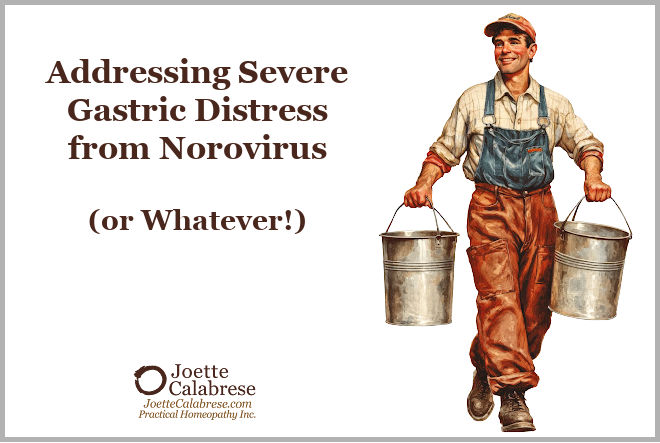
Blech. It’s winter, and they say that norovirus is going around. It’s hard to peruse a news source without reading something that blames it for all sorts of suffering. To make it even more scary and evil, it’s sometimes called the “two-bucket disease.” (I’ll let you use your imagination on that one, but it’s not because you feel like going to the beach to build sandcastles.)

Indeed, seemingly never-ending vomiting and diarrhea are the hallmarks of what many are suffering. Taking care of your family and yourself before an event is one of the best ways to protect against conditions.

What should we do?

Worry? Avoid crowds?

No. I don’t worry, and you shouldn’t either. Instead of going back to bed and pulling the covers over our heads, we who know Practical Homeopathy® can often go about our business. We need not succumb to fear because we have time-honored homeopathic medicines that have addressed gastric upset for over two centuries.

Does “norovirus” require a specific homeopathic remedy unique only to this condition?

Again, no.

In Practical Homeopathy®, we often make our remedy determinations by analyzing the symptoms rather than by the name of the virus or bacteria du jour. Nausea, vomiting, diarrhea, and accompanying aches and pains are universal symptoms that generally call for the same medicines.

BAM!

If the gastric distress hits quickly — like one minute you’re fine, and the next minute you’re not — that would be a time to consider Aconitum napellus 200 immediately at the onset, perhaps twice a day for a day or so. Aconite is our medicine to remember for conditions with a quick onset.

Then, we can add another homeopathic medicine to address the precise symptoms impacting us.

Ugh, the nausea.

If the condition presents with nausea, a good consideration would be Ipecacuanha 30 (Ipecac) employed according to severity. For instance, during the initial waves of nausea, one might require this medicine every few hours, reducing the frequency to twice daily as the condition improves.

If the nausea hits like a ton of bricks, one might consider alternating the Ipecac (for the nausea) with the Aconite (for the fast onset). This would be accomplished by utilizing one medicine followed in brief succession by the other medicine — perhaps five minutes apart.

What about a two-bucket situation with extreme exhaustion?

Perhaps vomiting ensues, accompanied by diarrhea and especially great fatigue. Now we can turn to a Banerji Protocol that I love: Veratrum album 200 mixed together in the mouth with Cuprum metallicum 6. One might require this protocol every few hours in the beginning — again, according to severity. As the condition begins to shift and improve, then gradually elongate the time between doses.

Joette Calabrese, Practical Homeopathy®, Addressing Severe Gastric Distress from Norovirus (or Whatever!)

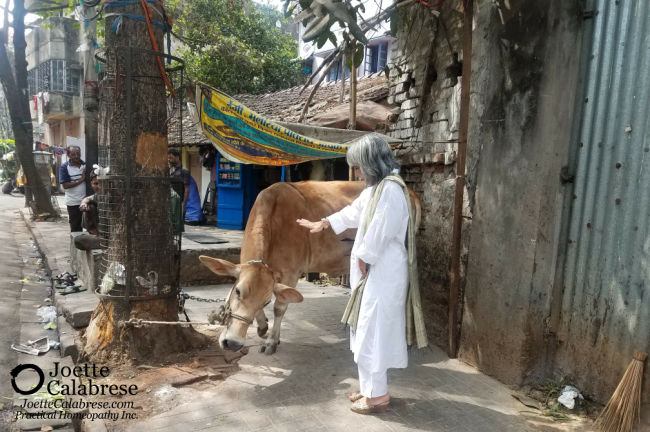
This protocol helped me recover from “Delhi Belly” (dysentery) during one of my trips to the Banerji clinic in India. I was very sick, but this proven combination righted the ship. (You can read about it in my blogs, “Not Sensitive Anymore, but I Get ‘Delhi Belly’ ” and “Disasters, Diarrhea, Dysentery.”

Now, suppose one doesn’t have access to the Banerji Protocol combination of medicines for the symptoms of dysentery — extreme weakness from terrible diarrhea and relentless vomiting. In that case, either the Veratrum album or Cuprum alone can often do the job.

How about just diarrhea alone?

Persistent diarrhea can also present with many acute gastrointestinal conditions. However, rather than discuss it here, I plan to talk more about this timely topic in my Monday Night Live tomorrow, January 6, 2025, at 8 p.m. EST on my Joette’s Mighty Members site or our simulcast network through the Joette Calabrese Facebook page, YouTube, X (formerly Twitter), Rumble and Instagram. Join me, won’t you?

If you’re reading this after the live event, remember you can always find my archived Monday Night Lives on Facebook or YouTube. Better yet, my Mighty Members can view the archives on their dashboard, utilizing an exclusive searchable index that helps them find the precise condition, remedy or category they’re looking for. How convenient is that?

So, until tomorrow night, please pass on the good news of Practical Homeopathy® to anyone suffering. Watching the suffering melt away will be a heady experience for you and a welcomed relief for them.

Warmly,

Joette Calabrese, Practical Homeopathy®

P.S. My course, Good Gut, Bad Gut, contains all things gut-related, including acute conditions like this and much more. If tummy troubles are typical in your family, I urge you to consider this valuable course. My students report that it gives them freedom from angst about getting sick.

Additionally, my magnum opus, The Survivalist Guide to Homeopathy, contains information for almost any eventuality. Presented in a hard-copy binder, you can use this guide even if the internet is down and you’re left without electronic resources. This book is an indispensable addition to a home shelter or an emergency bug-out bag.

And remember, all my Mighties (Joette’s Mighty Members) qualify for a 10% discount on course purchases. If you need assistance getting your discount, email [email protected] for more information.


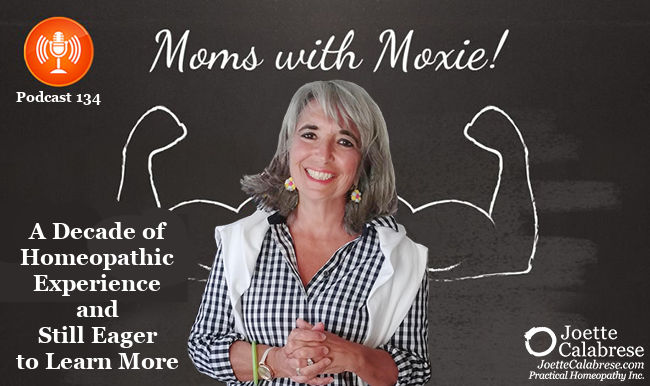
Podcast 134 — Moms with Moxie: A Decade of Homeopathic Experience and Still Eager to Learn More

Joette Calabrese, Practical Homeopathy®, Podcast 134 — Moms with Moxie: A Decade of Homeopathic Experience and Still Eager to Learn More

IN THIS PODCAST, WE COVER: A Decade of Homeopathic Experience and Still Eager to Learn More

00:58   Introduction 

            Podcast 116 — Moms with Moxie: A Close-Knit Study Group

            The Academy of Practical Homeopathy®

            Gateway to Practical Homeopathy®: A Guided Study Group Curriculum I and II

03:23   What Has Beth Tackled With Homeopathy?

05:23   The Evolution of Beth’s Gateway Study Group

             A Materia Medica: Practical Homeopathy® for Busy Families

             Joette Calabrese’s Monday Night Lives on Facebook

             Joette Calabrese’s Monday Night Lives on YouTube

             Good Gut, Bad Gut: A Homeopathic Strategy to Uproot Seemingly Unrelated Illness in Body and Mind

             Feminopathy: How You Can Correct Female Ailments Using Safe, Inexpensive and Effective Homeopathy

07:20   Homeschooling With The Ultimate Cool Kids Guide to Homeopathy

08:44   Success Story: Allergies (Seasonal, Dairy, Cat Dander, Anaphylaxis)

            Boiron AllergyCalm®

            Allergic?! Escape Allergies, Chemical Sensitivities, Food Intolerances, and More with Homeopathy: Practical Protocols to Get Your Life Back

            The Survivalist Guide to Homeopathy

12:58   Success Story: Hernias

            Update: Hernias and Homeopathy

            Get Back in the Game, Hernias and Homeopathy

14:43   Success Story: Heat Stroke

15:56   Curate Your Own Homeopathy Kit

18:14   Learn More in The Academy of Practical Homeopathy®

19:16   Closing Advice

ADDITIONAL RESOURCES MENTIONED IN THIS PODCAST:

Joette’s Learning Center

PracticalHomeopathy.com

Joette’s Study Group, Find Your New Study Group Friends

Joette’s Mighty Members


Kate:

This is the Practical Homeopathy® Podcast, episode number 134.

Joette:

Hi, I’m Joette Calabrese, and I welcome you to our health care movement — yours, mine and the countless men and women across the globe who have re-taken control of their families’ health with Practical Homeopathy®.

So, for the next few minutes, let’s link our arms as I demystify homeopathy — what was once considered an esoteric paradigm — into an understandable, reproducible, safe and effective health care solution available to all.

This is the medicine you’ve been searching for — my unique brand of homeopathy, PRACTICAL Homeopathy®.

INTRODUCTION

Kate: (00:58)

Hi, I am Kate, and I want to welcome you to the podcast. We’re so glad that you’re here today. I want to thank you for taking the initiative to learn about homeopathy because it’s going to have a big impact on your life if you learn about it and you use it.

So, if you’re new here, just jump right in. We want to welcome you, and we’re going to get started.

Today, I have a special guest. Her name is Beth. She’s joining me. And I met Beth through studying homeopathy. Believe it or not, that’s where I met all my closest friends, honestly, that I have now.

Beth and I are dear friends, and I’m so thankful for her, and I can’t wait for you to get to know her a little more. You may have listened and heard her on Podcast 116 called, Moms with Moxie: A Close-Knit Study Group. And she’ll explain a little bit more about that study group as we talk.

But for now, I want to welcome Beth to the podcast.

Beth:

Hey Kate, how are you?

Kate:

Good. It’s so fun to be with you here today. I want our listeners to get to know you a little bit. I know if they’ve listened to Podcast 116, they may have heard from you. But for those who didn’t listen to that podcast, can you just tell us a little bit about yourself?

Beth:

Sure, Kate. So, basically, I have been studying homeopathy for about 10 years. I started off as my daughter was a client of Joette’s … and then my whole family. And then, I started studying it and teaching it. And I have a group that’s just awesome, as you mentioned. And then I worked with you guys for a little while, and now I’m in The Academy. So, it’s just awesome.

Kate:

We probably started using homeopathy about the same time. I think you were in the Gateway II study group that I was leading, and that’s how we first met.

Beth:

Yes.

Kate:

And we’ve been talking ever since then.

Beth:

Exactly.

Kate:

So, you live in Florida, and I get to see you, and I come down there a couple times a year at least, which is super-fun. I love your family and your dogs. They’re great. I’ve adopted them, or maybe they’ve adopted me.

Beth:

Yeah.

Kate:

So, I know you have a lot to talk about today. You have many things that you’ve used homeopathy for in those last 10 years. Just kind of give us a rundown about all the different things that you’ve used homeopathy for with your family, your friends, clients and so forth.

WHAT HAS BETH TACKLED WITH HOMEOPATHY?

Beth: (03:23)

Okay, so how long do we have?

Okay, so I kind of broke it down a little, like some of the acutes and then some of the more chronic things.

So, with friends and family, we’ve done everything from allergies, colds, flu, bites, injuries, stress, burns, stress from studying and things, loss.

And then more on the chronic side, we’ve addressed things from UC, which is ulcerative colitis to diverticulitis to allergies (like food allergies as well as animal allergies), back issues, torn ligaments, diabetes … I mean, it goes on and on.

Kate:

Yeah, I think when we were talking earlier, you mentioned other things, too: hernias and blood clots and anaphylaxis.

Beth:

Yes, that’s right. We did. I’ve done anaphylaxis. That’s been amazing. And then friends even more like asthma, vertigo, UTI. I’ve dealt with Alzheimer’s with some family and aging. And then, I also had a practice for a little while and everything from miscarriages to pregnancies to gout, eczema, teeth issues. Yeah, it’s been amazing.

Kate:

Yeah, and I’m sure there’s many more you haven’t written down because on a day-to-day basis, we encounter many things in our families and our friends’ lives. And I know whenever we get together, Beth, we always just talk about homeopathy and all the different remedies and books and what we’re learning, and it’s very fun to have others that you can talk to about this.

So, tell us a little bit more about your study group for those who didn’t listen to the other podcast and what you’ve been doing over the years.

THE EVOLUTION OF BETH’S GATEWAY STUDY GROUP

Beth: (05:23)

It’s an amazing group. It’s just, we’ve been together … it started maybe about seven years ago, and then, it’s kind of organically changed as needed. But we’re online; we do Zoom. And we started off every Tuesday, and now we’re every other Tuesday — kind of just changes depending on what we’re doing.

Started off with me just teaching everyone Gateway and getting us kind of all on the same page. And then we’ve gone into other classes. We did Joette’s materia medica through her Live. So, we’ve gone through the Facebook Lives [Editor’s note: Archived Lives may also be found on YouTube here].

And especially during the “C” time, we did all the materia medica. So, we all bought her materia medica — Joette’s. And then we went through the Lives, and it was great to connect the dots between what was in the book and then her expanding on them. So, we did that.

We’ve done Good Gut, Bad Gut. We’re about to do Feminopathy. We’re going to start that in January.

Kate:

And right now, you’re going through some more Facebook Lives together. And I think that’s an interesting way to study together because there’s so much free information that you can go through together in addition to the courses. So, that’s a great idea that you guys are listening to Joette’s Facebook Lives and then talking about those in your study groups. That’s great.

Beth:

Yeah, it works really well. We’re behind, so we pick two or three. And then, the group is just amazing now even, or I don’t have to teach everything. I haven’t had to the last couple years. Everybody takes turns. So they listen, and then they talk about it, and we all give input, and it’s just amazing. It works really, really well.

So yeah, it’s just an amazing group of women. And it started off just some of my friends from homeschooling, and then their friends and then maybe some of my friends. And so that’s a really nice group of people.

HOMESCHOOLING WITH THE ULTIMATE COOL KIDS GUIDE TO HOMEOPATHY

Kate: (07:20)

And I know that you’ve gone through what we’re calling the “Kids’ course,” but the full name is The Ultimate Cool Kids Guide to Homeopathy. Tell us a little bit about that and why you went through it and how you did it.

Beth:

So, right when that first came out, I was so excited. I was like, I love working with kids. I homeschooled my kids. I taught second grade in homeschooling. And I offered a few friends that I would teach it if their kids would be interested. And the kids were just so great, and you know they pick up so quickly on information.

In fact, recently, there was an event, and there was a picture. So, this was … I don’t know, five or six years ago that I did it, right? When did it come out? I don’t remember. Anyway, there was an event, and there was a picture. And there was all these desserts. And one of the young girls — she’s now in high school — that took the class with me was like, “Oh, they’re going to need Nux vomica.”

They remember. It’s amazing.

Kate:

Oh, that’s neat. I was actually looking at some of the videos from the Kids’ course the other day, and I was reminded how interactive that is with the videos and sound effects, and I think it’s very engaging. What are your thoughts? And I think an adult would gain information from that as well.

Beth:

Absolutely. I think it’s a really great class for anyone, and it’s fun. The kids’ class is fun — not that your other classes aren’t fun, but …

SUCCESS STORY: ALLERGIES (SEASONAL, DAIRY, CAT DANDER, ANAPHYLAXIS)

Kate: (08:44)

So, let’s get into some specifics on some of the things that you mentioned earlier. Pick out a couple of things and just talk to us about how you handled a couple of those conditions that you mentioned earlier.

Beth:

So maybe a big thing that people will deal with is allergies, and that can be a lot of different things. It can be just like a basic allergy that something’s in the air, and you start sneezing … all the way to having digestive problems or even going to anaphylaxis. Right?

And so, with the acute, I love the Boiron AllergyCalm®. I think that’s what it’s still called. [Editor’s note: AllergyCalm® was formerly called RhinAllergy®.] Anyway, that combination is really great for just those quick acutes when you’re around someone, and they’re sneezing a lot, and you can tell they’re struggling. And people are more likely to take something that’s in a package — unfortunately or fortunately, I don’t know. So, I do use that for acutes.

I also carry around some other remedies like Apis, if I really need it. And I’ve also used the protocols from the Good Gut, Bad Good class on food allergies and food intolerances.

So, I have one son who really had issues with dairy, and I was able to address that. And now, he’s fine. I mean, it’s just amazing. I mean, for years and years, he couldn’t.

And then even myself … I had terrible gluten allergies. And I did a couple of other things trying to get over it before I knew about homeopathy, but homeopathy was what finally got rid of that. I have no symptoms anymore, which is amazing. It does take time, but it’s totally worth it because then, it’s gone.

Also, my husband was allergic to cats, and we were able to treat that. And we had people here that I didn’t know they had cats, and a few years ago, my husband would’ve really struggled with that, but nothing.

Kate:

You mean they came over with their cats?

Beth:

No, just coming over with the dander on their clothes would have set him off.

Kate:

Oh! Okay.

Beth:

I used to ask people, “I’m sorry, do you have cats? If you do, I can’t have you sit on the furniture.”

I would really have to be really careful. And now I didn’t even think about asking because he doesn’t react anymore. So, that was really amazing.

And then, I had an anaphylactic reaction. I was at a restaurant. I was eating a lot of stuff, so I don’t know what it was, but something set me off, so I knew what I needed for … I carried that around because I had had previous anaphylaxis. I was allergic to bees and venomous insects — which I am not anymore, which is just amazing.

So, I treated that with protocols, and then I had this anaphylactic reaction to some sort of food. But thankfully, I had the remedies with me, and I was able to take them. And I did exactly what Joette recommends.

There happened to be a walk-in ER place just around the bend. So, I drove over there, and I sat in the car. And I took the remedies, and I never had to go in. And it was just amazing because I have been in the hospital for that. And it takes weeks and weeks and weeks to get over those drugs that they give you.

Kate:

And that information is covered, I know, in Gateway II and also the Allergic?! course, and I’m sure there are other courses that it’s mentioned as well … of course, Survivalist.

So, if you’re interested in — that’s something that your family struggles with — you can learn that information in those places.

So, what else, Beth?

Beth:

Stomach pain, diverticulitis … those kind of things that aren’t necessarily there shorter term, and we wouldn’t do a chronic allergy treatment with, but I’ve had really great success with those, too.

SUCCESS STORY: HERNIAS

Kate: (12:58)

I know someone in your family dealt with hernias, and that’s a pretty major thing that people usually are recommended to get surgery for. And you’ve had some success with the homeopathic remedies.

Which, by the way, is it something that your family struggles with or someone who does? There’s a blog called Update: Hernias and Homeopathy. There’s one previous to that called Get Back in the Game, Hernias and Homeopathy. So, if you go to JoetteCalabrese.com — that’s J-O-E-T-T-E-C-A-L-A-B-R-E-S-E.com — and you type in the top-right search box, just search “hernia”. Those blogs will pop right up for you.

So, can you tell us about your experience with using the remedies for that?

Beth:

Yeah, we use the remedies, and we did some red light. We like to try to be healthy in general, right? And red light has been shown to be good, too. So, the combination of doing the natural modality of the red light as well as the homeopathy worked amazing. And it was very quick!

And where we were getting the red light, they were like, normally the red light helps, but it doesn’t get you there. You still have to get surgery. So, I believe — obviously — that the homeopathy was the other thing that we did instead of doing a medical procedure.

Kate:

Since we talked about that recently (because I knew someone who had a hernia), and I mentioned it to some other people who’ve also dealt with that, and they’ve actually just used homeopathy alone. And it’s reversed it, which is incredible.

You go to the doctor’s office, and they say it’s not … “You can’t reverse this.” But it has been, and your family is proof of that. So, pretty incredible.

SUCCESS STORY: HEAT STROKE

Beth: (14:43)

Yes, definitely. Something else is we live in Florida, and it’s hot. And I’ve dealt with heat stroke with homeopathy, and that’s been amazing.

When we were with groups of kids for homeopa … I mean, for homeschooling, and we would go to the beach, and the kids are running around, and they don’t want to stop, and they don’t want to drink anything. And you have kids that get heat stroke.

And before homeopathy, there were a few times where people had to go to the hospital. But once we knew homeopathy — or I knew homeopathy — I was able to offer it and make suggestions. And it was amazing because it just works so quickly, and they didn’t have to.

And then it’s always funny. Then people question, “Well, maybe it really wasn’t.”

I’m like, “No, definitely was.”

Kate:

Isn’t that funny?

Beth:

Yeah. But it worked really amazing. I have a little bag that has all the remedies that can be used for heat stroke together, and I carry that when I go to the beach.

Kate:

Along with probably the remedies for stings from things that are in the ocean perhaps. Right?

CURATE YOUR OWN HOMEOPATHY KIT

Beth: (15:56)

Yeah, you know, as you get more comfortable with homeopathy, and you understand it more, that’s what I’ve ended up doing is … I kind of make my own kits for things.

So, when my son was going on a mission trip to Hawaii, and I put together a kit, I looked up where he was going: What are the bugs and different things that are there? And thinking about, okay, he’s going to be in a really hot setting. He is going to be working outside. What kind of remedies is he probably going to need?

Traveling remedies, right? Injury remedies. And I put together a whole kit just for him to take with him.

I also do that when they go off to college. Of course, that’s really hard because they could run into a lot of different things. But the first year, I’ve really sent a lot of stuff. The second year I got better at it, but that’s something that I like to do.

You can be more specific. I know what my son is more likely to deal with, and my daughter’s going to deal with, or my husband. He’s going to have more indigestion. My daughter’s going to be more exhausted. My son’s going to maybe have a little stomach thing. So, you can gear your kits towards that, which is fun.

Kate:

Do you send them with any instructions? Or do they just contact you when they’re not feeling well, and you point them in the right direction?

Beth:

It’s kind of a combination. Because I’ve been doing it so long that they all understand (on a basic level) homeopathy, but they usually call me. I create a little spreadsheet, and I print it up that has little suggestions for what to take with what. And so, they can look it up and just take it.

But they do generally contact me just to make sure they’re taking the right thing.

Kate:

Yeah.

Beth:

Because the cold and flu kit that I send them with — that I put together — but they’re not going to take all of that. Right? So, they’ll call and ask or text.

Kate:

Right. As kids do these days, most often text. A phone call is rare. Well, not for you. Your children call you more than most, I think. You get to stay in touch.

Beth:

I do.

LEARN MORE IN THE ACADEMY OF PRACTICAL HOMEOPATHY®

Kate: (18:14)

Let’s transition to talking about The Academy because I know some people like to know what is it like and what kinds of things do you learn. And so, you are about a third of the way through The Academy of Practical Homeopathy® year. Tell us what it’s like.

Beth:

It’s great. It’s a lot of work. No, it’s really good. I really enjoy it. I worked with you guys when we were first putting it together and the beginning of it. I wasn’t involved in that much of it, but being on the other side is so interesting.

It’s a really good program. It’s really well put together, and it covers a lot of different things that some people might not have thought of as important, but they definitely are. And I can see how it all works together.

I’m not a history person. I am just not, but I am actually enjoying the history. And I sent that to Joette the one time I was like, “Thank you because I really would not have looked into that at all.”

But it really is good, and it really does connect some of the things that we’re also learning. Right?

CLOSING ADVICE

Kate: (19:16)

Well, good.

What I’d like to finish up with today is: I’d like to get your thoughts on some things that people can do to learn more about homeopathy, or what tips or ideas do you have for people who are learning?

Beth:

Just keep going along. Start wherever you can. If you don’t want to buy classes, that’s okay. Joette has a lot of information online and just keep listening to it and learning about it and reading about it and listening to it, and it’ll be amazing what you pick up.

And then, I think following what she recommends really does work. And that’s where — when I kind of had a practice there for a little while, well, I did — but following what she specifically said:

Get the timeline and understand what’s happening over time with them is good to be able to see. Have them pick out the main things that they want to work on, and you really can see it work backwards on the timeline, and it just encourages you to keep learning more and doing more.

So, watching people get healthy and be able to function in life better is just, it’s priceless. It really is.

Kate:

I liked the idea that you had … where you told me that as you were learning more about the different homeopathic medicines, that you take notes. And I know you do that in a couple of different ways. Maybe you can share a couple of ideas for people who are wanting to study this.

Beth:

Yeah, so, I think anything that you want to learn more about, the first thing is knowing what your learning style is. One of my sons is definitely an auditory learner. If he just listens to it, he learns it. Where for me, I need to take notes, and that’s how I remember it.

But then, also, I want to have good information that I can use later. So, when I do the materia medica class for The Academy, I take notes on what she says. I also check her materia medica — Joette’s — and I write little notes in there. And then I also make the materia medica cards that come with The Academy. So, I’m basically creating my own materia medica written in my own words. And I think that will be really cool for me after we’re done when I’m searching for information to help people.

Kate:

You also make spreadsheets sometimes as well. So, for those of you listening, Beth is amazing with her notes. She’s incredible. So, she knows where to find anything you need to know.

Beth:

Yes. I’m doing a spreadsheet on all of the protocols and more, so that as I’m going through, I’m creating that so I can really easily search.

I had a friend stop by yesterday. She needed some remedies, and we were talking, and I’m like, “Let me just look and see what else we have.” And I can just search on a word, and I can find all kinds of information. So, I like to do that.

I also make little cards with PowerPoint that are the protocols, and then I have the protocols saved as little recipe cards like Joette started with on her website.

Kate:

Oh, my goodness. You do even more than I knew about.

Beth:

Yes.

Kate:

Wow. So, do you do the spreadsheets in Excel?

Beth:

I do. I use Excel, and I do the cards in PowerPoint usually.

Kate:

Beth, thank you so much for sharing all this information. It’s a lot, and I’m sure we’ll be talking again because you always have so much to talk about.

And I know your daughter. We’re going to have a podcast where we talk to her because she has her own story about using homeopathy and actually studying it as well. So, I look forward to hearing from her.

And I want to thank you for sharing this information today.

Beth:

Yeah, thank you. It was fun.

Joette:

It’s my honor to share many lessons on this simple method of using homeopathy for free —without affiliates or advertising — here in my podcasts, but also my blog posts and Monday Night Lives.

But it’s critical that you learn how to use these medicines properly. These podcasts should serve as only the beginning of your training. Peruse JoettesLearningCenter.com to find fun study group opportunities and in-depth courses developed by subject.

So, with the proper training, you can join the thousands of students before you in developing the confidence and competence to protect the health of your family and loved ones with my brand of homeopathy, Practical Homeopathy®.

Kate:

You just listened to a podcast from internationally acclaimed homeopath, public speaker and author, the founder of The Academy of Practical Homeopathy®, Joette Calabrese. Joette’s podcasts are available on all your favorite podcast apps.

To learn more and find out if homeopathy is a good fit for your health strategy, visit PracticalHomeopathy.com.

The Perfect 2025 New Year’s Resolution: Become Independent

The Perfect 2025 New Year’s Resolution: Become Independent, Joette Calabrese, Practical Homeopathy®

Another year is almost behind us. Did you accomplish everything you set out to in 2024?

No matter how much you’ve learned about homeopathy, there is always more to discover … deeper dives in which to immerse yourself … more hacks to discover.

Whatever your current skill set, everyone’s perfect New Year’s resolution in 2025 should be to become independent in their homeopathic abilities.

“Why?” you might ask. “I’ve got Joette!”

True. As long as I am on this earth, I’ll be spreading the word of homeopathy to anyone who will listen. But as long as you’re dependent on me, you’re not truly fulfilling your own destiny to be an autonomous resource for yourself, your family and your loved ones.

Where am I when you’re up at 2 a.m., suffering from that ultra-pasteurized whipped cream dessert you knew would trigger your food intolerances?

I’m asleep.

The Perfect 2025 New Year’s Resolution: Become Independent, Joette Calabrese, Practical Homeopathy®

I’m not doing live presentations at 2 a.m. I’m not writing blog posts at 2 a.m. I’m not reading emails at 2 a.m. I am off in dreamland, rejuvenating for another busy day ahead.

At 2 a.m., you’re on your own, my friend. That’s when your own deeper understanding of homeopathy should be ready to spring into action.

Granted, if you’ve been in a Gateway to Practical Homeopathy® study group, you have your study buddies to contact. Perhaps your virtual study group friend in London is awake and can help.

If you’re a Mighty Member or have advanced to Mighties Plus, you can search through the old Musings, Memos and Monday Night Lives to find an answer. Maybe you can throw out an SOS on your private discussion board and get assistance from a wise night owl.

But why be satisfied with constantly counting on others for your health care? You can do this. YOU can be the one that others turn to.

I’m encouraging you to change your mindset. Being content with knowing where to turn for an answer may be handy, but knowing the answer yourself is the ultimate goal.

For instance, in my next Monday Night Live*, I’ll teach you how to know what potency of a homeopathic medicine to use and how often to use it. The time to learn this information is now. (Well, Monday night.) Don’t wait until you have a health condition at 2 a.m. to play catchup.

I’ve provided many free resources in my blogs and podcasts, but they do no good until you assimilate the information. Unfortunately, only a limited amount of time and space is available to discuss topics in those short formats.

If you or members of your family often have food intolerance issues, my course, Good Gut, Bad Gut: A Homeopathic Strategy to Uproot Seemingly Unrelated Illness in Body and Mind, would be a perfect deeper dive for you. I’ve created protocol courses that cover skin problems, women’s issues, mental and emotional conditions and more. If you’re unsure where to start, check out my helpful course selector on Joette’s Learning Center.

But I urge you to glean; don’t lean. Don’t use me as a crutch. Grab tightly onto the promise of homeopathy that’s practical, independent, autonomous health care. All it takes is your commitment to education.

I am happy to teach you everything I know. In fact, that’s exactly what I do for my students in The Academy of Practical Homeopathy®, Mastery™ and my highly exclusive Mastermind group. My sincerest wish is that my students will glean enough to handle any eventuality without depending on me or others.

My friend, the ball is in your court. It’s up to you to absorb as much as you possibly can, so you won’t need me at 2 a.m. You’ll know exactly what to do without leaning on others. You’ll be independent, competent and confident.

Let’s usher in 2025 with independence in mind. Stay hungry for knowledge. These are exciting times!

Warmly,

Joette Calabrese, Practical Homeopathy®

* Join me live to learn about potency and frequency on Monday, December 30, at 8 p.m. EST, within my Joette’s Mighty Members site or on our simulcast network through the Joette Calabrese Facebook page, YouTube, X (formerly Twitter), Rumble and Instagram. If you can’t make it live, search for the archived recording on your favorite platform.


A Success Story: Atopic Dermatitis (Eczema)

Joette Calabrese, Practical Homeopathy, A Success Story: Atopic Dermatitis (Eczema)

Atopic dermatitis
“It’s a Christmas miracle.” Many folks use that expression to describe events that defy belief. You’ve heard it before. Statements such as, “Little Johnny cleaned up his room without being asked! It’s a Christmas miracle!”

To my taste, the word “miracle” is bandied around a bit too freely. I believe there was only one singular Christmas miracle. Besides that, most events that strain credulity generally have a logical explanation.

But — and it’s a big but — sometimes, events can seem like miracles, especially in the world of homeopathy.

A case in point: atopic dermatitis (eczema)

Joette Calabrese, Practical Homeopathy, A Success Story: Atopic Dermatitis (Eczema)

Joette Calabrese, Practical Homeopathy, A Success Story: Atopic Dermatitis (Eczema)

We have blocked out this young lady’s eyes to protect her privacy.
However, her atopic dermatitis surrounded her eyes as well, both upper and lower lids.

Gabriella’s dermatologist said she would never get rid of her atopic dermatitis (eczema). A second opinion from another dermatologist confirmed the prognosis. Gabriella was warned she might have to be hospitalized and would certainly have to use steroids and cortisol creams for the rest of her life.

If you’ve followed me for any length of time, you’ll remember that synthetic steroidal lotions and potions are often one of the worst things one can do for skin conditions. They may seem to work temporarily, as they can suppress the symptoms. But they don’t dislodge the condition. Instead, they usher in a heartbreaking vicious circle of damaged skin and even potentially other physical conditions arising from the suppression of eczema. (See my blog post, Itchy Skin.)

The future of Gabriella’s skin was grim. However, her mom, Kayla, turned to homeopathy. Without getting into too many details, Kayla (with her homeopath’s help) addressed Gabriella’s condition with several homeopathic medicines. Unfortunately, the most commonly utilized medicines did not act in Gabriella’s case.

Homeopathic medicines for eczema

I have taught previously about the first medicine I generally consider, Antimonium crudum 6, in previous blog posts. (See: I Was an Itchy Little Girl and Look What You Can Do for Free, Folks!

At this point, since nothing had shown success, they turned to me.

Now, there are times when we can give an absolute protocol — meaning, in 80 to 85% of the cases of this condition, this is the remedy that acts. But this case was a little different. This time, because they had tried the usual medicine already with little to no success, we had to pivot.

I took Gabriella’s case — fully — in November of last year, noting every aspect of this lovely young lady’s condition. This case turned out to be quite specific, and it pointed to Sulphur as the tightest-fitting medicine.

You might notice I’m not including a Remedy Card for this medicine, as I don’t want you to think that Sulphur is the answer for atopic dermatitis or that you should leap to Sulphur if Antimonium crud doesn’t appear to act.

Sulphur is not something I would necessarily use in other cases. However, I felt I had to tell you what Gabriella utilized because I knew you’d ask if I didn’t. I know you, my curious friend. (If you want to hear more about medicines for eczema — including Sulphur — you can listen to my Podcast 76 – Here an Itch, There an Itch, Everywhere an Itch-Itch.)

Gabriella employed it for 6 months under constant observation, and, on my recommendation, she applied only tallow to her skin. This “after” photo was taken in September of this year, after about ten months. Indeed, Sulphur did the trick.

Joette Calabrese, Practical Homeopathy, A Success Story: Atopic Dermatitis (Eczema)

A powerful testimonial (just look at that smile)

To quote Gabriella’s mom, “I am forever grateful for Joette’s gift and knowledge. The last [photo] of her driving was a few days ago. She has no scars, her skin is luminous and flawless (not something many teenagers can say), and we are SO grateful!”

What a success story. And while it may seem like a miracle, we know it’s not. It’s homeopathy. It’s Dr. Samuel Hahnemann’s brilliance in discovering this gentle, natural medical paradigm. It’s the masters who have practiced homeopathy throughout the last two and a half centuries (not the least of whom were my dear friends, Drs. Prasanta and Pratip Banerji).

It was also Gabriella’s mom, the nurturing mother who wouldn’t let her daughter suffer at the hands of conventional medical thought. Like you, she is an ardent seeker of health care freedom.

Yes, the results may seem like a miracle, but it’s proven reproducible homeopathy. Pass on the good news.

Warmly,

Joette Calabrese, Practical Homeopathy®

P.S. To learn more about how homeopathy can address atopic dermatitis and other skin conditions, consider my course, Skin, The Ugly Truth: Safe, Effective Treatment of Skin Ailments, Chronic or Acute, with Homeopathy. Whether you’re a sufferer yourself, a mom concerned for her family, a nurturing friend or a medical professional, this course will lay out protocols and commonly used homeopathic medicines that can change lives.

And don’t forget, all my Mighties (Joette’s Mighty Members) qualify for a 10% discount on course purchases. If you need assistance getting your discount, email [email protected] for more information.


Podcast 133 — The Intriguing Story of Georgie and Bryonia

Joette Calabrese, Practical Homeopathy, Podcast 133 — The Intriguing Story of Georgie and Bryonia 

IN THIS PODCAST, WE COVER:

01:00   Introduction: The Story of Georgie

            Joette’s Mighty Members

04:35   Which Specific Homeopathic Medicine Might Have Helped?

            Aconitum napellus 200

06:44   Aconitum napellus and Bryonia alba

08:56   Are These Medicines Always Used in Combination?

12:53   Bryonia Is More Valuable Than People Often Realize

            Bryonia alba 30 or 200

15:12   Be Grateful for The Occasional Cold

19:07   Rest Is Important

21:26   Listen to The Masters

ADDITIONAL RESOURCES:

Joette Calabrese on YouTube (Monday Night Lives)

Joette’s Learning Center

The Academy of Practical Homeopathy®

PracticalHomeopathy.com

Gateway to Practical Homeopathy®: A Guided Study Group Curriculum

Joette’s Study Group, Find Your New Study Group Friends

Kate:

This is the Practical Homeopathy® Podcast, episode number 133, with Joette Calabrese.

Joette:

Hi, I’m Joette Calabrese, and I welcome you to our health care movement — yours, mine and the countless men and women across the globe who have re-taken control of their families’ health with Practical Homeopathy®.

So, for the next few minutes, let’s link our arms as I demystify homeopathy — what was once considered an esoteric paradigm — into an understandable, reproducible, safe and effective health care solution available to all.

This is the medicine you’ve been searching for — my unique brand of homeopathy, PRACTICAL Homeopathy®.

INTRODUCTION TO THE STORY OF GEORGIE

Kate: (01:00)

Hi, I am Kate, and I want to welcome you to the podcast. We’re so glad that you’re here with us today. I want to thank you for taking the initiative to learn about homeopathy, which will have a big impact on your life.

So, if you are new here today, we want to welcome you, and we’re so glad that you’ve joined us.

On today’s podcast, I’m joined by Joette. Hi, Joette!

Joette:

Hi Kate.

Kate:

Hi. And you have a story to tell us today, and I’m excited to hear it. So, let’s just dive right in and hear about the story of Georgie.

Joette:

Yes, this is a story about Georgie. This is not my story. This is Dr. James Compton Burnett’s story. He’s the author of a number of books, but one book that I have read chapter by chapter over the past year or so to Joette’s Mighty Members. And that’s something you folks might want to consider joining because you’ll hear me teaching and teaching and teaching there.

So, I read this book chapter by chapter, and one of the first chapters from this book: “Fifty Reasons for Being a Homeopath.” Dr. Compton — James Compton Burnett — authored this book back in the 1800s. And he was a medical doctor — conventionally trained medical doctor — in London and the area around London.

And so, he worked in a large hospital, and he describes how — before he became a homeopathic physician, and he was still conventional — he worked in this large hospital. And there were a lot of people that were dying around that time from — I think it was around … it was in winter. There were some beds that were no longer available.

And so, there was a young man who worked in the hospital. My guess is he was the equivalent of an orderly. His name was Georgie, and he described him as a waif, I think … pretty sure that was the word he used — and that he was just a “fixture” in the hospital. And he actually lived in the hospital because he didn’t have a home. And it was the benevolence, of course, of the administration and Dr. James Compton Burnett, that Georgie was able to live there and work there, and he was fed and taken care of.

Dr. Compton Burnett was in his office when he saw somebody — another orderly — pushing a gurney past his desk and he said, “Oh my goodness. Who is it now? Who just passed away?”

The man who was pushing the gurney along said, “Sir, I’m sorry. It’s Georgie.” And he had a tear in his eye because this man, Georgie, was quite loved by the staff at the hospital.

And it touched Dr. Compton Burnett deeply because of course he knew him and was fond of him.

Years later, after learning homeopathy, he recognized that the reason that — likely — that Georgie passed away — got very sick with pneumonia and passed away — was because he — Dr. Compton Burnett — had told Georgie that he couldn’t stay in this room because they needed the beds. He had to stay in that room.

And this room was warm and cozy in the cold, damp winter of London. And that room, where Georgie had to stay, was drafty.

And he realized later that it was the draft in which he caught cold and ended up with pneumonia in short order.

And he reminisced — is it “reminisced” the word? I guess he suffered from his decision — from not having known that Georgie could have stayed in that drafty room — but once he got sick, he should have been given a specific homeopathic medicine.

WHICH SPECIFIC HOMEOPATHIC MEDICINE WOULD HAVE HELPED?

Joette: (04:35)

Now, he didn’t talk about this medicine right away — the one I’m going to mention — but he did talk about Bryonia.

Now, the first medicine I would think of is Aconitum 200 because it’s from a draft.

Kate:

Right. Yeah, that’s what you would expect.

Joette:

I would expect it too … that it was a quick onset. It was from a draft: cold, dry air. Cold, even damp air. And I would’ve thought of Aconitum.

Now, he didn’t say that though. He was thinking — Dr. Compton Burnett — was that the medicine was likely Bryonia. And had he given Georgie Bryonia — had he been trained in homeopathy — then he would’ve likely saved young Georgie’s life.

So, here’s the story. This is what I want you to know about Bryonia — and also Aconitum, for that matter.

Aconitum is the first step towards a quick onset of a cold — a chest cold, especially bronchitis or pneumonia, pleurisy, et cetera. Upper respiratory, lower respiratory infections, we think of Aconitum first, and then we can also use Bryonia.

Now, Dr. Compton Burnett didn’t include Aconitum because he was emphasizing the importance of knowing how to use Bryonia. The Banerji’s have a protocol, which is Aconitum 200 mixed with Bryonia 30 for exactly this kind of a situation. And Dr. Compton Burnett was unfamiliar, of course, with the Banerji protocols. So, he would have used simply Bryonia.

So, there are a couple of points that I want to make with his story. One is what the uses of Bryonia and Aconitum are, and two, but there are many ways to skin a cat. We needn’t go with only one way, or that Dr. Burnett’s way was wrong, and the Banerjis were right, or vice versa. But rather, these protocols and these methods of using our medicines are developed by the use of these medicines and developed from the need for the medicine.

ACONITUM NAPELLUS AND BRYONIA ALBA

Joette: (06:44)

So, for Aconitum, I want you to remember a quick onset — at the moment, the first moment of an illness. By the time Dr. Burnett may have gotten to Georgie, it may have been he’d already developed pneumonia, perhaps Aconitum might’ve been secondary. I still think of it as primary, but he might’ve seen it as secondary. And the primary medicine was Bryonia.

So, here’s a description of Bryonia. It is especially right-sided in the lungs. So, pneumonia on the right side, and the person finds that they must lay very still because any movement can cause coughing if it’s in the lungs.

If Bryonia is needed for a headache, any movement of the head can cause more pain. So, it’s worse from movement. The need for Bryonia informs us that the person is suffering anytime they move. They’re better if they lay on the painful side. And I think that what that does is that perhaps the reason is because it holds the person in place and movement is less likely because they’re firmly placed in that position.

Worse from taking a deep breath. Why? Because it’s movement of sorts. So, the person may breathe in a shallow fashion to avoid inspiring too much air and making the movement too grand. So, it is a medicine that is specific for a cough that is worse from movement. The person moves a little bit in the bed, and that causes coughing.

And I’m focusing mostly on respiratory because I’m hoping that we get this information out during the winter months, and my guess is we’re going to be doing that. So, I want you to remember Bryonia as a wonderful remedy for chest infections.

And often when the cold travels to the chest, and the person actually has a cold travel to the chest, and the person perhaps has a history of that “Every time I get a cold, it goes to my chest.” Often that is a call for Bryonia.

ARE THESE MEDICINES ALWAYS USED IN COMBINATION?

Kate: (08:56)

So, we’re talking about Bryonia. We talked about Aconite and the Banerji Protocol of Aconite and Bryonia.

So, I’m curious, Joette, if a person has a cough or something that’s developed into a cough and something in the lungs, would you employ the Banerji protocol of Aconite and Bryonia, or are there times where you simply use Bryonia alone?

Joette:

I’m glad you asked that because I hinted on it a moment ago, but I didn’t fully explain it.

I think that the reason Dr. Compton Burnett did not consider Aconitum and Bryonia is because it had already developed. Aconitum is for the onset of a cough, at the onset of pneumonia, at the onset of a cold that feels like perhaps it’s going to travel down to the chest.

But Bryonia is when it’s a little more ripened. So, if it was days later that the person got the cold, then turned into the sore throat, then it went into the chest, turned into a cough, hence, developed into bronchitis or pneumonia, then I would lean a little more towards what Dr. Compton Burnett suggested, and that is simply using Bryonia.

Whereas if Georgie had said to Dr. Compton Burnett, “You know what? I got a chill from sleeping last night in that drafty room, I don’t feel so well today.” That would be, my sense, a good time to use Aconitum either alone or in conjunction with Bryonia as the Banerjis would use.

Kate:

Okay, that’s helpful. But I’m still curious because I know there’s been times where you’ve mentioned go back to Aconite and Bryonia together, even when the person has been sick for a while. And I have actually found that useful when you’ve said that. Because like you just mentioned, I think of Aconite and Bryonia for the onset of an illness.

So, then when it’s developed, and it’s maybe four days into something, I tend to abandon the Aconite and Bryonia and go with maybe something else. But you’ve said, “No, go back to the Aconite and Bryonia.”

So, I’m curious, when would you go back to the Aconite and Bryonia?

Joette:

Well, for one thing, Bryonia — let me just say this for a moment —Bryonia can have anxiety, but Aconite has tremendous anxiety. So, if the person is really anxious, fearful of getting pneumonia, fearful of the illness growing bigger, fearful of dying, or thinking that this will be their demise — they’ve been through this before; they know what this is like, and they’re pretty frightened — that would establish a tighter need for Aconitum. That’s one.

The other is if the illness came on with a quick onset, and yet it’s four days into the ripening of the illness, I might still consider using Aconitum mixed with Bryonia.

So, I don’t know that I can give a hard and fast rule, but it’s how the person is experiencing the disease. How the person is emotionally, physically; how long it’s been; how fast it came on.

Quick onset is a very important key in determining homeopathic medicine — whether it’s a slow onset or a quick. If it’s quick onset, then I automatically think of Aconitum, especially if there’s anxiety — a great deal of anxiety.

Belladonna is another great medicine for quick onset, but that usually develops into a fever — those kinds of … hot and high temperature.

But for cold or something like that, I might still revert back to Aconitum. It certainly won’t do any harm, let’s put it that way, by including Aconitum with Bryonia four days into the disease.

Kate:

Well, what’s interesting is I seem to remember from reading about Bryonia, that Bryonia is usually something that comes on slowly.

Joette:

Slower. Right.

Kate:

Isn’t that funny?

Joette:

Yeah, they almost contradict each other sometimes. That’s what works best. Yeah, those combinations can work like that.

BRYONIA IS MORE VALUABLE THAN PEOPLE OFTEN REALIZE

Kate: (12:53)

I know when we were talking earlier, you had said that Bryonia is an underutilized medicine. Why did you say that?

Joette:

Because I don’t think that enough people know that it’s such a great medicine for a cold that goes to the chest. I don’t think they realize how valuable it can be for bronchitis, pleurisy, pneumonia, chest infections. That it’s such a great remedy for acutes such as that.

I don’t think people think about it because of its characteristic of worse from movement that they don’t think about it as a medicine specific for a broken bone. I mean, if you break your tibia and you move, that pain can be excruciating. That’s Bryonia. And we would use Bryonia in, perhaps, conjunction with Symphytum for broken bone or Arnica for the injury itself and the pain.

We might add other medicines, but when we see that it’s worse from movement: a headache, that is worse from … what kind of movement? Just moving the head the tiniest bit can be very painful. Or just moving the eyes when someone has a headache can be an indication for the use of Bryonia.

So, I do think it’s underused because people are just not as aware of it. It’s a good medicine to have in your repertoire.

Kate:

Alright. When you’re talking about using Bryonia alone, would you use it in a 30th potency, a 200, a 6?

Joette:

Well, I would use it in a 30, most likely, for a cold or a cough. But I also would use it if it were a broken bone or a headache. If it’s for a broken bone, then I might consider using it in a 200.

So, how often do we use these potencies, these medicines?

Well, it depends, of course. If it’s something that is not very serious or is not plaguing the person at this moment in time, we might use it twice daily.

But at the onset of a cold or, let’s say, that someone is developing pneumonia — they feel it coming on — I might use it more than twice a day. I might use it two, three times a day, maybe even four times in the very beginning. And then, as the next day progresses, if we see a little shift, then we might back off. Instead of three or four times a day, go to twice a day and then stay at that until it’s finished.

BE GRATEFUL FOR THE OCCASIONAL COLD

Kate: (15:12)

I know you say that colds can often be tricky, and we want them to move along quickly and be finished quickly. But it’s often one of the more difficult things to have come to a full resolution in a short amount of time, especially if we don’t catch it at the beginning. Do you find that to be true?

Joette:

I not only find it to be true, but I’m grateful for it. And this is what I mean.

I think that we have to understand, as humans, that we’re supposed to get these kinds of things. We need to detoxify. And when the body is sneezing, it’s getting rid of something that is unnecessary, or that is necessary to get rid of.

The nose is running, the throat is creating a lot of mucus. There’s coughing to bring up the mucus that’s in the chest.

Yes, there may be aches and pains and fatigue, but that’s a sign that we need to do something different than what we were doing. And that is … we need to pay attention and rest. Just let it go. Let it roll off your back. It’s not a, “Oh no! I’m sick!”

No, no.

“Oh, yeah. Okay. I could use a few days or so a week, maybe, to rid myself of something, to cleanse my body of something and then rejuvenate.”

And I noticed frequently — not only in my own children but in my clients and students who report this to me — that when their children get sick …

Let’s say, it’s a seven-year-old, and everyone in the neighborhood’s able to ride their bike. But this child can’t seem to ride a bike, can’t get the balance right. They can’t ride. If everybody else is riding … can’t ride, can’t ride.

And so, then they get sick — the child gets sick. And shortly after being sick, the child has a developmental leap. Watch for it, mothers and grandmothers, and you will see this happen time and again. After the illness, there’s a shift that seems as though it’s necessary that they got sick in order to get to the next level of development. And now, after being sick, they can get on the bike and ride it.

Or “I can’t read these paragraphs,” says the third-grade child. “I can only read one sentence. I can’t get through a whole paragraph.”

The child gets sick — whatever sick is — ear infection, conjunctivitis, strep throat, lung infection, whatever it might be … a fever. We actually expect and want these developmental shifts to occur as a result of simply leaving that child alone and letting the child get the illness.

And what I mean by that is we don’t want to give them Tylenol and aspirin and steroids and antibiotics and all the other things — all the newfangled, synthetic, patented stuff that comes from industry to suppress the symptoms.

Instead, we can use homeopathy, decent food (if the child or the person is even hungry. They may not even be hungry, and that’s perfectly fine). But we want to keep them hydrated with good bone stock broth that you’ve made at home or some fresh lemonade that you’ve made with fresh lemons, et cetera, or just salted water.

And allow the child to — or the adult to — simply finish the work of being a human ready to jump into the next developmental shift. And after that amount of time — after they’ve been sick — you will find that that child will have an awakening with being able to read. Now, the child can read a whole paragraph comfortably.

So, if this happens to children, might this also be happening to adults?

I think it does. I think we have shifts that occur when we allow ourselves to just take it easy and know that this is intended to happen. We’re cleansing, and we’re moving to the next level.

REST IS IMPORTANT

Kate: (19:07)

I also like what you said about rest, Joette. I hear your voice in the back of my head. Every time someone comes down with something that is affecting their lungs, and you say, “The lungs require rest. In order for the lungs to heal, you really need to rest.”

And I’ve shared that with a lot of people because I think we as humans tend to just go, go, go —  like you were insinuating — even though we’re sick. But our bodies need this slowdown time in order to recover.

Joette:

Well, I’ve found time and again that if somebody has, say, a stomach upset from some bad food or they get an ear infection, and when it’s over, they can pretty much resume their activities. Even though they may not be a hundred percent. They might be a little shaky in the stomach or their ear’s a little bit uncomfortable (remains that way), and there’s still some symptoms that linger on.

But when it comes to a lung infection, my friends, I can’t urge you enough to know that you must stay down. Must stay down. Because just because you’re feeling better within a day of taking the medicines doesn’t mean, “Okay, I’m done. It’s over.” Because that’s when, more often than not, if the person is not really ready to get up and get onto their daily tasks, the condition will recur, and sometimes it gets worse.

I will also say that’s not only the same with lung infections, it’s also the same with breast infections. So, a breast infection is also something we do not ignore. We take it easy and use the homeopathic medicines for it.

So, yeah, there are some commonsense ways to live, and we have to expect that we are going to be down sometimes. Yes.

And it’s an opportunity to sleep, ponder, pray, listen to great music: Mendelssohn, Beethoven. That’s the time to go for the lofty. Sit in the sun. If you’re up north, then you sit in the window, and you just take it easy. Fire in the fireplace. There’s a nice little simmering sound on the stove with the bone stock simmering away. Take it easy and take stock of what is really important in life.

Kate:

Joette, thank you so much for that information. It was very helpful.

LISTEN TO THE MASTERS

Joette: (21:26)

Well, I just want to add one more statement, and that is that when we learn these medicines — especially when we have protocols — it gives us the sense that there’s a certain order to life, a certain order to medicine. That there’s a design that was determined before us. That these protocols — for example, Aconite and Bryonia — is a protocol that has been used clinically for well over a hundred years by the Banerjis. And so, the great minds, the decades of experience can be very calming.

Once you have a number of these protocols that you can press to service, it will give you a sense of confidence that only comes from something that’s well-designed and well-ordered.

Thank you, listeners. It’s great to have you here. I do want you to spread the word. Make sure that you are using this and learning as much as you can and teach others, and I’ll see you next time.

Thanks, Kate.

It’s my honor to share many lessons on this simple method of using homeopathy for free —without affiliates or advertising — here in my podcasts, but also my blog posts and Monday Night Lives.

But it’s critical that you learn how to use these medicines properly. These podcasts should serve as only the beginning of your training. Peruse JoettesLearningCenter.com to find fun study group opportunities and in-depth courses developed by subject.

So, with the proper training, you can join the thousands of students before you in developing the confidence and competence to protect the health of your family and loved ones with my brand of homeopathy, Practical Homeopathy®.

Kate:

You just listened to a podcast from internationally acclaimed homeopath, public speaker and author, the founder of The Academy of Practical Homeopathy®, Joette Calabrese. Joette’s podcasts are available on all your favorite podcast apps.

To learn more and find out if homeopathy is a good fit for your health strategy, visit PracticalHomeopathy.com.