Podcast 146 — Absolutely Anyone Can Lead a Study Group: Let’s Peek Inside The Gateway to Practical Homeopathy®


Joette Calabrese, Podcast 146 — Absolutely Anyone Can Lead a Study Group: Let’s Peek Inside the Gateway to Practical Homeopathy®

In this podcast, we cover:

01:00   Introduction: Absolutely anyone can lead a study group

            Joette’s Learning Center

02:35   A website complementing The Gateway to Practical Homeopathy® study guide

02:59   Joette’s creative vision for the Gateway study group program

            Podcast 17 — Homeopathy Can Help Mothers Care for Their Children – New (and Not So New) to Homeopathy Part l

09:59   A virtual tour of The Gateway to Practical Homeopathy® study guide

11:52   Lesson One: Basic principles and a few medicines

12:52   Lesson Two: The top homeopathic medicines and case-taking

            “How to Raise a Healthy Child… In Spite of Your Doctor”

15:04   Lesson Three: First aid situations

17:22   Aconitum napellus

19:41   Own the homeopathic medicines; better yet, own a kit

20:55  Joette’s time with the Banerjis

            Arnica montana 200C

            Ignatia 200C

30:04   Lesson Four: Protocols, diagnoses and acute conditions

31:28   Lesson Five: Chronic conditions (and a bit more on diagnoses) and case management.

            Good Gut, Bad Gut: A Homeopathic Strategy to Uproot Seemingly Unrelated Illness in Body and Mind

            Feminopathy: How You Can Correct Female Ailments Using Safe, Inexpensive and Effective Homeopathy

36:37   Closing Thoughts

Additional resources:

Joette Calabrese on YouTube (Monday Night Lives)

The Academy of Practical Homeopathy®

PracticalHomeopathy.com

Joette’s Study Group, Find Your New Study Group Friends

Joette’s Mighty Members

Kate:

This is the Practical Homeopathy® Podcast, episode number 146, with Joette Calabrese.

Joette:

Hi, I’m Joette Calabrese, and I welcome you to our health care movement — yours, mine and the countless men and women across the globe who have retaken control of their families’ health with Practical Homeopathy®.

So, for the next few minutes, let’s link our arms as I demystify homeopathy — what was once considered an esoteric paradigm — into an understandable, reproducible, safe and effective health care solution available to all.

This is the medicine you’ve been searching for — my unique brand of homeopathy, PRACTICAL Homeopathy®.

Introduction: Absolutely anyone can lead a study group

Kate: (01:00)

Hi, I am Kate. Welcome to the podcast. Hi, Joette and Michelle.

Joette:

Hi Kate, Michele.

Michele:

Hi Kate. Hi Joette.

Kate:

It’s good to be here together with you guys.

Today we’re doing something a little bit different. Today, we are going to share a sneak peek into the contents of Joette’s Gateway to Practical Homeopathy® I. And Joette’s going to share some of her insights along the way.

So, you may have listened to podcast number 142, where Michelle and I talked about leading a Gateway study group. And we asked the question, “Can anyone lead a Gateway to Practical Homeopathy® study group?”

And Michelle, what was your answer? What did we determine by the end of that?

Michele:

Absolutely anyone can lead a study group.

Kate:

Yes, yes.

So today, we’re going to go deeper into what exactly is in the Gateway study group. So, if you’ve participated in or led a Gateway study group, you’ll want to share this with other people, who you might know, who might be interested.

And you’ll still want to listen in because we’re going to share some insights — well, actually, Joette is. So, this might be some new information to you.

And if you’re new, this is a great place for you to start.

So, with that, I wanted to explain just a little bit about what the Gateway to Practical Homeopathy® entails … and it’s a physical book. You can purchase that book on Joette’s Learning Center. It’s JoettesLearningCenter.com.

And there’s also special access online to some additional information, and we’ll get into that a bit later.

But Michelle, do you want to explain a little bit more about what they can find on the website that goes along with the book?

A website complementing The Gateway to Practical Homeopathy® study guide

Michele: (02:35)

Sure. In the Learning Center, you’re going to find that there are great resources in there to go along with your study guide.

You’re going to have videos to study, and also, as you go through each lesson, you’ll find the homework in there that you need for each lesson there as well.

You’ll also find valuable additional, supplemental blogs and information for each of the lessons for those of you who’d like to study further.

Joette’s creative vision for the Gateway study group program

Kate: (02:59)

Okay, great. As we get started, Joette, I would love to hear your vision. Well, I’ve heard it, but so many people haven’t. What was your vision for the Gateway study guide?

Joette:

Okay, well, first of all, hi friends! It’s great to know that there are people interested in this because there was a time when I would be talking about this subject, and no one was listening.

So, now it’s happening. It’s happening in a very exciting way. Many, many, many people — tens of thousands of people — are now following this information, this Practical Homeopathy® that we’re teaching.

So, my vision was based on what I had done when I was first learning homeopathy. And at the time, I had one small child. He’s now 37. And then, I had two subsequent children after that. But that first child … I knew that I didn’t want to depend on a pediatrician. I didn’t want to depend on antibiotics, should he get otitis media or strep throat or conjunctivitis or something.

And so, I looked around and asked a few friends to see if there was anyone else who was interested in learning an alternative way to treat these kinds of conditions.

And at the time, I had just been introduced to homeopathy. That’s a whole ‘nother story. I won’t go into that story now because it was as a result of taking my son to a well-baby checkup. And I learned my lesson thoroughly. I already knew what the lesson was, but I learned it more thoroughly by him having gotten something that I didn’t want him to get, having taken him into the pediatrician’s office. So, my focus was on — at that moment in time — my baby.

And so, I gathered my friends, I said, “Let’s study together.”

And so, we got a book, and we started to study. We met in my living room and other people’s living rooms here and there as well. But we studied together every Thursday night for four years. It was an absolute, we would never miss it.

If someone had a sick child, they just left the child home with their husband. Or if I had a conflict, it simply wasn’t going to happen. My focus was on meeting with these friends because we studied, and we studied rigorously. We really challenged ourselves in this study.

And so, what occurred from that — even though we were all mothers of young children and even babies at the time — what we learned … what I learned was that this was much bigger than just treating colds and flus and ear infections and strep throats.

We realized that there was more to be had here, that homeopathy had an ability to deal with even chronic conditions and conditions of our parents, our husbands, our pets, our dog, our cat, livestock, even wildlife. We had no idea the depth and breadth of the medicine until we started to learn more.

And so, not only did we have that realization together, but we also were then able to treat those everyday conditions that children have without depending on synthetic drugs of commerce or a pediatrician, who seemed almost always in the ready to push some kind of product.

But we also learned that we could deal with chronic conditions, too, occasionally. We were not very poised to do that, and that’s how this came about.

But the other aspect of this that was absolutely huge was that that was 36 years ago, and I’m still in touch with those friends. They became lifelong friends. And that camaraderie, that sense of mother-to-mother … Later on, a couple of other people joined in, and they were grandmothers. Mother-to-grandmother, grandmother-to-grandmother was something that was unexpected.

We helped each other in all of our situations. When one person had problems, the other two were there when the third person had a condition that she didn’t know how to handle, we were always in the ready.

Now, at those days, there was no internet; there were no cell phones. So, we would just pick up the phone and dial and help each other.

And we also happened to live in a somewhat proximitous neighborhood, but those friends were really my pediatrician. Those friends were my go-tos. Those friends were my father’s cardiologist. I mean, that’s how it happened. That’s how I learned much of what I learned.

And so, the thought of that just dying away and not sharing that with other like-minded people seemed like a travesty. So, I said, “I’ve got to get a book out and encourage folks to join a study group or start a study group and see if they can get going in the same fashion that I did.”

And what I’ve found is that not only could they, but they are. Tens of thousands of students using this book that I have authored and meeting with each other have come together. Not all in one 10,000 group of people, but each group. Sometimes, the group has five people, sometimes it has 15, some groups have had as many as 50 or even 80 in a study group.

And what we’ve learned from this is that once these folks get to know each other — and it’s usually done on Zoom, if it’s not in your own living room or your church basement or the school cafeteria or wherever you decide to do it in a brick-and-mortar setting — what we’ve learned is that it takes a little while to get to know each other and to start trusting each other and then being open with each other.

And then after a while, the bonds are very powerful. It’s probably not only because we’re sharing — you are sharing; everyone is sharing their sufferings, their family’s sufferings, asking for help from each other — but it’s also you’ve shared yours; you’re now vulnerable. They share theirs; they’re now vulnerable. And that vulnerability really creates an incredible bond.

But also, we count on each other. This mom who’s in this group, who has four daughters, knows all about menarchy and young female issues. And this mom has seven boys, and she knows all about injuries. And this woman has goats and chickens. So, she knows all about livestock.

And so, that coming together of those “meeting of the minds” of people of often similar situations, but sometimes just enough variety that it really makes it fascinating and interesting.

So, if you ask why, that’s the reason why,

Kate:

Oh, that’s a good story. I love it that it’s happening, Joette. We see so many of these groups, and these connections made through these study groups … that it’s spreading out into the world as you envisioned it. So that’s very exciting.

A virtual tour of The Gateway to Practical Homeopathy® study guide

Kate: (09:59)

So, I think what we should do now is let’s walk through the study guide together. So, we’re going to give you a verbal tour of the Gateway study guide.

The first chapter is the introduction. And in the introduction, there are instructions on setting up your study group and action points to take before your first study group meeting. So, the introduction covers everything that you need to know to set up your study group, including even an example of an email that you can send out to study group members explaining what they need to know to prepare for their first meeting.

Michele:

And there’s also, Kate, an addendum at the back of the book, specifically for study group leaders with all the information you need to lead your study group. And just so you know, even if you aren’t currently leading a study group, you’re going to want to take a look at this information in this section. Who knows? It may inspire you to get out there and lead a group.

Kate:

People ask me all the time about leading a study group, and I say, “You don’t have to have experience. You can just do it. The book has everything that you need.”

So, Joette, I think you’ve tried to think of everything that someone who’s new to homeopathy might need to lead this study group. Right? What would you say about facilitating a group?

Joette:

Well, I have experience as a homeschooling mom, and so do you, Michelle and Kate. And so, if we have learned anything, we learned that in the land of the blind, the one-eyed man is king.

And so, all you need is a little information just before the meeting. That’s all laid out for you. And that’s exactly what we’ve done. You’re not pretending to be an expert. You’re simply being a friend who says, “Look, I’m going to read this, and I’m going to see where we need to go with this.”

And then everything is laid out so that there’s no room for, “I wonder if I can do this?” It’s all laid out word by word by word, just like in a homeschool study guide for the parent (that I so rarely really used after a while).

Lesson One: Basic principles and a few medicines

Kate: (11:52)

Right.

Okay. So, let’s talk about Lesson One. Lesson One is a bit about the history of homeopathy and some basic homeopathic principles. It includes how homeopathic medicines are made, classical versus Practical Homeopathy®.

Each of these lessons, by the way, in this study guide includes remedies or protocols that you can use for various conditions. And we’ll go through those as we go along. But Lesson One focuses on three medicines: Aconitum napellus, Belladonna and Chamomilla.

And at the end of that lesson, there is a “Discuss, Ask, and Share” section to guide you and your study group into certain questions and even some answers. And it directs you where to go to look for those answers if you don’t know them, and everything that you need for a successful study group. And that’s at the end of every lesson in this book … there’s a section that you can use as a guide for your discussion with your study group.

Lesson Two: The top homeopathic medicines and case-taking

Michele: (12:52)

In Lesson Two: You are going to learn about the top 41 homeopathic medicines to have on hand. This is so valuable for you to have; just a great tool.

Also, you’re going to learn about instructions on the care and handling of the medicines, how to administer them, how often to repeat the medicines, the difference between acute and chronic conditions, along with some examples.

You’re going to learn how to keep records on the medicines you’ve used, how to choose a homeopathic medicine.

And there’s valuable information on fevers and some of the top remedies to use for fevers.

Kate:

Yeah, that’s a very interesting section.

Michele:

It is.

Kate:

And Joette, you have some great resources to go along with that. In fact, you talk about a book that is a reference for this study guide. And do you remember the name of the book?

Joette:

Do I remember the name? It’s on my desk at all times! I refer to it because I think this doctor was brilliant. He was a pediatrician. His name was Dr. Robert Mendelsohn, just like the composer. (I don’t think they were connected.)

He passed away some time ago, and he had no knowledge as far as I could see — because I’ve read all of his books and followed all of his works for some time — of homeopathy. But what he did know is common sense.

He was a pediatrician who understood that pediatrics is a discipline in medicine that has often scared the wits out of mothers and leads mothers to fall into line and do what the pharmaceutical industry would prefer that they do, rather than what he believes they ought to do.

And that is to use common sense and to calm down and take it easy. And that — here’s the bottom line — that childhood illnesses are not to be afraid of. They’re just common childhood illnesses. And today’s world has led moms to believe that they’re very dangerous, and he gives a completely different take on it.

So, “How to Raise a Healthy Child… In Spite of Your Doctor,” by Dr. Robert Mendelsohn, a wonderful pediatrician. You can also find him on YouTube should you be interested. He used to be on the Phil Donahue Show and many other programs. So, you’ll find little bits and pieces of him online.

Kate:

Yes, great information in that chapter on fevers, especially for new moms.

Lesson Three: First aid situations

Kate: (15:04)

Alright, going on to Lesson Three. Lesson Three is all about how to use homeopathy for first aid situations for people and animals, too. It includes a brief materia medica for first aid.

So, I thought we could take just a minute, Joette, and explain what is a materia medica for those who may not be familiar with the term.

Joette:

Well, homeopathy depends on Latin. So, the names of our medicines are in Latin. We don’t have made-up names like “Lunesta.” We don’t have fake names; we don’t have marketing names. So, not only are the medicines named in their original, real botanical and medical names, actually, the books are named in that same fashion.

So, “materia medica” means the materials of the medicines.

So, what that really means on a day-to-day, practical sense is that it is an anthology in alphabetical order of homeopathic medicines, and what a description is of each of the medicines, and how they act — what we’re looking for to match the medicine with the condition.

You’ll lose yourself in these books. There are many of the many different authors, but we have a materia medica in this, as well, in this guide. But there are many different authors of materia medicas, and they have slightly different takes on how the medicine can be interpreted.

But I try to give you the easiest and the simplest, best way to get started so that when you look up Arnica montana, for example, in your materia medica, it will make sense to you because you know it’s for injuries, soft tissue injuries, head injuries, bleeding, pain, et cetera. And that’s what the materia medica is going to describe … all of those keynotes related to each of the medicines.

Kate:

And can you give us an example of using one of the medicines in the Gateway, one in a first aid situation? I could just read off the medicines, and maybe you can pick one and tell us about a great use for that medicine and first aid.

There’s Aconitum, Arnica, Arsenicum, Bryonia, Calendula, Cantharis, Hypericum, Ignatia, Ledum, Mag phos, Ocillococcinum, Nux vomica and Rhus tox.

Joette:

That’s a mouthful if ou don’t know homeopathy …  

Kate:

Oh, I know! How can you pick just one to talk about? Right?

Aconitum napellus

Joette: (17:22)

But I can choose one; I can choose my favorite.

My favorite used to be Arnica montana. And I used to keep it in my purse at all times because my children were young, and they were often falling or tripping or injuring themselves. And so, I kept Arnica montana in my purse at all times.

But now, my favorite is Aconitum. So don’t tell Arnica I said this, but … Just don’t tell her.

So now Aconite is my favorite, and I’ll tell you why: because I don’t have children who are falling and tripping, and I don’t fall and trip. But Aconitum is an excellent medicine for an anxiety attack, for when someone has gone through an automobile accident.

So, I keep it in my purse if I should get into an accident, or I see an accident, that shock that hits us immediately after being exposed to something shocking, something unexpected.

There’s Aconitum.

It’s also great for the onset of a cold. You’re in the car; you’re driving. You’ve got another 30 minutes before you get home, and you say to yourself, “Uh-oh! I know this feeling. I can feel this in my chest. I feel as though I’m going to be sick.”

And I can feel as though … sometimes you say, “It’s going to be a real doozy.” Rummage in my purse; get the Aconitum out and take a dose of it. And it often will abort the whole condition right then and there. Other times, it tamps it down and makes it more comfortable.

And then if you take the next dose and the next dose, you can see you’re going to shorten the version of this onset of a cold.

So, Aconite is one of my favorites. It’s also … I used it for cardiac conditions in my father and vascular conditions in my mother. They’re no longer with me, but that’s when I really started to carry Aconite in my purse.

And so, it’s an excellent medicine for anytime something comes on with a rapid onset.

Automobile accident, you’re driving along and everything’s fine, and then BAM! Accident.

You’re driving along and all of a sudden, BAM! You feel a chest cold coming on. Aconitum.

A child is in the backseat of the car, and they’re fine. They’re playing, but all of a sudden, BAM! They’ve got a sore throat. Aconitum.

Anytime you see a fast-approaching condition — really fast — always think Aconitum first. I keep it in a 200C in my purse, but 30 would work just as well.

Own the homeopathic medicines; better yet, own a kit

Kate: (19:41)

Good. And with that, we’re talking about emergency first aid situations. In the book, you discuss owning a kit. And so that’s really important. Right, Joette? Because if you don’t have the remedies, how can you use them?

And by the way, Michelle, we are sworn to secrecy and not telling Arnica about Joette’s story about Aconite. So, we …

Michele:

For sure. My lips are sealed!

Kate:

So, okay. It’s important to own your remedies. Whether it’s a kit or the medicines individually, definitely have those on hand.

And you’ll know which remedies because you can just go through the Gateway to Practical Homeopathy® study guide and write down all of the remedies in there.

And then those are the ones you purchase to get you started.

Joette:

Or simply, Kate, let me just say that’s why people buy a kit. Because when you buy the top “X” number — 29 remedies, the top 30, the top 50 — these pharmacies — these homeopathic pharmacies that we give a list of in The Gateway — these pharmacies already know in advance what you need — what most families need — because they know exactly the common conditions that most families suffer.

So, you don’t have to buy each one individually, and it does make it much less expensive to buy them en masse.

Joette’s time with the Banerjis

Kate: (20:55)

All right. Let’s go on to Lesson Four. Michelle, will you tell us a little bit about the fourth lesson?

Michele:

Sure. The fourth lesson, Joette, is about the Banerjis and the Banerji clinic. And I would actually love for you to share about how the Banerjis shaped your practice, and how they came up with the protocols.

How much time did you spend in the clinic in India? I know a lot of people want to know that.

Joette:

Well, we were there seven years and eight times over those seven years. So, one year we went twice.

And so, the first time I was there, it was 13 weeks, and I was there every day at the clinic side-by-side. In the first year, I sat next to Dr. Prasanta Banerji and observed and recorded everything. I saw 13 weeks of that.

And when I got home, I collated, organized it, and decided I’d better teach some of this because none of this was being taught in the U.S. or in Europe.

So, then the next time I went, we went back again, and this time I went 11 weeks.

This time, I spent time with Dr. Prasanta Banerji, the father, the elder, but I spent more time with Dr. Pratip Banerji, and I sat by his side and observed and recorded everything I saw. I worked every day.

Now a second year, also, I worked with them partially on Sundays, as well. Because by that time, I got to know them well enough, and my husband, Perry and I were invited into their home on Sundays. And we had Sunday dinner with them, or we went out to restaurants with them, and homeopathy was discussed consistently.

We didn’t take cases, we didn’t observe patients, but we did talk about homeopathy. So that was the 11 weeks.

The following year, we went back again and went for nine weeks. And from that time forward is about nine weeks, except for that last year. And so, what I did is I observed and recorded — handwritten recording.

I didn’t record on a tape recorder or on my phone. I hand-recorded 7,560 cases. I think I’ve got that number right. I have not recalled it in quite some time, but it was close to 8,000 cases, all told.

And each time I got back home in Buffalo, New York, I collated, organized and put it — and categorized — because when I was seeing and witnessing these cases, they didn’t come in all nice and tidy: These are all gastrointestinal cases; these are all kidney cases; these are all OB-GYN cases.

No, they were all random cases, one after another, one after another. And so, I had to organize it and put it together so that I could then teach it according to each condition or each category — medical category.

And so, it was a lot of work, but it was joyful work. I loved every minute of doing it. So, once I put them all together, it really made sense that I organize it and try to teach it in as many venues as I possibly could.

So that’s why I do it on the blog. We record it in podcasts; we discuss these medicines, these Banerji protocols, in many different venues so that the information can get out.

Now, I want to say one other thing that many people are fascinated by. When I sat with Dr. Prasanta Banerji the first year and Dr. Pratip Banerji the second year, and then Dr. Pratip year after year after year, what we did in one day was we observed and recorded 100 patients per day.

And there were 12 doctors in the clinic at that time. And each doctor could not leave until they had each seen and prescribed to 100 patients per day. So that meant there were 12 doctors (actually, in many cases, were 13).

Let’s say it was 12 doctors each seeing a hundred patients per day. That’s 1,200 patients per day, total … 7,200 patients at the end of a week. And the Banerjis have been doing this through their family. So, it’s the grandfather, the great-grandfather, the great-uncle, the great-great-uncle, et cetera, for over 120 years.

This is their paradigm.

So, what does that leave us with? It leaves us with patterns. When you see that you use Arnica, montana, for example, for a hematoma on the thigh. And you use that in a 200C, and you recommend to the patient that they take it every six hours and then come back in a few days and report. And then they come back a week later, and it’s gone. The hematoma is gone. The pain was gone after the second day. They’ve reported it’s much, much improved.

So, then the next patient that comes in that has a hematoma. This one might be on the tibia, and now there’s a hematoma there. And so, what do you do? You don’t foolishly think of another medicine. The first medicine you think of, of course, is Arnica: Arnica montana 200C, every six hours or whatever, depending on the severity of the pain.

And then you find out from that patient.

And so, over the last 120 years, it has been established — not just by the Banerjis, but by many doctors throughout the world who’ve been using homeopathy efficaciously — that Arnica montana is an excellent medicine for hematomas.

Now, we can do that with many conditions — all conditions for that matter and homeopathic medicines. Hence, what the Banerjis shared with me were their protocols.

And a protocol means that this is the name of the condition; this is the medicine that’s used; this is the potency that we use the medicine in; and this is the frequency with which we use it. That’s a protocol, and it’s all put together in a formula of sorts.

And so, I had never seen anything quite like this in homeopathy. So that’s why I went to India because I knew that I was going to be learning these Banerji Protocols because they are gold, my friends. Gold.

And the reason I say that is if you get involved in homeopathy or in those of you who may have already been involved in homeopathy through the years and have been frustrated by it, it’s because there were no protocols.

So, these protocols have made this like a recipe. Here’s the condition; here’s the medicine that’s used in 80% of the time. Here’s the potency, and here’s the frequency.

And now, we can go on to the next case. It can be often that simple. So, that’s what I bring back from the largess of the Banerjis, spending those years with them to share with you.

Kate:

So, one of the examples in the book that you use is an example of a Banerji protocol for anxiety, grief or insomnia. And you saw the Banerjis use it all the time. And that’s Ignatia 200C, twice daily for those conditions. So, that’s just one of the examples.

But I love that quote that you have in the book, that a protocol is not a layman’s guess, right? It’s founded in many years of study and records that the Banerjis have collected over that 120 years.

So, Joette, I thought of a question that I would love for you to answer. When you were at the Banerji clinic, were there lots of other people coming in to study from the U.S. or other countries under the Banerjis? Was it just you, or how did that work?

Joette:

Well, I was actually pretty surprised that there weren’t. I’m not saying that there were none at all. I met a wonderful medical doctor, who I’ve actually interviewed in our Academy, Dr. Claudina from Spain. And so, I met her the first year, and then there … she was there with me the second year. And then I think she came the fourth year I was there again. So, she was pretty much a regular, just as I was.

Then there was another doctor, Andre from Portugal. I met him the third year. And then I saw him there again; I think it was the fourth or fifth year.

So, people did come to the clinic and observe and record — not for any length of time. They were there during their few weeks that they were able to get away. They both had practices.

I had a practice, too. But to be honest, my focus at that time in my life was I really wanted to learn every single one of these protocols that I could possibly gather up so that I could teach them.

Once in a while, I’d meet a doctor there who would spend a couple days. Met one from Switzerland. He was interested, but he was there for three days. I don’t know how you could get enough information after observing for three days.

There was another doctor from South Africa. He came for a short period of time, too.

All very respectful, very interested, but they didn’t stay. Even, there were some doctors from India who came, and they would take photographs and watch a little bit of what was going on in the clinic, but they didn’t stay and observe and do what I did.

And so, this is a world-class clinic. These were world-class doctors. They had traveled the world. They’d taught their protocols at Anderson Cancer Institute in the U.S., and they taught at the NIH. They taught at world-class cancer institute, Roswell Cancer Institute. They presented in Switzerland and Portugal and Spain and Italy and Germany every year.

And those doctors were very interested there. But again, I was surprised that they didn’t come to the clinic and sit and watch and observe … record.

Kate:

Okay. Well, that gives us good insight into the Banerjis and their clinic and your time spent with them.

Lesson Four: Protocols, diagnoses and acute conditions

Kate: (30:04)

Let’s talk now about Lesson Four. We have a couple more lessons to go through very quickly. Lesson Four. Michelle, do you want to go through Lesson Four?

Michele:

Sure. In Lesson Four, we talk about what constitutes a diagnosis. We talk about practical protocols for some acute conditions such as sinus infections, hay fever, sore throats, strep throat, measles.

I remember one time, we actually had someone in our study group, Kate, her child had the measles in the beginning of the group. Do you remember that? She actually came every week, and she used the protocol, and that child got better by the end of the study group lessons. It was so exciting to see that hard journey for them, but it was really great to see a protocol in action.

So, we also cover onset of cold with achy and chilly symptoms, gastrointestinal bugs, ear infections, influenza and conjunctivitis. That’s all in Lesson Four. It is really packed.

Lesson Five: Chronic conditions (and a bit more on diagnoses) and case management

Kate: (31:28)

It is.

And then Lesson Five is just addressing chronic conditions with Practical Homeopathy®. So, now we talked about acute in Lesson Four, and Lesson Five is about chronic.

So, one of the things I wanted to have you bring up, Joette, is just that chronic conditions are a little bit different than acute … because you talk about how a diagnosis is important and that the protocols are based on specific conditions. Do you want to elaborate on that at all?

Joette:

Yes. Let me say that one of the times when a diagnosis can be very important is when someone says, “I have a sensation in my throat, and I’m really feeling as though maybe I have — I dunno — a nodule in my throat, a thyroid nodule.”

And so, because they’ve read about thyroid or maybe their sister has hypothyroidism, they’re assuming that that’s probably a thyroid condition, never considering that it could be something esophageal.

So, if she takes — and I’ve had this happen a number of times — if she decides that that’s probably what it is, she takes the homeopathic medicine for nodules in the throat that are thyroid nodules, and it’s not right. They’re not right.

The problem with that thinking is that people misunderstand what homeopathy is. It’s not a supplement; it’s not a vitamin; it’s not a “Oh, gee, maybe I should just take some vitamin C and some vitamin D because, oh, just in case.”

No. Homeopathy is actual medicine.

These are specific medicines. And when they’re very specific in their protocols, we must know what it is we’re treating in order to carry on for now.

In that case, it would behoove her to have a diagnosis and know that that’s what it was. That it was not a nodule on the thyroid, but perhaps it was an esophageal nodule or something like that.

On the other hand, if the baby is pulling at her ear and she starts to cry because there’s pain, and mom takes the baby to the pediatrician, and the pediatrician declares — with the otoscope to diagnose it — that indeed there is otitis media and ear infection, then the mom knows, “Okay, I know what to use.” And then she uses homeopathic medicine for it.

Let’s say two months later, the baby gets another sensation in the ear, and the baby starts pulling again and starts to cry and has a fever.

Does the mom have to take the baby to the pediatrician for the otoscope to expose that indeed is an ear infection? No, we don’t have to know that that’s what it is!

Common sense tells us same conditions, same response, same tugging at the ear, same kind of fever. It most likely is going to be an ear infection.

So, whether it’s a chronic or an acute, there is some common sense involved in this. So, in that case, the mom simply uses the medicine that’s specific for the ear pain, and she’s probably correct.

It’s a measuring It’s a weighing out of how far we need to go as to what the exact diagnosis is.

Kate:

Alright.

And in Lesson Five, it also talks about selecting an appropriate remedy, the improvement time, what to expect, what to do once there’s improvement, and if there’s no improvement.

And protocols for chronic conditions like teenage acne, cystic acne, acid reflux, chronic gastrointestinal bloating, a protocol for before and after surgery, and some common symptoms that may present after surgery, chronic diarrhea, yeast infection, morning sickness, allergic rashes, chronic stuffy nose, gum infection, itching, neck and back muscles, TMG pain. (Oh, I said “TMG.” Too Much Goodness.) TMJ pain, a fractious child crying or screaming, baby gingivitis, anemia, and much more.

But we wanted to give you an idea of everything that’s in this Gateway study guide.

Michele:

Yeah, and Kate, remember, there’s also information in that section on how to obtain discounts on Joette’s courses by coordinating or participating in a group purchase for more courses.

Kate:

Oh, yeah. That’s a great benefit.

Michele:

That’s the protocol … yeah, the protocol-based courses.

Kate:

Yeah, like Good Gut, Bad Gut, Feminopathy … those kinds of things.

Michele:

Right.

Lesson Six: Q&A with Joette

Kate: (35:48)

And then, we finish up with Lesson Six. And Michelle, do you want to just talk a little bit about that?

Michele:

Sure! Lesson Six is a Q&A with Joette. So, there is a video of a live Q&A in this session of the Learning Center, along with some podcasts about some study groups.

But the exciting thing is that you’ll have the opportunity to join Joette in a live Q&A with your study group leader. These special Q&As are coordinated by your leader with Joette, along with several other study groups. So, you learn, I mean, they’re just packed with information, aren’t they, Joette?

Joette:

Well, I love the groups when they’re large because that means they are a lot more questions and a more variety of questions. We have people from Europe and Australia, Canada, and the U.S. That really makes it very interesting.

Closing thoughts

Kate: (36:37)

Well, let’s finish up, Joette. And you had a couple of things that you wanted to be sure to share with people.

Now that we’ve gone through what is in The Gateway to Practical Homeopathy® study guide I, you wanted to talk a little bit about how easy this is for students to do, and the good place to start your journey on homeopathy.

Joette:

Well, let me start with this … that when you are on the path of learning something that is separate from what the rest of the world knows or is learning, you want someone that you can travel with on this pathway. And I can’t think of a better choice of people than your best friend, your mother, your daughter-in-law, your sister-in-law, your neighbor, your churchmate, your friend who’s also homeschooling her children. These are the people that your circle is made up of.

And if you have a conversation about homeopathy with them and they seem interested, what a great way to solidify the relationship even further. What a great way to have something that is a bonding between you. It’s a very powerful thing. I said that earlier.

It’s a very powerful bond when you have something new and exciting to share with someone, and they are equally as excited. Or maybe not yet … maybe you’re going to give them the excitement, but then it turns into excitement for them. It’s something that is very special between you.

Then, you add another friend to that circle and another friend to that circle, and now you have helpmeets throughout the rest of your life. And when I say the rest of your life, I’m not overstating this. Oftentimes, folks who meet in these study groups become lifelong friends. I know it because I hear about it all the time.

As a matter of fact, I think it happened between Kate and Michelle.

Kate:

Yes, we met in a study group, and we’ve been together ever since as far as doing life together, really. We talk on the phone a lot, and now we work together. And yeah, we’ve supported each other for many years.

And we hear that over and over again from the people that we’ve gone through study groups with. So, it’s very exciting.

I am so thankful that you shared all this information with us today, Joette, and I hope it’s helped some of you to know a little bit more about the Gateway to Homeopathy study group, but a little bit more also about what is in it for you as someone who is learning more about homeopathy.

Whether you are new or you’ve studied homeopathy for a while, this really benefits you. Michelle and I learn something every time we go through this study, so I just encourage you to take a look at it and consider starting or joining a study group of your own.

Michele:

Absolutely. Absolutely.

Joette:

Thanks, Kate. Thanks, Michelle. Really fun.

Michele:

Thank you, Joette.

Kate:

Bye.

Michele:

Bye.

Joette:

It’s my honor to share many lessons on this simple method of using homeopathy for free —without affiliates or advertising — here in my podcasts, but also my blog posts and Monday Night Lives.

But it’s critical that you learn how to use these medicines properly. These podcasts should serve as only the beginning of your training. Peruse JoettesLearningCenter.com to find fun study group opportunities and in-depth courses developed by subject.

So, with the proper training, you can join the thousands of students before you in developing the confidence and competence to protect the health of your family and loved ones with my brand of homeopathy, Practical Homeopathy®.

Kate:

You just listened to a podcast from internationally acclaimed homeopath, public speaker and author, the founder of The Academy of Practical Homeopathy®, Joette Calabrese. Joette’s podcasts are available on all your favorite podcast apps.

To learn more and find out if homeopathy is a good fit for your health strategy, visit PracticalHomeopathy.com.
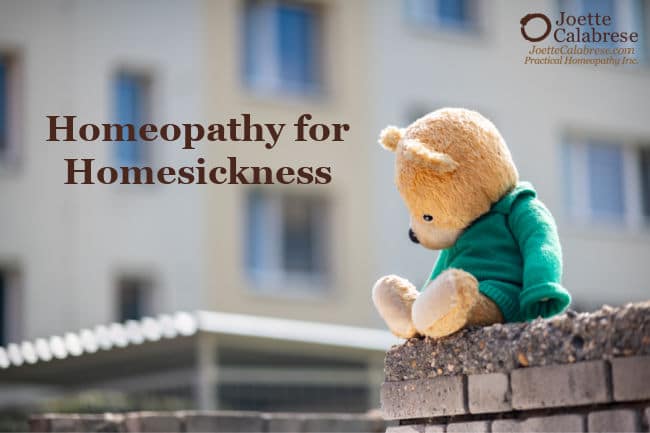

Homeopathy for Homesickness: Gentle, Natural Relief When Kids Travel Away From Home


Joette Calabrese, Practical Homeopathy®, Homeopathy for Homesickness: Gentle, Natural Remedies for Relief When Kids Travel Away From Home

Summer. The kids might go off to an overnight camp. Perhaps, they’ll head away to Grandma’s house for an extended visit. Or maybe the plan is only a day trip with a friend to the beach or a baseball game.

Whatever the plan, this is the season for homesickness. Yet, you can wipe the tears and send them on their way. Rest assured: Homeopathy can soothe homesick hearts.

Indeed, there are several homeopathic medicines that might be considered in cases of homesickness. However, today, I would like to teach the main two that my practice has shown are important to own — and know how to use.

Cocculus indicus for homesickness

The first medicine, Cocculus indicus, is the same remedy we think of when we have ailments from night-watching a sick loved one. You may recall that I wrote about it previously in Care for the Caregiver. Remember that association. Homesickness is related to the same kind of sensitivity involved in caring for someone we love. It’s often triggered by the sufferer’s anxiety about their family.

“What if something happens to my baby sister while I’m gone?” “What if Daddy doesn’t feel well?” “What if Mommy isn’t there when I get back?” “What if my dog dies?” That kind of irrational sadness and worry.

Add a component of “out of sight, out of mind,” and being away from home can initiate a complicated type of grief — not traditional grief, but a concern about potentially losing anything and everything left behind.

Coincidentally, this remedy also happens to be great for jet lag. So, if a child (or someone else in the family) has traveled a long distance, and they’re experiencing homesickness, this medicine can be a tight fit.

I spoke about Cocculus in one of my Monday Night Live events called, “Really! One Remedy for Both Motion Sickness AND Jet Lag.”

For homesickness, I would generally consider utilizing Cocculus in the 30th potency, twice daily, until very much better.

When do I begin employing the medicine?

Say your child is going to a sleepaway camp on Monday. Would we start the use of Cocculus earlier … just to be on the safe side?

No. Homeopathy is medicine, not a supplement. We don’t use it willy-nilly or “just because.” Just as with conventional medication, we only employ homeopathy when there is a definite need — a condition that is presenting. You want to see the symptoms first.

Homeopathic treatment might commence when the child starts to cling abnormally as their departure date approaches. “Oh, I don’t want to go!” Or “I don’t think this is going to be good for me.” Or “I don’t feel well enough to go. Maybe I’m getting sick.”

As a parent, you know the signs that your child is backpedaling, avoiding or getting unnecessarily worked up. This is the beauty of reaffirming your family’s health care autonomy. You know your child better than anyone, so just keep your antennae up and observe … yet, don’t anticipate or project your own feelings onto the situation. That’s just borrowing trouble. Wait for definitive symptoms before administering a homeopathic medicine.

Joette Calabrese, Practical Homeopathy®, Homeopathy for Homesickness: Gentle, Natural Remedies for Relief When Kids Travel Away From Home

Capsicum annuum for nostalgia and longing

What if your child is not necessarily anxious before they travel, but instead, nostalgia hits them while they’re away?

That’s when we think more of Capsicum annuum 30C (twice daily, until very much better). The child is not quite as emotional, in general, as their Cocculus counterparts. However, there’s a feeling of great nostalgia and longing.

“Oh, this reminds me of home.” “Oh my gosh, that smells like home.” “This room looks like home.” “Where’s my home?” It’s that deep nostalgia, and you could even call it a form of depression.

This can sometimes be hard to take note of in a child, because children often mask their feelings. But there’s a certain dullness in them, as though their glow has been dimmed. They no longer display that unique childhood optimism.

Consider Capsicum 30.

Now, a fleeting thought, a moment of nostalgia, is different from when they’ve lost their shine. To warrant Capsicum, they would appear dull and depressed in general, not just when they are shown a picture of their puppy from home.

Obviously, those symptoms might only develop after the child is already away from home. You’re not there, so what do you do?

Even if your child seems fine as they’re leaving, we might consider including some Capsicum in their little emergency homeopathy kit that you pack in their suitcase.

Indeed, we should be sending all the most commonly needed homeopathic medicines along with them on their journey. (You know the usual suspects: Arnica, Arsenicum, Ledum, Apis. I’ll be talking more about this in an upcoming podcast.)

No matter where they are, one would assume that the adults around them might pick up on the loss of joy — that your little one is just not themselves. Or you may have a phone call or text with your child, and you hear it in their voice. Perhaps you could ask the adults responsible for their care to locate their homeopathic travel kit and provide a short schedule of Cocculus to the child.

Be the confident, competent healer in your family.

Depending on the presenting symptoms, both of these homeopathic medicines can be invaluable for your little one’s homesickness. In all honesty, this feeling of melancholy is not exclusive to children. Adults can feel it, too. Homeopathy can help alleviate homesickness in anyone who misses home.

Regardless of the sufferer’s age, we can determine the most suitable remedy by consulting our materia medica and reading up on both Cocculus and Capsicum to choose the one that best suits.

My friend, you can be the healer in your family without being dependent on an outsider’s less-informed opinion. Your entire family can experience health freedom through Practical Homeopathy®.

However, education is key. I can only teach so much in these short venues. If you want to become proficient in managing your family’s conditions with homeopathy, you’ll need to take a deeper dive.

There’s the Mighty Members’ private enclave, where I go a little bit deeper with more candid conversation. There are Gateway to Practical Homeopathy® study groups forming all the time so that you can learn my study guide curriculum with others. And of course, there are my condition-specific protocol courses found in my Learning Center.

But to truly immerse yourself in learning homeopathy — so that you know it like the back of your hand — consider my Academy of Practical Homeopathy®. It’s a year-long educational curriculum in which I not only teach my students protocols for myriad health conditions but also how to determine the correct medicine when there is no protocol.

General enrollment is currently underway for the next graduating class, who will begin their studies in July of this year. If you’ve ever considered that my Academy might be right for you, watch this recently recorded Q&A for more information and all the links you’ll need to take the next steps on this well-worn educational and inspirational pathway. We are changing lives and perhaps even changing how society views health care — together.

There has never been a better time to join me as I pass on the good news of Practical Homeopathy®!

Warmly,

Joette Calabrese, Practical Homeopathy®


Dry Eye Relief: When Unexpected Change Comes, We Can Pivot


Joette Calabrese, Practical Homeopathy®, Dry Eye Relief: When Unexpected Change Comes, We Can Pivot

“There is nothing permanent except change,” said the ancient Greek philosopher, Heraclitus. 

We women know that better than anyone. Our perfect lipstick color always seems to be the one that’s discontinued. Losing a favorite cosmetic is annoying.

However, having our favorite homeopathic remedies removed from the shelves is more than annoying — it’s downright frustrating! Especially remedies for dry eyes.

In recent years, homeopathic eye drops have been targeted by the powers that be. (Don’t get me started on that, as it’s an entire blog post unto itself.) So, what do we do now that homeopathic eye drops are no longer available from our respected manufacturing pharmacies?

First things first, when dealing with chronic dry eye …

I previously shared the story of Carla, one of my clients, who suffered from chronic dry eyes. Her information, contained in my eye-related issues series, “The Eyes Have It,” is essential reading for individuals with chronic dry eyes.

However, today, let me reiterate one of the remedies I taught in that previous article.

For chronic dry, burning eyes, I generally rely on Euphrasia officinalis 30 (utilized twice daily, until very much better).

There are also other remedies that may be appropriate, such as those utilized in Carla’s case. Just remember: We always want to hone our homeopathic schedule to be as tidy as possible. So, I often start with whichever medicine most closely fits the condition as it presents. We can start with one and observe. If that medicine isn’t providing any improvement at all, then we can move on to the next.

However, although we endeavor to be specific and intentional with our medicine, that does not mean we can never use more than one remedy in the same schedule, as Carla did in her case.

The pivot

In addition to remedies in pillule form, many dry eye sufferers depended on various homeopathic eye drops, such as Boiron’s Optique. However, as mentioned, homeopathic eye drops are sadly no longer available for purchase in the United States, except from aggregators selling leftover product.

In lieu of being able to obtain those drops, we pivot.

I recommend what I always do with combination remedies: read the ingredients included in the combination product and learn about their keynotes by reading up on them in your materia medica.

For instance, in Optique, the active ingredients were:

  • Calcarea fluorica 10X HPUS (0.25%): Used for relieving eyestrain and fatigue with flickering light.
  • Calendula officinalis 4X HPUS (0.25%): May help relieve eye dryness associated with smoke or airborne irritants.
  • Cineraria maritima 6C HPUS (1.50%): Aims to soothe sensitivity to light and glare.
  • Euphrasia officinalis 4X HPUS (1.00%): Intended to relieve burning, irritated eyes.
  • Kali muriaticum 10X HPUS (0.25%): May alleviate the gritty sensation (feeling of sand in the eye).
  • Magnesia carbonica 10X HPUS (0.25%): Used for relieving sharp, flashing eye pain associated with eye fatigue.
  • Silicea 10X HPUS (0.25%): May help relieve tired eyes. 

Granted, Boiron prepared these ingredients in a soothing liquid formulation that could assist in relieving dry eye topically, as any necessary dry homeopathic remedies worked more deeply to uproot the underlying condition.

However, my friends, the pillules of these ingredients can often be equally as effective when employed orally.

Dry Eye_INTERNAL

So, read through that list and think, “Which of those keynotes most fit with my experience? Which medicine(s) would be the tightest match for my dry eyes?”

But you’re not done yet. You need to do more digging for yourself.

Look up the best candidates in your materia medica, reading their full descriptions to find additional keynotes that may be applicable to your case. A materia medica provides a wealth of information carefully curated from renowned clinical practitioners. Let their experience guide you in streamlining the choice you make.

Other thoughts on dry eye

Now, some ophthalmologists will tell you that drinking more water can help. To be honest, in my clinical experience, I have not found that to be so.

However, taking note of what you eat — including food additives that can cause inflammation, such as artificial dyes and preservatives — may be a contributing factor to an inflammatory condition, resulting in dry eyes.

Have the eyes been more sensitive after a few rounds of antibiotics to treat, say, a UTI? Perhaps the use of antibiotics has adversely affected the gut biome, causing a reaction to gluten that has never been experienced before.

Careful, observational notes may help pin down an additional offender.

In the meantime, the well-chosen homeopathic medicine for dry eyes will be working to put things right. Additionally, a homeopathic medicine may be chosen to address the underlying problem, whether it is related to food, allergies, or some other intolerance.

More to come on dry eyes

Next week in my Memo to Mighty Members, I’ll provide more information on this subject to my Mighties (as I always do). I’ll share a water-based method for addressing dry eyes, as recommended by distinguished homeopath Joepathy. (NOTE: His method does NOT involve introducing anything directly into the open eye.)

Additionally, in answer to a member’s question, we’ll discuss a specific homeopathic medicine that is historically known for tackling clogged tear ducts (a cause for some instances of dry eye).

If you’re not yet one of my Mighty Members, what on earth are you waiting for? I want you to possess the ability to learn in a place where homeopathic knowledge can be shared safely, without worry of censorship or cancellation from the very same powers that be who removed homeopathic eye drops from our stores.

Plus, in my exclusive Mighties enclave, you’ll belong to a group of like-minded individuals. Whether they have used homeopathy for decades or are new to this paradigm, you’ll find your new support structure and lifelong friends.

Pass on the good news of Practical Homeopathy®!

Warmly,

Joette Calabrese, Practical Homeopathy®

P.S. And remember — all my Mighties qualify for a 10% discount on course purchases. If you need assistance getting your discount, email [email protected] for more information.


Podcast 145 — Calling All Parents: “How to Raise a Healthy Child in Spite of Your Doctor”


Joette Calabrese, Practical Homeopathy, Podcast 145 — Calling All Parents: “How to Raise a Healthy Child in Spite of Your Doctor”

In This Podcast, We Cover:

01:00   Introduction: “How to Raise a Healthy Child in Spite of Your Doctor”

01:51   Dr. Robert Mendelsohn
           
Gateway to Practical Homeopathy®: A Guided Study Group Curriculum

            “How to Raise a Healthy Child… in Spite of Your Doctor”

            “Confessions of a Medical Heretic”

            “Male Practice”

04:30   Childhood illnesses: We just have to take them with a grain of salt and not worry.

06:01   It’s just common sense.

12:40   Fevers

            Get Your Kids High: Fever Is Good

18:21   The takeaway? Relax.

Additional Resources:

Joette Calabrese on YouTube (Monday Night Lives)

Joette’s Learning Center

The Academy of Practical Homeopathy®

PracticalHomeopathy.com

Joette’s Study Group, Find Your New Study Group Friends

Joette’s Mighty Members

Kate:

This is the Practical Homeopathy® Podcast, episode number 145, with Joette Calabrese.

Joette:

Hi, I’m Joette Calabrese, and I welcome you to our health care movement — yours, mine and the countless men and women across the globe who have retaken control of their families’ health with Practical Homeopathy®.

So, for the next few minutes, let’s link our arms as I demystify homeopathy — what was once considered an esoteric paradigm — into an understandable, reproducible, safe and effective health care solution available to all.

This is the medicine you’ve been searching for — my unique brand of homeopathy, PRACTICAL Homeopathy®.

Introduction: “How to Raise a Healthy Child in Spite of Your Doctor”

Kate: (01:00)

Hi, this is Kate and Joette here today. Hi, Joette.

Joette:

Hi Kate.

Kate:

Hi. It’s always great to be with you. And when we were talking just a minute ago about the topic that you’re going to cover in today’s podcast, I was kind of giggling to myself because every time we meet, you have so many ideas and topics that you want to share with everyone. And so, it’s just great. We’re overflowing with information to share!

Joette:

Oh, it never ends because this topic of taking control of your family’s health — yourself — and homeopathy and even foods and meals and philosophy about family, as never ending. Those are some pretty heavy-duty topics that we could go on for decades with. Yeah.

Kate:

Yeah. But also, you are a very avid reader. You continually go through books and have new ideas.

So, you have one of those here. But it’s not necessarily new, is it, Joette?

Dr. Robert Mendelsohn

Joette: (01:51)

No, it’s not. It’s actually an old book, but it’s one of my favorites, and I encourage everyone to own this book. The last printing … last copyright was in 1984. And so, the title of the book is “How to Raise a Healthy Child in Spite of Your Doctor.”

Now, this was authored by Dr. Robert Mendelsohn, who was a pediatrician. And I actually remember when he was on television back in the eighties — the early eighties, before I even had my children. I remember him going on Phil Donahue and some other programs like that, those talk shows. Yes, he was on talk shows.

So, if you look him up, if you go to YouTube, you’ll find him. You’ll find snippets of him — maybe the entire … Actually, I think one of the entire interviews of him is still up there with Phil Donahue. And he did more than one.

He was celebrated partly because of this book and because he was questioning the status quo. And you know how we feel about questioning the status quo.

Kate:

Now, for those people who have done Gateway to Practical Homeopathy® I, you’re familiar already with this book. You might have read it. That’s part of the curriculum, at least a section of the book. So …

Joette:

Yeah, so this book, “How to Raise a Healthy Child… in Spite of Your Doctor” is on Amazon, and I’ve bought it for as little as $2, and then it goes up, and then it goes since $8.

And I must have, I don’t know, five copies? I’ve given them to my daughter-in-law, and I have a copy in the car and one in the office because this man was an eloquent writer … and prolific, also. He’s written some other great books, too.

I have to say that “Confessions of a Medical Heretic” and “Male Practice,” MAL-E Practice … It’s the practice of OBGYN practices, and how they have gone too far — even back in the seventies and eighties —with how women are treated in these specific practices.

So, I like everything he’s written. But this one particularly because it’s so useful for mothers. A

And what I love about him is that he’s very practical; he’s easily read. He’s got a bit of a caustic edge, which I love. He’s sarcastic, and he’s fun. And if you watch him on YouTube, you’ll see what I’m talking about. He’s got a great personality — or had, he’s no longer with us.

Childhood illnesses: We just have to take them with a grain of salt and not worry.

Joette: (04:30)

So, what’s particularly interesting about this book, there’s not even a whisper of the word homeopathy. Never does he say anything about it. And it’s fascinating because here’s a man who’s teaching mothers and encouraging grandmothers for their daughters and daughter-in-laws to follow this way of thinking.

And his line of thinking is that you can do this without a doctor. You can do 90% — I think that’s the number he chose of the conditions that afflict children — on your own, without a doctor involved, without a pediatrician involved.

Such as childhood illnesses: We just have to take them with a grain of salt and not worry. We don’t have to see the doctor every time. And that’s basically his message.

And he goes through the book by telling us what do you do for eczema? What do you do for sleeplessness? What do you do for food intolerance? As he’s covered the main conditions, chicken pox, measles — and now, of course, we’re living in a world that has frightened the bloomers off of moms about measles.

And I will tell you, I’m here in my seventies, and I’m a measles epidemic survivor. As was my brother. So were all my cousins. So were all my classmates. So were all my churchmates. Everybody in the neighborhood survived measles, and it was not a big deal. No one even gave it any thought at all.

Kate:

I just saw a posting recently where they compared on a TV show and the Brady Bunch. Do you remember the Brady Bunch?

Joette:

Yes, I do. And I remember that that came up a while ago. Yes.

Kate:

Yeah. So, the Brady Bunch … the kids came home, and they had measles, and they celebrate like a party. “Oh, we’re having a fun day off of school,” and it was no big deal. And then they compared it with today and media, social media about today, and how it’s just very deep and scary …

Joette:

Dark. It’s a dark disease. It’s a very dark disease.

Kate:

Right? It was funny.

It’s just common sense.

Joette: (06:01)

So, back to the idea that Dr. Robert Mendelssohn had no understanding of homeopathy — or at least it doesn’t show up in any of his books. But I’m going to read to you the back cover of this book because it’s so fascinating. And so, my point that I’m making here by reading this and presenting these ideas today is that he had nothing but common sense.

We have common sense PLUS homeopathy. So, we actually have a medicine that he didn’t even have access to. Yet, he still felt as though mothers could handle 90% of the conditions that befall their children on their own with just simple common sense and the release of the angst that is promulgated on parents these days.

So, this is what he says:

“Mothers, grandmothers and Mother Nature are the best doctors around.” That’s the title of the back cover.

And then it says, “Dr. Robert Mendelsohn has dedicated his life to demystifying the medical profession …” [“Demystifying “is a very kind word. That’s a real euphemism. He does more than demystify it.]“ … both as a renowned pediatrician for nearly 30 years and as the widely read author of ‘Confessions of a Medical Heretic’ and other books.”

“In this practical and informative guide, he turns his expertise to his own specialty, maintaining that parents tend to rely too heavily on their pediatricians and that they can take a more active role in determining which ailments require an office visit and which can be dealt with at home.”

Now, I have to say, since the eighties, this has ramped up because of social media. And even before that, with all of the television commercials when people were watching television — what is it, 15 years ago? 20 years ago? They have scared people into running to the doctor because then they insist on “Doctor, give this child — my child — an antibiotic.” Then the antibiotic sales increase dramatically so we all know where it’s all coming from.

Now he says — still on the back cover — “Learn how to treat and diagnose at home.” [That’s italicized: “at home.”] “Everyday colds and flus, childhood illnesses, strep throat …”

Yes, my friends, strep throat. But what if it’s “type B” strep throat? My friends, it is still strep throat. And when I was growing up, it wasn’t called strep throat, it was called “sore throat.” As soon as you attach a Latin-sounding name to it, it all of a sudden sounds more threatening.

“Vision and hearing problems.”

Vision! Are you listening? “Vision and hearing problems.” Must we run to the doctor if there’s a vision or hearing problem? Let’s think this through, my friends.

“Allergies.” Yes, allergies, yes. Should we run to the allergist? Hmmm. He says no, and he doesn’t even have homeopathy.

“Emotional problems, skin ailments and everything else you’ll need to know about major symptoms and illnesses.”

So, then it says “Plus” — plus/bullet point — “A complete section on picking the right doctor for your child.”

And that’s paramount. You want someone, if you’re even going to use a doctor — and I will say, parenthetically, my friends, I didn’t. I went to a pediatrician one time when my oldest child, my first child, was six weeks old, and I learned my lesson. Now, you may not feel as gutsy as I did or confident, but I didn’t have … I knew nothing about homeopathy. I employed it after that first visit.

If you happen to know my story, I employed it, but it was the first medicine I’d ever used — homeopathic medicine — and I did not know what I was doing. But I knew I was not going to go back to the doctor that caused the condition that my child was suffering. I was certain of it.

So, a complete section on picking the right doctor for your child.

The second bullet is “Comprehensive guidelines for using time-honored, age-old remedies.” And he doesn’t mean homeopathic. He means age-old remedies like putting the child to bed, making them chicken soup, like letting a fever rise on its own and leaving it alone. Just make sure the child is hydrated.

The next one is “All the facts about immunization.” Well, you can imagine what he’s saying about that.

The next bullet point is “Step-by-step instructions for knowing when you should call a doctor.”

That’s key. You’ll find that as you become more confident by reading a book such as this or at least referring to it. You may not have to read it from cover to cover, although I urge you to do so. Once you get the confidence, then, you gain competence.

And so, with that, you learn not only to relax — because that’s really where much of the over-doctoring comes from, is the anxiety of the mothers and the fathers or both or the grandparents — and then knowing, in our case, how to apply homeopathic medicines that are so readily available today.

The next bullet point is “Detailed information for coping with accidental injuries.”

My friends, the real danger to a child is not childhood illnesses. Is not a cold, a flu, a fever, a strep throat, an ear infection, conjunctivitis. No, that’s not where the real danger is.

The danger lies in one area: accidents. Drowning, getting burned, falling from high places, getting cut. Those are the areas that are of the greatest danger to children, and that, my friends, if it’s a small enough injury, you can handle yourself with homeopathy.

If it’s a dire enough concern and you need emergent help, of course, you go to the emergency room if there’s a deep laceration, if there’s a deep puncture wound, et cetera. That’s when you do go to the doctor — when there is truly a need, not a perceived fear.

And at the very end “With Dr. Mendelsohn’s help, you can [italicized word] trust your instincts.”

And so, my concern is that today’s world’s instincts have been pounded out of mothers. We’re left with very little common sense because the common sense that we think is of good sense is the stuff we hear on a regular basis. And those ideas that we hear on a regular basis are paid for by an industry that wants you just enough afraid to ask for drugs and to get treatment that is often — more often than not — superfluous.

Fevers

Kate: (12:40)

Yes. I think that also the idea of the family unit staying together. And the grandmother teaching the grandchildren or the mother, and it’s being passed down. That’s not there as much anymore.

I recently saw a post about someone asking a question about their child. They were saying that their child had a fever of, I think it was right around a hundred or 101, and they said, “Should I take my child?” (It was only for a day.) “Should I take my child to the emergency room?” is what they were asking.

And I was thinking, “The emergency room for a fever of 101?”

But these people aren’t taught about that fevers … they occur with illnesses, and it’s helping the body. It talks about that in the book, doesn’t it, Joette, how …

Joette:

Yes, it does. Yes, it does.

Kate:

Tell us about that a little bit.

Joette:

Even the American Academy of Pediatrics, who for years — because I watched them. I followed them even before they were online. I would get their information because I wanted to see what they were teaching mothers.

Even they, who said, “If your child has a fever, get your child to the doctor.” Even they now admit — in the last, I’m going to say, maybe it was five years ago, online — they admit that fever is a curative action of the body, and we need the child to get a fever in order to cook it all off. It’s a very positive thing for a child to get a fever.

And when a child’s fever is suppressed by, well, used to be aspirin, then Tylenol and antibiotics, steroids, and even, my friends, tepid baths … we should not be suppressing a fever. A fever needs to get good and high. A hundred is nothing.

When I learned about all of this, my first child, the one that I took to the pediatrician for a well-baby checkup — there’s a real euphemism if I ever heard one — was given a vaccine. And he went to a fever the following day, maybe a day and a half later of 105.5. Still, that is not dangerous.

And so, parents need to know how high a fever is dangerous. And there is, as far as I can read in all the literature that I’ve read — and I’ve not read it all, but I’ve been doing this for a long time — there is no fever that is too high.

And those of you who know anything about this, look it up and start reading and don’t believe what you were taught in nursing school or medical school. Look at the studies, look at the research that shows that if there’s a head injury, if there’s a concomitant condition, a disease, that’s not the fever, that’s the problem. It’s the condition that’s driving the fever. That’s the problem that needs to be treated.

So, we don’t treat the symptom that fever is a symptom, and it’s a beautiful symptom, and it’s a symptom that we want our children to experience.

Now, having said that, you see, I’m focusing on children. When adults get fevers, it’s a whole ‘nother arena, and we’re not going to even talk about that today.

But for children, a high fever is within the range of normal. The only fear that we should have is that the child becomes dehydrated.

And so, I have talked about this before. We coat the bottoms of the feet and the palms of the hands with olive oil, and we make sure that child is drinking, or you’re giving them ice chips. Or you get some fresh lemons and make some lemon ice chips and let them suck on those.

Do whatever. Make your own lemonade, bone stock, whatever you can do to keep the child hydrated because they’re perspiring heavily. And that’s the danger, especially in very young children.

But other than that, we love fever.

I’ve actually written about it. I have an article out there. It’s been published in a number of places. I think “Wise Traditions” for the Weston A. Price Foundation … I’m pretty sure they’ve published it. It’s called, “Get Your Kids High.” And so, it’s been out there for many years. I’m going to say a good 12, 13 years ago I wrote that. And it’s all about the importance of allowing a fever to spike and resolve over days, not hours. Even if it goes for days; is that a problem?

No, it’s not a problem.

Kate:

Getting back to what you were alluding to before about there may be times when a fever can be a symptom that is as a result of something …

Joette:

… that needs to be tended to. Yes.

Kate:

And that could be overexposure to sun, or I think there were a few other things. But yeah, I just wanted to point that out that there are a few things that fever might …

Joette:

Might, but it’s not the fever that’s the problem. It’s the condition that’s the problem.

The fever is just a symptom of that condition. So, it is important that we understand the difference.

Now, are there exceptions? There are exceptions to every rule because we’re all a little different. We’re mostly alike, but we’re still all slightly different. And so, you need to know what those exceptions might be.

But most parents, because they have anxiety (especially this generation and even the grandparents who are around have been trained to be frightened by conditions such as fever), are eager to believe that their child is the exception.

Or maybe it’s not an “eager to believe,” but fall into (during those anxious moments) thinking, “Well, what if my child is the exception?”

If you understand what they are, and you have this book, “How to Raise a Healthy Child in Spite of Your Doctor,” by Dr. Robert Mendelssohn, then you’ll know how to handle it.

So, that’s why I urge parents, when mom is pregnant, this is when the book should be read and then looked into every few months and checked again. And I have a pink tab in mine, and mine is all marked up. I have writing along the sides in the margins.

And that’s when you’ve personalized the book so that you know how to get to it quickly when you’re in need. And that need is usually when the parent is very frightened.

The takeaway? Relax.

Kate: (18:21)

So, Joette, summarizing what you said today, can you give us an overall upshot of that book and your message?

Joette:

Yeah, my message is relax. Parenting is fabulous. It doesn’t mean it’s not a lot of work. It doesn’t mean you’re not going to be up at night, or that you’re not going to be dealing with a child who’s ornery or difficult or uncomfortable or et cetera.

But what we’re doing by parenting in this fashion — using Mother Nature, as he says — is we are setting the stage for a lifetime of not only keeping the child away from drugs and treatments, but also setting the stage for you as the child grows.

And, the third stage we’re setting is that the child understands that, “Yeah, it’s perfectly normal to be sick.” Yes, let’s just make this child comfortably sick. It’s okay to be sick for a few days, a week, 10 days.

Yes, my friends, even 10 days. Even two weeks is not abnormal. That’s within the range of normal.

So, we’re setting a stage, and we’re getting control of our own worries by doing one thing: reading. Just read, my friends. Don’t let someone tell you what the answer is. Don’t outsource the most important job you’ll ever have in your life, and that is raising your children. Don’t outsource

You go to the best sources, read up on it, and then, make your decisions and then, choose your lifestyle based on your research.

That’s my message.

Kate:

Great message, Joette. Thank you for sharing your thoughts and tips with the listeners today.

Joette:

Yes, thanks, Kate. Talk to you soon.

It’s my honor to share many lessons on this simple method of using homeopathy for free —without affiliates or advertising — here in my podcasts, but also my blog posts and Monday Night Lives.

But it’s critical that you learn how to use these medicines properly. These podcasts should serve as only the beginning of your training. Peruse JoettesLearningCenter.com to find fun study group opportunities and in-depth courses developed by subject.

So, with the proper training, you can join the thousands of students before you in developing the confidence and competence to protect the health of your family and loved ones with my brand of homeopathy, Practical Homeopathy®.

Kate:

You just listened to a podcast from internationally acclaimed homeopath, public speaker and author, the founder of The Academy of Practical Homeopathy®, Joette Calabrese. Joette’s podcasts are available on all your favorite podcast apps.

To learn more and find out if homeopathy is a good fit for your health strategy, visit PracticalHomeopathy.com.

Homeschool Hack: Foster Independent Thinking by Teaching Practical Homeopathy®

Joette Calabrese, Homeschooling Hack: Foster Independent Thinking by Teaching Practical Homeopathy®

Back in the day, my mother and I spent the greater part of my young life trying to figure out why my health was lacking and why conventional medical interventions were making me worse.

I wish I had a time machine and could go back to learn homeopathy as a child. It’s frustrating when I think of the years of suffering that could have been avoided had I had the knowledge I have today.

Learning homeopathy at a young age is a truly effective way to become an autonomous, independent thinker. And isn’t that what we want for our children?

I homeschooled my children.

When my own sons were born, I didn’t want them to travel on the same medical conveyor belt I had been on at their age. You’ve heard me say it before: Armed with nothing more than homeopathy, nutrient-dense foods, and guts, spunk and moxie, I raised my now-adult sons without a single visit to the pediatrician. (Well, at least not after that infamous first well-baby visit. That first appointment was so spectacularly awful that it solidified my determination never to step foot in a pediatrician’s office again.)

It was incredibly important … critical … vital … all the imperative words you can think of … for me to ensure my children could care for themselves when they grew up in the same way I was determined to care for them as children — without drugs, medicaments and unnecessary conventional medical interventions.

Luckily, homeschooling and homeopathy are perfect bedfellows.

Cover several subjects with one curriculum.

Our homeschooling lessons fully incorporated the various aspects of homeopathy as we studied.

Biology, botany, anatomy, zoology and animal husbandry were all part of the sciences that homeopathy encompassed for homeschooling. Math, reading, Latin and health were also included as they easily correspond to various aspects of homeopathy.

I drilled my kids on the remedies.

“If your brother is nauseated, and I’m not around, which homeopathic medicine would you give him?”

“If you’re out skiing with your brother, and he falls and hurts himself. Which homeopathic medicine are you going to give him?”

(I always put a tube of Arnica montana in their ski jacket pockets. In the event that one son was injured, another son could come to his aid and treat him with Arnica — swiftly, right there on the slopes before too much time had passed.)

My boys learned to treat our pets and farm animals with homeopathy. Relieving the conditions of pets is a perfect way to observe firsthand how homeopathy works.

We took in a sickly kitten, rejected by her mother because she was so weak that she couldn’t even meow. I’ve told this story before, but let me add this detail. While I chose the remedy, imagine my deep satisfaction when my boys said, “Mom, we can do this!” and cared for the kitten.

The biggest win is that homeopathy can foster independent thinking.

My husband and I wanted our children to grow up to be self-sufficient, autonomous, resilient adults. Learning homeopathy at a young age primes the child to question, not meekly acquiesce to external dogma.

I’ve witnessed it myself with my own boys. They learned to think outside the box, to be discerning, self-assured problem solvers.

Again, isn’t that what every parent wants?

Today, my three adult children are independent and entirely self-sufficient. My oldest is a captain for a major airline. My middle son runs a property management company. And my youngest has full responsibility for maintaining our company’s computers and system-wide servers.

Plus, they each know how to care for themselves and their growing families. In fact, only this morning, my youngest wrote me to tell me that he successfully treated his dog for a cold — homeopathically, of course. (More on that in another blog to come.)


Joette Calabrese, The Ultimate Cool Kids’ Guide to Homeopathy: Become a Revolutionary, Independent Thinker with Practical Homeopathy®

I’ve condensed my knowledge and experience into an appropriate homeschool curriculum for kids.

My friends, when I was homeschooling, I had to figure this out on my own. At the time, no one else was learning homeopathy at home, let alone teaching it to their children.

Now, you can benefit from my knowledge and experience by bringing this education to your children, as I have designed a course specifically for your family.

The Ultimate Cool Kids’ Guide to Homeopathy: Become a Revolutionary, Independent Thinker with Practical Homeopathy® is a family-centered curriculum intended for shared learning, bonding and growth.

Younger children and even grandparents will benefit from engaging with the material. So, whether you study it together or separately, this course builds more than simply knowledge — it nurtures resilience, critical thinking and self-respect.

It encourages leadership, creativity and care for others — from treating a pet to helping a sibling or friend. It’s a study rich enough for the curious and practical enough for the doers, while it nurtures the desires of caring children who want to help and heal.

If you’re interested in learning more, complete the opt-in form below to receive additional information. No commitment necessary. 

There’s already one new opportunity to consider: Would you prefer your child to be guided through the course by one of my experienced Ambassadors (students and graduates of The Academy of Practical Homeopathy®)? If so, more information will be available soon through the opt-in form below.

Even if you’re not a homeschooling parent, the additional education homeopathy can provide to youngsters is invaluable. So, why not consider it as an extracurricular activity for the children in your family? Take a look at The Ultimate Cool Kids’ Guide to Homeopathy: Become a Revolutionary, Independent Thinker with Practical Homeopathy®.

This isn’t just another homeschool course. It’s an investment in lifelong learning, family unity, and the development of the most important life skill of all: self-reliance.

Pass on the good news of Practical Homeopathy® … especially to your children!

Warmly,

Joette Calabrese, Practical Homeopathy®

P.S. I will be participating in the Dimensions of Homeopathy’s International Homeopathy Online Congress, held from June 5 to 15, 2025. I believe my interview date is June 7. 

If you’d like to join me, click here for specifics. However, note that this website may initially appear in their native German. English speakers can take advantage of their internet browser’s translation capability to read the website and register.

Don’t be deterred. Considering I don’t speak German, I assume my interview will be conducted in English.


10. Poison Ivy: How to Antidote Poisonous Toxins With Homeopathy


Joette Calabrese, Practical Homeopathy®, 10. Poison Ivy: How to Antidote Poisonous Toxins With Homeopathy Series

“Look at this beautiful vine!”

Just look. Don’t touch!

A too-close brush with poison ivy can ruin your whole day, week and even a month or more. Poison ivy can cause anything from a menacing eruption to an illness of chronic proportions.

First, set your foundation.

If you missed the introductory and background information I previously provided, click here to read it before proceeding to the rest of this series.

Why? Understanding the methodology behind utilizing homeopathy to antidote a poison or toxin is equally important as knowing which condition-specific homeopathic medicine to consider.

Poison ivy? Think Anacardium.

One of the most common remedies for poison ivy is Anacardium orientale 30C. When administered every four hours for several days, the itching is often relieved, eruptions minimized, and the entire ordeal shortened.

There are other homeopathic medicines to choose from when afflicted with this scourge, and the correct choice can also depend on the location of the eruption as well as the nature of the pustules. If no improvement is observed after giving Anacardium 30 due time to act, I suggest you consider pivoting by trying a different medicine. You can find the most likely candidates in my previous blog post, The Perils of Summer: Poison Ivy and Poison Oak.

Now, if none of those do the trick, then I recommend you contact a Practical Homeopath™ for a consultation. They can choose a medicine that is more specifically suited to your overall picture.

Joette Calabrese, Practical Homeopathy®, 10. Poison Ivy: How to Antidote Poisonous Toxins With Homeopathy Series

A prophylactic for repetitive sufferers.

Many people suffer from poison ivy yearly. Some are so sensitive to the plant that even proximity causes a problem.

Homeopaths have seen encouraging results utilizing the following prophylactic protocol: Four doses in one day of Rhus toxicodendron 30 at the onset of the season to help minimize the intensity of the exposure.

This protocol should be repeated once a week for a month.

Interestingly, Rhus tox is made from poison ivy. We don’t often use the homeopathic version of the gross substance from which the condition originates. However, this is an exception when those who are exquisitely sensitive to poison ivy use homeopathy prophylactically.

Learn more from my Monday Night Live.

For years, I have been sharing my knowledge live on various social media platforms every Monday night at 8:00 p.m. ET. I began on Facebook, and I now simulcast to YouTube, X (formerly Twitter), Rumble and Instagram.

Of course, my Mighty Members participate through the Joette’s Mighty Members site, their own private enclave securely hosted on my servers. After the public presentation concludes, I continue on with my Mighties to answer their questions and offer a little more candid take on the topic. (It’s but one benefit of being Mighty. Consider joining us!)

Last season, I featured this topic in one such Monday Night Live episode: 06-17-24 Poison Ivy [Practical Homeopathy®]. I encourage you to listen for a more well-rounded discussion.

Do toxins scare me?

In a word? No.

I used to think “detoxing” was a worthwhile pursuit. I doubt there’s a detox program out there that I haven’t heard about from one of my clients or tried myself. Trust me, I’ve tried most of them!

However, most of them increased my stress levels and contributed to neurotic thinking, yet they did little to improve my health. Most of these detox regimens make life more complicated and more difficult. And ultimately, they don’t work the way we hope they will.

I believe that homeopathy is a superior medicine when it comes to achieving our health goals without the stress. Homeopathy works!

A free infographic on toxins.

To provide you with the knowledge that true solutions do exist to counter the ill effects of poisons, toxins and other substances that can create unwanted reactions, I created my course, Rethinking Detox with Practical Homeopathy®: How to Stop Stressing About Toxins and Fearlessly Achieve Health the Simple Way.

I also designed an accompanying infographic, titled “Toxins Don’t Scare Me Anymore!,” which lists eight common toxins and their corresponding homeopathic medicines. Click here to download your free copy and watch a short informative video about the course.

My series on poisonous toxins is complete. (Or is it?)

With that, we have reached the end of our series, “How to Antidote Poisonous Toxins With Homeopathy.” However, I’ve read your comments on each and every one of my blog posts. You’ve submitted some queries regarding other potentially toxic substances and poisons. So, I have kept a list, my friend. I’ll be addressing many of your additional topics over the coming months.

For now, here’s a list of substances that we’ve covered that can cause toxic effects in the body.

  1. Cigarette smoke — Natrum muriaticum 6X
  2. Carbon monoxide — Carbo vegetabilis 200C
  3. Paint Fumes — Arsenicum album 30
  4. Pesticides — Arsenicum album 30C
  5. Medications — Nux vomica 200C
  6. Bee venom — Ledum palustre 200C
  7. Food poisoning — Arsenicum album 30C
  8. Alcohol overuse — Nux vomica 200C
  9. Sugary overindulgence — Nux vomica 30C
  10. Poison Ivy — Anacardium orientale 30C

Be sure to read the accompanying posts for each substance for more specific information. Again, if you truly want to comprehend homeopathy better, there are no shortcuts to education!

Pass on the good news of Practical Homeopathy®!

Warmly,

Joette Calabrese, Practical Homeopathy®

P.S. In answer to numerous requests, my social media updates are now featured on TikTok!

Unfortunately, my Monday Night Live events can’t stream live on TikTok until I have more followers. Help me reach a whole new demographic by following me. Once my account reaches a critical mass of followers, TikTokers will be able to join my MNL events live, too.


Podcast 144 — Moms with Moxie: Homeopathic Success Stories from Horses to Humans


Joette Calabrese, Practical Homeopathy®, Podcast 144 — Moms with Moxie: Success Stories from Horses to Humans

In This Podcast, We Cover:

01:00   Introduction: Podcast 144 — Moms with Moxie: Success Stories from Horses to Humans

04:28   Homeopathy and the Amish Community

07:15   Success Stories: Farm Animals

09:26   Success Story: A Pulsatilla Child

11:02   Success Stories: Emotional Conditions

14:21   Success Story: Umbilical Hernia

15:17   The Pathway to Learning Practical Homeopathy®
           
Gateway to Practical Homeopathy®: A Guided Study Group Curriculum
             Gateway to Homeopathy II           
             Feminopathy: How You Can Correct Female Ailments Using Safe, Inexpensive and Effective Homeopathy 
           The Academy of Practical Homeopathy®

Additional Resources:

Joette Calabrese on YouTube (Monday Night Lives)
Joette’s Learning Center
PracticalHomeopathy.com
Joette’s Study Group, Find Your New Study Group Friends
Joette’s Mighty Members
Find a Practical Homeopath® (for consultations or for educational study groups led by my Discovery Ambassadors)

Kate:

This is the Practical Homeopathy® Podcast, episode number 144.

Joette:

Hi, I’m Joette Calabrese, and I welcome you to our health care movement — yours, mine and the countless men and women across the globe who have retaken control of their families’ health with Practical Homeopathy®.

So, for the next few minutes, let’s link our arms as I demystify homeopathy — what was once considered an esoteric paradigm — into an understandable, reproducible, safe and effective health care solution available to all.

This is the medicine you’ve been searching for — my unique brand of homeopathy, PRACTICAL Homeopathy®.

Introduction: Podcast 144 — Moms with Moxie: Success Stories from Horses to Humans

Kate: (01:00)

Hi, my name is Kate, and I want to welcome you back to the podcast. Whether you’re new here or have been using homeopathy for a long time, we are so glad that you’re here, and I can’t wait for you to meet our guest today. Her name is Jane.

Hi, Jane.

Jane:

Hi, Kate. Thank you for having me.

Kate:

Yeah, welcome.

Jane:

I’m very humbled.

Kate:

As am I. I look forward to hearing your stories. Well, actually, I’ve heard it, but those who are listening have not heard your story yet. And so, let’s just dive right in.

Tell us where you’re from and a little bit about yourself.

Jane:

Well, I’m almost 60 years old. I’ve been a physical therapist for over 30 years. I’ve been married for 30 years, born and raised on a farm in the Midwest, and after high school, I left during the farm crisis.

I went to California as a nanny, went to college to be a physical therapist, stayed in California and traveled for 10 years.

Then I came back home to help my dad and my mom when my dad was ill, started dating my childhood family friend, and we got married.

He had bought his family farm that he was raised on, and it’s an organic farm. So, we’ve been organically farming for many years.

We raised nine children. We have one child still at home, and we homeschooled them all through high school, and we have 12 grandchildren.

And gradually through those years, we transitioned from what the mainstream medical was to using more alternative medical, natural health, and now, homeopathy, which has been great.

We feel that we love the homeopathy because it helps empower us to take care of ourselves and our families. Doesn’t mean we don’t use mainstream medical when we need it.

My intro to homeopathy, since I lived in California, I heard of homeopathy, dabbled in it over the years, using Arnica mainly. That was the main thing that seemed to always come back to, like using it topically or with the pellets.

Probably 15 or 20 years ago, there was a mom’s homeschool meeting which featured two homeschool moms, and it was about 40 minutes away from me. And they were speaking about homeopathy, but it was classical homeopathy. I loved it. I thought it was so interesting, but I just could not wrap my head around classical homeopathy.

So, I abandoned, basically, my journey with homeopathy at that time.

Fast forward about two or over two years ago, I belonged to a homeschool email group. And a homeopath, Wendy, on her journey, she introduced us to homeopathy. And she invited us to a Gateway I class in homeopathy — one of Joette’s classes, the first class, I guess.

And I took that with my sister and two of my daughters. And basically, I was hooked.

Right away took Gateway II. Started using it right away. I still practice some physical therapy, and now I’ve integrated using homeopathy. And it’s really helped my practice quite a bit as far as making suggestions to people: what they can use for homeopathy to help them with their own healing while they’re healing from injuries that I helped them with, also with manual therapy and exercise.

Homeopathy and the Amish Community

Kate: (04:28)

So, Jane, you have a very interesting story about the clients that you work with, and who you see, and how you integrate homeopathy with physical therapy. Can you tell us a little bit more about that?

Jane:

Yes. We live in a very rural area, and I largely serve the Amish communities in and around our state. And there’s one very close to us, about 10 miles away. So that’s the one I mainly serve.

There’s 200 families in that community, and then there’s three other communities outlying about 40 minutes away in different directions. So, they are very familiar and always interested in alternative medical. And they’ve been introduced to homeopathy in the past, especially their parents and the older ones, but they were unable to obtain it at some point from the companies they used to order from.

So, now they’re so happy to have homeopathy back. In fact, Wendy hosted a on-site, in-person Gateway I in one day at the Amish community for about 30 different women that attended.

That’s kind of catapulted my practicing and knowledge of homeopathy so quickly because of being able to use it so often and the experience.

Kate:

So, you’ve told me that when you go, and you have an appointment, that you talk about therapy, but you also educate about homeopathy as well, and you get sometimes lots of calls. Give us an idea about how many people you help and how busy you are helping others.

Jane:

Well, I’m definitely as busy as I want to be, but I work about 20 hours a week. So, I see about 20, depending on how long it takes for one session of physical therapy and massage. But I often get many calls.

So, in the Amish community, of course, they have several children … many of them do. So, I see a lot of prenatal visits for physical therapy and massage. And with that being said, the pregnancy protocols, I give them information on that.

Several use the Calc carbonica, the protocol that they have for the eight months, and the Pulsatilla at the last month.

I have two daughters that had breach pregnancies toward the end. So even my own daughters, I mean, they use it all of the time.

But one of ’em, I consulted with the homeopath. She said she could start taking it at 33 weeks — the Pulsatilla — and each time it’s been a hundred percent turning those babies, which might have in the past been a C-section.

Kate:

That’s very exciting.

Jane:

Yes.

Success Stories: Farm Animals

Kate: (07:15)

So, you are very busy, and you told me earlier, every kind of animal that you can think of on your farm. We were talking earlier about horses and your children training horses, and how many horses did you say that you have?

Jane:

We have 12 here, and then we bring in horses that we train for 30 days at a time.

Kate:

And five babies on the way, huh?

Jane:

Yes, five babies on the way in May.

Kate:

Very fun. I bet you have some stories using homeopathy with horses or some of your other animals.

Jane:

One, this year in particular. We have about 60 ewes. We raise hair sheep, so they’ve been lambing. And in February, we had a little lamb that was kind of cold, and it was laying in front of the stove in a box. And it was very tiny; it was a twin. And it wasn’t getting up and laying there.

And my 15-year-old son, for sure, thought it had died. Well, I went and got Carbo veg, and I popped it in its mouth, underneath its lip. And my son turned his back and turned around, and the lamb popped up and was then standing.

Kate:

Oh my gosh.

Jane:

Carbo veg is the corpse reviver.

Kate:

Yes.

Jane:

It really works.

Kate:

Yeah, I’ve heard that from so many people who have a lot of animals that the Carbo veg can turn an animal around from being deathly ill to just like you said …

Jane:

In literally seconds. He always kind of giggles when I get out my pellets, but that time he was just so impressed.

Kate:

So, are your kids learning how to use homeopathy as well?

Jane:

Oh, definitely. Yes. Yeah. Two of my daughters took Gateway I with me, and one of them is a massage therapist, so she actually uses it a lot. She makes some suggestions, and she is often calling me.

Kate:

So exciting to see our kids learn and then use the medicine. Yeah.

Any other animal stories?

Jane:

We had a horse with a cut leg, and we were using Calendula on that, and I think it was Hyper/Ars.

Kate:

For an infection?

Jane:

Yes.

Kate:

And that’s a combination of Hypericum and Arsenicum. That’s a protocol for infection.

And then the Calendula, were you using topically or …

Jane:

Topical. Yes. And Symphytum, I think we were using.

Success Story: A Pulsatilla Child

Kate: (09:26)

Okay. So, I know you have a lot of stories, and it’s hard to narrow down which ones to share. But give us a few more.

Jane:

One is Pulsatilla again. So, the Pulsatilla child that Joette has talked about — you know, the emotional up and down.

I have a three-year-old grandson. My daughter-in-law and son live about three hours away. My daughter-in-law wasn’t ever sold on homeopathy, but didn’t ever really say anything. Right? I was always offering it, and when they’d get hurt, I’d use Aconitum and Arnica and things like that.

Well, one day, I mean, he was having meltdown after meltdown, and I offered Pulsatilla. They took it and gave it to him.

Boom. He calmed down in less than three minutes. That had never happened before.

Then, later that week, they texted me and asked me what the “P word” was that I gave him. And that is what converted my daughter-in-law. And I’m telling you, she was a hard nut to crack. And I gave them the book; they ordered kits. And she has been using it ever since.

She had a baby in January, had a breast infection. She used Belladonna every one to four minutes and then Hepar sulph and using that to heal two times a day.

And she said it — boom — it brought her right out of it. The last baby she had, she ended up going into the hospital a bit.

Kate:

You mean before she had homeopathy? Yeah.

Jane:

Yes, before she had homeopathy and her last child — the child before that. So, they could not believe it. So, they use it now all the time.

Success Stories: Emotional Conditions

Kate: (11:02)

You have some situations where some emotional things have happened.

Jane:

Okay, so, I have friends that about a year and a half ago, our friend’s husband committed suicide. He has 10 children himself, and he came from a large family. And they asked for help.

I went over … right over to their house the day it happened and took them Aurum metallicum 200. That really helped his siblings and his parents and his wife and his children. I actually had to water dose the Aurum metallicum right away and then, ordered it as soon as I could get it.

And then later, they started using the Ignatia 200, two times a day. We keep in very close contact with them, and they still use the Ignatia to tend, you know, manage their feelings of sadness and as things come up.

Kate:

So, when you talk about water dosing, I just want to make it clear, what I heard you say is that you maybe didn’t have that much of it. And so, you put some of the pellets in water, and that way, several people could take sips of that, and that would be considered a dose of that medicine.

Jane:

Exactly.

Kate:

Yeah. What a difficult situation. How amazing was it, though, that you could go there and help them in this way? And I can’t even imagine. So, I hope they’re doing okay, and I’m sure they …

Jane:

They are. They still have their ups and downs, but they are really managing the best they can.

Kate:

Jane, I know you have another story about a niece and what you’ve been helping her with.

Jane:

Actually, and I referred her on to Wendy because it was more complicated case that I definitely know my limitations as far as complicated cases go or things like that.

So, she had been working with Wendy coming off of all of her seizure and her anxiety meds. She’s 25, has been on them for at least eight years. And it did take quite a while, but she’s off of everything — and has been off of everything — for four months now, and only taking homeopathic remedies and checking in with the homeopath every month, I think.

Kate:

Wow. And I would imagine she’s also keeping in touch with her doctor and just making sure that as she went off those meds that …

Jane:

Oh, definitely

Kate:

… in conjunction. Yeah.

Jane:

Yeah, they weaned her off those meds. She got their permission, and she goes in for her regular doctor visits as well.

Kate:

Yeah. Well, what a gift. Yeah, Wendy’s a special person. That’s great that she could work with her.

Jane:

I use homeopathy for myself as well, just because of my busy life and the way things go and things that have happened over the last couple of years, and my age.

I use my Sepia regularly, Ignatia when I need it for help sleeping, or Coffea cruda. And I use the combo remedy, SleepCalm®, sometimes.

So, those are all great tools that help me stay balanced in my own life.

Kate:

Yeah, those are good medicines. I love that. Sleeping can sometimes be such a problem, and what a gift it is to have something that you can use to help with that. We all know that if you’re sleep deprived, it’s just much harder to get through your day. So … yeah.

Success Story: Umbilical Hernia

Jane: (14:21)

I have one more story that I should really tell about my husband. He had an umbilical hernia — very large, the size of a baseball, and we were able to reduce that. And he takes Lyco/Plumb combo. He completely healed it. And if he does lift too much or exerts himself too much, and it starts to come back, he just starts on the Lyco/Plumb again.

Kate:

Okay. And that’s a combination remedy protocol, that’s Lycopodium and Plumbum, mixed together.

If you want to learn more about using homeopathy for hernias, it’s called “[Get Back in the Game:] Hernias and Homeopathy.” So, that will be posted with the transcript from this audio as well.

[Editor’s note: Also see “Update: Hernias and Homeopathy.”]

Jane:

And that works with all hernias. I’ve used it for babies’ hernias and hiatal hernias that were definitively diagnosed.

Kate:

I’ve heard many stories about this protocol working for hernias. Yeah, good job.

The Pathway to Learning Practical Homeopathy®

Kate: (15:17)

So, Jane, it sounds like you’ve been very busy using homeopathy all the time with animals and friends and family. And what are your plans to continue studying, or what recommendations do you have for those who are listening who want to be able to help their animals or friends … just like you’re doing?

Jane:

Well, my journey has been taking the Gateway I and getting hooked. And I’ve taken that three times! I’ve just had the ability to do that with Wendy, repeating it.

Kate:

Yeah.

Jane:

Gateway II, two times, and I’ve taken the Feminopathy class because that’s a lot of the people that I see — the women and young women and even older women. So, that’s been very, very helpful.

I would love to go to The Academy. And I don’t know if that’s God’s will, and He is going to open those doors for me to take that this year or next year. We’re praying about that. And yes, so The Academy would be the next step for me.

Kate:

So, for those who don’t know, Joette has a Academy of Practical Homeopathy®. And that is a one-year school, online, and it starts in July each year.

So, if you’re interested in finding out more about that, we will provide a link that you can sign up to get some emails and find out more information about The Academy.

It’s a school where you can come in and learn more about Practical Homeopathy®. It has all the basics about homeopathy and going into case taking, and just really a full one-year education in what you need to know to help your family.

And for those who are interested in going on and helping others like Jane is doing — helping other people and seeing clients — that information will be provided with the transcript on Joette’s website.

So yeah, that’s a really good goal. And I would imagine until that time, you’re going to keep taking, whether it’s courses or sticking with Wendy and repeating those Gateway to Homeopathy classes.

Jane, it’s been so fun talking to you. I know that you have many more stories that you could share. As we wrap up today, do you have anything that you want to share with the listeners?

Jane:

I just want to say I’m humbled to be here with you, Kate. And since I was introduced to Practical Homeopathy® and Joette and her website, I love homeopathy!

It has empowered me as a mother, and to bring health — not only healing back to me and our home — safely — and care for ourselves and our family and all the other people that we’ve been able to help.

Kate:

That’s so exciting. Thank you so much. I appreciate your time and look forward to hearing many more stories about your successes with homeopathy. Thank you, Jane.

Jane:

Thank you, Kate.

Joette:

It’s my honor to share many lessons on this simple method of using homeopathy for free —without affiliates or advertising — here in my podcasts, but also my blog posts and Monday Night Lives.

But it’s critical that you learn how to use these medicines properly. These podcasts should serve as only the beginning of your training. Peruse JoettesLearningCenter.com to find fun study group opportunities and in-depth courses developed by subject.

So, with the proper training, you can join the thousands of students before you in developing the confidence and competence to protect the health of your family and loved ones with my brand of homeopathy, Practical Homeopathy®.

Kate:

You just listened to a podcast from internationally acclaimed homeopath, public speaker and author, the founder of The Academy of Practical Homeopathy®, Joette Calabrese. Joette’s podcasts are available on all your favorite podcast apps.

To learn more and find out if homeopathy is a good fit for your health strategy, visit PracticalHomeopathy.com.


8. & 9. Alcohol and Sugar Overindulgence: How to Antidote Poisonous Toxins With Homeopathy


Joette Calabrese, Practical Homeopathy®, 8. & 9. Alcohol or Sugar Overindulgence: How to Antidote Poisonous Toxins With Homeopathy Series

Another turns into another turns into another … until another becomes too much.

Another what? Well, for the purpose of this blog post, I’m talking about another cocktail or another sweet treat. They’re not poisonous, of course, but overconsumption can have toxic effects.

Today, as we return to our series on how to antidote poisonous toxins with homeopathy, I’m going to combine #8 (alcohol overuse) and #9 (sugary overindulgence) from our list of offenders because the preferred homeopathic medicine for each issue is the same.

“What? Joette, there’s a list of the toxins you’re covering in this series?”

8. & 9. Alcohol or Sugar Overindulgence: How to Antidote Poisonous Toxins With Homeopathy Series

Yes. If you missed my introductory post to this series, please stop. Go back and read it now before you continue here.

Not only does that post contain the list of toxins I planned to discuss, but it also provides essential background information. Understanding the methodology behind utilizing homeopathy to antidote a poison, toxin or ill effect is equally important as knowing which condition-specific homeopathic medicine to consider.

8. & 9. Alcohol or Sugar Overindulgence: How to Antidote Poisonous Toxins With Homeopathy Series

An Antidote for Alcohol Overuse

I don’t think we need too much explanation behind alcohol overuse. We’ve probably all witnessed someone having one drink too many. Let’s face it, the reason alcohol is used is because of its intoxicating effect, and that effect is caused when the load of alcohol intake overruns the liver’s ability to process it effectively.

So, remember this when you sit down to that martini.

One chilled glass of overindulgence— shaken or stirred — may be a lovely, relaxing diversion, but guzzling too many servings of a good thing may become … well … toxic!

Do you remember our preferred medicine for consideration in overuse of prescription drugs, over-the-counter medicaments, and recreational street drugs? Indeed, if you guessed Nux vomica 200C, you are correct.

Generally, when one has overimbibed, homeopathic Nux vomica 200C (employed twice daily until very much better) can antidote the subsequent effects.

Remember, Nux vomica is often associated with overindulgence. Nux vomica 30 can also be used if that’s all that’s on hand, but 200 is my preference.

Alcohol-Sugar_INTERNAL 3

Utilizing Nux vomica to Antidote Excess Sugary Indulgences

Nux vomica can even be put to work when a child has had too much sugar, such as after a Halloween or a sleepover. Sugar is not a poison, of course. So, while we don’t necessarily think of sugary treats as toxins, they are included in this list because excessive consumption can have harmful effects. 

A few doses of Nux vomica 30C can help the child settle into sleep more readily. (Perhaps, you’ll also recall discussion of this medicine from my recent blog post, Put Your Kids to Bed: 4 Remarkable Homeopathic Remedies for Getting Kids to Sleep Through the Night.)

Any nausea, indigestion or other gastrointestinal disturbances stemming from the overuse of such will often melt away. By the way, so will the fractious behavior that often ensues after a day or so of dietary excesses.

However, lest we attribute an overindulgence to only children, we grown-ups can often expose ourselves as well. As a full-blooded Italian-American, I have never met a cannoli or a cassata cake that didn’t tempt me to indulge.

So, remember that the same homeopathic medicines are applicable no matter the sufferer’s age or even their species. Homeopathy works with children, adults, seniors, cows, camels and cockatoos.

Plan for Moderation

Naturally, as an intelligent species, we should plan to exercise moderation with any substance that can become stressful in excess quantities, especially alcohol and desserts. We’re not like many animals, who will eat whatever food is left out for them until they become ill — or, at least, we like to fancy ourselves as “intelligent” and possessing self-control. However, that New Year’s Eve party or a dessert buffet can frustrate even the best-laid plans.

If planned moderation fails, at least we have homeopathy to right the ship. By gently nudging our bodies to antidote poisons, toxins and overindulgences naturally, we can live to fight another day. (Or eat another cannoli.)

Pass on the good news of Practical Homeopathy®!

Warmly,

Joette Calabrese, Practical Homeopathy®

P.S. Each week in my exclusive Memos to Mighty Members, I discuss something either more complex or more personal than I am willing to broach in a public forum. In fact, I often cover topics that are specifically requested. For instance, last week, I answered a reader’s question about Group B strep (a condition of particular interest to expectant mothers).

What? You’re not one of my Mighty Members yet? Do you realize you have already missed out on over 250 extra weekly blog posts?

Well, not to worry, my friend. I also provide my Mighties with a searchable database of all the previous Memos as an ongoing reference. So, if you join now, you can catch up with everything you’ve missed.

And remember, all my Mighties qualify for a 10% discount on course purchases.

There’s so much more to a Mighty membership that I can’t even describe it all here. Why not check it out for yourself?


Put Your Kids to Bed: 4 Remarkable Homeopathic Remedies for Getting Kids to Sleep Through the Night


Joette Calabrese, Practical Homeopathy®, Put Your Kids to Bed: 4 Remarkable Homeopathic Remedies for Getting Kids to Sleep Through the Night

Happy Mother’s Day to all moms and grandmoms. In honor of the day, homeopathy would like to give you a special gift: a good night’s sleep for both you and your child.

“IT’S TIME FOR BED!!!”

Yes, that’s in all caps. I bet every mom (and dad) has yelled that phrase at one time or another (even if the raised voice only occurs in their head). Nothing can be more frustrating than a child who won’t simmer down and go to sleep.

Unless, of course, it’s the child who wakes up a few hours after going down, forcing you to perform their entire nighttime ritual all over again in the middle of the night.

Don’t fret, parents! Practical Homeopathy® has your back. We’ve got this.

Childhood Sleep Issues

Insomnia in children can often be different from insomnia in adults. We grown-ups have a lot on our minds that can keep us awake. Babies and even some toddlers are just beginning to develop their circadian rhythms and are not consciously awake because of a big meeting in the morning or a growing list of to-dos. Indeed, they just need a little nudge in the right direction.

Let’s examine four different scenarios of bedtime difficulties and four different homeopathic medicines that can bring order to bedtime chaos.

Joette Calabrese, Practical Homeopathy®, Put Your Kids to Bed: 4 Remarkable Homeopathic Remedies for Getting Kids to Sleep Through the Night

1. Chamomilla 200C

For the fractious, irritable child, Chamomilla 200C (employed twice daily until very much better) has historically been shown to calm the child, allowing them to fall asleep more readily when bedtime rolls around.

This child may be particularly sensitive to pain. Consequently, Chamomilla would be a first consideration if the child is teething. If none of these keynotes exist, then Chamomilla is probably not the correct remedy.

2. Nux vomica 30C

Sleep issues can often arise in children who have been exposed to conventional meds. Even if the child has not been subjected to their own OTC drugs or prescriptions, the pharmaceuticals used during pregnancy and delivery can also have a lasting effect on the unborn child.

Nux vomica 30C (employed twice daily until very much better) can help clear out those problems caused by exposure to meds. Other keynotes to watch for (aside from difficulty getting to sleep) might include waking between 2-4 a.m., a short temper, and, perhaps, constipation.

Joette Calabrese, Practical Homeopathy®, Put Your Kids to Bed: 4 Remarkable Homeopathic Remedies for Getting Kids to Sleep Through the Night

3. Coffea cruda 200C

Coffea is another homeopathic remedy to consider for overstimulation from meds. However, the overall picture is slightly different. The child can go to sleep initially, but wakes up. Goes back to sleep, then wakes up. Over and over. It’s not that they can’t go to sleep; they just can’t stay asleep.

If the child is nursing, this pattern can also result from Mom drinking coffee, eating chocolate or other stimulating substances. This child will appear busy, busy, busy during the day, and perhaps a bit nervous or anxious. Unlike the other remedies discussed here, Coffea 200C would be utilized once a day, before bed.

Joette Calabrese, Practical Homeopathy®, Put Your Kids to Bed: 4 Remarkable Homeopathic Remedies for Getting Kids to Sleep Through the Night

4. Pulsatilla nigricans 200C

This child is sweet, yet can be described as clingy and maybe even needy. At night, she wakes up feeling forsaken. “Where is everybody? Why am I all alone? Where’d everyone go?” This child needs affection and attention, so bedtime is difficult for them.

Don’t read too much into this, but if this sounds like what you’re witnessing, Pulsatilla 200C (used twice daily until very much better) can ease the child’s separation anxiety, allowing them to sleep through the night in their own bed with comfort.

General Insomnia

None of these are specific protocols. Yet, I have successfully called on them in my practice for decades and with my own children when they were young.

Sleep is restorative for both the child and the parents. When one can’t sleep, neither can the other. Homeopathy can gently and politely get your kids to sleep — and stay asleep — turning your nights into a more productive pattern for everyone in the household.

In case you’re wondering, I’ve written in the past about general insomnia in adults. These previous articles may come in handy for adults in your household or older children and teens with more specific symptoms than little ones.

Ditch the Drugs and Use Homeopathy for Insomnia
Counting Sheep? Try Homeopathy
Elusive Sleep? Zzzzzzzzzz.

Get everyone safely tucked into bed and have a good night’s sleep. Tomorrow, pass on the good news of Practical Homeopathy®!

Warmly,

Joette Calabrese, Practical Homeopathy®

P.S. To help you decide between different potential homeopathic medicines for sleep or any other condition, I highly recommend owning a materia medica. A professional, comprehensive materia medica can sometimes be too much for families to deal with in the middle of the night when the baby’s screaming and you’re exhausted.

That’s why I wrote A Materia Medica: Practical Homeopathy® for Busy Families. This easy-to-understand materia medica is written in plain talk with real-world stories and illustrations. It contains over 150 of the more commonly utilized homeopathic remedies, so you can find exactly what you need without leafing through thousands of pages.


Podcast 143 — Health Fears: The Power of Assessing Symptoms (Without Unnecessary Tests)


Joette Calabrese, Practical Homeopathy®, Podcast 143 — Health Fears: The Power of Assessing Symptoms (Without Unnecessary Tests)

In This Podcast, We Cover:

01:00   Introduction: Health Fears: The Power of Assessing Symptoms (Without Unnecessary Tests)

01:19   When Should I Use a Remedy?

02:10   What Could Be Extrinsic?

10:30   Routine Tests Fuel Fear.

12:29   Using Symptoms to Determine Illness (Not Tests)

Additional Resources:

Joette Calabrese on YouTube (Monday Night Lives)
PracticalHomeopathy.com
Gateway to Practical Homeopathy®: A Guided Study Group Curriculum
Find a Practical Homeopath® (for consultations or for educational study groups led by my Discovery Ambassadors)
Joette’s Mighty Members

Kate:

This is the Practical Homeopathy® Podcast, episode number 143, with Joette Calabrese.

Joette:

Hi, I’m Joette Calabrese, and I welcome you to our health care movement — yours, mine and the countless men and women across the globe who have retaken control of their families’ health with Practical Homeopathy®.

So, for the next few minutes, let’s link our arms as I demystify homeopathy — what was once considered an esoteric paradigm — into an understandable, reproducible, safe and effective health care solution available to all.

This is the medicine you’ve been searching for — my unique brand of homeopathy, PRACTICAL Homeopathy®.

Introduction

Kate: (01:00)

Hi, it’s Kate! Joette and I are back for another podcast.

Hi, Joette.

Joette:

Hi, Kate.

Kate:

We’re going to record this because we were just having a conversation, and we thought it was so good that you wanted the listeners to hear this. So, let’s get into it. This is just off the top of our heads, and we’re just going to have a conversation about what to do.

When Should I Use a Remedy?

Joette: (01:19)

Should I use a remedy for this? Should I not use a remedy? Should I ignore it? Should I live with it? Should I allow it to pass naturally, et cetera. I think that’s kind of what the upshot of this conversation was. Wouldn’t you say, Kate?

Kate:

Yes. And that’s something that you talk about in your Mastery™ program because we have a whole lesson on “Is It Normal?” I think that is something that most people wonder and have fear about.

“Is this normal?” “I’m experiencing this thing, is it normal?” “Is it something I should be concerned about?” “Is it something I should take a homeopathic medicine for?”

Joette:

“Be tested for this?” “Should I be checked for this?” “Should I be worried about this?” “Can I assume that if it’s (on a scale of 1 to 10), a 4, now that it’s going to go to an 8, it’ll progress that it could get worse.” “I could die from this?” (Whatever “this” is.)

What Could Be Extrinsic?

Joette: (2:10)

Alright, so let’s go back to Kate, because you had mentioned to me that you had this sensation in your chest. And my first thought always is, what could be extrinsic? What could be from the outside coming in?

And, of course, diet matters, food matters, but that’s not what I was thinking.

I was thinking that I know, Kate, that you were taking a medicine (a homeopathic) for appetite, right? To curb your appetite?

Kate:

I was, but I actually stopped taking that a while ago.

Joette:

Oh, okay. Okay. So, my first thought is in looking at that medicine — at any homeopathic medicine — if we have new symptoms, then my first thought is it’s likely the medicine — the homeopathic medicine.

Kate:

That’s a good point because I actually did stop taking that medicine because I had a new symptom. Now, I don’t know for sure if it was from that medicine or not.

Joette:

We don’t know. We don’t know. All we can do is, yes, check it out. That’s right.

Kate:

Yes. But I did stop taking it, and I haven’t had that symptom since. So again, it could be, or it could not. But it wasn’t a medicine that I absolutely needed to take.

Joette:

No, you were kind of testing it out. “Let’s have some fun with this. Let’s see if this will work for me and see if it reduces my appetite, et cetera.”

So, that’s always my first thought, is what’s coming in. And if there is, whether it’s a conventional drug, whether it’s a vitamin, a supplement (which are, by the way, often synthetic) or a homeopathic medicine, we do have to consider that. Because what we’re doing is … we are — even if it’s for good — to a certain degree  we’re manipulating our bodies. And so, it would behoove us to consider that the manipulation is working. Perhaps in other ways we might get some good from it, but if we get other symptoms, even if they’re mild …

This description that you were giving me today, the sensation you were having in your chest, it’s rather mild, but it’s new, and it’s something you say, “Hmmm. I don’t know. I’ve never had this before.” That’s my first clue that it could be something that you’ve been taking.

Now, even if you stopped taking that homeopathic — say, even four days ago — it doesn’t mean that it’s done. It also doesn’t mean that it’s still in your bloodstream, but it stimulates the body to make shifts.

As my mother used to say when we were doing something that she thought we should rethink and rearrange the way we’re approaching a subject, she would say, “arrangiare te,” which means arrange yourself. And so, in a way, well, she meant that we need to rethink things and to approach a concern, a problem, a condition differently. Rearrange it and rethink it and come to a conclusion.

In a way it’s the same message, but what we’ve done is we’ve already arranged or rearranged, and perhaps that re-arrangement (by taking a homeopathic medicine, a supplement, a vitamin a drug, whatever else it might be) is now showing itself in a, perhaps, not so savory fashion.

Now, here’s the upshot. If you had said to me, Kate, “I’m having this little sensation in my chest. It’s not horrible, and it doesn’t feel as though it’s of imminent danger. But there it is, and I wonder what it is.”

But meanwhile, you’ve been taking a homeopathic medicine that’s helping you reduce your craving or your appetite, and it’s working, then we have to weigh it out.

One of the best ways to weigh it out is to open up the materia medica and read up on the medicine that you’re presently taking,which I assume you did. I know you already did that. But I would encourage people that anytime take something, you really should know what you’re doing. You should know what the medicine represents. Read up on it and see if any of the symptoms that you’re experiencing are noted in the description of this medicine in the materia medica.

Now, we’re being intelligent, and we are arranging ourselves properly. So, I’m not slapping you on the back of the hand, Kate, because I’ve done the same thing myself … so many times that that’s how I’ve been able to come to this conclusion — not only in treating myself and my family, but certainly clients and thousands of students.

And that’s how I can come to a more comfortable conclusion and teach people that if on the other side of this, you’re finding that the sensation in your chest outweighs the benefit (or perhaps no benefit quite yet), in taking the homeopathic for the cravings and appetite — it’s outweighing in such a way that it makes you uncomfortable — it’s time to rethink. It’s time to reassess and decide, “I think I’m just going to stop this homeopathic medicine and see what comes of that.”

Or if it’s something you’re insistent upon, okay, instead of taking it twice daily, you might take it only twice a week and see what comes of it that way.

So, as I always tell my students, knowing how to use Practical Homeopathy® — in other words, knowing which homeopathic medicines to choose, their potency and their frequency — is the easy part because I give it to you. I just give it out!

The hard part is knowing what to do once you’ve taken it (or once you’ve observed someone else taking it) and knowing how to assess what’s next.

In other words, in a way, it’s really case management. You’re managing what’s coming down the pike, and this is what gives us greater freedom and liberty in understanding how to treat, using homeopathy — using Practical Homeopathy®.

It gives us more wisdom; it gives us a greater depth of knowledge. And it puts us in a place where we can be a little more confident instead of just, “I don’t know what’s happening. I have no idea.”

Now, having said all of this, I’m not going to tell you, we absolutely know. These are indicators. This is a way to assess.

I’m not telling you that we absolutely know. Because what if randomly out of nowhere, you have a sensation in your chest that’s new, that has nothing to do with taking vitamin supplements or new homeopathic medicine or a drug. Now, what if it has nothing to do with that?

To be honest, we will not know. We actually may never know, but we’ll have a better knowledge — a better understanding of it — from 30,000 feet above. Meaning, it’s only in time will you recognize that this potentially triggered that.

Because you may try it again, and the same incidence occurs, and then, you halt the use of the medicine again. And then six months later, you try it again. And it’s pretty clear that this medicine — this homeopathic medicine — causes this sensation in my chest. And is it worth it or is it not worth it?

And that’s how we can truly judge whether or not we’ve chosen the correct medicine and the correct potency and frequency.

Kate:

Yes. One of the things that occurred to me was it could be a new food that I’m eating, and maybe it’s something that I’m allergic to, and it’s causing a sensation in my airways or my chest.

So yeah, you’re right. We have to look at all of the things that we’re doing, and I think one of the things that we see often is that people start to have this fear, right?

“Oh my gosh, it’s this new thing. It must be something terrible.” Right? Our minds go to that.

But what you’re saying is really step back, have that bird’s eye view — that view from above.

What are all these extrinsic factors? Am I doing something new? What might I try to eliminate, whether it’s a new homeopathic or a new food that I’m eating? And see if that makes the difference.

And instead of having that fear, and oftentimes, Joette, if we talk to someone about this, it brings us down. And that’s why we love our study groups and our homeopathy buddies, and they can help us think logically when we have this fear of something.

Routine Tests Fuel Fear.

Joette: (10:30)

And what really fuels the fear is things like regular testing and checkups.

I met with a client yesterday, and she is actually improving greatly. Mentally, he feels really good. She’s had a little setback in one area. But mentally, which was one of the greatest concerns that I had, she was improving in great leaps and bounds.

But she went to the doctor and got blood labs and said, “You’ve got to look at these. I sent them to your assistant so you can look at them. Have you studied them?”

And I did look at them, and to me, her blood labs looked within the range of normal, but because the labs are written the way they are, they show a red highlight for any number that’s outside of the normal numbers. And so, she was alarmed because it was red, so her LDL was high. However, her ratio was perfect.

Her A1C was high by a half point — not grandly — a half point. So, it was in red. There was another … what was the other marker? Creatinine, maybe. Everything that was off. And there were only three items that were off … were off by a fraction, nothing that I would ever consider dangerous in the least.

So, she was panicked. She thought, “Oh my gosh, am I eating too much butter? Am I having too much meat? My cholesterol is really … this is really serious stuff.”

And these tests … first of all, these tests are not conclusive. They’re a snippet in time. That whole vitamin D thing, I question it dramatically. And I also find that if you happen to eat a lot of butter and bacon and full cream and eggs before you have the cholesterol test, it is going to show that your LDL is on the high side, but that is meaningless.

Using Symptoms to Determine Illness (Not Tests).

Joette: (12:29)

What really matters is tell me how you feel because we’re using symptoms.

Now, here’s the problem. Homeopathy has been teaching we use symptoms to determine whether or not someone is ill.

Whereas, conventional medicine has taught people that there are a lot of blind illnesses … that you could die without ever knowing that there was anything wrong. So, you’d better be tested on a regular basis.

And I think that that is — excuse my skepticism — but I think it is a way to get people to get tested on a regular basis. Because every time you get tested and every time you purchase a medication, they can bill your insurance a couple thousand dollars, minimum.

And if you don’t come in to be tested and you just live your life, and if you find something that needs to be rearranged, that you maybe make some lifestyle changes, they will not make a decent living.

And that’s such a shame, isn’t it? Don’t we all want everybody to make a $2,000 “ka-ching” because they took your blood tests and now have alarmed you?

Excuse me again for my skepticism and my sarcasm, but I think a lot of tests — not all, but a lot of tests — are useless at best. They’re superfluous. And what they cause is more harm than good. Because had she not listened to me … she may still not follow my directive. I told her I thought everything was fine. I think that she should stay with the food she’s eating.

But if she goes back, if they call her in, she’ll probably be on Lipitor. She’ll probably be on the drug that’s used for diabetes. They’ll have her on drugs in no time. And all the headway that we made so far with her staying away from these drugs could easily be lost.

Kate:

So, you’re not saying Joette that we should never go to a doctor or never get a test. But you are saying use reason, right? So, if there is an emergency situation, of course, we want to go to the …

Joette:

Well, what I’m saying is why would you go to a doctor to find out what’s wrong when there’s nothing wrong? That just blows my mind!

You already know you have this condition. You’ve had some depression for some time. You’re off of the psychotropic drugs. You’re using homeopathy once in a while for that depression. You already know that you have a skin condition that is being dealt with homeopathically. And naturally. Your energy is quite good. Your outlook is good.

Why test?

Let’s put it this way … and I’m not telling you, dear followers, that you need to do this, but I’ll give you my approach. I simply don’t go to be tested. Because if I were to be tested, they would want to do a mammogram and a pap smear and lots of blood tests. They would try to prove to me that I needed this, or I needed that.

I’m looking for markers and cancer markers. And do I want to know if I have cancer markers? Do I really need to know that?

Why don’t I just eat properly, live properly, get outside in the sunshine without sunscreen, eat the highest-quality food that I can obtain, live a decent life, and just go on with my life instead of spending time in waiting rooms and being panicked by the red letters and the red numbers on a blood lab report.

So, that’s my philosophy. Not everyone would be comfortable with that.

Now, if I had something wrong and I was very concerned about it, and I had already made a lifestyle change that perhaps I’m not following through enough on, and I’ve already used a homeopathic medicine, and yet still I feel as though I absolutely must know what this is because it’s sobering enough, then I might get something tested.

But my gosh, I’m going to be 73 in a few weeks. And I have to say, that should be happening to me now. Right? By this age, shouldn’t this be happening to me?

This is not luck that I’ve gotten this far with this quality of health. It’s not luck, my friends. It’s I’ve educated myself. I was a very sickly young teenager. I was a very sickly 32, 34, 36-year-old woman. And all of that has completely turned around with what I have studied and learned, and that’s what I want to share with everyone, should they be interested.

Kate:

That’s great. Thank you for sharing, Joette. As always, really good information. And it, hopefully, will help to bring down the level of fear in some of your listeners.

Joette:

Yeah, nice conversation, Kate. Take care.

It’s my honor to share many lessons on this simple method of using homeopathy for free —without affiliates or advertising — here in my podcasts, but also my blog posts and Monday Night Lives.

But it’s critical that you learn how to use these medicines properly. These podcasts should serve as only the beginning of your training. Peruse JoettesLearningCenter.com to find fun study group opportunities and in-depth courses developed by subject.

So, with the proper training, you can join the thousands of students before you in developing the confidence and competence to protect the health of your family and loved ones with my brand of homeopathy, Practical Homeopathy®.

Kate:

You just listened to a podcast from internationally acclaimed homeopath, public speaker and author, the founder of The Academy of Practical Homeopathy®, Joette Calabrese. Joette’s podcasts are available on all your favorite podcast apps.

To learn more and find out if homeopathy is a good fit for your health strategy, visit PracticalHomeopathy.com