Podcast 156 — Why Did You Stop Taking the Remedies?


Joette Calabrese, Practical Homeopathy®, Podcast 156 — Why Did You Stop Taking the Remedies?

In This Podcast, We Cover:

01:00   Introduction: Why Did You Stop Taking the Remedies?

03:28   Falling Back Into the Status Quo

05:04   When the Symptoms Return

06:36   “Maybe I’ll Try Another Modality.” (Shiny Object Syndrome)

08:58   Staying on Track With Homeopathy

            Joette’s Learning Center (Protocol courses)

            Gateway to Practical Homeopathy®: A Guided Study Group Curriculum

            The Academy of Practical Homeopathy®

13:20   It’s All About Keeping Notes

15:47   What Is Our Goal?

17:15   Closing Advice

Additional Resources:

Joette Calabrese on YouTube (Monday Night Lives)

PracticalHomeopathy.com

Joette’s Study Group, Find Your New Study Group Friends

Joette’s Mighty Members

FindAPracticalHomeopath.com

Kate:

This is the Practical Homeopathy® Podcast, episode number 156, with Joette Calabrese.

Joette:

Hi, I’m Joette Calabrese, and I welcome you to our health care movement — yours, mine and the countless men and women across the globe who have retaken control of their families’ health with Practical Homeopathy®.

So, for the next few minutes, let’s link our arms as I demystify homeopathy — what was once considered an esoteric paradigm — into an understandable, reproducible, safe and effective health care solution available to all.

This is the medicine you’ve been searching for — my unique brand of homeopathy, PRACTICAL Homeopathy®.

Introduction: Why Did You Stop Taking the Remedies?

Kate: (01:00)

Hello and welcome back to the Practical Homeopathy® Podcast with Joette.

I’m Kate, and whether you are a longtime listener or joining us for the first time, we’re so glad that you’re here.

Today’s episode is one I think many of us can relate to, especially those of us who’ve been using homeopathy and have seen results either for ourselves or our loved ones. So, today we’re asking the question: Why do people stop taking the homeopathic medicines that are helping them, and what’s going on when something is clearly working, and yet we drop it?

So, Joette is going to help us shed some light on this mystery in today’s episode. Whether it’s forgetfulness, skepticism, or just falling back into old habits, we’ll be talking about what’s behind this and, more importantly, how to stay on track with homeopathy.

Hi, Joette.

Joette:

Hi, Kate. I think this is a compelling subject. It’s super-common that people kind of lose track of what they’re doing. Working with clients for all of these years, I find that many of them are really tight to their schedule, and they stay true to it — the schedule of remedies, two remedies or maybe, sometimes, even three remedies.

And others, when I meet with them, they’re not doing so well. And the first question I have to ask is, “Well, have you been taking the remedies since the last time we met?”

And I get a variety of answers to that question, but one of the most common is that “No, I stopped taking that because I just wasn’t sure,” or “I ran out,” or “I forgot.”

This is so common. I think it’s just part of human nature.

Most people don’t even like to take pills at all — even though these are not the usual pills. They’re not the big fat purple pill, and they’re certainly palatable. But when you’re feeling better, you’re not thinking about, “I need to do something about not feeling better,” because you’ve improved.

Kate:

Right? And you can stop taking the remedies when you are feeling better.

I think the question is — the reason we brought this up, Joette — is because I have a friend that I’ve noticed that when they stop taking the homeopathic medicine, then they fall into the same … symptoms start reappearing, and they don’t even notice it.

And then I ask the question, “Well, are you taking the homeopathic medicine?” And they say, “Oh, no, I forgot,” because they were better for a period of time.

But now it’s creeped in a little bit again, and so they need to start taking it again. But they didn’t realize it. And so, that’s what we were talking about when this question came up, and …

Falling Back Into the Status Quo

Joette: (03:28)

Well, what happens is they fall back into the status quo, and they say, “Well,” when you say …

So, if you were to ask them, “How long have you had those joint pains?”

And they might say, “Oh, my goodness, for 25 years.”

But what we really are asking is the comparison from the last time we met with that person (and we try to keep up with meeting with them every couple of months, if we’re talking about clients).

But even if we’re talking about friends, what we want to know is “You were doing well”

“Yes.”

(You have to put together a timeline of essence.)

“Yes.”

“You were doing well while you were taking the medicine?”

“Yes, that’s correct.”

“And then you felt well enough that you could back off.”

“That’s correct.”

All good stuff. This is exactly where we want to go.

But then it came back again. And what returns to their thinking often … and I’ve had this. I shouldn’t say “they” because I’m included in this, too. We’re all …

Kate:

Right, me too.

Joette:

This is just human behavior.

But what folks are thinking is that “Oh yeah. Well, that’s back again, and that’s what I’ve always had for … I’ve had it for 20 years.”

And it’s easy to forget that you had such improvement while taking the medicine, and even after having taken it for a while and having stopped. The goal is … I’m sure one of the questions is going to be, “So, does this mean we have to take these homeopathic medicines forever for the rest of our lives?”

No, that’s not what we’re looking for. We really are looking for it to start softening, minimizing, becoming less intense, showing up only occasionally. But it does take some awareness — self-awareness — which is sometimes hard to do, especially when it comes to our own health. Some self-awareness that it was better, and now it’s not doing so well.

And what changed?

“Well, I stopped using the medicine.”

When the Symptoms Return

Kate: (05:04)

Right. And it could also be that now the person is thinking, “Oh, I’m going to try X, Y, Z therapy, or I’m going to try something else.

Joette:

Yeah, start taking supplements now. “I think I’ll take supplements, or I’ll go for acupuncture.”

I think acupuncture can be very valuable. And chiropractic. Valuable. Supplements? I’m … generally speaking, I am not a supporter of supplements. But of course, it depends on what people mean by supplements.

I don’t like vitamins because supplements can often be synthetic. But if we’re going to use supplements, then I’d like to think of something like, okay, apple cider vinegar. Could you call that a supplement? Could cod liver be considered a supplement?

I suppose I think of those more as foods, but I digress a little bit too much there because what I really want to say is that what you brought up, and that is that people say, “Well, you know, I’ll try this for a while,” and then they forget about using homeopathy.

So, when it comes to chronic conditions and depending on what they are, it may take a while —quite a while — before things really shift.

And so, when there’s improvement — a great improvement, let’s start with that …

There’s great improvement. Then, we do want to stop using the medicine. This is not something we want to use the rest of our lives. We want to assume that the medicine has acted.

But if it returns — that condition returns — then that is our indicator. That is our red flag that tells us, “Okay, back to the medicine again.” Maybe for as long a period of time, but maybe not. Maybe as frequently, but maybe not.

The only way to know is to start it up again and see how it goes.

“Maybe I’ll Try Another Modality.” (Shiny Object Syndrome)

Kate: (06:36)

So, Joette, getting back to what you were saying just a bit ago about different modalities, which again, they can be useful. But sometimes, we think of that as what you often call the “shiny object syndrome,” right?

We’re seeing the new thing, or someone’s telling us about something new that might help. So, explain that a little bit.

Joette:

Particularly given the vastness of the internet, if what you’ve been looking at are subjects around health, automatically, it’s going to set up your feed to be talking about health. And it could be bringing up, as I said, vitamins, podcasts on physical therapy, et cetera. I mean, it’s going to cover the whole gamut, which is interesting.

And I’m not saying that we shouldn’t be watching all of that, but if you’ve had a success with a modality, then I would say don’t tinker with it. Stick with it. Whether that’s homeopathy or it’s chiropractic or it’s botanical or it’s diet, I would stick with it.

And by “sticking with it” doesn’t mean that you’re going to be taking this medicine, as I said, forevermore. It means stick with the paradigm. And then note when you could back off because you’re feeling so much better, and when to take it up again because the condition is starting to return. And then back off again as you find that the improvement has been realized again.

Kate:

Or at a minimum, don’t introduce new paradigms while you’re just starting to see if a medicine is acting, especially in a chronic condition. Because then, how do you know what it is that’s helping?

Joette:

And we do need to know that. People think, “Well, whatever it takes, I just have to get rid of this.”

And I understand when somebody’s in a real bind and the suffering is grand. But to stay with one paradigm gives a lot better information.

And someone might be thinking, “I don’t care about information; I just want a resolution to this problem.”

If that is the course that the person is taking, we want to try to minimize those other modalities as much as possible because we do need to know where we’re going in the future. We do need to understand that this medicine was acting, or it was not acting.

What do we do in a month from now, two months from now, six months from now, a year from now? We have to have our pathway cleared, and the best way to do that is to not add shiny new objects here and there and throughout those days, weeks and months.

Staying on Track With Homeopathy

Kate: (08:58)

Okay. Let’s talk about how do we figure out what’s working and when we might need to go back to the homeopathic medicine that was working.

Let’s talk about some of the ways that we can stay on track. One of them I wanted to mention briefly — Joette, I know you have several of them — because I’m so passionate about study groups, is having a study buddy: Someone that you’re close to that can help you remind you that “Hey, you were feeling better. That hip pain was gone, and now it’s back. And did you stop taking the homeopathic medicines?”

So, one of the ways that you can do that is joining a Gateway to Practical Homeopathy® study group, and you have these people that you’re studying together with, and they can help you and remind you of the things that you were doing that did work at one point.

But I know there are some other things. Joette, what might those be?

Joette:

Well, what you’ve brought to the fore, Kate, is that sometimes we need to depend on others. And so, whether that means that your phone’s set up with a timer or on your calendar, whether you have your spouse reminding you or asking the questions.

Let’s say we’re talking about you and your suffering, your personal … not about your child at this point — but probably the most valuable is to track and to keep notes. That’s what I teach in my courses — in the protocol courses — and in The Academy is you have to keep good notes.

I teach a very specific method of keeping notes, where there’s a margin on the far left that puts it into a specific category. So, if you’re having hip pain, you’re going to say on the left margin “hip.”

And then on the right side, you’re going to describe what’s happening and what has occurred and to what degree it’s improved. Actually, to start with, what the pain number is. We have to assign a value — a pain value — to it so that in six months from now, you can go through those notes and find — instead of reading everything you’ve written, which would be tremendously laborious — you can go right to that set of notes.

Look down the left side of the column of the way you’ve structured it, look in that little cell, and it says “hip.” Now you can read, “Oh my goodness, that hip pain was happening every day as I got out of bed. and I couldn’t sit on the floor with my cat, and I couldn’t move if it was cold out, and it was every day, and the pain was the whopping 7.”

Now, two months later, when I’m reading this, I’m saying, “Oh my goodness, that’s improved greatly.” You want to jot that down.

How has it improved? “Well, it’s no longer every day.”

How else has it improved? “Well, it’s no longer a 7; it’s now a 3.”

How else has it improved? “It doesn’t last as long, and I find myself on the floor with the cat more often.”

So, we have to make a note of that.

And then how do we relate that to the medicine that was used?

Well, you have to go back and look at “What did I take two months earlier when I was in more pain? Oh, I took Symphytum. Oh, my goodness. Yeah, I took Symphytum 200 with Calc phos.

And let’s see, when did I stop? Oh, wow. I ran out of it about three weeks ago, and it was all right for the first week without it and the second week. But you know, in the last week, it really is painful. Again, not as painful,” (because parenthetically, we might say that that’s because the medicine was still acting, and we’re at a better place now). “But I think I need to take that medicine again and start right up where I left off.”

That’s how we do it.

Keep notes and keep them like a ledger so that on the left side of the page, whether you do this digitally or on a sheet of paper and keep it in a file, the left side of the page tells you what part of the body you’re concerned with or that has been a problem, and now, what has happened with it. And so, then, you can scroll down with your finger or with your mouse and see what has improved and what has not.

Kate:

I like Joette also how you talk about writing down the medicines that you use at the top of the paper, and then I like to write notes. “This helped whatever condition,” because six months, a year from now, I might think, “Okay, I had this nagging cough. What remedy was it that I used when I had that nagging cough?”

And I can, like you said, go back to that page and right there at the top, it says, whatever homeopathic medicine helped this type of cough, and it’s easy for me to, then, employ that medicine.

It’s All About Keeping Notes

Joette: (13:20)

Well, unless you have an extraordinary memory — an ability to remember details like that — pretty much most people are not going to remember what they took, what potency, what frequency, and how quickly it changed.

And having that information readily at hand — just by opening the file and looking at what was used last time for that cough — will give you, in your darkest moments … if a cough has returned three years later, you will have at your fingertips precisely what you used last time.

Now, I’m not going to say that it’s an absolute, and that it will work because it acted last time, that it will act this time. But let’s use that as a springboard. Let’s start with what we know as successful in the past and then move forward to other possibilities. Then also, what you used those years ago for that cough, what other medicines had you tried that were useful or not useful, but didn’t take it perhaps all the way to the end of the problem?

But you need those notes. I urge you to use the method that the system that I’m discussing, and that’s keeping margins on the left for each subject of each part of the body. And if you have a repertory, and hopefully you do — if you have a repertory, open up the beginning of the repertory and look at the list of the parts of the body so that you can lay yours out in the same fashion, as long as it’s useful. (As long as it’s pertinent is what I mean to say.)

In other words, if you look in the repertory, you’re going to see “Mind.” And so, if you’re talking about or you’re feeling very blue, you’re going to write “Mind” on the left side of that column and then describe how blue you are. You’re feeling like life is not worth moving forward in, et cetera, et cetera. On a scale of 1 to 10, it feels like a whopping 9.

Okay, now, you can go down to the neck. Okay, what about the head? “Nothing about the head.”

Okay, what about the throat? “Oh, I have mucus in my throat.”

What about the shoulders? Nothing in the torso? Okay, then you can skip right down over that.

But if you have that repertory lineup as your template, even if you don’t fill out all of those areas of the body — and of course, you wouldn’t because it’s not … everything in the body is not falling to pieces, only certain areas are problematic that need some effort.

If you follow that, you will have a very nice layout so that you can return to it at a later date. A month from now, two years from now, 10 years from now. I actually have files for my family and even some of my clients that are 25, 30 years old … even older than that.

What Is Our Goal?

Kate: (15:47)

So, what is our goal, Joette, and how can we achieve great health?

Joette:

Well, the goal is not perfection. Let’s start with that.

Not only not perfection in experiencing good health, but in addressing how to go about doing this. What’s important in working towards this method of keeping notes is consistency and keeping on track with your remedies.

Again, I want to reiterate: It does not mean that you take these medicines forevermore. You do indeed often stop once the condition is much improved.

The other goal is to empower you so that you can empower yourself and to recognize what’s working.

You can’t recognize what’s working or be empowered if you don’t know what you’ve done, and you don’t stick with it when you find out that that is indeed what was aiding the condition.

The last thought that I have is that we don’t need to find another solution often. That doesn’t mean we never do. No, I think diet’s very important. Again, I say chiropractic is a really wonderful tool. Physical therapy’s great. There are many wonderful tools out there. But I would not add them while you’re also adding or starting with homeopathy because you won’t know at the end of the line (whether that’s a week from now or two months from now) what has done the work. And so, you will not be able to repeat what you had done previously that brought you to that success.

Closing Advice

Kate: (17:15)

This has been very helpful. Joette, what would you like to say in closing?

Joette:

Something that needs to be considered at all times, and it’s so different than what we’re trained to think in society. We are trained to think that the body is always on the way to falling apart. Aging, things are going wrong.

When instead, I believe that our default is good health, but it just needs some intelligent prodding: better diet, using the homeopathic medicine, according to the needs of this issue or that.

And then what that medicine does: It gently prods the body to get back to its homeostasis and back to good health. And if we remember that our default is good health, then we can be more optimistic about it and look at the possibility that all that’s needed is a little tweak — a little tweak of this, a little tweak of that. Maybe eliminate this in your life or add that to your life.

And then, for most people, we can enjoy pretty good health if we pay attention.

It’s my honor to share many lessons on this simple method of using homeopathy for free —without affiliates or advertising — here in my podcasts, but also my blog posts and Monday Night Lives.

But it’s critical that you learn how to use these medicines properly. These podcasts should serve as only the beginning of your training. Peruse JoettesLearningCenter.com to find fun study group opportunities and in-depth courses developed by subject.

So, with the proper training, you can join the thousands of students before you in developing the confidence and competence to protect the health of your family and loved ones with my brand of homeopathy, Practical Homeopathy®.

Kate:

You just listened to a podcast from internationally acclaimed homeopath, public speaker and author, the founder of The Academy of Practical Homeopathy®, Joette Calabrese. Joette’s podcasts are available on all your favorite podcast apps.

To learn more and find out if homeopathy is a good fit for your health strategy, visit PracticalHomeopathy.com.


A Pain in the Neck: 3 Homeopathic Medicines to Consider


Joette Calabrese, Practical Homeopathy®, A Pain in the Neck: 3 Homeopathic Medicines to Consider

It’s no coincidence that the expression “a pain in the neck” is used for anything causing distress, annoyance and interruption.

Granted, neck pain for a human is no laughing matter, but at least you’re not a giraffe! (Can you imagine how debilitating neck pain would be for a giraffe?)

Anyway, a few months ago, I discussed neck pain in one of my Monday Night Live events. (What? You’re not familiar with my Monday Night Lives? Scroll down to the P.S. at the end of this article, and I’ll tell you more about these weekly opportunities for live learning.)

Causes of Neck Pain

Many folks conveniently blame their neck pain on a bad pillow. I suppose either a flimsy or too-thick pillow could be a cause; however, don’t throw your pillow out quite yet. With three homeopathic medicines in your carefully curated inventory, you can dismiss a pain in the neck in short order.

Neck pain is generally considered to be an acute condition (even if it lasts a while). Remember, acute conditions are such that have a distinct beginning and eventual end.

On the other hand, chronic conditions may begin more subtly and stay with the sufferer for a longer period of time. But, not to worry. Homeopathic medicines can also address chronic conditions. We just utilize the medicines a bit differently.

This is called case management and cannot be easily taught in a short blog post. My courses on Joette’s Learning Center will begin your education in case management, and The Academy of Practical Homeopathy® will give you the knowledge and confidence to operate at an expert level.

For now, though, let’s consider garden-variety acute neck pain.

A stiff or painful neck can stem from many causes: overuse, stressing the muscles and tendons, holding one’s head in an unnatural position (like at the dentist), an accident or injury, or even something as innocuous as falling asleep on a road trip with the car’s air conditioning blowing on one’s neck.

By the way, if you enjoy this content, please share it. Also check out my podcasts, Monday Night Lives, and connect with me on YouTube, Instagram and Facebook.

3 Homeopathic Medicines for Neck Pain

Rather than suffer in silence, here are three homeopathic medicines to consider:

Joette Calabrese, Practical Homeopathy®, A Pain in the Neck: 3 Homeopathic Medicines to Consider

1. Rhus toxicodendron 30 or 200

More often than not, Rhus tox is the first medicine I generally consider. That’s not because it’s more valuable than the other remedies. They’re all valuable! However, Rhus tox has been proven over and over again in my clinical and personal experience to act on stiff, painful necks.

Plus, Rhus tox is also our go-to medicine for arthritis, so it is ideally suited to a stiff neck due to an emerging arthritic condition.

I generally teach those new to homeopathy to stick with the 30th or 200th potencies, depending on the severity of the condition. (That is why you may occasionally see a discrepancy between the potencies given in my public blog posts, which are designed for the general public, and my courses, which can be accompanied by deeper education yielding a more thorough understanding of the foundational principles of homeopathy.)

If the condition is severe, one may choose to prime the healing engine (as it were) by taking one dose every 15 minutes for the first hour, then observing. In some cases, that may be all it will take, but if symptoms persist, one may choose to continue the medicine every few hours, gradually reducing the frequency to twice daily until very much better.,

In non-extreme cases, one may simply choose to employ the medicine twice daily.

Just understand: Homeopathy is medicine, not a supplement. We employ it when needed, but do not use it more frequently than necessary or continue using it beyond our time of need. When the symptoms indicate that the condition has halted, so do we. We halt the use of the medicine.

Later this week, I’ll share how I personally utilize Rhus tox for stiff, painful necks with my Mighty Members. So, Mighties, watch for your Memo to Mighty Members* on Thursday, as usual. If you’re not yet a member, what are you waiting for? Join us here.

2. Ruta graveolens 30 or 200

Ruta may be considered instead of Rhus tox, especially if the sufferer’s head feels heavy, sometimes as though they can’t even lift it. It is also a prime consideration if knots are felt in the neck muscles. (For instance, if a friend or loved one tries to massage the painful neck and remarks that the tissues are “hard as a rock” or “knotty.”

Another differentiator is when the sufferer is made better by warmth, or when they are naturally drawn to it. For instance, they may desire to stand repeatedly in the shower, allowing the warm water to fall onto their neck.

One would employ this medicine in the same manner as described for Rhus tox: in a 30 or 200, depending on severity, and perhaps with more frequency in the first hour, tapering off to every few hours or twice daily until the condition resolves.

We never want to overdo our medicines. We use them only when absolutely necessary, based on severity.

3. Aesculus hippocastanum 30 or 200

I want to leave you with one more consideration — a less commonly discussed medicine. Aesculus can be a tighter fit when a bruised pain presents at the occiput (the back of the head) and radiates into the neck and shoulders.

Administration would be the same as for Rhus tox or Ruta, so for brevity’s sake, I won’t repeat it here.

My friends, there you have it. A pain in the neck can be addressed with one of these three homeopathic medicines. There are others, as well, but these will suffice for a short lesson. In fact, in that Monday Night Live from August 25, 2025, I also discuss when Arnica montana might be a consideration for neck pain. You’ll want to hear that as well, I’m sure.

Should you need additional education on pain of all kinds, I suggest my course, Make It Stop! Escape From the Prison of Chronic (and Acute) Pain Using Practical Homeopathy®: Learn Effective Methods to Uproot Pain, Often for Good.

Pass on the good news of Practical Homeopathy®!

Warmly,

Joette Calabrese, Practical Homeopathy®

P.S. I’ve been doing Monday Night Live appearances for years now, as part of my free educational outreach. Each week, on Mondays at 8 p.m. Eastern, I discuss a different topic on the Joette Calabrese Facebook page, YouTube, X (formerly Twitter), Rumble, and Instagram, and welcome your questions.

If you’ve missed these informative, fun events in the past, YouTube houses an archive of the last two years’ worth of MNLs.

Have you been searching in vain for the older MNL events on Facebook? No, you’re not going crazy. Facebook recently stopped archiving all but the five most recent live videos. It’s a shame, but I can’t control their ever-changing policies.

In fact, their policies are part of the reason I created my Mighty Members subscription site. On my own private servers, we don’t have to be at the mercy of social media companies’ whims. My Mighties have access to an archive of all of my past Monday Night Lives in a searchable database* for their convenience.

And that’s only ONE of the many benefits of Mighty Membership. Click here to find out more, so you don’t miss out. And remember, all my Mighties (Joette’s Mighty Members) also qualify for a 10% discount on course purchases. If you need assistance getting your discount, email [email protected] for more information.

*You must be logged into your Mighty Member account for protected links to take you directly to the offering.


Nix the Halloween Stuff and Do This Instead

Joette Calabrese, Practical Homeopathy®, Nix the Halloween Stuff and Do This Instead

It’s almost Halloween. Now what? Do we pass out candy? Do we let our kids eat it? Do we even participate in such events?

I’ve discovered a few solutions that years ago saved me time, guilt and hyper-kids.

An Alternative Treat

First of all, here’s my best, timesaving (and generally appreciated) handout in lieu of candy.

I gather up the loose change my husband instinctively collects all year, and I put the coins in a big, carved pumpkin. (The seeds and fibers have already been cleaned out, but it may still be rather moist inside.) Then, I dole out enough coins so that everyone gets approximately the same amount.

When we lived in the city, we probably had more than 30 kids on Halloween night, so I’d have to ration. Then, when we lived out in the country, perhaps only one neighbor would stop by with her grandchildren. They each would plunge their chubby hands into the still slightly clammy pumpkin center for a fistful of coins.

Somehow, the loot was more exciting when it was coated in just a little pumpkin muck. Go figure.

What to Do With All That Candy

When my kids were little trick-or-treaters, I’d agree to let them eat three pieces of candy while walking from door to door. But I held firm to their eating no candy with dyes. That helped eliminate the worst offenders. Seed oils weren’t even on my radar back then.

Then, when we got home, I’d trade with them. When they were really young, I’d have an inexpensive Lego toy ready for the ultimate bribe.  

“Give me all the candy, and I’ll give you this toy.” 

Yes! It worked. Holding firm made all the difference.

As they grew a bit older, it took a few dollars for the bribe to take hold. 

But even these tactics didn’t work if they were hungry or craving sweets at the time of the transaction, so I used one more ploy to close the sale.

Like any good lobbyist, I fed them.

But it’s what I fed them that counted.

It’s All in the Preplanning

Here’s the secret to my preplanning before any event where my children would be enticed by edibles that I called into question. I went the saturated fats way.  And I do mean saturated! 

Before going out for celebrations, I’d serve them the dinner of all dinners. For example, it was always a butter-laden soufflé, or potatoes turned and roasted in lard and lamb chops.

I made certain it was something they really enjoyed. 

A big glass of raw milk with a couple of raw egg yolks whipped in was also a requirement, as in a “you-can’t–go-out-unless-you–drink-the-entire-glass” kind of demand. 

And for dessert, I served my specialty: coconut-date-walnut clusters in a chocolate, coconut oil base. You might want to try this yourself. I didn’t make it often, though, because if it became standard fare, they didn’t appreciate it. 

Everything in my recipe is 100% whole and organic. Most importantly, it will make them so satiated with fats that there won’t be a millimeter left in their plumped-up little stomachs for a piece of commercial candy. 

My client and friend, Hillary Boynton, gave me her version of these healthy candy clusters, as I incorporated them into my repertoire of treats.

My New Halloween Bribe Candy (aka “Stuff ‘Em to the Gills”)

Ingredients*
  • 1 cup virgin coconut oil
  • ¼ cup organic raw cocoa powder  (I like Wilderness Family Naturals brand best.)
  • Big pinch of Celtic salt 
  • 1 tsp of vanilla (I make my own, but any organic one will do.)
  • ¼ cup raw honey (Less, depending on what it takes for your family to be satisfied. Today, I might replace honey with dried fruit.)
  • ½ cup shredded coconut
  • ¼ cup dried ginger (Fresh will work, but it must be grated.)
  • ½ cup pistachios (If they’re salted, don’t add the big pinch of salt mentioned above.)
  • ½ cup dried cranberries
  • ¼ cup fermented cacao nibs (Again, Wilderness Family Naturals are good.)

*This is super easy, fast, and to be honest, you don’t even need to measure.

Instructions

In a food processor, mix the first seven ingredients.

Once thoroughly combined, incorporate the last three ingredients so that they remain chunky.

Fashion a smooth layer of the mixture on a cookie sheet lined with parchment paper.

Cool in the freezer for a few minutes. 

Once hardened from the cold, break up into small chunks and serve immediately.

Keep the treats on a bed of ice. They stay firm only while cold.

What remains, if anything does, can be stored in an air-tight container in the refrigerator or freezer.

The consistency is like a rocky road of delightful textures and flavors. 

Overdose of Candy and the Like? Think Nux Vomica.

Ok, let’s say you’ve done everything you can to steer clear of the commercial stuff on Halloween, but your kids get handed a bag of candy in school. (One of the many reasons I chose to homeschool.)

Here’s where Nux vomica 30 can be put to work. It’s like an antidote to the high fructose corn syrup, sugar, dyes, the wrong fats, too much wheat … you know the stuff. 

Consider this for the next sleepover party, too.

A few doses of Nux vomica 30, and the child will settle into sleep more readily, and any nausea, indigestion or other gastrointestinal disturbances will softly melt away. 

By the way, so will the nasty behavior that ensues after a day or so of such excesses. 

We moms have our own tricks too, ya know?

If you enjoy this content, please share it. Also check out my podcasts, Monday Night Lives, and connect with me on YouTube, Instagram and Facebook.

Pass on the good news of Practical Homeopathy®!

Warmly,

Joette Calabrese, Practical Homeopathy®

P.S. Join Joette’s Mighty Members to receive extra weekly blog posts on homeopathic remedies, conditions requested by fellow members, research, current events, humor, and yes, I occasionally share even more recipes!

There are simply too many more benefits to list here. So, discover all that my private group has to offer by clicking this link.


Podcast 155 — Quashing the Pain of Fibromyalgia With Homeopathy: Rhus tox

Joette Calabrese, Practical Homeopathy®, Podcast 155 — Quashing the Pain of Fibromyalgia With Homeopathy: Rhus tox

In This Podcast, We Cover:

01:00   Introduction: Quashing the Pain of Fibromyalgia With Homeopathy: Rhus tox

02:00   Personal Experience Dealing With Fibromyalgia

            How I Cured My Fibromyalgia With One Simple Medicine

03:43   Symptoms of Fibromyalgia

07:50   The Most Valuable Homeopathic Medicine for Fibromyalgia

10:17   Do We Change Our Use of Homeopathy Depending on the Specific Sufferer?

11:30   Where To Buy Homeopathic Medicines

12:16   Causes of Fibromyalgia

14:48   What if Fibromyalgia Returns?

16:20   Homeopathy vs. Conventional Medicine

19:14   Closing Advice

            Joette’s blog

            Joette’s podcasts

            Joette Calabrese on YouTube (Monday Night Lives)

           Gateway to Practical Homeopathy®: A Guided Study Group Curriculum

Additional Resources:

Joette’s Learning Center

The Academy of Practical Homeopathy®

PracticalHomeopathy.com

Joette’s Study Group, Find Your New Study Group Friends

Joette’s Mighty Members

FindAPracticalHomeopath.com

Kate:

This is the Practical Homeopathy® Podcast, episode number 155, with Joette Calabrese.

Joette:

Hi, I’m Joette Calabrese, and I welcome you to our health care movement — yours, mine and the countless men and women across the globe who have retaken control of their families’ health with Practical Homeopathy®.

So, for the next few minutes, let’s link our arms as I demystify homeopathy — what was once considered an esoteric paradigm — into an understandable, reproducible, safe and effective health care solution available to all.

This is the medicine you’ve been searching for — my unique brand of homeopathy, PRACTICAL Homeopathy®.

Introduction: Quashing the Pain of Fibromyalgia With Homeopathy: Rhus tox

Kate: (01:00)

Hello and welcome back to the Practical Homeopathy® Podcast with Joette. I’m Kate, and as always, we are thrilled to have you joining us today. If you are new here, welcome. This is the place where we dive deep into the power of homeopathy and how it can offer real, practical solutions for you and your family.

Today, we’re exploring the topic of fibromyalgia. It’s a condition that’s often misunderstood and notoriously difficult to manage using conventional approaches.

But what if there was another way, a gentler yet powerful system of healing that addresses this chronic condition? Well, that’s exactly what we’re diving into today with Joette: how homeopathy can offer and help those suffering from fibromyalgia.

We’ll be talking about some real cases, practical remedies, and what makes the homeopathic approach so unique and effective.

So, let’s get started.

Hi, Joette.

Personal Experience Dealing With Fibromyalgia

Joette: (02:00)

Hi, Kate.

This is one of my favorite subjects, you know.

I used to have fibromyalgia, and I’ve actually written about it. I think it might even be on my blog, but I think it’s time to go over it again because it’s such a common condition, particularly for women. And it’s something that seems like all we can do is take an analgesic, and it simply is not so.

In fact, analgesics only cause more trouble. Some of them cause liver disease and cause gut problems, and we can keep going on all the problems that are related to taking drugs just to soften some pain. And all that does is it drives the condition to a deeper state and causes more conditions that we call side effects.

And side effects, my friends — I have to just add this one little aspect to this — doesn’t mean that it just happens right away, and you know what it is and okay, and you’re calculating it into your determination or a decision as to whether or not you want to stay with the drug.

No, no. Side effects can be very subversive without us ever really realizing. They can cause liver damage that you’ll never know, or you may not know for many years.

They may cause side effects that seem like, “Oh, no, that’s not a side effect, that’s just aging.”

No, my friends, we don’t want any “effects” from a drug. We want to use a medicine that’s relatively safe — as long as it’s used properly — is relatively safe, is efficacious, and is very inexpensive and often resolves the condition once and for all.

And that’s why I say that I really appreciate this particular condition or subject we’re talking about today, because this topic is dear to my heart.

As a result of having used homeopathy, I no longer have fibromyalgia.

Symptoms of Fibromyalgia

Kate: (03:43)

Joette, can you talk about the symptoms of fibromyalgia? Because I think everyone has heard the word fibromyalgia, but they may not know what it actually is or what the symptoms might be.

Joette:

Well, “myalgia” means pain, and “fibro” means fibrous tissue, such as muscles — mostly muscles — but it can also be tendons. And there’s a tendency for there to be a kind of tenderness. And so, the muscles are inflamed; they’re in pain.

So, there’s a tenderness, but it’s also accompanied by a couple of other symptoms, such as fatigue, sometimes sleep difficulties. Because sleep, of course, if you’re laying on a place that hurts, such as your shoulder or your arm or your knees, your back, your neck, that can cause pain because it’s so tender.

So, it affects sleep, but it also can affect cognitive abilities — to be able to reason and think through your day-to-day activities. So, it depends on how severe it is.

Now, there are certain areas where we find fibromyalgia to be most commonly positioned in the body, and it’s often in the shoulders, as I said, in the upper back, near the neck, the sternum, the knees, the hips, sometimes even the hands.

And it’s also a condition that afflicts women more than it does men. Now I have a theory: Why does it affect women more often than men?

It’s only a theory, my friends, but I have to mention that I think it’s often women suffer from a lot more conditions than men because women are more often tinkered with, yet women start going to a doctor at a very early age.

Once they finish with the pediatrician, then if they get their menses, or they’re going through menarche, and there’s a little problem here or a little problem there, or they get acne.

The thought of acne: “Oh my gosh, we’ve got to get to the doctor right away!” And instead of considering the possibility that it could be diet, BAM! In come the birth control pills, in spite of the fact that she’s only 13 years old. Or BAM! Antibiotics.

And so, we see a lot more tinkering.

And because of those kinds of conditions that are treated, synthetic drugs of commerce, I believe that it causes an inflammation. I don’t have proof of this. It’s my theory based on thousands — and I mean many thousands — of cases that I have taken.

Now, I’ve also noticed that fibromyalgia often comes a little bit later in life. Could that be because there’ve been more and more antibiotics, more and more birth control pills, years and years of all of these steroids and all of the drugs that women automatically take?

And I have to say parenthetically that you don’t realize how many drugs you’ve taken because we don’t care to remember, to be honest. It’s only human nature.

What we need to do is even look at: “I had pneumonia two years ago. Let’s see, and ever since then, I’ve had pain, and after that, I had a urinary tract infection, and then I was getting headaches. Oh my gosh, remember? Oh, and I also had that otitis media. And then, oh my, oh yeah, I had that sty.”

For every one of those conditions, I guarantee most people have had drugs that have accompanied them. So, that’s something that has to be considered.

Now, let’s put that all aside and get back to fibromyalgia. I’m happy that you thought of this topic, Kate, for today, for us to discuss, because we’re heading into autumn in the north. Autumn is cold and damp and wet, and that often exacerbates the myalgia. It brings things more to the fore, and it’s something that we find ourselves when we have something like this.

And let me also say, it can be very mild version of fibromyalgia. It can be a moderate version of fibromyalgia; it can be an extreme version. And I found myself, when I had it, I found myself rubbing my neck, rubbing my shoulder, rubbing my wrists. That sleep was disturbed, indeed, because I’d be sleeping on my shoulder, and it would cause sensitivity and pain, making it much worse.

The Most Valuable Homeopathic Medicine for Fibromyalgia

Kate: (07:50)

So, Joette, that leads me to the question, what do we do about fibromyalgia? Especially, is there a homeopathic solution?

Joette:

I find that the most valuable homeopathic medicine for fibromyalgia is Rhus tox, Rhus toxicodendron, and it’s usually used in a 30th potency, sometimes in a 200 potency.

I like people who are new to homeopathy — that means within the last couple of years to consider starting with Rhus tox 30, instead of going directly to the 200, and using it twice daily. I find that medicine to be, excuse my repetitive use of the word, “gobsmacking,” but it can be.

Now, when I had fibromyalgia — by the time I had that, I had a good understanding of homeopathy and what to watch for and how to assess — what occurred, once I started using the medicine, I started using it in a 200C. So, I used Rhus tox 200C, and I used it twice daily. And within a few days, for me — I’m not going to tell you that this is so for everyone — within a few days, I had complete relief, so I stopped.

That’s a big part of homeopathy. When the condition is resolved, we halt it. This is not a supplement or a vitamin in which we would say, “Oh, well. Just take vitamin C for the rest of your life.” Or “Here, let’s take some vitamin D.”

No, no, this is medicine. So, that means that when the condition is aborted, so is the medicine. We stop. Now, for me and for many others, we find that once it’s stopped, there’s a really wonderful, beautiful grace period. And it can go on for days, weeks, months. And then it might show up again.

And when it shows up again, what do we do? We don’t say, “Oh, no! It’s back again.”

We say, “Oh, cool. It’s back again. I know exactly what to do. I get my Rhus tox 30C, and I get it out of my homeopathy cabinet, and I start using that again.”

For how long?

As long as it takes for the medicine to act, usually within a few days or a week or so. And once it halts the condition, again, we halt the use of the medicine.

Do We Change Our Use of Homeopathy Depending on the Specific Sufferer?

Kate: (10:17)

So, Joette, if there’s a dog exhibiting the same symptoms or maybe an elderly person who has these symptoms. Can you talk about how homeopathy would differ with the use for an animal or an elderly person or a middle-aged person?

Joette:

Yes. It matters not.

But how would you know that the dog has fibromyalgia? Well, you would use that description. Is there tenderness? If you touch the dog’s shoulder, and it kind of winces or pulls away or moves away from your touch, then that can be arthritis.

But this is the same medicine that we use for arthritis, as a matter of fact.

And if you touch, and the dog is very fatigued. Now that’s a hard thing to determine because dogs usually sleep all day long. But let’s say the dog has no time up and running around and asking you to throw the ball. That’s unlike this dog. Then there’s a possibility that it could be something like a muscle pain and tenderness that we would characterize as fibromyalgia.

So, we would use the same medicine, the same potency, and the same frequency for a poodle as we would for an elderly woman. That’s all the same. It works beautifully in both.

Where To Buy Homeopathic Medicines

Kate: (11:30)

So, if you’re newer to homeopathy, and you’re hearing this and it rings true with you, and you think you or someone you know needs these medicines, you might wonder, “Where do I purchase homeopathic medicines? What is a trusted source?”

And I just wanted to mention, Joette, that you have a blog titled Where To Buy Homeopathic Medicines, and that’s on your website, Joette Calabrese, that’s J-O-E-T-T-E-C-A-L-A-B-R-E-S-E.com. And it’s titled, again, Where To Buy Homeopathic Medicines.

And you can just type in the search bar, and it’ll bring that blog up and give you lots of ideas about trusted sources for homeopathics.

Causes of Fibromyalgia

Kate: (12:16)

So, now I want to ask, Joette, these symptoms that you’re talking about, are they always maybe a side effect of a medication or what could cause these fibromyalgia symptoms?

Joette:

Well, there are other reasons that fibromyalgia shows up, and one of them is trauma.

If someone was in an automobile accident, for example. And maybe no bones were broken, and perhaps there wasn’t even any bruising, but the body was shocked by the impact of another car.

Or somebody falls on the ice, and their whole body feels rather shocked by the event. And after a while, the person finds that they feel tender and kind of a widespread muscle pain and fatigue. That is a way that fibromyalgia could also present.

So, it’s not always from drugs.

And another source, I believe, is inflammatory foods. So, I would urge you to consider looking at your diet. Should you indeed be eating bread? Should you be eating foods with gluten? Ask yourself that question. And in fact, you might even want to check with it and say no bread, no gluten, no grains for, say, six weeks.

And then at the end of six weeks, have a glutenfest. Have waffles for breakfast and a sandwich for lunch and pasta on the side for dinner. And then after dinner, have a dessert — maybe a cupcake or something — and see how it feels after a few days of eating those kinds of foods and see whether or not you feel inflamed.

This is an experiment that’s, I think, prudent to do. We want to know what foods are doing to us because we put them in our mouths every day, and there’s a lot of wiggle room here. There’s a lot of ways that we can get this shifted if we have complete understanding of what it is we’re eating and what we’re doing to our bodies as a result of it.

And I have to say, when I talk to people, most people believe they’re eating a good diet.

It’s very rare that somebody says, “No, I don’t eat a good diet.” No, people want to feel as though they’re making good, intelligent decisions, but there’s a lot of erroneous information out there, friends.

So, I urge you to question what it is you’re eating on a regular basis and be honest with yourself because it’s really easy for us. We humans like to pretend that we are doing the best thing for ourselves, and we’re being intelligent and educated, but we are also emotional beings. And I don’t know that we like to. But we often hide — even from ourselves — what we’re doing. And myself included, so, I’m not slapping anyone’s hand.

What if Fibromyalgia Returns?

Kate: (14:48)

So, let’s go back to what we talked about in the beginning and how you talked about your fibromyalgia that you had and no longer have. How are you doing now? You said that you no longer have symptoms. Do you ever have to take those medicines once in a while, or is it just completely gone?

Joette:

Well, I would say it’s 99% gone. Every once in a while — especially if I’ve overworked, like I’ve cleaned out the garage for far too many hours, walking up and down the stairs from the basement, carrying boxes or that kind of thing, and it’s been a full day — I might get a little achy.

Sometimes it’s hard to know, is this in my joints (so that it’s more arthritic), or is it more in my muscles? And sometimes it’s difficult to know, but it matters not, my friends.

I simply use Rhus tox. I take it for one day — maybe two doses in one day — and for me it goes away. That’s it.

And then it doesn’t show up again until — I don’t know, a year later — the next time I clean the garage because everything’s accumulating again. The next time I move heavy boxes that it can come back again.

But I’ve noticed through the years that I need these medicines less and less frequently because that’s the goal of homeopathic medicines. The goal is to uproot. And I’m not saying it does it in every single case, but we should see a shift in how the body is moving along, having been using these homeopathic medicines.

And I also have to add in there, I don’t eat inflammatory foods very often.

Homeopathy vs. Conventional Medicine

Kate: (16:20)

Joette, it’s so amazing what these medicines can do that I was just having a conversation with someone yesterday about homeopathic medicines. And I just wonder, what do people do who don’t use homeopathy? And they’re always running to the doctor, and I guess another medication?

I don’t know, but it’s so incredible how we don’t really have to go to the doctor. That all the things that come up in our lives, unless it’s an emergency, can really be handled efficacious with homeopathy. And I don’t know how people live without it.

Joette:

I agree with you. And what happens is they go to the, let’s say, rheumatologist, for this condition, and then they go to the gastroenterologist for the stomach upset and the bloating and the inability to eat this food or that food. And then they go to the OB-GYN to get another test and their prescription for their birth control pills. They go to the neurologist because now they’ve got headaches, and they go to …

And then; and then; and then; and then.

And none of these specialists are coordinating all of this. So, in the end, it’s surprising to me. It’s really stunning to me how many drugs people are on.

I was taking care of my elderly uncle years ago, and he was very, very sick after having had minor surgery. He was very sick, and he was not able to sleep.

Now, let me just say this. (This is a fascinating case.) When I say he was not able to sleep, I mean he was not able to sleep at all.

The drug that they were giving him … I wish I could remember the name of it; I don’t. The drug they were giving him for after surgery kept him completely awake for three or four days, as I recall.

By the second day, he was moaning. He could not fall asleep.

Now, it would’ve been nice if somebody had told him this, but according to the directions that he was given after surgery, no one said anything to him about getting off of that medication. No pharmacist knew anything about this.

And when I called the doctor, they said, “Oh no, he shouldn’t be taking that any longer.”

That was only for the day after surgery, and it was many days after surgery. It was like Chinese torture. That was absolutely horrible to witness this, I don’t know, 85-year-old man going through this terrible suffering.

Thankfully, I made the call and got rid of that prescription, and he was able to sleep. And he slept for two days after that.

So, if we’re not watching and if it’s an elderly person, if you are not the advocate for someone else, no one else is watching my friends. I would love to say that the system is really organized and well thought out and tidy and has your best interest in mind.

But it does not.

It is up to you to take care of yourself and your family, and have others willing to take care of you when you need an advocate.

Closing Advice

Kate: (19:14)

Wow, Joette. This has been a lot of excellent information. So, what should we do next?

Joette:

Well, for listeners who are new, I urge them to consider just going to JoetteCalabrese.com. I have a universe of information — much of it is at no charge at all — on my blog and my podcasts and Monday Night Lives and social media, et cetera.

But if you are not-so-new or you want to go further, faster, then I urge you to consider joining a Gateway group (one of our study groups), and join in with others, because it is important, friends, to do this with others.

This is an unusual medicine in North America. Not unusual in Europe, not unusual in India and in some parts of South America, but here, it’s unusual. And you don’t want to be alone in pursuing this kind of information. It’s really great to join a group. That’s the way we humans are made … is to be a part of a group.

So, I urge you just to look into my study groups, Gateway study groups, and just peruse — just to hang out — on my site.

And if you go to my blog, say hi to me. I respond to my blog every day.

Kate:

Great. Joette, thanks so much for the information.

Joette:

My pleasure, Kate. It’s always good to talk with you.

It’s my honor to share many lessons on this simple method of using homeopathy for free —without affiliates or advertising — here in my podcasts, but also my blog posts and Monday Night Lives.

But it’s critical that you learn how to use these medicines properly. These podcasts should serve as only the beginning of your training. Peruse JoettesLearningCenter.com to find fun study group opportunities and in-depth courses developed by subject.

So, with the proper training, you can join the thousands of students before you in developing the confidence and competence to protect the health of your family and loved ones with my brand of homeopathy, Practical Homeopathy®.

Kate:

You just listened to a podcast from internationally acclaimed homeopath, public speaker and author, the founder of The Academy of Practical Homeopathy®, Joette Calabrese. Joette’s podcasts are available on all your favorite podcast apps.

To learn more and find out if homeopathy is a good fit for your health strategy, visit PracticalHomeopathy.com.

Morning Sickness: 6 Powerful Homeopathic Medicines to Tackle First Trimester Nausea

Joette Calabrese, Practical Homeopathy®, Morning Sickness: 6 Powerful Homeopathic Medicines to Tackle First Trimester Nausea

Katrina is over the moon. She and her husband are expecting their first child. She’s nesting, readying the nursery, reading “How to Raise a Healthy Child … In Spite of Your Doctor” by Dr. Robert S. Mendelsohn and eating well. However, Katrina is still in her first trimester, and the morning sickness is taking all the fun out of her pregnancy.

Adding insult to injury, apparently, Katrina’s pregnancy can’t read the clock. If only her nausea were confined to the “morning.” Much to her dismay, she can be hit with severe nausea at any time of the day.

Morning Sickness by Any Other Name …

Whether one calls this condition morning sickness, nausea or by its medical name, hyperemesis gravidarum, it can result in dehydration, weight loss, fatigue and even depression.

In pregnancies plagued by this, homeopathy can be an expectant mother’s best friend. Here are six homeopathic medicines that can help. Some are our more common remedies for nausea — our usual suspects; some are not quite as well known.

If you enjoy this content, please share it. Also check out my podcasts, Monday Night Lives, and connect with me on YouTube, Instagram and Facebook.

These medicines are not listed in order of most effective. However, they are listed in the order they might be considered. I have used the first three in my practice for years. Consequently, I would naturally turn to them first. They are easier for the sufferer to procure, and, in my experience, once the correct medicine is chosen, these usually act well.

The last three medicines are not generally included in homeopathic kits or widely available in local stores. For this reason, they are not my initial go-tos. However, they are equally valuable. If, like Katrina, one is struggling and the first three medicines have not met one’s expectations, by all means consider moving to the others.

Joette Calabrese, Practical Homeopathy®, Morning Sickness: 6 Powerful Homeopathic Medicines to Tackle First Trimester Nausea

6 Homeopathic Medicines for First Trimester Nausea

1. Sepia 30C

Women in need of Sepia may experience nausea that is worse from the smell of food as it’s cooking, so she often can’t prepare meals for her family. But it can also be plaguing enough that even just the thought of food can trigger nausea. These expectant mothers may also exhibit revulsion to previously enjoyed bread and certain dairy products, such as cheese or milk. They may complain that everything tastes too salty. Sepia is also associated with headaches, allowing it to be a win-win for those experiencing headaches and nausea. I might also add that Sepia is sometimes associated with a history of synthetic hormones such as birth control pills.

2. Ipecac 30C

Ipecac (Ipecacuanha) is another homeopathic medicine that addresses both nausea and headache. Ipecac would be especially worth considering if vomiting occurs, most often triggered by the smell of food.

3. Tabacum 30C

Tabacum lends itself well to relentless nausea, especially those in which smells become terribly bothersome. Because Tabacum is homeopathically prepared tobacco, we can compare the sufferer’s symptoms to the overwhelming nausea that smoking one’s first cigarette can trigger — that same “makes you turn green,” sickening feeling.

4. Symphoricarpus racemosus 30C

What if persistent vomiting is the sufferer’s issue, sometimes accompanied by violent retching? What should the expectant mother do when the smell — and even the thought of food — is repulsive?  Symphoricarpus racemosus is a lesser-known homeopathic that can aid in these cases. Additional symptoms can be a residual unpleasant bitter taste in the mouth or worsening when she lies on her back.

5. Gossypium herbaceum 30C

Another perhaps unfamiliar homeopathic medicine, Gossypium herbaceum, might be considered when the mother experiences an inclination to vomit upon waking in the morning, usually before breakfast. The nausea may persist, accompanied by unusually heavy salivation.

6. Amygdalus persica 30C

Worst of all is the expectant mother who experiences near-constant nausea and vomiting. She may also suffer the resulting gastric irritation caused by this level of stomach upset. This would be a consideration for Amygdalus persica. It can also address a total intolerance of food. 

How to Employ Your Chosen Homeopathic Medicine for Morning Sickness and Nausea

I think one of the problems in addressing nausea during pregnancy is that sufferers expect it to take only a dose or two, and with a snap of the fingers, they can call it a day! Instead, it may take a more diligent approach.

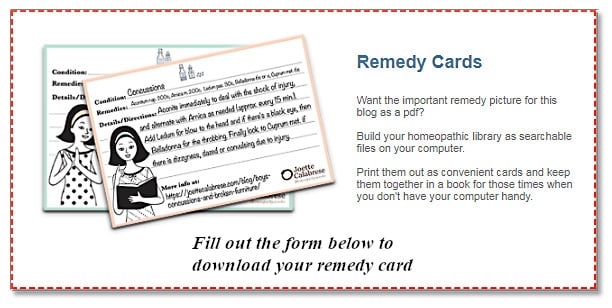
We might consider utilizing a priming schedule — what some folks call a loading dose. In other words, use the chosen medicine every 15 minutes for the first hour, and, after that, maybe every few hours. (Scroll down to receive your free Remedy Cards for more specific details regarding each medicine discussed in this post.)

One caveat: Sepia is known to be problematic when overused. Consequently, we should avoid using it for more than a day or two if no improvement results while we determine whether it is the correct medicine. If it doesn’t act — even in a small measure — within that shortened time frame, don’t increase the potency. Instead, move on to a different medicine.

Now, I know I’ll get questions asking me what to use if the nausea occurs in the second trimester, rather than the first. My friend, the medicines would be the same. Generally, however, nausea and morning sickness are more prevalent during the first trimester, which is why I worded my blog post thusly.

You see, I want to make sure that expectant moms (most in their first trimester) can successfully Google to find this article and discover the power of homeopathy. However, should the nausea continue into the pregnancy, this information remains the same.

Joette Calabrese, Practical Homeopathy®, Morning Sickness: 6 Powerful Homeopathic Medicines to Tackle First Trimester Nausea

In fact, let me leave you with a success story involving lengthy nausea. A client from earlier in my practice came to me after having already given birth to seven children. In each of those pregnancies, she experienced severe nausea … and I do mean severe.

She was hospitalized with hyperemesis gravidarum during all seven of those pregnancies because she simply couldn’t accept food orally. Frustratingly, she had to be on an IV for months — way past the first trimester — continuing many months into the pregnancy.

When she found herself expecting her eighth child, she came to me. I directed her towards Sepia, and she never had to be admitted into the hospital for that pregnancy. She still had slight nausea, but it was nothing like what it had been in the previous situations.

Believe it or not, I heard from her much later on that she went on to have a ninth child. She utilized Sepia again, and it worked just as well.

Come on!

 That’s one of those cases where the results speak for themselves. 

She experienced seven pregnancies with seven hospitalizations, but once she discovered homeopathy, the pattern was broken. Sepia enabled her to keep down food and kept her out of a hospital bed. That speaks rather loudly!

Do you see why I can’t stop!

Pass on the good news of Practical Homeopathy®.

Warmly,

Joette Calabrese, Practical Homeopathy®

P.S. For feminine issues like those we’ve discussed here and more, I highly recommend my course, Feminopathy: How You Can Correct Female Ailments Using Safe, Inexpensive and Effective Homeopathy. You can download a free, helpful infographic while you’re there.

Women around the world have benefited from this popular course, which includes educational material not only on the appropriate homeopathic medicines for pregnancy but also for all manner of conditions affecting women and girls. (There are even a few additional remedies to consider for morning sickness.)

And remember, all my Mighty Members qualify for a 10% discount on course purchases.


Surgical Protocols: Practical Homeopathy® Helps Create More Positive Outcomes

Joette Calabrese, Surgical Protocols: Practical Homeopathy® Helps Create More Positive Outcomes

Homeopathy doesn’t change, my friends. However, our understanding of it continues to grow and evolve, just like with any scientific pursuit.

Years ago, I posted a blog article on surgical protocols. In the ensuing years (13 to be exact, at the time of this writing), I have adjusted these protocols and the information I provide to my clients and students.

Now, I’d like to share them with you. Many of you are new to my site and may not have discovered my older posts. Some of you have found the older posts and may wonder why the information may be slightly different.

If you enjoy this content, please share it. Also check out my podcasts, Monday Night Lives, and connect with me on YouTube, Instagram and Facebook.

As I mentioned recently, if you read the very first of my blog posts, you’ll see I was quite classical in my approach. I leave all those posts there so that you can see my evolution as a homeopath. They also show that in homeopathy, there’s generally more than one way to scramble an egg.

When we need conventional medicine for a necessary surgery — such as setting a bone or repairing injuries from an accident — these surgical protocols will help the body return to homeostasis, both during the procedure and as it recovers afterward.

Ensure that your caregiver, advocate or family member also has this information to assist you through the event, as stress can sometimes cause our brains to skip a beat.

Surgical Protocols

Before Surgery:

Arnica montana 200C is given the night before and morning of surgery. Arnica has a reputation for keeping infections at bay, minimizing the shock to the system, reducing swelling, and minimizing the possibility of hemorrhages, while also putting the patient at ease.

An additional precaution is to add Hypericum perforatum 200C mixed with or taken along with Arsenicum album 200C. Taking these medicines on the day of surgery, as well as the following few days, is reported to protect against infection, swelling and other complications.

After Surgery:

Arnica 200C can be repeated as soon as possible after surgery and administered every few hours  or so for the first day. Then, it may be repeated as often as required for pain.

If the pain is persistent, this may indicate the need for Hypericum 200C to be alternated with Arnica. For example, Arnica is given at noon and 4 p.m., while Hypericum is given at 1 p.m., 5 p.m., and so on. As soon as there is some relief from pain, the remedies are tapered to a more open frequency.

The more intense the pain, the more likely these remedies are essential. As improvement ensues, the need for the remedy will decrease, and the space between each dose will lengthen even further.

There are times when other homeopathics are required, such as Staphysagria 200C for incisional pain or Nux vomica 200C for nausea or other gastrointestinal issues from  anesthetic.s or other drugs. One or both of these can be integrated into the above schedule.

Phosphorus 200C also comes into use as a powerful remedy for headaches following anesthesia, as well as difficulty withdrawing from it.

X-Ray Protocol:

A method considered around X-rays is to incorporate Calc fluor 12X and Nat mur 6X. Each one is taken twice in one day (on the day of the X-ray). This process may be repeated one week later.

As Recovery Ensues:

As the apparent need for remedies is no longer required, they should be eliminated from the schedule.

I generally provide Remedy Cards for the homeopathic medicines I discuss in my blog posts. However, I would prefer all this information remain together — in one place — rather than several separate cards.

So, feel free to print out this blog post and keep it in a safe place for future reference. You never know when an accident can trigger a necessary surgery for you or one of your loved ones. These surgical protocols will be just what the doctor ordered … well, you know what I mean.

Pass on the good news of Practical Homeopathy®!

Warmly,

Joette Calabrese, Practical Homeopathy®

P.S. If you want to learn more about these medicines and their application to surgical procedures, you’ll need a materia medica (an alphabetical listing of homeopathic medicines, along with their keynotes and most appropriate uses).

If you’re not quite ready to dive into the over 2,000 pages of a professional materia medica, I have just the thing. I wrote A Materia Medica: Practical Homeopathy® for Busy Families, just for you, in common, easy-to-understand language. I detail over 150 of the most commonly utilized homeopathic medicines and provide stories and insights on how I’ve used them in my family and my practice. This book most assuredly belongs on your reference shelf.

P.P.S. This Monday, October 13, 2025, at 8 p.m. EDT, we’ll continue this conversation. Surgery, whether scheduled or emergent, is something you must be prepared for. Let’s go over the remedies you should have on hand and those you might not have thought of when the unexpected comes your way. 

Join me within my Joette’s Mighty Members site or on our simulcast network through the Joette Calabrese Facebook page, YouTube, X (formerly Twitter), Rumble and Instagram.

Invite your friends! Everyone should have this information … just in case.

Joette is not a physician, nor is she prescribing, advising or making health decisions for you. The relationship between you and Joette is not one of a patient and prescriber, but rather that of a client and educator. It is fully your choice whether or not to take advantage of this educational information.


Podcast 154 — Moms with Moxie: From Hopeless to Hopeful, Homeopathy Addresses Serious Conditions.


Joette Calabrese, Practical Homeopathy®, From Hopeless to Hopeful, Homeopathy Addresses Serious Conditions

In This Podcast, We Cover:

00:58   Introduction: From Hopeless to Hopeful, Homeopathy Addresses Serious Conditions.

03:27   It All Began With a Diagnosis of Neurofibromatosis           

04:45   A Slightly Overwhelming Introduction to Classical Homeopathy

07:06   Gateway to Practical Homeopathy®

            Gateway I and Gateway II courses

08:56   The Brain Surgeries

            Surgical Protocols

12:48   A Horrible Accident

15:32   Aconitum for Shock

16:30   The Academy of Practical Homeopathy®

            Good Gut, Bad Gut: A Homeopathic Strategy to Uproot Seemingly Unrelated Illness in Body and Mind

            The Academy of Practical Homeopathy®

18:24   Success Story: Epstein-Barr, Chronic Lyme and Mold Toxicity

            Rethinking Detox with Practical Homeopathy®: How to Stop Stressing About Toxins and Fearlessly Achieve Health the Simple Way

            What To Expect When Using Homeopathy: Part 1

21:00   Success Story: Elevated PSA

22:30   Closing Thoughts

Additional Resources:

Joette Calabrese on YouTube (Monday Night Lives)
Joette’s Learning Center
PracticalHomeopathy.com
Joette’s Study Group, Find Your New Study Group Friends
Joette’s Mighty Members
FindAPracticalHomeopath.com

Kate:

This is the Practical Homeopathy® Podcast, episode number 154.

Joette:

Hi, I’m Joette Calabrese, and I welcome you to our health care movement — yours, mine and the countless men and women across the globe who have retaken control of their families’ health with Practical Homeopathy®.

So, for the next few minutes, let’s link our arms as I demystify homeopathy — what was once considered an esoteric paradigm — into an understandable, reproducible, safe and effective health care solution available to all.

This is the medicine you’ve been searching for — my unique brand of homeopathy, PRACTICAL Homeopathy®.

Introduction: From Hopeless to Hopeful, Homeopathy Addresses Serious Conditions.

Kate: (00:58)

Welcome to the Practical Homeopathy® podcast, where we dive into the transformative world of Practical Homeopathy® and how it empowers families to take charge of their health.

I’m your host, Kate. And today I’m thrilled to introduce our guest, Shannon, a remarkable woman whose journey with homeopathy is nothing short of inspiring.

Shannon is a dedicated stay-at-home homeschooling mom of three on a small farm near the Amish community in southeastern Pennsylvania. Shannon and her family embrace a holistic lifestyle, where they raise chickens, goats, and even pigs to ensure they know exactly what’s in their food.

Her passion for natural living began 20 years ago when she started exploring the impact of food and lifestyle on health, leading her to embrace organic eating, fermented foods, and traditional practices, inspired by the Weston A. Price Foundation.

From crafting bone broth to sourdough bread with freshly milled flour, Shannon’s commitment to a chemical-free life is truly inspiring, but it’s her journey with homeopathy that we’re here to talk about today. Shannon’s introduction to homeopathy began with her son’s diagnosis and a classical homeopath’s suggestion to explore homeopathy. This eventually led her to Joette’s teachings.

Homeopathy was also instrumental to help her husband who suffered a devastating accident. We’ll hear more about these incredible stories in just a few minutes, and you won’t believe what this family has been through.

Now, on a lighter note, Shannon is a soon-to-be graduate of Joette’s Mastery program. She’s taken her knowledge to new heights, helping others with complex health issues, from supporting a woman with chronic Lyme, Epstein-Barr, and mold toxicity to helping a man lower his PSA levels naturally.

Shannon’s success stories highlight the power of homeopathy. Her message is clear. There is another way, and there is hope.

So, let’s get started. Shannon, welcome to the podcast.

Shannon:

Thank you, Kate. It’s wonderful to see you again.

Kate:

It’s great to see you. We’ve known each other for a little while now. It’s been about four years, I think you said, since you joined our Gateway to Practical Homeopathy® study group. And so, that was fun getting to know you then.

And since that time, you’ve really taken your knowledge of homeopathy to a new level. And I would love to just hear a little bit more about the story of what happened, how you got into homeopathy and where it’s led you.

It All Began With a Diagnosis of Neurofibromatosis

Shannon: (03:27)

Sure, Kate, thank you. I love sharing my story. So, it began with my oldest son, who is 16. (We do have three children. So, I have another son who’s 14, and our daughter is 12.) And he was diagnosed with neurofibromatosis type 1.

Kate:

What is neurofibromatosis? Did I say that right?

Shannon:

You did. What that is … it’s a rare genetic disease, and it causes tumors to grow on the outside jacket of your nerve, and they can grow anywhere in your body.

Now, 20% of these cases have what’s called a plexi neurofibromas. And what that is is you have a cluster of these tumors that are somewhere in your body close together, and my son happens to have that as well. It is rare, and I didn’t really know much about it because my husband and I do not have it. No one in our past has it either. It’s kind of like a snip in his gene that he has.

We went to a doctor — we have some hospitals around here, conventional doctors that specialize in children that have NF1 — and we went to them. And we decided to get some imaging done — MRIs. He would get them every year just to kind of keep an eye on things to make sure that nothing is growing and that things are okay.

A Slightly Overwhelming Introduction to Classical Homeopathy

Shannon: (04:45)

We ended up going, Kate, to his doctor around here in the past — we don’t go there anymore — was a classical homeopath; he was also an M.D. And we went there to have him check on Aidan just for wellness checkups. And he was the first person to obviously introduce me to homeopathy. I really didn’t know much about it, and he actually said, “I think there’s something that we could do to help him.” And of course I was ecstatic, Kate, because I did the one thing a lot of people do. I googled what this was, and it was really scary.

Kate:

There was nothing that you could do medically that you hadn’t tried.

Shannon:

Correct, as of right now, because his tumors weren’t causing an issue at this point. And there really wasn’t anything even in the conventional world at this time, and that was 10 years ago. It was still so rare that there really wasn’t any other options. So, that was exciting for us to hear.

And he was a wonderful doctor. He did not teach homeopathy, obviously, the way I’m learning now. He would give him the remedies, and then I kind of would ask what they were. And he was very vague about it, which probably was a good thing at the time, Kate, because I was so overwhelmed with information on things that I probably honestly wouldn’t have really understood what was going on.

And he also encouraged me to buy a kit — homeopathy kit — and I bought the 50-remedy kit from Washington at the time with the 30th potencies. And I was like, “Okay, this is great!” But I had no idea how to use it.

So, he encouraged me to purchase Dana Ullman’s book of “Everybody’s Guide to Homeopathic Medicines.”

So, Kate, I’m going to be honest with you, I bought the kit; I bought the book; and honestly, I didn’t use it. I was like, I have no idea how to really do this. I was intimidated.

So, what happened moving forward … my son was getting the checkups, and we had an MRI checkup (a standard routine), and the doctor told us that one of the tumors that was near his trachea — it’s on the nerve by his trachea — has grown larger than what it should be growing.

At that time, they didn’t have any options but surgery, and surgery was extremely risky. It was also near his carotid artery. We didn’t really know what to do.

Gateway to Practical Homeopathy®

Shannon: (07:06)

And we decided God has been wonderful with a lot of prayer. God intervened.

And at that time, they decided that they were experimenting with a chemotherapy drug. We decided to try that for Aiden. And there was no radiation in this chemotherapy drug, but they found in studies of children with NF1 that this drug would help reduce benign tumors.

So, since we didn’t really have any other options, we decided to go down this path. And the drug worked for a little bit, but then over time it stopped working.

And what we did is … I always continued, Kate, in my journey to explore other options — any alternative way that maybe we didn’t have to go down this road with him.

In between all of this, I started learning about Gateway I and Gateway II courses through Joette, which I took with you and Michelle. I started learning about Joette’s blog and a different way to use homeopathy, and I was really intrigued.

And during — it was Gateway II — I actually finished that course in the hospital because in the interim with all of this, my son got a rare brain infection, and he was really sick. And it was actually four years ago, around this time, that he went to the emergency room. I had thought he had the flu, and he was just really sick. Very sick, very sick.

I honestly, Kate, I do not run to the doctors unless I feel it’s absolutely necessary. I try a lot of things at home, and this warranted an emergency room visit. And I was even doing homeopathy at the time, Kate, trying something. Again, all I had was the — which I’m thankful for — I had the kit of 30th potencies. I wish I had more, but I didn’t at the time.

And we went to the emergency room, and I’ll never forget when … here I’m thinking my son’s going to get … maybe he’s dehydrated or what was going on.

And I’ll never forget them telling me they did an MRI, and they came back and they said, “Well, the good part is it’s not any of the neurofibromas in his head because he does have tumors throughout his body, so it’s not that causing an issue. It’s an infection, a brain infection.”

I was like, “Wait, what?” I’m like, “Okay.” So, I’m thinking brain infection. I’m thinking infection. I’m thinking, “Okay, he’s going to be on some type of antibiotic. And my son has never been on an antibiotic ever in his entire life.” And I was like, “Okay.”

I went back to the emergency room, the ER doctor comes in, and he’s like, “Yeah, so we’re going to prep him for surgery. He’s going to be getting brain surgery.” And I was like a deer in headlights.

I’m like, “Wait, what?”

The Brain Surgeries

Shannon: (09:53)

So, he ended up having four brain surgeries in total.

They tried two surgeries to drain the infection. And then the third, because the infection was so bad, they needed to relieve the pressure in his head because the antibiotic wasn’t getting there fast enough.

So, his third surgery was removing the part of his skull to help relieve the pressure in his brain, or he was going to die. So, we opted for that, obviously, and thank God he survived the surgery — all of the surgeries. And after that surgery, he started to make a full recovery.

He had to wear one of the helmets on his head because he had nothing protecting his brain for three months.

So, the time came three months later — remember it was right around Christmas — he was to have the surgery to have his bone flap (they call part of the skull put back together). And at this time, I finished Gateway I. I finished Gateway II with you guys, and I was really into Joette’s blog daily and researching.

I came across her surgery protocol, and I was like, “I’m using this.” And one thing I did learn after my son’s bout in the hospital. He was in the hospital for about four or six weeks, and he did make a complete recovery, which I’m so thankful for.

Kate:

Yes.

Shannon:

And Kate, I ended up buying so many kits with different potencies at that time. So, I knew that I was going to be prepared in the future for whatever was in store.

I’m so glad I did because I used — when he went back for that fourth surgery — I used the surgery protocol that Joette has on her blog.

I used Arnica the night before. I used Arnica the day of the surgery. And when he got done surgery, I even gave it to him while he was in the hospital.

And he was supposed to stay overnight for observation to make sure everything was okay. And he came home that night! It was awesome, Kate! The doctors could not believe how well his surgery went.

Kate:

Oh, that’s so great.

Shannon:

It was so exciting because he just wanted to be home. I mean, he did have some pain that night, and Arnica helped with that. But in hindsight of everything that he went through with that surgery, Arnica took care of it. I didn’t have to use anything else. And he was back to himself within probably a couple days.

Kate:

That seems inconceivable, honestly.

Shannon:

Yes. He still has NF even with all of this going on. So, after all of that, we’re still dealing with the neurofibromatosis with him.

And a few months after that brain surgery, he became a client of Joette’s. That was an answer to prayer. And he is still on this health journey. With Joette’s help, he remains stable, and the tumor that was of concern by his trachea is not causing any issues. So, he is stable right now, and I am so thankful for that.

A Horrible Accident

Kate: (12:48)

Wow. And then I can’t even believe what happened after that.

Shannon:

Right! His last brain surgery was in December.

April, which was only a few months later, my husband was in a really horrible accident. He was crushed by a 14-ton steamroller that tipped on its side and fell on him and crushed him.

Kate:

How did he survive that?

Shannon:

Well, Kate. God. That’s how he survived it.

But when they checked his pulse — the EMT wasn’t there yet — but when the gentleman that he was working with were checking him for a pulse, he didn’t have a pulse. He remembers feeling this amazing peace.

I remember him saying he prayed for all of us, and he was just excited. He was excited! We love the Lord. And he was excited to be with Jesus. And then he remembers, all of a sudden, extreme pain. He was like, “Oh, wow.” He was in so much pain, Kate.

And I remember when that day happened, I was having a hard time getting ahold of him. I needed to get ahold of him for something, and I couldn’t get ahold of him on the phone. I’m like … I don’t know. Something just did not seem right. I texted him; I called him. No answer.

I was like, “What is going on?” I kind of dismissed those feelings, but it was still there, that nagging feeling that something wasn’t right.

And my brother and sister-in-law pulled up in the driveway because we live near them. And Kate, I knew at that moment that something wasn’t right.

And they walked in. I said to them, “Is Derek alive? Is my husband alive?” And I said, “Wait, don’t tell me anything.” And I took a dose of Aconite.

I took a deep breath, and then I was ready for them to tell me whatever news it was going to be.

And I said, “Okay.” I said, “Is he okay?”

And they said, “I don’t know.” They’re like, “We need to go to the hospital.”

Kate, I had no idea what I was walking into.

Kate:

Wow. You didn’t know if he was alive even.

Shannon:

I didn’t. I didn’t.

They said he was in a really bad accident, and they took him to the hospital.

I said, “Okay.”

So, I took another dose of Aconite — another amazing medicine, Kate — and I was able to drive to the hospital, and I walked in.

He was alive and in very bad shape. But I was able to process the information that I needed to hear at that moment because I was also having moments of PTSD from all of the information from my son that happened just a few months ago — within six months ago.

And when you have these things happen, the doctors are talking to you, and they’re trying to tell you what’s going on. And I’m trying to … I was just was having a hard time, just kind of like, “Alright, just give it to me straight. What’s going on?”

Aconitum for Shock

Kate: (15:32)

So, for those people who are listening and are new to homeopathy, Aconitum napellus is a great medicine for shock. So, that’s why Shannon chose that medicine.

Shannon:

It was amazing because I was able to function. I was able to process everything, and I was able to function with what was now going to happen with my husband.

So, after that — that was three and a half years ago — he survived with long recovery. He crushed his pelvis. He has permanent nerve damage, but he is able to walk today with a limp.

He’s in pain every day, but the pain is manageable, and he has permanent muscle damage and permanent nerve damage. But in hindsight of everything that happened, it’s a miracle that both my son and my husband are here today. Yeah.

Kate:

Wow. You have been through so much. Your family has been through that. And then on top of that, then you decide, “I need to know more, and I need to dig deeper in homeopathy.”

So, then you decided to join The Academy?

The Academy of Practical Homeopathy®

Shannon: (16:30)

I did. Kate, I did. While all this was going on after Gateway — Gateway I — my husband was recovering. I was like, “You know what? I want to purchase the Good Gut, Bad Gut course. I really wanted to start diving in.” But Kate, with his recovery and everything going on, honestly, I didn’t have a chance to do the course.

So, I remember The Academy was starting. It was a couple years that The Academy has started, and I’ve always said to my husband, “I really want to do this.” And it never seemed like the right time, Kate. Never.

Well, I chose to do The Academy at probably the most inconvenient time ever in my life because it was a struggle for us financially. My husband wasn’t working; he was still recovering. And I remember looking at him, and I said, “I really want to do this.”

And he goes, “I really want you to do it. We will figure out a way. Just enroll.”

And Kate. I mean, look! I’m going to graduate Mastery!

It’s nothing but wonderful things that I have. The information that I have learned through The Academy and Mastery is priceless. It’s priceless. Even if I never was able to help anybody else, just the information I have to empower myself and my family is something that I am forever thankful for.

Kate:

So, for those listening, again, who don’t know what The Academy of Practical Homeopathy® is, it’s a yearlong online school that Joette leads. And it’s an immersive school where you learn all about Practical Homeopathy®.

And then there’s a second year for those who choose to go on to what we call the Mastery program. And so that’s what Shannon is going to be graduating from soon.

And Shannon, you’ve been taking some cases of some of your friends, family members. You actually, as part of Mastery, are going to present a case coming up here as you finish Mastery.

You’ve already done one in your Mastery program, but tell us about some of those cases and what you’ve seen and how you’ve used homeopathy.

Success Story: Epstein-Barr, Chronic Lyme and Mold Toxicity

Shannon: (18:24)

Sure, Kate. So, the case that I presented to the class in Mastery was a friend of mine, and she was having some issues. She saw a few doctors (natural doctors, conventional doctors), and she was getting better, but she was still struggling.

And I said to her, “Would you like me to help you?” I said, “I can try. If you’re okay with it, I’d like to present it to Mastery so I can get some feedback from them.”

So, she came to me, and she was sharing with me what her symptoms were. She was diagnosed with chronic Epstein-Barr, chronic Lyme and mold toxicity. And what I was doing was basing off of the symptoms that were presenting and the diagnosis that she was given … is what I base the homeopathic remedies on.

So, she was experiencing chest tightness, fatigue, irritability, brain fog, sensitivity to light. She’s having ear ringing, headaches and muscle cramping. And a lot of these on a number scale with 10 being the worst … a lot of these were an 8, a 9 or a 10, Kate.

She was also on a hormone replacement therapy drug for many years. With everything that I’ve learned from Joette, I used the mold remedies Joette teaches in the Detox course of Nat sulph and Arsenicum album.

I used Gelsemium for the brain fog and fatigue, and Chamomilla for the irritability, as well as some other remedies that have been mentioned — especially the one for headaches, which Joette mentioned on her blog of the Banerji protocol of Picric acid mixed with Belladonna.

I presented the case to Mastery, and it went very well.

And I had a follow-up with her a few weeks ago. We went over everything in the consult, and, Kate, she was so encouraged because after she told me how well she was doing, I was able to kind of tell her what her numbers were from about eight weeks ago. And her numbers went from a 10 to a 1 and a 2, in almost 90% of her symptoms.

So, the only thing that she’s really struggling with right now is brain fog. Everything else? There was significant improvement, and she was so encouraged to hear this.

Kate:

That was only a matter of weeks!

Shannon:

About eight or nine weeks, yes, by the time we had our follow-up.

Kate:

Good job, Shannon.

Shannon:

It’s encouraging for me, but it’s encouraging for her. But Kate, as Joette says, “It’s God’s medicine.” It’s the remedies and just the tools that I have been taught — of how to use them — is priceless, Kate.

Success Story: Elevated PSA

Kate: (21:00)

Yeah. And you have another one with a man in his fifties, I believe it was.

Shannon:

I do. So, he is in his fifties. There is a history of a lot of prostate cancer in his family. And he went to the doctors, and his PSA levels were rising. And his conventional doctor said, “If these continue to rise, my suggestion would be to do a biopsy.”

And he really did not want to do that, Kate. So, he asked me is there anything that I could help him with his elevated PSA levels? And I said, “Sure.” So, I said, “We can try it.”

I suggested that he try Conium and Thuja. And I learned about these medicines for elevated PSA levels in a men’s health lecture in The Academy, and how beneficial they can be.

And he just had a follow-up appointment with his doctor. His PSA levels are now within normal range. Kate, he was ecstatic. And the doctor said to him, “Whatever you’re doing, continue to do it!”

Kate:

Wow. You know, whenever I talk to people about homeopathy — like you — it is incredible the stories that they tell and how homeopathy has changed their lives and the lives around them. And I get tears in my eyes every time I hear these stories. You’ve been through so much, and now you are taking what you’ve learned and helping other people. What a rewarding thing to do, Shannon.

Closing Thoughts

Shannon: (22:30)

It is Kate.

And I wanted to share that there is another way to do things, and especially when it appears no other way. I mean, as I shared in the story, there was no other way for my son.

There was a way, and there still continues to be a way with homeopathy.

And it just doesn’t need to be with my son. It can be with anything. Homeopathy has given me hope, Kate, in a place where I didn’t have any. I had very minimal hope, and I am so thankful for this medicine.

Kate:

Well, Shannon, thank you so much for your willingness to open up and share your life and the life of your family with us and what you’re doing. I appreciate you being here and look forward to hearing about all the other things that you accomplish now with what you’ve learned. Thank you so much.

Shannon:

Kate, thank you so much.

Joette:

It’s my honor to share many lessons on this simple method of using homeopathy for free —without affiliates or advertising — here in my podcasts, but also my blog posts and Monday Night Lives.

But it’s critical that you learn how to use these medicines properly. These podcasts should serve as only the beginning of your training. Peruse JoettesLearningCenter.com to find fun study group opportunities and in-depth courses developed by subject.

So, with the proper training, you can join the thousands of students before you in developing the confidence and competence to protect the health of your family and loved ones with my brand of homeopathy, Practical Homeopathy®.

Kate:

You just listened to a podcast from internationally acclaimed homeopath, public speaker and author, the founder of The Academy of Practical Homeopathy®, Joette Calabrese. Joette’s podcasts are available on all your favorite podcast apps.

To learn more and find out if homeopathy is a good fit for your health strategy, visit PracticalHomeopathy.com.


The Combination Remedies That Save Us: Homeopathic Medicine Made Easy


Joette Calabrese, Practical Homeopathy®, The Combination Remedies That Save Us: Homeopathic Medicine Made Easy

I recently realized I have to eat my hat … or rather, Samuel Hahnemann’s beret.

In the early years of my practice, I was reluctant to consider combination remedies. Due to my classical training, the idea of combining several homeopathic medicines for a specific condition sounded almost heretical.

Why? I was taught that using multiple medicines together could potentially compromise the effectiveness of each individual medicine. I was taught to use one medicine, and one medicine only.

However, in the years that followed, my thinking changed.

I started using two or three medicines in the same schedule myself and observed better success rates. Then, I witnessed the tremendous power of certain combined medicines as described in the Banerji and French protocols. I’m also in a unique position to hear success stories from my students and clients regarding their use of the combination remedies that noteworthy homeopathic pharmacies have created.

In other words, can you pass the butter? I have a hat to eat.

Rethinking My Position

Permission to speak freely? I was hesitant about leaning on combination remedies because I worried their use would bypass what I teach about choosing the tightest-fitting homeopathic medicine(s).

You see, some combination remedies can include 8, 10, or even 12 different medicines, all in different potencies. That is a lot of remedies all in one dose. My concern was that it could potentially undermine people’s desire to learn more deeply how to use these medicines and understand the character of each medicine. If we’re going to provide our own health care and be autonomous healers in our families, we must endeavor to grasp the totality of homeopathy — both its principles and its medicines.

BUT (and it’s a big “but”), I keep hearing personally from my clients and students — and in large numbers — about how useful these remedies are. People report to me, “Oh my gosh, it works! It’s so great.” So, let’s face it, I’ve got to be realistic about their use.

(And take another bite of my hat.)

Certain Combination Remedies Provide an Influential Introduction to Homeopathy

In fact, when certain, well-developed combination remedies are effective, they provide an undeniable service to sufferers. PLUS, I have come to realize that they are an effective introduction to the power of homeopathy. These convenient combinations, available at many common drug and grocery stores, serve as an entry point for those unfamiliar with homeopathy, encouraging them to learn more.

I also should add that these combination remedies aren’t just slapped together willy-nilly. Manufacturing pharmacies have thoroughly researched their formulations to provide the most effective medicines for the most commonly experienced symptoms in a given situation.

Joette Calabrese, Practical Homeopathy®, The Combination Remedies That Save Us: Homeopathic Medicine Made Easy

Let’s Look at ColdCalm®

For instance, one of our frequently discussed homeopathic medicines for colds is ColdCalm® by Boiron. For many families, it’s their proven go-to for effective and side-effect-free cold intervention. My son even successfully used it for his dog (as you can read in this previous blog post).

In addition to their goal of softening symptoms and reducing the duration of their cold, I also encourage cold sufferers to read the ingredients with an educational goal in mind. Reading the back of the box is a capital way to learn more about homeopathy.

Boiron has listed each homeopathic remedy contained in ColdCalm®, along with the aspect of the common cold they address.

It’s virtually a micro-materia medica on the back of the box. Sufferers can easily pinpoint which medicine successfully tackled the causes behind their most prevalent symptoms by familiarizing themselves with the specific keynotes of each remedy.

Joette Calabrese, Practical Homeopathy®, The Combination Remedies That Save Us: Homeopathic Medicine Made Easy

They may, then, consider purchasing that single remedy to have on hand for the next time they experience that specific symptom alone.

Indeed, the combination remedies provide a tremendous way to learn more about homeopathy!

Side note: Don’t forget, when you order directly from Boiron’s website, you’ll receive 20% off your order by using my name as the discount code (joette) at checkout. For your peace of mind, let me clearly state that I don’t receive any remuneration for your purchases. I believe that receiving affiliate payments would create a conflict of interest with my goals as an educator.

ColdCalm is not the only combination remedy Boiron manufactures. I hear feedback on other products such as SleepCalm®, StressCalm®, AllergyCalm® … and the list goes on.

And Boiron is not the only respected homeopathic pharmacy offering combination remedies. Hyland’s offers the highly regarded BioPlasma®, a combination of all twelve cell salts. OHM Pharma (a non-retail homeopathic pharmacy exclusively available to professionals, students and clients) offers many as well. I also hear excellent reviews from my students on the complexes developed by Newton Homeopathics. And I tend to agree.

(Last bite of my hat …)

An important underlying message in this post is that science is never settled. We should always be open. We should always consider, reconsider and question what we believe and be our own devil’s advocate. We must learn and grow. In fact, if you read the very first of my blog posts, you’ll see I was quite classical in my approach. I leave all those posts there so that you can see my evolution as a homeopath (and they also show that in homeopathy, there’s generally more than one way to butter a biscuit).

You know that I now espouse Practical Homeopathy®, and I must admit, these combination remedies are quite practical! So, I have faith in you, my friends. I know that while you will enjoy the ease and efficacy of the combination remedies, you will also continue to develop your understanding and skills in properly utilizing homeopathic medicines.

Pass on the good news of Practical Homeopathy®!

Warmly,

Joette Calabrese, Practical Homeopathy®

P.S. I encourage all devoted students of homeopathy to own a good materia medica as the perfect place to look up more information on the ingredients contained in combination remedies.

There are several available online for free, but most of them are written in a technical style. Their information may be difficult for new homeopathy users to absorb at a glance, especially in an emergency.


Glaucoma: The Danger of Increased Intraocular Pressure


Joette Calabrese, Practical Homeoapthy®, Glaucoma: The Danger of Increased Intraocular Pressure

In Practical Homeopathy®, we consider symptoms to be gifts. They quickly inform us which parts of our body are affected by a condition and vividly demonstrate the effects it is causing.

Yet, then there’s glaucoma. As intraocular pressure increases in the eye, it damages the optic nerve.

However, one may not notice any symptoms at all. As the Mayo Clinic, a repository of conventional medical information, says, “Many forms of glaucoma have no warning signs. The effect is so gradual that you may not notice a change in vision until the condition is in its later stages.”

Testing Is Key to Diagnosis

The “later stages” of glaucoma are generally vision loss and even blindness. To avoid that eventuality, a simple, non-invasive eye pressure test during a routine eye exam can yield important information.

 It would be useful to have an accurate determination of eye pressure. Unlike with my tongue-in-cheek image, we are unable to see when our eyes are a little over-inflated (experiencing higher than normal pressure). And we certainly can’t feel internal pressure in our eyes.

However, if the results of an eye pressure test sound the alarm, homeopathy stands ready to right the ship.

Joette Calabrese, Practical Homeoapthy®, Glaucoma: The Danger of Increased Intraocular Pressure

Homeopathic Argentum nitricum for Glaucoma

The Banerji Protocol of Argentum nitricum 200C and Calcarea carbonica 30C would be a strong homeopathic consideration for glaucoma. Both homeopathic medicines would be utilized twice daily; however, they would not be taken simultaneously.

As I teach my Academy students, it’s interesting to note that Argentum is NOT one of the most highly recommended medicines as listed in Dr. Robin Murphy’s MetaRepertory (Fourth Edition) on page 713. Instead, it’s listed as a third-level medicine. But, my friends, my money is on the Banerjis. Every. Single. Time.

Keep in mind that glaucoma is generally not a condition that resolves quickly, as an ear infection might. In this chronic condition, improvement occurs over a more extended period of time.

In a case from my clinical practice, it took many, many, many months before improvement ensued. It could even take up to a year, depending on the severity. But take heart. I have been surprised more than once when improvement comes in cases deemed seemingly “hopeless” by conventional medicine.

I encourage you to read What Else? The Sweeping Ability of Homeopathy for more specifics on the assessment of conditions after beginning a homeopathic regimen.

Testing Is Key to Assessment

Yet, how do we carefully observe for changes in the condition if we couldn’t even tell we had it in the first place?

Repetitive testing. We want to track the pressure numbers as we progress through the homeopathic schedule. Those tests are a valuable measure of  success in addressing glaucoma. This is certainly one time when we can’t just decide that we “feel” better. We need the evidence that tests can reveal.

Glaucoma_INTERNAL 2

As the subsequent pressure numbers improve, the schedule can be backed off from the twice-daily schedule and halt when very much better.

It goes without saying that it would probably be the rare ophthalmologist who would say, “Wow, you’re improving!” They probably wouldn’t be able to wrap their minds around it. But who can argue with the numbers?

However, as in any condition, if no improvement has ensued, then we would most likely back away from this remedy and pivot to another (perhaps under the expert care of a well-trained Practical Homeopath™).

Plus, Get Back to the Basics

In fifth grade, we learned which foods are beneficial for different parts of the body (e.g., milk for bones, etc.). Now, I’m not an expert in glaucoma. However, my layperson’s opinion is to go back to the fifth-grade basics, in addition to our well-chosen homeopathic medicine.

Fish oil is excellent for eye health. However, you know I’m not a fan of manufactured, often synthetic supplements, so let’s get our fish oil from the fish.  Then, for good measure, add some wild salmon and other wild fish (such as mackerel and sardines) to the weekly diet.

Want to try an unusual superfood? I suggested cod fish livers — not the oil, but the actual livers — to one of my team members for her eye issues (along with Argentum nitricum 200C and Calcarea carbonica 30C, of course), and she experienced significant improvement. Plus, she fell in love with their unctuous taste. They’re so rich that only a small bite daily is necessary, but she found it hard to resist the occasional extra nibble.

They really are delicious. (My favorite brand is King Oscar, but that brand is becoming increasingly difficult to find. Amazon has several other brand selections.)

Sunshine can also be helpful for eye conditions. I don’t mean staring into the sun; naturally, that would not be prudent. However, getting out into the sun allows one’s body to manufacture natural vitamin D (so much better than a supplement). There is a growing body of research correlating higher levels of vitamin D with eye health, so why not? Besides, getting into the great outdoors is fun, relaxing and healthy in many ways.

Homeopathy works, and a few added common-sense dietary and activity changes can also be a great adjunct.

Pass on the good news of Practical Homeopathy®!

Warmly,

Joette Calabrese, Practical Homeopathy®

P.S. Consider the security of having a network of like-minded friends to call in the middle of the night when a loved one is suffering, and you’re freaking.

My Gateway to Practical Homeopathy®: A Guided Study Group Curriculum is your entrance to a self-reliant yet well-supported future. With Gateway to Practical Homeopathy®, you will get started on the right foot, learning homeopathy skills you can use right away, as well as connecting with mothers and others who will be there when you need a little help.

By stepping through the Gateway to Practical Homeopathy®, you’ll be prepared when your family experiences the bumps, bruises, scrapes, fevers, flu and more that life regularly throws our way.


Podcast 153 — Homeopathic Stramonium for Violent Tendencies


Joette Calabrese, Practical Homeopathy®, Podcast 153 — Homeopathic Stramonium for Violent Tendencies

In This Podcast, We Cover:

01:00   Introduction: Homeopathic Stramonium for Violent Tendencies

04:18   Arnica for Head Injuries

04:45   Stramonium for Violent Tendencies

            Monday Night Live: Rage

07:18   Homeopathy Works!

            Stramonium 200C

08:36   Employing Homeopathic Medicine Until It’s No Longer Needed (Very Much Better)

10:32   How Often to Consider Utilizing Stramonium

11:51   Homeopathy Addresses Physical, Psychological, AND Emotional Conditions

Additional Resources:

 Joette’s video reel regarding Stramonium on YouTube or Facebook

Joette Calabrese on YouTube (Monday Night Lives)
Joette’s Learning Center
The Academy of Practical Homeopathy®
PracticalHomeopathy.com
Gateway to Practical Homeopathy®: A Guided Study Group Curriculum
Joette’s Study Group, Find Your New Study Group Friends
Joette’s Mighty Members
FindAPracticalHomeopath.com

Kate:

This is the Practical Homeopathy® Podcast, episode number 153, with Joette Calabrese.

Joette:

Hi, I’m Joette Calabrese, and I welcome you to our health care movement — yours, mine and the countless men and women across the globe who have retaken control of their families’ health with Practical Homeopathy®.

So, for the next few minutes, let’s link our arms as I demystify homeopathy — what was once considered an esoteric paradigm — into an understandable, reproducible, safe and effective health care solution available to all.

This is the medicine you’ve been searching for — my unique brand of homeopathy, PRACTICAL Homeopathy®.

Introduction: Homeopathic Stramonium for Violent Tendencies

Kate: (01:00)

Hi, and welcome to the Practical Homeopathy® podcast. I’m Kate, and I’m thrilled to be here with you today as we explore the wisdom and real-life applications of Practical Homeopathy® with Joette, where homeopathy is distilled down to be practical and accessible to moms, dads, grandparents, and even busy college students and skeptical uncles who just want results.

Joette has spent her decades teaching families how to take the reins of their health using time-tested homeopathic protocols that are simple, effective, and most importantly, doable.

Hi, Joette.

Joette:

Hi, Kate. We’ve got an interesting case to go over today, haven’t we?

Kate:

Yes, we do.

So, we’re going to talk about how to find the right medicine. So, turning the tables a little bit. I think you are going to ask me some questions about a case that I’ve encountered recently.

So, let’s get started.

The Emotional Case of a Young Man

Joette: (01:57)

Yes. As I recall, this was a case of a young man, right?

Kate:

Right. Yes.

Joette:

And he had some behavioral problems. Kate, why don’t you explain what behavioral and plaguing thoughts and then an interesting history.

Kate:

Right. So, we’re going to focus on some of the emotional components of this case. There are some other things that came into play, but as you say, Joette, “Look at what symptoms are the most prominent.” And it’s clear in this case that the emotional component was definitely the most serious — the most dire — of the symptoms. So, I’ll talk a little bit about it.

There was some violent thoughts, like wanting to kick people — so, almost rage. And the person was embarrassed by the fact that they’re thinking this. They don’t know where it’s come from, but it was really plaguing thoughts of just wanting to reach out in anger.

And I don’t know if this person actually kicked the door at one point or not, but it was pretty severe as far as the almost depression and the rage.

Joette:

And he was about how he wanted to do that. He wanted to hurt someone.

Kate:

Yes.

Joette:

He wanted to kick someone or harm someone, and it turned out that he kicked the door. But that’s as far as he went, at least as far as we know.

Kate:

Right. Yeah. I don’t think it was action as much as just those plaguing thoughts.

Joette:

Plaguing thoughts. Right.

So, how has this case opened, Kate?

Kate:

The person is someone that has used homeopathy on and off for years. So, they did, at one point, take Camphor.

Joette:

So, this is a person whose mother has been using homeopathy on and off for years.

Kate:

Yeah. Correct.

Joette:

Right. It’s in his blood of sorts. He knows enough to start thinking this through and asking for some help homeopathically.

Kate:

Right. And when the mother started thinking about it, she realized that at one point her son had a head injury, and so that played into it. But even though it was a pretty prominent head injury, where there was actually some broken bones in the back …

Joette:

And so, do we know how long ago that injury occurred before the case was taken regarding these?

Kate:

I think it was about a year or so.

Joette:

Okay. My guess is, if the mom knew — I’m just going to take a guess on this, and correct me if I’m wrong — she knows enough homeopathy, she probably treated that injury.

Kate:

Yes.

Joette:

At the time, correct?

Kate:

Correct.

Joette:

With Arnica first and then Natrum sulphuricum next, and that kind of thing, right?

Arnica for Head Injuries

Kate: (04:18)

Correct. Yes. So just if people are wondering, Arnica is so good for so many things, but head injuries is one of them.

Is that what you normally go to first?

Joette:

Yes. It’s the first thing we think of for hematomas and the shock of it. Pain, of course, but especially hematomas. That’s the concern that we most have. Yes.

Kate:

Okay. So yes, that was a long time ago, and now there are these emotional components that are coming to the fore.

Stramonium for Violent Tendencies

Joette: (04:45)

So, when the mom was taking the case — essentially, she was taking the case, and she was relaying to you — that she looked at violent tendency.

Now we don’t know whether or not he was actually violent (but for the kicking of the door). Right? But he talked about how he wanted to punch someone or kick someone and harm to someone.

Kate:

Right.

Joette:

Yes.

Kate:

Right. And so, she looked up in the repertory under “Mind-Emotions and VIOLENT.” And I know you talk about how the remedy Stramonium is pretty prominent when there are violent behaviors.

Joette:

It certainly fits. It fits that, for sure.

But now let’s look at what Stramonium also represents. It represents a shock to the system.

Buster, when he got that injection from the vet, went into a Stramonium state. (I’ve talked about this before. I’ve written about it. Actually, it was a Monday Night Live that I talked about it.) That injection was a shock to the system, and that’s the way I saw it.

Shortly after that, within weeks or so, he became a very violent dog. He’d never been violent. He was really passive and sweet, but he became aggressive towards me. Wouldn’t let me in the bedroom; wouldn’t let me near my husband; snarled at me; showed me his teeth and actually snapped at me several times. My husband had to grab him by the scruff of the neck a number of times.

And so, I knew that the cause of that was likely the neurological shock to the system. I used both medicines specifically for that injury to the system, as well as how he was behaving. I gave him, Stramonium …

Kate:

Turned him right around, as I recall.

Joette:

It did. Immediately within a day or two. It was really fast.

And then it came back again a couple weeks or a month or something later, but not as severe. He didn’t snap this time. He showed his teeth, and he wouldn’t let me near my husband or let me in the bedroom. My husband had to grab him again, and then I knew it was time to give him the Stramonium again.

So, it was a neurological shock to the system, and we could say the same, perhaps, for this young man … that there was a neurological shock. And that can happen after an accident, after an injury (especially a head injury), something that is extreme to the body can often show up later in this kind of behavior, anger, desire to do harm, violent thoughts, et cetera.

So, Stramonium fits both the fact that this behavior is presenting, but it also fits because of the etiology — the potential cause of the condition in the first place — which, indeed, could have been the head injury.

Homeopathy Works!

Kate: (07:15)

Yes. And so, interestingly enough, the mother reports that the Stramonium acted, and it acted so quickly and so beautifully that within one dose, this boy stopped having those (the thoughts of rage), and he calmed right down and was doing really well.

Now, when he stopped taking it — and I believe, he was taking it … at first, it was twice a day, and then gradually going to every other day — but when he didn’t remember to take it, those things crept back in. Right?

And so, when he took it again, they went right away. It’s so incredible. I mean, every time we talk, Joette, we talk about these medicines and how amazing they are.

Joette:

God’s medicine. There’s no doubt about it. No side effects, et cetera. It was probably 200?

Kate:

Yes.

Joette:

In a 200C. So, Stramonium 200C. And so, used it a couple times a day for what? Probably a week or so?

Kate:

I would say yes.

They tried to go to the Stramonium every other day, but it didn’t seem like enough. So, they went back to the twice a day. And I didn’t follow the case, so, I don’t know what they’re doing now, but I know that this boy is doing really well.

And whenever he starts to get those thoughts again, he just takes the Stramonium. Or if he’s taking it regularly, then those thoughts don’t even creep in.

Employing Homeopathic Medicine Until It’s No Longer Needed (Very Much Better)

Joette: (08:36)

So, the upshot of this is that you use it until it’s no longer needed, and then you test it out. We’re not using it for years; we’re using it for days. And then when it’s clear that the condition is much improved, then we back off.

When we see that it’s not time to back off because the symptoms return, then it’s time to return to the original schedule or a schedule that’s perhaps not as tight as twice a day. Maybe they just use it once a day, see how it goes.

So, we’re always looking for that tipping point to find a place where it’s just right. And it could be taken for a long … it could be taken weeks, perhaps even a month.

Again, we test. We check and see how it’s going without it again. And after a while, the person will no longer need the medicine, and that’s how we know that the medicine has done its job.

Now, just like Buster. It happened months later that he started to behave like this again. It’s almost as though the body said, “I’m ready for another couple doses of this.”

We used the medicine … we loaded up front twice a day for several days. It became much better. I backed off, and we halted the use of it because it appeared to be completely resolved.

Then months later, it started up again. I started right where we left off: twice a day every day for another week or so.

And I don’t remember exactly how long it was because, my friends, it doesn’t matter. People ask me, “So, for how long?”

Well, that is dependent upon what you’re observing. So, once I saw again that he was much better — we’re talking about Buster now — that it’s time to back off the medicine again. And if we see that it reared its ugly head one more time, I would’ve started again.

As I recall (it’s been years now), I don’t think I needed it a third time. But if I had needed it a third time or he needed it a third time, I would’ve done it again. And each time I would’ve expected just what happened … a little bit less, the next time. The symptoms are not as intense. They’re not lasting as long, and there’s a larger space between each of the episodes of the behavior.

So, that’s what apparently happened with this young man. Right?

How Often to Consider Utilizing Stramonium

Kate: (10:32)

So, I’m wondering, Joette, if there’s a case that you had and the symptoms were leading you towards the use of Stramonium, do you think about the severity? And if it’s more severe, maybe you would use it twice a day in the beginning? Or would you start with every other day? Or how often do you like to use Stramonium?

Joette:

Well, it can be used every other day if it’s a rather milder version. But usually, when we’re using a remedy like Stramonium, it’s pretty intense. Because they’re already in depression. That’s intense. And they’re experiencing violent thoughts. I would say that’s worth repeating it twice a day for a while.

These are serious conditions, and it is something that needs to be addressed by someone who’s experienced, a seasoned homeopath, a health care professional, someone like that.

But I do want people to learn how this is done because it gives us freedom from worry that this could never be resolved, or now they’re going to need drugs, et cetera.

Kate:

And it can change someone’s life in amazing ways. So, thanks to these medicines that are so inexpensive. It’s really unbelievable.

Joette:

Yet, in this case, it changed at least two lives. We know about the mother and the son. My guess is it changed the life of his father and his siblings and his friends and his classmates and et cetera.

Homeopathy Addresses Physical, Psychological, AND Emotional Conditions

Kate: (11:51)

Joette, thank you for helping us understand the use of Stramonium and how to think about these emotional cases that can be complex. I appreciate your thoughts, and I think it’s clarified some things in my mind, and I hope the listeners’ as well.

Joette:

I like the point that we’ve brought to the fore today, and that is, most people don’t know that it’s possible that homeopathy can treat emotional and psychological conditions and events as well.

Most people have believed that homeopathy is assigned to acutes, like a cold or a flu or an ear infection. But no, there’s even this.

So, this just helps people understand the universal ability of this medicine. So yeah, it was an interesting case. Thanks for bringing a case.

It’s my honor to share many lessons on this simple method of using homeopathy for free —without affiliates or advertising — here in my podcasts, but also my blog posts and Monday Night Lives.

But it’s critical that you learn how to use these medicines properly. These podcasts should serve as only the beginning of your training. Peruse JoettesLearningCenter.com to find fun study group opportunities and in-depth courses developed by subject.

So, with the proper training, you can join the thousands of students before you in developing the confidence and competence to protect the health of your family and loved ones with my brand of homeopathy, Practical Homeopathy®.

Kate:

You just listened to a podcast from internationally acclaimed homeopath, public speaker and author, the founder of The Academy of Practical Homeopathy®, Joette Calabrese. Joette’s podcasts are available on all your favorite podcast apps.

To learn more and find out if homeopathy is a good fit for your health strategy, visit PracticalHomeopathy.com.